
I have been writing a series of articles on special days or weeks each month. It is a fun undertaking; I find it interesting what I have learned about each of these special “holidays.” Here is a quick overview of the articles published so far in 2026. I am providing a short overview of the content. I hope you find the subject interesting enough to click the links and read the articles in full.
Valentine’s Day: I kicked it off by writing about Martyrs, Fertility, and Greek mythology: the strange history of St. Valentine’s Day, which begins on the cover page of the February Edition of The Freshwater Reporter. You will learn about the saints the day is named after and the day’s pagan connections, including the cute, chubby Cupid we are all familiar with. I then cover the American Valentine’s Day card giving craze that empties our pocketbooks each year.
Michigan Wildfires: Turn to page 3 in the March edition of The Freshwater Reporter to learn about Michigan’s Historic Wildfires: What We Know Today. In this article, I cover the facts about Michigan’s history of wildfires, including its holding two spots on the list of the 10 Worst Wildfires in U.S. History. Learn about three large wildfires that have taken place in Michigan: The Great Michigan Fire, Oct. 8-10, 1871; The Peshtigo Fire, Oct. 8, 1871; and The Thumb Fire, Sept. 4-6, 1881. Although those three fires occurred in the 1800s, Michigan wildfires continue to affect the state, averaging 8,000 to 10,000 annually.
Easter Bunny and Easter Eggs: The History of the Easter Bunny and His Eggs begins on page 8 of the April edition of The Freshwater Reporter. It is a fun look at the history, with me being surprised that it began in the Neolithic era of Europe with a religious ritual in which hares and humans were buried side by side because the hare represented rebirth. When we move on to decorating and coloring Easter eggs, you will learn that these practices date back to the 13th century, when eggs were forbidden during Lent. The traditional Easter Egg Hunt began in the 1600s in Germany and came to the U.S. in the 1700s. History sheds new light on what we consider simple, fun events.
Foster Care: In the May edition of The Freshwater Reporter, I shared The History of Foster Care, which begins on page 5. There are over 365,000 children in foster care throughout the U.S., and understanding the origins of this organization and what it represents is important. The article covers the early placement of children and its evolution into a system of care. Foster care systems are similar throughout the United States, so when learning about the childcare network in Michigan, you can assume similar procedures are used in other states. The article concludes with information on the effects of foster care on children and how people can become foster parents.
Juneteenth: For the month of June, I wrote about Juneteenth and Its Historical Significance, which begins on the front page. This is a federal holiday of historical significance, yet many Americans do not understand its purpose. The day honors Black Americans who suffered enslavement over a 400-year period. The date commemorates Emancipation Day, specifically the day slaves in Texas learned they had been declared free two years earlier. Learn how even the 13th Amendment, which made emancipation national policy, contained a loophole that allowed for black people to be used for prison labor. You will learn about the education barriers they encountered, how these barriers were recognized, and how the wealthy attempted to help them overcome these as far back as 1861. It took 156 years for Americans to recognize the significance of Juneteenth and establish it as a federal holiday; today, only 30 states recognize it as a paid legal holiday for workers.
Disability Pride Month: I sidestepped the typical Independence Day history and chose to write In Celebration of Disability Pride Month, beginning on page 5 in the July edition of The Freshwater Reporter. July was selected as Disability Pride Month to coincide with the anniversary of the Americans with Disabilities Act (ADA). The purpose is to honor the experiences, history, and achievements of the disability community. You will learn the background of this month’s significance, including centuries of disabled people being segregated from the public, denied education, stripped of rights, and often institutionalized. The Rehabilitation Act of 1973 was the first civil rights law that prohibited disability-based discrimination. How people in the community perceive and communicate with people who have disabilities is the key to overcoming negative attitudes and stereotypes. Physical barriers to mobility continue to impact their ability to enjoy everyday tasks and enjoyment. Learn more about the challenges these people face and what can be done to help anyone you know who deals with visual, hearing, or physical challenges.
I hope you enjoy history as much as I do, take the time to read some or all of the articles above, and share your impressions with me in the comment section below.






















 I have spent weekend after weekend at home, sorting through all my current items and those in boxes, preparing for my estate sale. Today I took some “me” time and attended the #RochesterWriters Spring Conference. I enjoyed a day of informative keynote speakers and instructors, plus socializing with other writers. It was time well spent, combining instruction in self-publishing with networking. There is something about spending a day with other writers that inspires one to write. Even though you haven’t seen me here in quite a while due to everything going on in my personal life, I find myself here tonight writing a quick blog, just to say hi and let you know I am still alive and kicking.

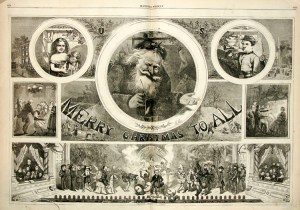 Along with tree decorating traditions, most of us grew up with the magic of Santa Clause. Saint Nicholas was a Christian holy person believed to have lived in the third century, who became known as a protector of children. The bearded, jolly Santa dressed in red that first appeared in Clement Moore’s A Visit from Saint Nicholas in 1820. Thomas Nast was an artist who’s first major depiction of Santa Claus in Harper’s Weekly in 1886 created the image we envision today. Nast contributed 33 Christmas drawings to Harper’s Weekly between 1863 to 1886, and Santa is seen or referenced in all but one. It is Nast who was instrumental in standardizing a national image of a jolly, kind and portly Santa dressed in a red, fur-trimmed suit delivering toys from his North Pole workshop.
 Today I participated in two holiday traditions, a Christmas gathering for the Blue Water Shutterbugs Camera Club and the writing of my annual Christmas letter, which I do in lieu of a card. The writing of Christmas greetings and handling out of Christmas gifts are two areas where I recently learned the history of the tradition.

 Do I set goals for the new year? Usually. Do I achieve them? Sometimes. Even though for the most part New Year’s Eve and New Year’s Day are just another day, they still contain a bit of tradition that is repeated year-after-year.