The History of Christmas Trees and Gift-Giving

As we approach Christmas, I had a photo from 2014 pop up on my Facebook Memories feed: the tabletop tree at my house in Michigan, with presents stacked around it for the grandchildren, is a sharp contrast to my skinny pencil tree in my park model in Arizona. I love having this tall skinny tree after six years living in a 35-foot motor home with no room for a tree.

My tree this year is not laden with gifts. I miss the fun of wrapping all those gifts, stuffing the stockings, and watching the kids unwrap them. There is nothing as beautiful as a dark room with a lit tree and gifts below it, and nothing as fun as watching kids open those gifts on Christmas.

Shows writer's table-top Christmas trees and presents sitting around on the floor.
My Christmas Tree in 2014 — gifts for my grandchildren and adult children

That made me wonder about the traditions of Christmas trees and gift-giving. The act of exchanging gifts began long before Christmas and was done during the winter solstice in ancient Rome, celebrated from December 17 to 23rd. The gifts were usually small figurines called Sigillaria, made of wax or pottery and designed to resemble gods or demigods. Then, during the new year celebrations, the Romans gave gifts of laurel twigs, gilded coins, and nuts in honor of the goddess of health and well-being.

It was in the early 4th century AD (January 1, 301 to December 31, 400) that the gift-giving custom was linked to the biblical Magi delivering presents of gold, frankincense, and myrrh to the baby Jesus.  This was co-mingled with the gift-giving tradition of the 4th-century bishop, Saint Nicholas. Saint Nicholas had a habit of secretly giving gifts, and he was the inspiration for Father Christmas and Santa Claus.

In the 16th century (1501-1600), the custom of giving gifts to children developed in Europe as a way of reducing rowdiness on the streets around this time of year. Parents used it to keep children away from the streets and from becoming corrupted. These actions resulted in Christmas becoming a private, domestic holiday rather than a public holiday of carousing.

Saint Nicholas was the inspiration for the Dutch Sinterklaas, with a festival that arose during the Middle Ages. The feast was to aid people experiencing poverty, especially by putting money in their shoes. This tradition developed, and by the 19th century, it had become secularized into him delivering presents. By this time, the Santa Claus of North America had developed.

My 2025 slim pencil Christmas Tree

Now, the next question is, why do we place our gifts under a decorated tree? In ancient Rome, homes and temples were decorated with evergreen boughs for the winter solstice feast of Saturnalia. Celtics associated evergreens with everlasting life, and the Hebrews linked them with life and growth. In Han Dynasty China, evergreens symbolized resiliency, and the Norse people associated them with their sun god.

The Christmas tree tradition began in Germany in the 1500s. Evergreens were placed beside the medieval home’s entry, which grew into indoor trees covered with apples for the feast of Adam and Eve on December 24. The trees were also decorated with cookies and lit candles. Another tradition was the Christmas Pyramid, which was formed by wooden shelves that held Christian candles, figurines, evergreen branches, and a star.

The two traditions merged as the first decorated indoor Christmas tree. German immigrants brought the Christmas tree to the U.S. in the 1600s, but it did not become popular until the 19th century. What boosted its popularity was Prince Albert, Queen Victoria’s husband, who introduced Christmas trees to England in 1846. By the early 1900s, electricity made electric lights for trees possible, and they began decorating town squares.

Tree decorations began with simple, handmade items, and food was a popular decoration, with strings of berries, popcorn, and nuts along with cookies, marzipan, and apples. Mass production of ornaments, tinsel, beads, and “snow” batting in the 1900s developed into the intricate ornaments we see today.

The gifts under the Christmas tree began as small presents on the branches, but as the gifts grew larger and too heavy, people placed them under the tree instead.  

When giving or receiving a gift, remember the spirit in which the tradition developed: a representation of the Three Kings presenting gifts to baby Jesus. That tradition has become very commercialized, with U.S. consumers expected to spend $242 billion on holiday gifts in 2025.

Leave a comment

Filed under celebration, Festivals, Holidays, Life is a Melting Pot, winter

I’m a Bookaholic

I’ll admit, I’m a bookaholic—a person with a deep love for reading and an insatiable desire to buy and collect books, or both. There are various other terms for people with this obsession, depending on how far they take it. For instance, a bibliophile loves physical books, viewing them as objects, while a lectiophile’s affection is for the act of reading in any form, be it books, magazines, blogs, etc. Tsundoku is a Japanese term for people who habitually buy books but never read them.

My book collection is not as extensive as it used to be, and that includes both read and unread volumes. When I lived in my house, I had tubs of read books I didn’t want to part with stored in my basement. In my bedroom there was a 7-foot bookshelf, double- and triple-stacked with unread books, and still I purchased more.

When I sold my house to live and travel full-time in a 35-foot motor home, I was forced to reduce my collection. It was a long, painful day of sorting and re-sorting until I reduced my collection down to fit into a plastic tub that would hold what I had room for. I laid out all the unread books on my bed and sorted them into two piles, the ones I could part with, the ones I wanted to keep. The “keep” pile didn’t fit into the plastic tub. I then took my “keep” pile and sorted it again into keep and part-with piles. I repeated this process about four times, each more painful than the prior one, before they finally fit into the plastic tub. Believe me, it was packed tight, filling every little space to get as many in as possible. 

Most of the books that didn’t make it into the plastic tub, went into my estate sale. Most of the tubs in my basement went into the estate, sale, but some books I gave to my kids. There were many good books, copies with author signatures, the complete works of Mark Twain, Poor Richard’s Almanacs, the original, hard cover set of The Chronicles of Narnia, all of the hardcover Children’s Book of the Month Club books from when my children were growing up, and more. I gave my son his favorite childhood book, Home for a Bunny, falling apart from continuous use.

 Now I own a park model, which is only 406 square feet of living space, so my storage options  are still tight. The RV Park where it is located has a free book exchange, and there are a lot of readers in the park. I regularly contribute books I’ve read and pick up books I haven’t read. My constant accumulation doesn’t stop there; I have a habit of buying books whenever I travel. My  newest obsession is visiting used bookstores, so I doubt I will ever run out of reading material.

Image shows the author's bookshelves inside their park model home. This provides a visual confirmation on the limited space they have for storage.
The bookshelves in my park model. The top right is almost empty because that is where I place the books as I finish reading them. When the shelf is full, I determine what to keep and put those into a tub in my shed, then donate the rest. The refilling of the shelf with read books begins again.

I recently stumbled across an article titled The Benefits of Buying Books You’ll Probably Never Read. I never purchase a book without the intent of reading it, but I know that I may not read it immediately, or a year from now, or five years from now. I sometimes own books that are 10+ years old before I read them.  Why? The topic is of interest to me, but I may not be in the mood to read it immediately. I like to “shop” my bookshelf to see what catches my eye as a read-now topic when selecting my next book. Remember that tub I brought from my home in 2019? Most of those books are still in it because I had an additional 15-20 books I brought and placed inside the RV for easy access, plus I purchase additional books every year during my summer travels. I periodically pull a few out of that plastic tub, but who knows when I’ll get through them all.

As I said above, I’m a bookaholic—a person with a deep love for reading and an insatiable desire to buy or collect books, or both. Because of my limited space, I no longer go to extremes —in my opinion — but others may dispute that. I consider myself a bookaholic who reads many but saves few. That said, the article about the benefits of buying books you’ll probably never read piqued my curiosity. This is especially true since I always thought it would be awesome to own a huge mansion with a designated library filled with books, along with a writing desk and comfy chairs near a fireplace for reading. I know —it’s a big dream for someone who has downsized into a small home.

I do love bookstores and museums, historical spots, and tourist attractions with book sections in their gift shops. Purchasing anywhere from 10 to 25 books while traveling is not unusual. Where do I fall mentally for this practice?

The Japanese Tsundoku practice has evolved to take on a positive connotation, with the act of surrounding yourself with books seen as a good thing. It indicates you have a fruitful relationship with knowledge and signals your need or desire for continuous discoveries and learning. Once I learned I’m mentally in good shape due to my book-buying habit, I decided to roam a bit further into this topic.

According to Psychology Today, the number and types of books you read can reveal insights into your intelligence, self-control, ambition, time management, and overall outlook on life. The article references a 2014 study published in Child Development that found that stronger early reading skills may predict higher verbal and nonverbal intelligence later.

A 2018 Pew Research Center study found that 67% of adults in the United States read an average of 12 books a year. Intelligent, highly successful adults are usually avid readers and far exceed the average. This is supported by the reading practice of well-known business people, such as Bill Gates, who reads about 50 books per year, and Elon Musk, who read the entire Encyclopedia Britannica by age nine and science fiction for over 10 hours a day as a child. Billionaire Warren Buffett spends an average of five to six hours per day reading. While the article only sighted successful men, I decided to delve into the female side of this.

Oprah Winfrey (mid-2025 ranked number one on Forbes list of America’s Richest Women Celebrities and number four on Forbes World’s Billionaires list) was reading by the time she was three and, like many top businesspeople, follows the 5-hour rule. This means reading at least one hour a day, or five hours a week.  Taylor Swift (ranked number nine on Forbes  World’s Celebrity Millionaires List 2025) is an avid reader and supporter of literacy and libraries. She was only 24-years old (she is now 35) when she partnered with Scholastic Books to make book donations to libraries in her hometown of Reading, Pennsylvania and current residence of Nashville, Tennessee.  Francoise Bettencourt Meyers is a French entrepreneur, philanthropist, writer, billionaire heiress, the second richest woman in the world. She is also an avid reader and the author of several books and is known for being a reclusive intellectual who spends her time at home reading and playing the piano.

While I haven’t yet achieved millionaire status (one can hope), my reading level usually meets the 5-hour rule. If things go according to plan, I have 1-1/2 to 2 hours of reading time every morning before Paul (my partner) gets up and turns on the TV, interrupting my quiet time. Depending on my schedule, I sometimes spend an hour or two outside reading in the afternoon, and a trip to the laundry mat gets me about two hours of reading time. If I’m alone for any meals throughout the day, I read while eating.

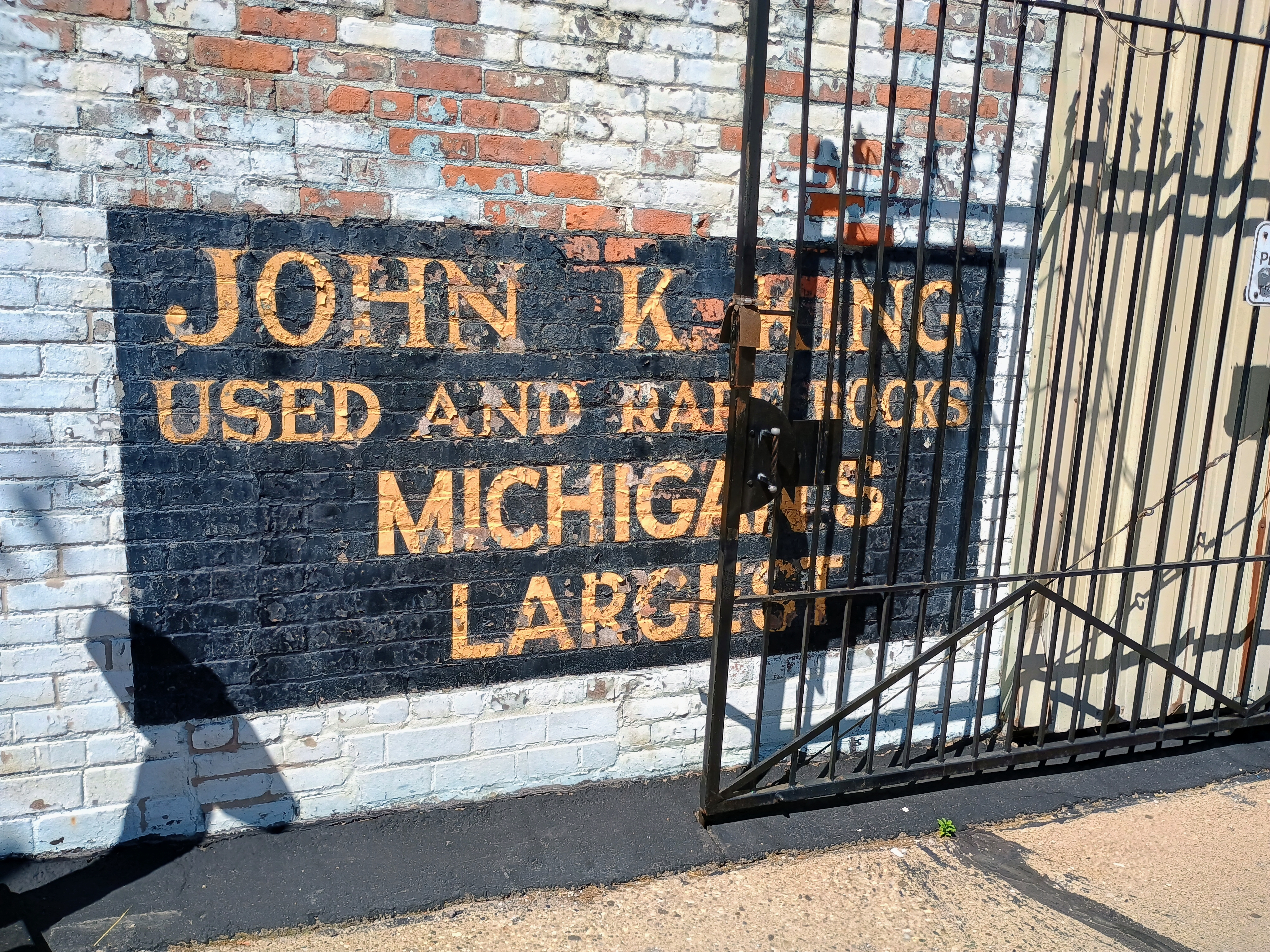
Painted on the brick of an old 4-story warehouse is the name John K. King Used and Rare Books Michigan's Largest.
Painted on the brick of an old 4-story warehouse building in Detroit, Michigan, is the name of the J. K. King Used and Rare Books, Michigan’s Largest. This is the largest used bookstore in the state, and well worth the visit.

For several years, I have kept a list of the books I read during the year. At the end of each year, I print the list and place it in the “All About Me” notebook I keep. The total number of books I read in a year range from 6 to 26. I’m going to beat that this year, as I’m already working on book 26 with two months of reading to go. Yippee! I love breaking my own record.

According to the Psychology Today article, I am an optimist. I don’t view my unread books as a burden or failure of self-control and time management. I see them as a future opportunity to engage with their content. I primarily read non-fiction, so most of my reading is a learning experience. I do blend a few pieces of fiction into the mix for fun. While I have more books than I could read in a year, collecting them is not compulsive hoarding, nor is it damaging to my social interactions.

With few exceptions, I now donate the majority of books I have read rather than keeping them, due to space limitations. I enjoy visiting used bookstores, where you can buy books at much lower prices. I maintain my membership with Barnes & Noble, though, because sometimes I have to purchase and read a new release. The Psychology Today article suggested slowing down the rate of acquisition and becoming more selective, not purchasing a new book until you’ve read one of a similar size. I don’t think that’s possible. I can’t wrap my head around such a ridiculous limitation.

Leave a comment

Filed under decisions, Discoveries, education, exploration, Full-Time RV, habit, hobbies, home, Life is a Melting Pot, memoir, Michigan, summer, time, travel

What Happened to the Bermuda Triangle?

I recently had a pop-up on Facebook regarding not hearing about the Bermuda Triangle anymore. I recall growing up in the 1970s and hearing frequently about boats and airplanes disappearing in that location. As time went on I realized it was no longer in the news. With the recent pop-up on Facebook, my curiosity was piqued.

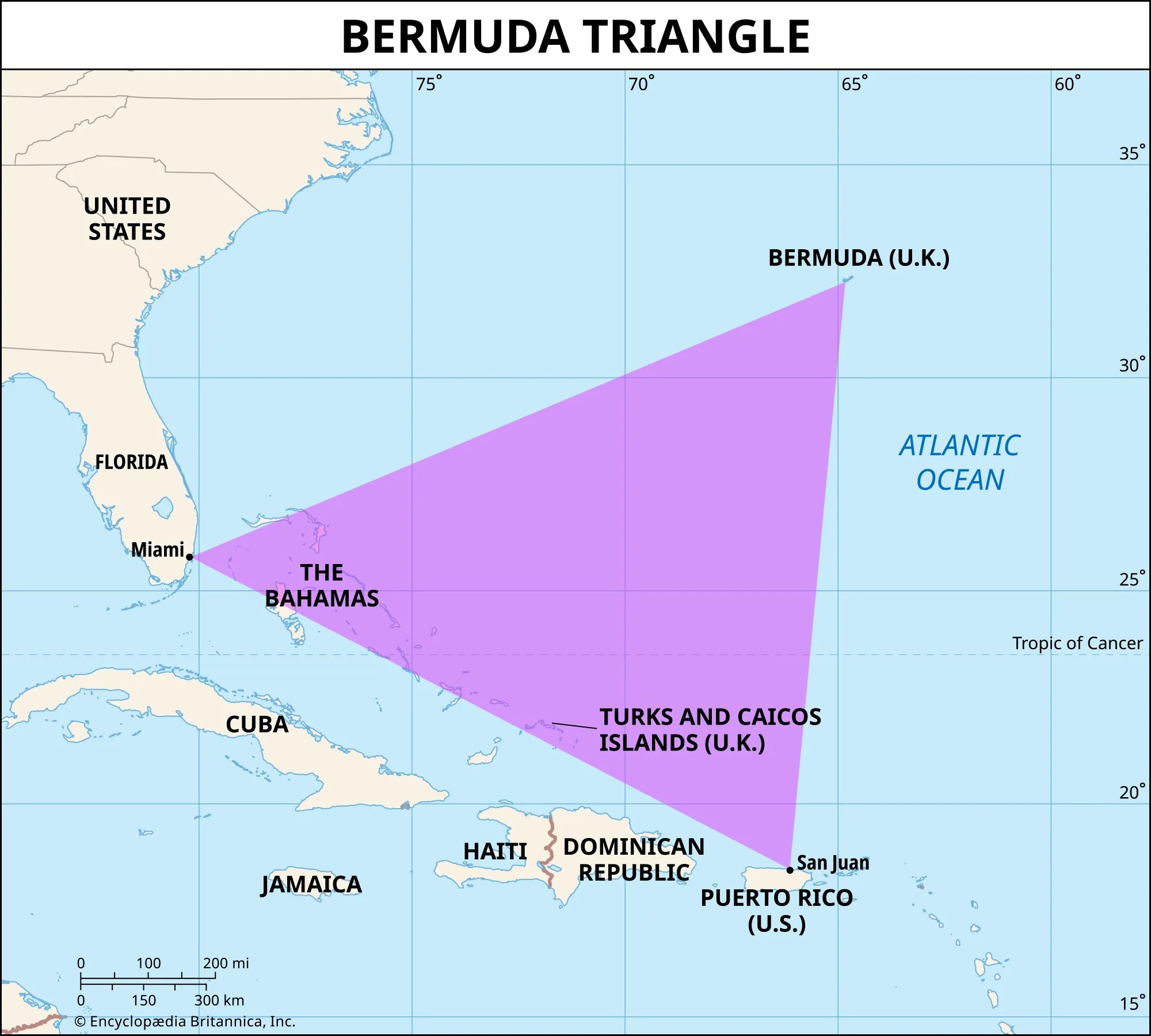
What better place to begin my research than the Britannica Encyclopedia? According to the encyclopedia, more than 20 airplanes and 50 ships disappeared without a trace in the triangular area between the northern point of Bermuda, Puerto Rico, and Florida, near Miami. Occasionally a  vessel was found completely abandoned, with no apparent reason for abandonment. Aircraft flying in the area completely vanished. No distress signals were received from ships or airplanes, and only minimal debris has ever been found; no bodies have been recovered. Even search and rescue missions disappeared without explanation.

I remember people being very superstitious about the area and wondering why anyone would travel within that zone because of the numerous disappearances. Some believed the pilots failed to consider the agonic line. This is an imaginary line on the Earth’s surface where magnetic north and true north are identical, resulting in no need to compensate for magnetic compass variation. Failing to compensate for this can result in a severe navigational error that can lead to a catastrophic accident and disappearance. Others believed the ships were overcome by rogue waves, which can be as high as 100 feet and strong enough to destroy a ship or a low-flying airplane.

The name “Bermuda Triangle” dates back to a 1964 article in Argosy, an American pulp magazine. The article discusses a pattern of ships and airplanes disappearing in the area without any explanation.  The Deadly Bermuda Triangle by Vincent H. Gaddis examines the history of industrial, military, and commercial flights and ships that have disappeared in the area before the writing of the article. Gaddis provides a list of ships disappearing in the area as far back as 1854. It goes back to 1840 if you include the Rosalie, which was found with everyone missing onboard except a half-starved, caged canary.

In 1881, a schooner was found that was deserted, everything was in order, and there was “evidence of a struggle.” A crew from the ship Ellen Austin went on board to claim salvage. A squall separated the two ships as they were en route to port. The schooner was found; the crew had vanished. Another crew agreed to go aboard, but again a squall separated the two ships. The schooner and its men were never heard from or seen again.

Marina Life has an article by James R. Barneff, The Mystery of the Bermuda Triangle, written in September 2023. According to him, it was Christopher Columbus in 1492 who first recorded weird phenomena in the Bermuda Triangle—strange lights in the distance, erratic compass readings, patches of white water, and a large ball of fire crashing into the sea. They encountered a floating sargassum carpet, a mass of seaweed and tropical berries, which was so thick that they had difficulty navigating through it. The article lists a series of disappearances. It begins with the 1918 disappearance of the U.S. Navy ship, the USS Cyclops. The 542-foot-long cargo ship was carrying over 300 men and 10,000 tons of manganese ore. They sent a message that they had fair weather, and all was well, but it never arrived in port. In 1941, two of her sister ships also vanished in the same area without a trace.

Over the years, various theories have been proposed regarding the disappearances, including those involving aliens, time warps, and reverse gravity fields. Scientists have noted that the Bermuda Triangle is one of two locations on Earth where compasses align with true north instead of magnetic north, which can interfere with navigation if not accounted for. Other theories include pilot errors, sudden storms, running out of fuel, and damaged ships and airplanes. The mystery is that the Coast Guard has never been able to find any wreckage in the area.

So where are we today? The article The Mystery of the Bermuda Triangle Finally Unveiled, shares that a shipwreck occurred in December 2020, when the vessel and its 20 crew members all disappeared. No trace of the ship, debris, or persons on board has been found. An average of 20 boats and four planes disappear in the Bermuda Triangle each year without explanation.

No firm explanation has ever been made, probably because there are no distress signals, no survivors, and no wreckage to determine a cause. Various factors may contribute to the disappearances, including the Gulf Stream crossing the Bermuda Triangle, which can cause sudden weather changes. The Milwaukee Depth (27,493 feet, 5.26 inches), the deepest point in the Atlantic Ocean, is located within the Bermuda Triangle. Methane gas production below the water’s surface is massive. Due to these natural circumstances, scientists believe that the ocean depth and methane gas production may cause underwater crevices to open, releasing giant bubbles of methane. This could lead to massive blowouts of gas that could suck boats below the surface and cause engines and aircraft probes to malfunction.

Why don’t we hear about it anymore? Most likely because, as science evolves, the mystery of the Bermuda Triangle has been debunked. Compasses that read true north instead of magnetic north can cause a 20-degree difference in readings, leading to navigational errors and significantly deviating from course. The unpredictable weather patterns of the area can create sudden waterspouts and thunderstorms, putting ships and airplanes into danger, and the fast, turbulent Gulf Stream can quickly erase any wreckage.

One of the main factors contributing to its loss of media coverage is that conspiracy theorists and journalists built popularity and hype around a dangerous area, when in fact, there are other, more hazardous locations. The Bermuda Triangle didn’t even make the list for dangerous shipping incidents from 1999-2011:  British Isles, Bay of Biscay, North Sea; East Mediterranean Black Sea; Japan, Korea; West Mediterranean; Gulf; South China Sea, East Indies; West African Boast; Panama Canal; East African Coast; and Bay of Bengal.

The bottom line is that the mystery of the Bermuda Triangle remains a topic of debate to this day. Many minds still ponder its origins. However, scientists often attribute it to natural phenomena and weather. The Bermuda Triangle is considered safe and is heavily traveled.

Leave a comment

Filed under assumptions, Discoveries, environmental, exploration, Life Changing, Life is a Melting Pot, Mystery, nature, reality, travel, Weather

Why Didn’t the U.S. Adopt the Metric System? – Part 3 of a 3 Part Series

In Part 1 of this series, I explained how I became curious about the planned conversions from the Imperial to the Metric systems of measurement in Canada and the United States. In Part II, I provided a history of Canada’s laws that enforced the conversion and where the country stands now in utilizing the Imperial versus Metric measuring systems. Now, let’s examine the United States’ history regarding the metric system, followed by my opinion on why it failed to implement the planned conversion.

The United States is a muddled mess when it comes to its measuring system. This inconsistency and lack of follow-through dates back to our founding fathers and continues through our failure to complete the transition to the metric system in the 1970s.

History:

 When the American Colonies were being formed, the Founding Fathers decided to use an antiquated measurement system they inherited from the British Empire. Article 1, Section 8, of the Constitution of the United States provided that Congress should have the power “to coin Money… and fix the Standard of Weights and Measures.” Thomas Jefferson, Secretary of State in 1790, endorsed the use of a decimal system of measurement. The only fear was that the United States would be unable to verify the metric units without sending a delegation to France, which would be costly.

The metric system originated in France. The goal was to establish a uniform standard for all measurements and weights. The unit of length was a portion of the Earth’s circumference, and volume and mass were derived from the length unit. This was achieved by multiplying or dividing by 10 and its powers. Ten is much easier to work with than dividing by 16 (to convert ounces to pounds) or 12 (to convert inches to feet). The metric system is a decimal system with a base of 10, allowing for calculations by shifting the decimal point.

The French government officially adopted the metric system on April 7, 1795. A scientific conference was held from 1798 to 1799 to validate the system and design prototype standards, with representatives from Denmark, Italy, the Netherlands, Spain, and Switzerland in attendance. The adopted standards became official in France on December 10, 1799.

The United States was snubbed by France when it invited the other dignitaries to travel to Paris to learn the metric system in 1978. This snubbing was due to the U.S. entering into the Jay Treaty of 1796 with Great Britain, a French rival. France viewed this as a violation of its own treaty with the United States. It retaliated by seizing American merchant ships and refusing to invite them to the conference on the metric system.

The United States, having not taken part in this gathering, adopted the U.S. Customary System as our official form of measurement under Secretary of State John Quincy Adams in 1821. Part of the reason for this decision was fear that the metric system might fail following Napoleon Bonaparte’s reign during the early 19th century. Napoleon imposed the metric system on the countries he conquered, making it a symbol of French control. When European countries revolted against French control, they returned to their original means of measurement. Even with this revolt against France, the metric system continued to grow in popularity. By the end of the American Civil War in 1865, most of Europe had adopted the decimal-based measuring system.

The metric system was gaining popularity worldwide, and although we had not been invited to the 1798 gathering in France to learn about the system, President Andrew Johnson recognized its importance. In 1866, President Johnson signed the  Kasson Act, making it “lawful throughout the United States of America to employ the weights and measures of the metric system in all contracts, dealings, or court proceedings.”

France held another meeting of the world’s leading nations to discuss a new international version of the metric system, and the United States received an invitation and sent delegates. During the 1875 meeting, the United States and 16 other countries signed the Treaty of Metre, establishing the International Bureau of Weights and Measures. The treaty also created the International Committee for Weights and Measures to oversee the Bureau and the General Conference on Weights and Measures to consider and adopt changes. A lab in Sevres, near Paris, was selected to house the international metric standards. The U.S. received its copies of these documents in 1890.

The Mendenhall Order of 1893 stipulated that the fundamental standards for length and mass in the U.S. would be based on metric units. This means the U.S. officially and legally recognized the metric system 159 years ago when Tomas Jefferson, in 1790, endorsed the decimal system of measurement. That standard was confirmed 132 years ago with the signing of the Mendenhall Order.

Current U.S. Standards

If you are like me, you probably read those last two dates and went “what!!!” If this has been our standard for over 132-159 years, why are we still not using the metric system? In my opinion, it is a combination of laziness, unwillingness to invest financially in the change, and, most importantly, lawmakers who were weak in committing to the change and developing a law that would mandate the conversion. Here is what happened that led me to that thought process:

Fast forward 78 years from the entry of the Mendenhall Order to 1971. The United States is still operating under the Customary Imperial system. The U.S. National Bureau of Standards recommended in 1971 that the U.S. transition to the metric system over the course of 10 years. This would mean that by 1981, the country would be fully converted to the metric system. The first problem was the weak law that enacted this process.

The Metric Conversion Act was signed into law by President Gerald Ford on December 23, 1975. It states that the metric system is “the preferred system of weights and measures for United States trade and commerce.” Still, it permits the U.S. customary units in all activities. It states that all conversions to metric are “completely voluntary” rather than establishing the 10-year deadline recommended by the U.S. National Bureau of Standards. Schools began teaching children the metric system, and some businesses made the change; however, the majority of conversions never took place.

Due to the U.S. failing to complete the conversion to the metric system, conducting business with foreign countries became more difficult. In 1988, the Omnibus Trade and Competitiveness Act amended the 1975 Metric Conversion Act. Federal agencies were now required to use the metric system in business activities, including procurement grants, by the end of the 1992 fiscal year. It designated the metric system as the preferred standard for trade and commerce and assigned the Federal Government the task of helping industry make a voluntary conversion to the metric system. The problem is that the conversion remains voluntary, and the private sector has no obligation to implement the change.

The result of these non-mandatory laws is that they left the United States out of sync with the rest of the world. It also means that some industries made partial or complete changes, while made no change at all. The United States is a hub of various measuring standards that are not mutually compatible.

Today, the U.S. uses the SI (International System of Units) on a daily basis. About 30% of products manufactured in the U.S. use metric units. Pharmaceuticals are all metric, and beverages show both U.S. customary and metric units. Film, tools, and bicycles are metric. U.S. coins & currency are produced using metric specifications. Wine and distilled spirits have been using only metric measurements since the early 1980s. Packaging uses metric units to provide net quantity, nutrition, and health-related information for prescription drugs, over-the-counter medications, vitamin supplements, and other products. The U.S. lighting sector uses metrics for light output (lumens), peak beam intensity (candela), beam distance (in meters), and impact resistance (in meters).

Understanding Imperial Standards

This article begins with Part 1, which explains my curiosity about how our current measures were established. I’ve taken a wide-ranging approach to the subject, due in part to my curiosity and love of history, and partly because I believe that to understand where we are, we must know where we came from.

While all this history is fascinating, it still didn’t answer my question of how the Imperial System of measurements was established. These measurements appear to date back to around 450 CE (Common Era; a secular version of AD). It was then that the Germanic tribes invaded England and established a system of measurement that remains in use today:

  • An inch (ynce) was the length of three (3) barleycorns.
  • A foot was initially based on the length of a human foot. This led to inconsistencies in measurement, so the 12-inch foot was officially codified by King Edward II, likely because 12 has more factors, making it easier to subdivide for carpentry and construction.
  • A yard was established as a 3-foot construction standard.
  • An acre means a field and was considered the size of a field that a farmer could plow in one day.
  • A gallon represents the volume equivalent to eight pounds of wheat.
  • A mile was established by the British Parliament as eight (8) furlongs, or 5,280 feet. A furlong was a length based on a single furrow in a plowed field and was standardized by England’s government around 1300.

The United States is the only industrialized nation that hasn’t made the metric system compulsory. While cost is one factor, the main reason is the failure of Congress to make the metric system mandatory in all 50 states, the District of Columbia, and all U.S. territories. The U.S. made the conversion voluntary in laws enacted in both 1866 and 1975. The country has failed to adopt a unified system of metric measurement for transactions that affect the lives of ordinary citizens.

This has led to a hubbub of mixed measuring standards:

  • A football field is measured in yards, but footraces are measured using meters.
  • Mechanics use horsepower to measure an automobile engine’s power, but the same engine’s displacement is in liters.
  • Air pressure is expressed in pounds per square inch, which is equivalent to millibars for air pressure aloft, and inches of mercury for surface atmospheric pressure.

In the U.S. Customary System, there are over 300 different units used to measure various physical quantities. The failure of Congress to make conversion to the metric system mandatory has resulted in the U.S. being a hodgepodge of imperial and metric systems.

Basic Measurement Conversions:

1 mile = 1.6 kilometers.
1 foot (12 inches) = 30 centimeters
1 inch is about 25 millimeters or 2.54 centimeters
1 yard (3 feet) is almost 1 meter
1 kilogram is just over 2 pounds
1 pound is about 454 grams
In the U.K., 14 pounds = 1 stone

Converting Fahrenheit to Celsius is easy:
0 degrees Celsius (°C) is equal to 32 degrees Fahrenheit (°F)
24 degrees Celsius is equal to 75 degrees Fahrenheit
To convert Celsius to Fahrenheit, use the formula of (c x 1.8) + 32

If you want to know more, you can use the World Wide Metric Conversion Calculator for converting pressure, temperature, length, weight, and volume. Just enter the measurement you have, and it will fill in all other boxes within that area.

In closing, should the United States have enacted firmer laws mandating the change to metric? Do you think it would be better if we were on the same measuring system as the rest of the world, or do you like being a stand-alone country using the U.S. Customary System adaptation of the British Imperial System? Share your thoughts in the comments below.

Leave a comment

Filed under assumptions, Canada, communication, decisions, Discoveries, education, habit, Michigan, reality, travel

Why Didn’t the U.S. Adopt the Metric System? – Part 2 of a 3 Part Series

In Part 1, I explained how I became curious about the reasons the U.S. did not convert to the metric system at the same time Canada was making the change, leaving us as one of only three countries in the world that do not use the metric system of measurement. This section explains what Canada did to ensure it completed its commitment to switching from the Imperial to the Metric system during the late 1970s and early 1980s.

In January 1970, the “White Paper on Metric Conversion in Canada” established the Canadian government’s policy regarding its conversion to the metric system. The document specified that Canada would utilize a single, coherent measurement system based on metric units for all purposes. They then developed the “Weights and Measures Act” in 1971 to recognize the International System of Units (SI) for use in Canada. The “Consumer Packaging and Labeling Act” in 1971 required the use of the metric system on most consumer packaging labels.

The change from Imperial to Metric took time in Canada and began in the mid-1970s. I was a high school student in the United States and didn’t concern myself with what was going on in Canada. I do remember them telling us that we needed to learn the metric system because the country was changing to that form of measurement. I also recall that there were many objections to making the switch. We did incorporate some changes rather quickly, the main one being the switch to one- and two-liter bottles of soda. I don’t remember many other changes being made.

A look at how Canadians Measure

In Canada, things were rolling along at a gradual but steady pace:

  • Temperatures in Celsius beginning April 1, 1975
  • Rain and snowfall in millimeters and centimeters starting September 1975
  • Road signs showing speed limits in kilometers in September 1977
  • Speedometers and odometers in cars are manufactured in metric units beginning January 1979
  • Gas stations were pricing and dispensing gasoline and fuel in liters in 1979
  • Fabrics and home furnishings were required to be advertised and sold in meters and centimeters beginning in December 1980
  • Conversion of food weight measurements for advertising and pricing in metric units, starting December 1983.

We tend to assume Canada is solely metric, rather than the melting pot of systems that actually exist there. Canadians still use imperial units rather than metric in some areas. In 1985, Canada exempted some small businesses from the requirement of metric sales. Other requirements were also revoked, including the use of metric alone for measuring gasoline, diesel fuel, and home furnishings.

Even given these leniencies to a complete change, if you travel to Canada, be prepared for your speed limits and mileage signs to your next stop to be in kilometers, gasoline is sold in liters, and if grocery shopping, have a calculator/cell phone handy to make conversions from metric sizing to imperial sizing. This information is especially helpful when determining the size of ingredients for a recipe.

Being a lifelong resident of the United States, I didn’t delve as deeply into Canada’s history of its measuring system conversion as I did into my own country’s. Watch for Part III, where I’ll give the United States’ history and why it failed to complete the conversion.

Leave a comment

Filed under Canada, communication, decisions, education, employment, impressions, Life Changing, time

Why Didn’t the U.S. Adopt the Metric System? – Part 1 of a 3 Part Series

Listening to a weather forecast on a Canadian TV station, the temperatures are given in Celsius. Paul, who grew up in Canada, makes the mental conversion easily. Paul grew up using the Imperial system of measurement, which is used in the United States. After he was an adult and had immigrated to the U.S., Canada converted to the metric system. Paul is an electrician, a profession that uses the metric system of measurement. That, combined with his frequent travel to Canada, means he is familiar with both systems and believes the metric is a more accurate means of measurement.

Paul frequently comments that the U.S. was supposed to make the conversion to the metric system when Canada did, but failed to fulfill their promise. I recall being in grade school when we were told that the United States would adopt the metric system. I wondered how valid Paul’s repeated comment was, so I delved into researching the topic.

 Canada was making the transition at the same time and completed their conversion between 1970 and 1985. The United States never finished the conversion, despite agreeing to do so, and continues to use the Imperial System today. That made me wonder, why did Canada succeed, and we didn’t?

In my opinion, the U.S. failed to complete the conversion due to a lack of effort and unwillingness to invest in implementing the change. Businesses opposed the cost of having to retool and adjust standardized measurement systems, including bolts, pipes, and nuts, to metric measurements. The Metric Conversion Act of 1975 [ https://usma.org/laws-and-bills/metric-conversion-act-of-1975 ] made the metric system preferred, but not mandatory. This, combined with public resistance and the government’s inability to enforce the change, led to the failure to implement the change.

As of today, the United States is only one of three countries (the United States, Liberia, and Myanmar (Burma)) worldwide using the Imperial measurement system. The Imperial system [ https://www.britannica.com/topic/Imperial-unit ] (also known as the British Imperial system) originated from the British Empire, which ruled many areas of the world between the 16th and 19th centuries. Although the U.S. Founding Fathers made numerous changes in governing style when obtaining independence from Britain, they decided to maintain the Imperial system of measurement, despite the metric system growing in popularity.

A chart showing the Imperial vs Metric measurement and weight differences.

Rather than adopting it in its original state, the United States devised its own version of the Imperial system, known as the U.S. Customary System. It uses measurements of feet, pounds, and miles, but differs slightly from the British Imperial system. The most substantial difference is in volume:

  • The U.S. Customary fluid ounce is 29.573 ml; the British Imperial fluid ounce is 28.413 milliliters.
  • The U.S. Customary pint is 473.176 ml (16 fl. oz); the British Imperial pint is 568.261 ml (20 fl. oz).
  • The U.S. Customary quart is 0.94 L (32 fl. oz); the British Imperial quart is 1.13 L (40 fl. oz).
  • The U.S. Customary gallon is 3.78 L (128 fl. oz); the British Imperial gallon is 4.54 L (160 fl. oz).

The reason for creating the Customary version of the Imperial system was that the metric system was not yet fully developed. The Founding Fathers had a desire to establish a unique national identity and infrastructure, and tweaking the system to make it unique to the U.S. was their way of achieving this goal.

Myanmar (Burma) and Liberia use the Imperial system but are transitioning to the metric system; neither has a predicted completion date. Once their conversions are final, the U.S. will be the sole user of the Imperial system. In 2021, the British government announced plans to return to the Imperial system during its exit from the European Union. The changeover began but was abandoned in 2024 after consulting with the public and discovering overwhelming support for using metric units. They do still use the imperial system for things such as beer sales, road speed, and distance signs, and body measurements.

Although I found the metric system difficult to learn as a child, our government failed its citizens by not enforcing a complete change in the 1970s. A full conversion would have served business owners better in international trade negotiations and put us on equal terms with all foreign lands in understanding measurements when traveling.  

All countries worldwide, including the U.S., Myanmar, and Liberia, have adopted or legally sanctioned the International System of Units (SI), the modern form of the metric system. Canada and the United States are both melting pots of the Imperial and Metric measurement styles.

Watch for Part II and Part III in upcoming blogs, which will deal with the law and the Canadian conversion, the laws and the United States conversion, and where the United States stands today.

Leave a comment

Filed under Canada, communication, decisions, Discoveries, education, home, Life Changing, Life is a Melting Pot, Michigan, reality, travel, Weather

Cherishing Front Porches: Memories and Connections
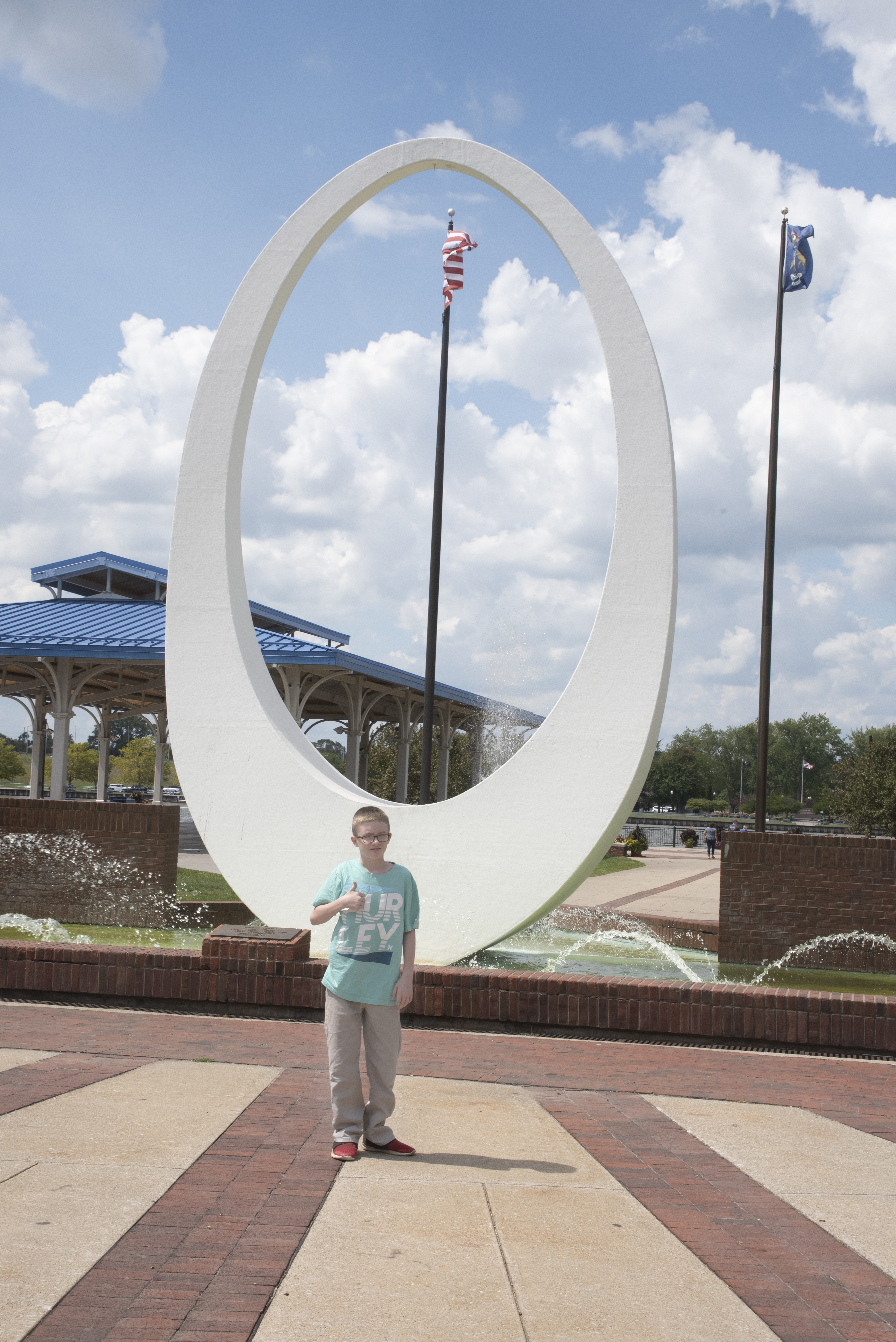
When was the last time you sat on the front porch of your home, waving at your neighbors as they passed by, or inviting them up to chat and share a glass of lemonade? 

I have always loved front porches, the big kind that holds several chairs. When I lived in St Clair, Michigan, I rarely sat on my private patio in the back. I preferred the front porch, where I often sat reading a book until it got dark. I was not in a neighborhood, but on a state highway, so I only had cars buzzing by.

My love of sitting on the front porch is something I developed as a toddler. Back then, my grandmother was my babysitter. I remember sitting on the porch at various times of the day, watching the birds in the yard, migrant workers across the street playing, and watching the sun set. Red sky at morning, sailors take warning. Red sky at night, sailor’s delight. Hmm, wonder where I learned that?

The world made more sense when folks waved from the porch instead of arguing with strangers online.

As a teenager, my best friend in high school lived in a large, older home with a large front porch. I loved that porch! We would sit on it talking with friends, shouting out to cute guys that drove by, and just enjoying life. The house I grew up in only had a small stoop. I envied April, living in a home with a large porch that looked out over the street.

I no longer have a front porch. I always intend to sit outside on my lawn chair, and those times when I make it out there, I enjoy sitting in the fresh air and reading a book. I don’t get out as often as I want; life gets in the way, even in retirement. I, like many others, spend a good deal of time on social media, sharing trivial quotes, travel, pictures, news articles, and day-to-day activities with distant friends and family. I participate in public forums, where political discussions can turn hostile. People have lost the etiquette exercised during face-to-face conversations. It is so much easier to be insulting and rude when done through an electronic device.

That image takes me back to another time, when life was more relaxed and friendly. Kids played outside; they rang their friends’ doorbells to see if they could come out, rather than having scheduled play dates arranged and monitored by their parents. There were neighborhood block parties, where everyone got together, brought a dish to pass, and adults enjoyed socializing while the kids played. You knew your neighbors, and your neighbors knew you, and everyone got along. In my opinion, it was a better time.

Leave a comment

Filed under backyard, communication, Family, friendship, home, kids, Life is a Melting Pot, memoir, Michigan, parents, play, summer, time

The Sweet History of Soft Serve Ice Cream

As the summer winds down, everyone needs to experience one more lickable twist of ice cream. Whether you prefer soft-serve or the old-fashioned hand-scooped variety, there is sure to be a flavor that will tempt your palate.

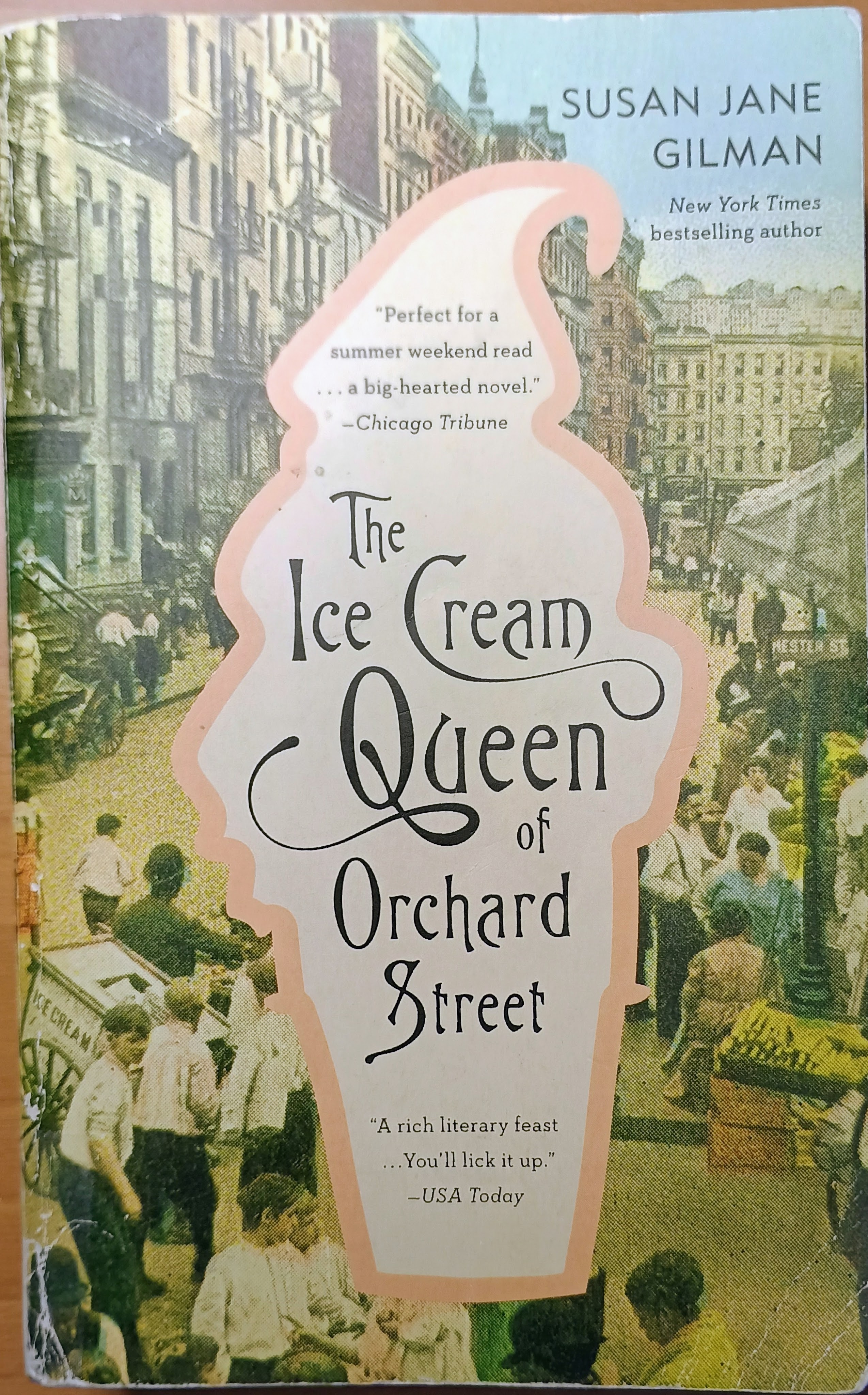
The Ice Cream Queen of Orchard Street is a novel that includes the history of ice cream.

I was reading The Ice Cream Queen of Orchard Street by Susan Jane Gilman and was intrigued by the story in the book about the discovery of soft serve ice cream. I wondered if it was fact or fiction, so I did some digging to get the full scoop. What I discovered is that the author intertwined creative non-fiction history about this discovery to set the scene for the story told in the novel.

When I find interesting topics, I like to share them. You can learn about the history of this tasty, lickable treat in my article, Twisted Tales of Soft Serve and Ice Cream, which begins on the cover of the August 27-September 16, 2025 edition of Michigan’s Freshwater Reporter.

Leave a comment

Filed under Diet, Discoveries, food, Life is a Melting Pot, summer

Freshly Mown Grass: A Journey Back in Time

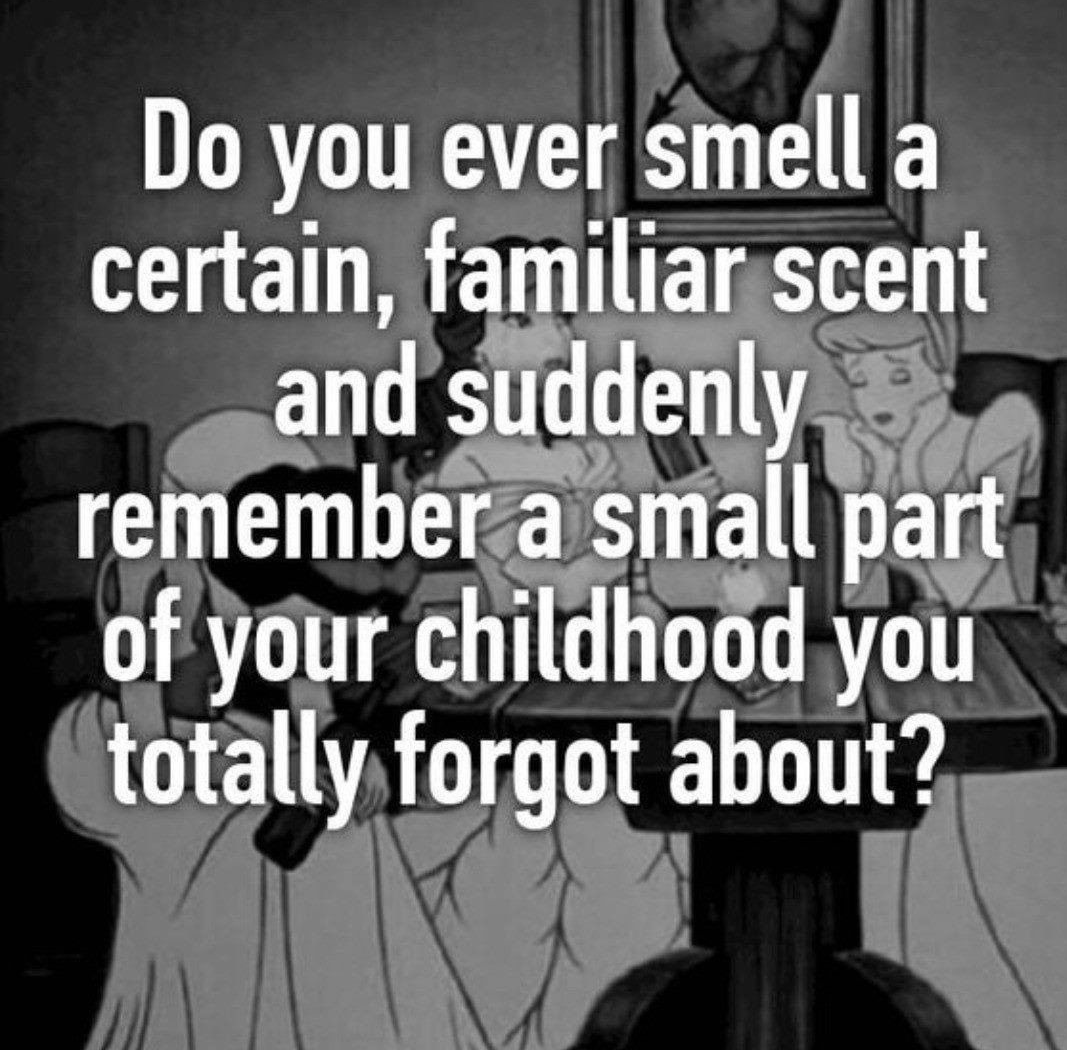
Do you ever smell a certain, familiar scent and suddenly remember a small art of your childhood you totally forgot about?

When I saw the question, “Do you ever smell a certain, familiar scent and suddenly remember a small part of your childhood you totally forgot about?” I knew instantly what it was…fresh mown grass.

Growing up in Michigan, I remember the smell of our freshly mown lawn on Saturday or Sunday summer afternoons. Once the yardwork was complete, Dad would come inside and watch the baseball game. This makes my memory multi-sensory, a combination of scent and sound.

The smell of freshly mown grass always takes me back to those summer afternoons, but it doesn’t feel complete without the sound of a baseball game playing on TV. Should I mention that this is an old-fashioned console TV that only receives four channels, has a TV antenna, and you had to walk over to the TV to change the channels or adjust the antenna? I know, I’m dating myself. That shows how far back this memory goes.

I don’t have any other scent-based memories that have such a substantial impact on me as freshly mowed grass. I will admit, if I hear a baseball game playing on TV, I miss the smell of grass. In my mind, they go together. What scent transports you back to your childhood? Share in the comments below.

Leave a comment

Filed under backyard, home, Life is a Melting Pot, memoir, Michigan, summer

Writing Prompts Are Everywhere

Friends connected to my personal page on Facebook know I have an addiction to what I refer to as image quotes. Little sayings and thoughts that hold deep meaning or inspire a laugh. They can also serve as writing prompts.

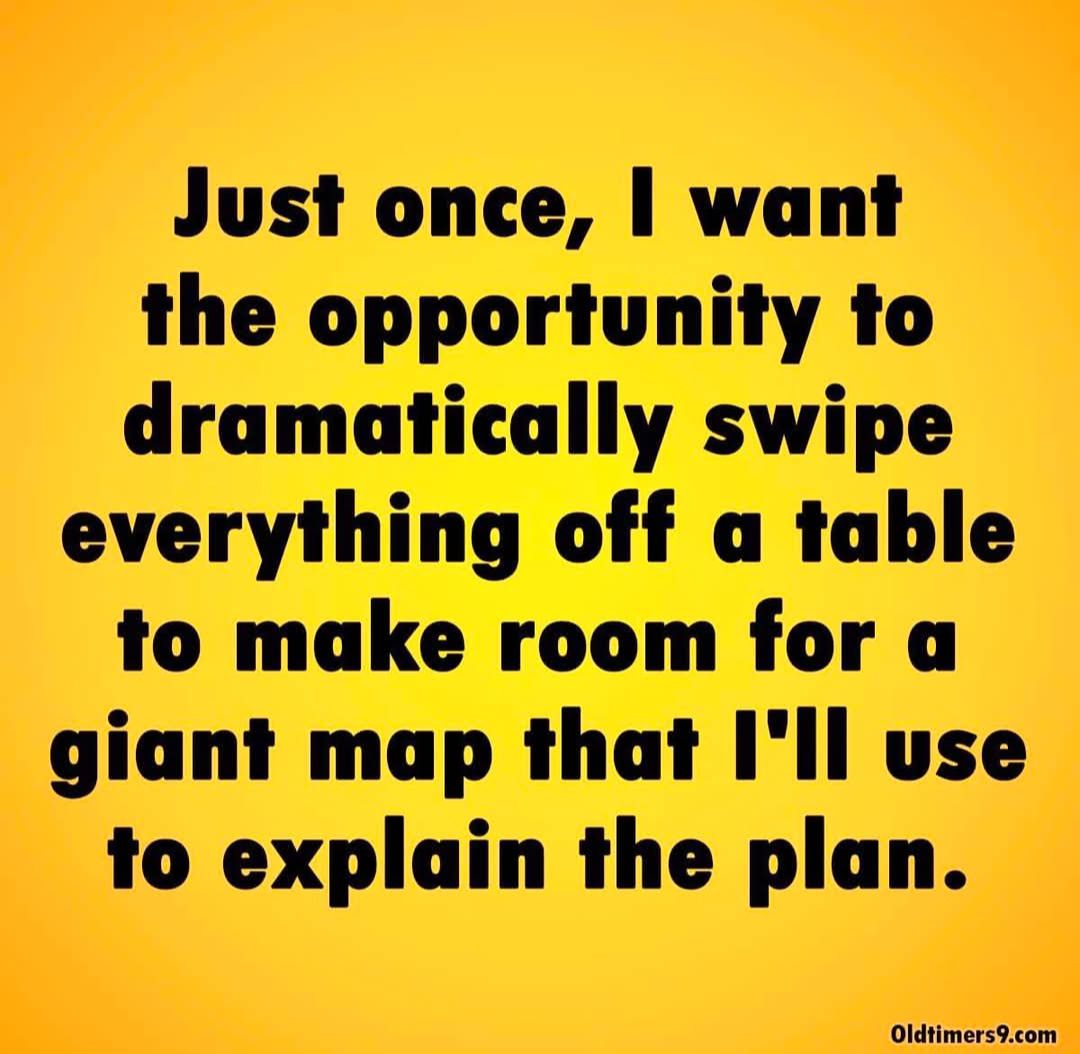
Just once, I want the opportunity to dramatically swipe everything off a table to make room for a giant map that I'll use to explain the plan.

Take, for example, the one to the left. You can picture this happening in a movie or in a book. What would be the reason for such a dramatic move in your own writing? Is it a treasure map, a guide to a search and rescue mission, or a plan for renovating a house? Let your imagination go as you put your thoughts on paper.

Years ago, when taking a course on writing for children, we were advised to save pictures from magazines we liked and put them into a book or folder for use as writing prompts. I probably still have that collection of magazine photos somewhere. I don’t think I could ever bring myself to toss them.

That may be why my phone is full of memes for sharing. I’ll admit that some are political, some inspirational, and some just fun, with the intention of evoking feelings and responses from a diverse range of people. When you are struggling with your writing, whether it’s a book, magazine article, or blog, flip through Pinterest, Facebook, magazines, or anywhere else you find inspirational images and save a few to inspire your stories.

Happy and Keep on Smiling dolls sitting on a bench

Look at this cute image of two smiley-face dolls sitting on a bench. They display the words ‘Happy’ and ‘Keep Smiling,’ but what is their story? Why are they sitting on that bench? Are they friends? Siblings? Strangers? Write a story about them.

There are many thoughts out there on memes that create memories of the past. Anything from the sound of the National Anthem followed by all TV stations going off the air to the idea of having to run and answer the phone because it was connected to a wall with no caller ID or answering machine. You had to answer, or there was no way of knowing who it was or what they wanted.

The purpose of a writing prompt is to get your mind rolling. By taking the focus off writer’s block and getting the mind rolling, your thoughts will soon exceed the speed at which you can type them. Keep in mind, it is only a starting point, and your story can go as far away from that beginning as you want.

Some writers develop their writing, which begins with a prompt, into something they later publish. Others consider it throwaway writing, where it allows them to experiment with a variety of topics and techniques without worrying about perfection or failure.

I was in a writing group for a while, where they did a fun thing at each meeting. About half an hour before the meeting was scheduled to end, a writing prompt was given. It was usually a sentence or two or an image. We were then given 15 minutes of quiet writing time to craft a story based on that prompt. At the end of the writing period, we would go around the room and each person would read aloud what they had written. It was fun and engaging to see how stories that started from the same prompt varied significantly in content.

Another area of writing prompts is the ideas you come across when reading. A couple of years ago, I visited a museum in Chippewa Falls, Wisconsin, and purchased the book “The Grey Eagles of Chippewa Falls – A Hidden History of a Women’s Ku Klux Klan in Wisconsin” by John E. Kinville. The information about a woman’s Ku Klux Klan group inspired my curiosity and led to the sale of an article published in the Freshwater Reporter, “The troubling persistence of Michigan’s Ku Klux Klan” [ https://freshwater-reporter.com/wp-content/uploads/2024/02/FreshwaterReporter_Jan24-web-2.pdf ]

I have also had other articles published as a result of prompts I received while reading about history. A recent example was when I read “The Ice Cream Queen of Orchard Street” by Susan Jane Gilman. In the novel, she writes that the creation of soft serve ice resulted from a flat tire on an ice cream truck. My mind kept going back to that incident, so I looked it up, and she had taken creative liberties in the story, but the basis of fact was there. I used that prompt for an article that will be published in the upcoming issue of the Freshwater Reporter about the history of ice cream.

The possibilities are endless once you open your eyes and mind to the numerous prompts that are around you. It can be two children on a playground, a family dining out together, or an image of an older man on a tractor. It was the meme about sweeping everything off a table to make room for a map that inspired me to write this blog. I shared it on my personal Facebook page a week or so ago, but it kept creeping into my brain. I even started a story with it that became a throwaway, and that led to this article.

If you have been following my blog for a long time, you know it has been a while since I last wrote. The time between blog posts has been significantly stretched over the past few years. When I look back, I feel bad for getting wrapped up in life and not writing more. At the same time, my ‘Life is a Melting Pot’ life means that after swirling around in that pot, I have now grabbed onto the spoon, climbed up on the edge, ready to dive in with a broader variety of writings and more frequent posting.

If you have been with me for the long haul, Thank You! I hope you’ll enjoy the new format and pass my link along to your friends. If you are a new reader, Thank You! Please sign up to receive an email notice each time I post a new blog.

Leave a comment

Filed under communication, Life is a Melting Pot, Writing

Five Problems With Social Media

Social media ball with various images on it

When I was growing up, there was no social media. No one owned cell phones or computers, and phones were attached to a wall in our home.

Fast-forward to today; there are numerous social media platforms on which you can be active. While there are many positives to electronic vs personal contact, including regular contact with distant family and friends, there are also negatives. Here are five problems with social media.

1. Rude Behavior

People can hide behind the wall of a social media platform. Even those you know are more likely to behave rudely. When it is people with whom you have no personal relationship, bullying becomes even worse. When people converse in person, things you disagree with are politely disputed or let pass. Under the guise of a social media platform, people are more likely to insult and attack those with whom they disagree, referring to them as stupid, ignorant, old, or in any other way demeaning them.

According to an article in Psychology Today, anonymity contributes to rudeness and trolling. However, the lack of eye contact is the chief contributor to a person’s inability to control inappropriate behavior online. Before the advent of social media, people tended to be more courteous, even when disagreeing on specific points. Social media allows people to hide behind their computers and be aggressive and rude.

2. Time Spent/Wasted

The average user between 16 and 64 spends approximately 2.5 hours on social media platforms daily, with YouTube and TikTok experiencing the highest usage. That doesn’t sound like much out of 24 hours until you consider that it adds up to 14 to 17.5 hours per week that we no longer spend on other activities.

Even more concerning is that teens spend an average of 4.8 hours on social media daily.  That is over 33 hours a week! When you consider how easy it is for adults to fall into bad online behavior, think about how vulnerable teens are to cyberbullying and its impact on their self-esteem. Suicide rates among teens have increased during the social media era, and about 42% of teens admit that social media use keeps them from connecting with their friends in person.

3. Political Hostility

Before the advent of social media, politics adhered to the rules of proper etiquette. Etiquette traditionally held that three topics were never discussed in polite company–religion, politics, and money. Social media has eroded the belief in being courteous and following the rules of etiquette. This has impacted political discussions and encouraged people to become outright hostile toward those with differing beliefs.

A University of Michigan study found that political anger and cynicism are rising in the United States and democracies worldwide. Social media contains a lot of political information and news, but much of the content is toxic rather than factual. These toxic news streams are often hostile and insulting, which increases anger and bad behavior toward those with differing beliefs.

When was the last time you held a cordial exchange of political information on a social media platform with someone supporting an opposing candidate? It may start okay, but eventually, one person will become insultingly aggressive and argumentative. This undermines the ability to exchange information, leading commentators to prioritize presenting their side over engaging in an open-minded exchange of facts.

The problem is that algorithms reward hostile behavior because they perceive heated exchanges as more engaging. This shifts political attacks to the forefront of media platforms, increasing their visibility and distorting public opinion. People should conduct research using various sources rather than relying on social media when making decisions about election candidates or policies.

4. Cyberbullying and Cyber-Harassment

Cyberbullying is bullying that is done through SMS, text messaging, apps, gaming, or social media platforms. It encompasses sending, posting, and sharing false, negative, harmful, or mean content about another person. The information shared can be personal or private and is done with the intent to cause that person embarrassment or humiliation. This behavior can cross the line into criminal or otherwise unlawful behavior.

Examples of cyberbullying:

  • Sharing embarrassing pictures or videos online
  • Posting rumors on social media
  • Sharing someone else’s private information online
  • Threatening someone online
  • Creating fake accounts and posting information to embarrass someone

Cyber-harassment is behavior intended to torment the recipient. This occurs on public forums and is carried out by the harasser to seek peer approval or build their image to appear superior and vital.

Examples of cyber-harassment:

  • Threatening or harassing emails or instant messages
  • Using electronic technology to bully, harass, or intimidate
  • Spreading rumors
  • Sharing private information
  • Spreading hurtful information
  • Intentionally provoking or annoying someone online

Visit the Stopbullying.gov website to learn about the laws and policies against bullying in your state. Click on your state for additional information about state, commonwealth, and territory cyberbullying laws and policies. Seven states have laws only; most states have laws and policies.

5. Addiction

Although not formally recognized in the medical profession, social media is more addictive than cigarettes or alcohol. Addiction can lead to negative consequences that impact mental health. The main tell-sign is an obsessive need to check and update social media platforms frequently to the extent that it disrupts real-world relationships and activities.

It is easy to become addicted because social media platforms are designed to trigger the release of dopamine. This triggers a feeling of pleasure, reinforcing the desire to repeat the process. Any positive feedback received, such as likes, comments, and shares, validates and encourages repeat usage.

Signs that you may be addicted to social media include spending an exorbitant amount of time on your platforms, sometimes to the extent that you forgo other responsibilities or activities. Your reliance on social media may become so obsessive that you feel compelled to check it constantly, and any inability to do so leaves you feeling anxious and stressed. This can also lead to depression if you find yourself comparing your abilities with those of others online.

To manage your social media interactions for better mental health, set time limits for platform use and plan regular breaks when you engage in real-life relationships and activities. Establish times when social media is not accessed, such as during meals or when socializing with friends and family. It is also helpful to turn off notifications so you are not constantly distracted.

Social Media is here to stay. In 2005, only 5% of Americans were using social media; that number grew to 72% by 2021. Over 4.8 billion people worldwide are active on social media daily, and estimates are that by 2027, that number will reach six billion. It is essential to exercise caution when using the platform’s responsibility.  We must not allow ourselves to fall into a pattern of abuse toward others, nor should we tolerate such behavior from others. If you or someone you know becomes a victim of cyber harassment or bullying, report it to the appropriate legal authorities.

Leave a comment

Filed under communication, Coping, Family, habit, handicapp

Michigan Was a Slave-Holding State

I decided to share the link to an article published in the March-May edition of Michigan’s Freshwater Reporter. Michigan is known for being a free state that helped freedom seekers via the Underground Railroad. That information is accurate, but Michigan citizens also were slaveholders. You can learn more about this by checking out Michigan’s hidden history of slave ownership on page 4 of the Freshwater Reporter.

Leave a comment

Filed under assumptions, Coping, decisions, education, events, Life Changing, Life is a Melting Pot, Michigan

Super Bowl Advertising–Could the Cost Be Better Spent?

I recently heard a comment that a 30-second spot for advertising during the 2025 Super Bowl was $8 million. In addition to the game-time advertising, Fox Network, which aired the game, also sold pre-game ad slots for about $4.5 million each and post-game ad spots for around $4 million each. Fox sold out its ad inventory early. Some companies, including Busch Light, ran two ads during the game, doubling their costs.

Super Bowl advertising is expensive because the advertiser has the potential to reach about 100 million viewers. While the added revenue generated by these ads is great for the big-name companies that can afford it, I wonder how many people those companies could help by using those funds in another way, especially when I learned their actual bottom-line cost.

product advertising image

In 2025, 57 commercials aired during the game, earning the Fox Network approximately $456 million in game-time advertising revenue. The year 2025 was record-breaking, and the combination of pre-game, game-time, and post-game advertising generated almost $700 million in revenue for the network.

Fox makes that for the advertising spot, but the cost for the companies who advertise is considerably higher, and so is Fox Network’s revenue. The ad agency cost for Super Bowl work is an average of $3 million to $6 million, film production costs are $3 million to $4 million, and post-production work such as visual effects, sound, and editing is around $1 million. Music licensing expenses are between $3.5 million and $5 million.

Those advertising costs do not include the fees that must be paid for the ad spokesperson. A non-celebrity will run about $250,000, a B-list celebrity about $1 million, and a more realistic celebrity appearance is between $3.5 million and $5 million.

In addition to those production and celebrity costs, advertisers need to spend additional funds on digital and social media ads and any additional activations, which adds another $3 million to $10 million to the final cost.

Now, remember that $8 million 30-second ad? Fox Network requires advertisers to commit an additional $8 million for media commercial time for the upcoming year, which means that the 30-second spot is a $16 million commitment.

The final cost for purchasing a Super Bowl Ad is about $40 million per ad. With 57 ads sold during 2025, that works out to about two billion two hundred eighty million dollars ($2,280,000,000).  

I realize my thoughts about how that money could be better spent will never materialize because Super Bowl ads generate a lot of revenue for advertising companies. That doesn’t stop me from wondering what would happen if those companies produced low-cost commercials notifying watchers that rather than spend $40 million on creating an advertisement, they spent the minimum advertising contract and created a simple ad to inform consumers they have donated the difference in expenditures, approximately $24 million, to homeless shelters, food banks, soup kitchens, building low-income housing, natural disaster relief, etc.

If you saw an advertisement like that, would it make you more or less inclined to purchase their products? Think how beneficial this type of action could be to the citizens of this country. Making this country great means helping others improve their lifestyle and achieve success. Is a $40 million commercial helping America? Could those funds be used better elsewhere?

As of January 2024, the Department of Housing and Urban Development reported over 771,000 homeless people in the U.S. Reasons for this status include ending COVID-19 relief programs, higher housing costs, and immigration to big cities. People experiencing homelessness include almost 150,000 children under 18.  

According to the Working Poor Families Project, 47.5 million people in the U.S. live in low-income working families, including 23.5 million children. In 2011, more than four in 10 working families were low-income working families in Arkansas, Mississippi, and New Mexico. Between 2007 and 2011, low-income working families increased by 5% in Alaska, Arizona, California, Connecticut, Florida, Georgia, Illinois, Michigan, Nevada, and South Carolina. These families spend more than one-third of their income on housing and, in doing so, exceed the accepted guideline for affordable housing.

What are your thoughts? Please comment below.

Leave a comment

Filed under Coping, decisions, events, impressions, Life Changing, reality

Christmas Memories

When I saw the quote from Laura Ingalls Wilder about childhood memories, it got me thinking about Christmas during my childhood. Every child should be able to experience the magic of the season—Santa Claus bringing gifts, Christmas programs at church and school, baking Christmas cookies—traditions that become so ingrained that they carry them into adulthood to pass on to their own children.

Our hearts grow tender with childhood memories and love of kindred, and we are better throughout the year for having, in spirit, become a child again at Christmas-time...Laura Ingalls Wilder
The quote that inspired this blog

Some say the holidays have changed over the years, and I know to a certain degree that is true, but some things remain the same. Let’s start with the most essential part of decorating: the Christmas tree. In my childhood, we went to the Christmas tree farm. After tromping through snow and checking out several trees, we finally selected one that met my mother’s approval. My dad would cut it down, haul it back to the car, tie it to the roof, and we drove home.

The debate over which tree to select always involved a discussion wherein my mother didn’t think it was tall enough or full enough, and my dad claimed it was too large and wouldn’t fit. We wouldn’t know for a while because we usually purchased it early in the month. The tree went into a bucket of water in the garage to keep it from drying out until a week before Christmas. That is when it was carried into the house and placed in the stand. Dad usually had to cut more off the base for it to clear the ceiling. One year, my mother kept thinking all the trees were too skinny. The one we brought home was so big around it took a massive chunk out of the living room.

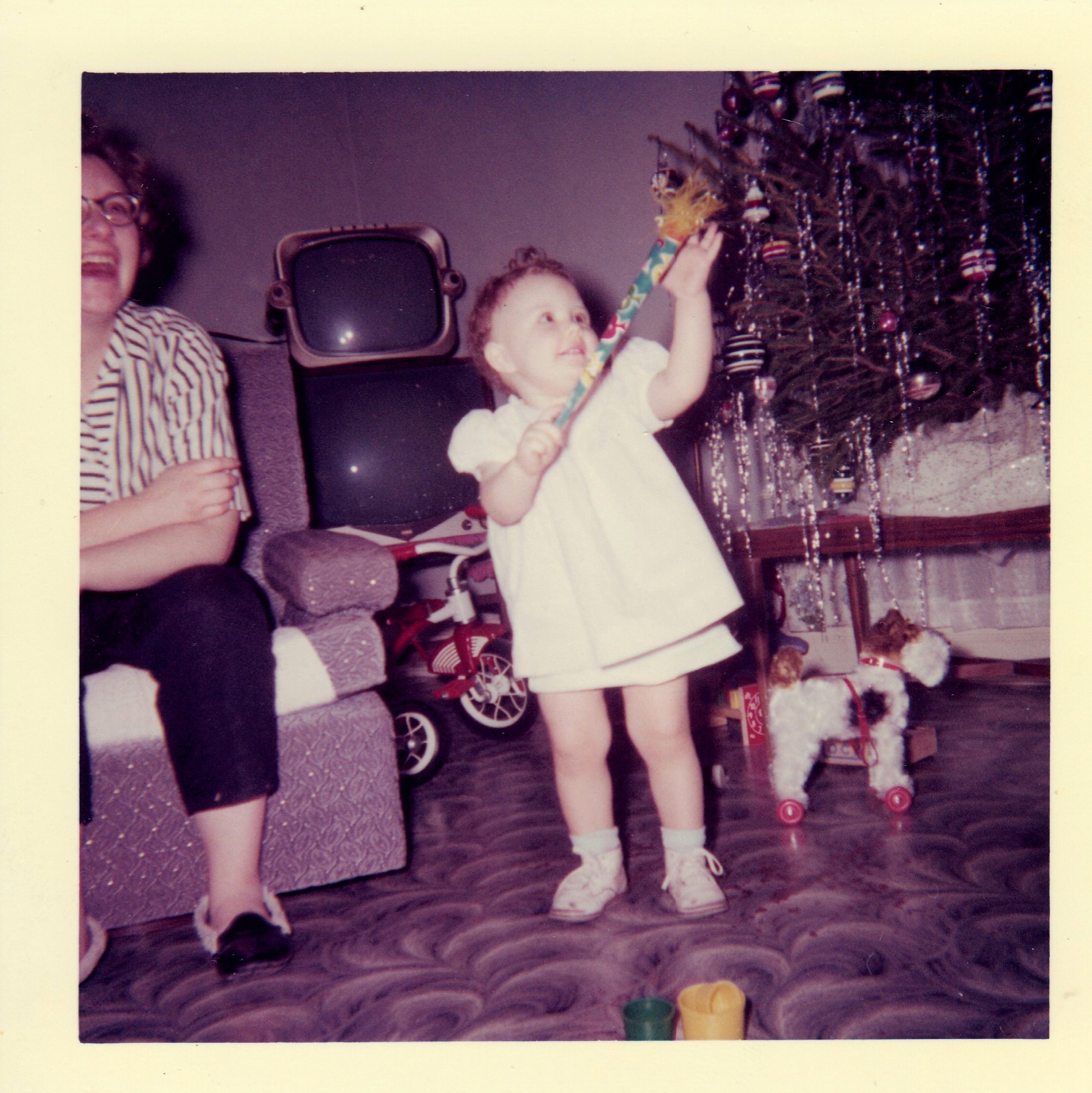
Author at Christmas, age one
The author and her mother at
Christmas, age one

My mother always insisted the tree sit in the living room for 24 hours to let the branches drop before we began decorating. The large, hot lights were strung on before we hung ornaments. Ornament placement was a procedure taught by my mother. Stand back from the tree and look for a spot needing an ornament. Once all the ornaments were on the tree, the garland and tinsel were applied. The trees of my childhood had a lot of sparkle, but the ornaments couldn’t be easily seen through all the add-ons.

Eventually, we went to an artificial tree, which allowed us to put it up earlier, and there wasn’t a rush to get it down after the holiday due to dry, dropping needles. That brought a switch to the small, cool bulbs, and we eliminated garland and tinsel. Now, our ornaments were easily seen, which, over time, I grew to prefer. Photos of trees with tinsel still make me smile with memories of days gone by.

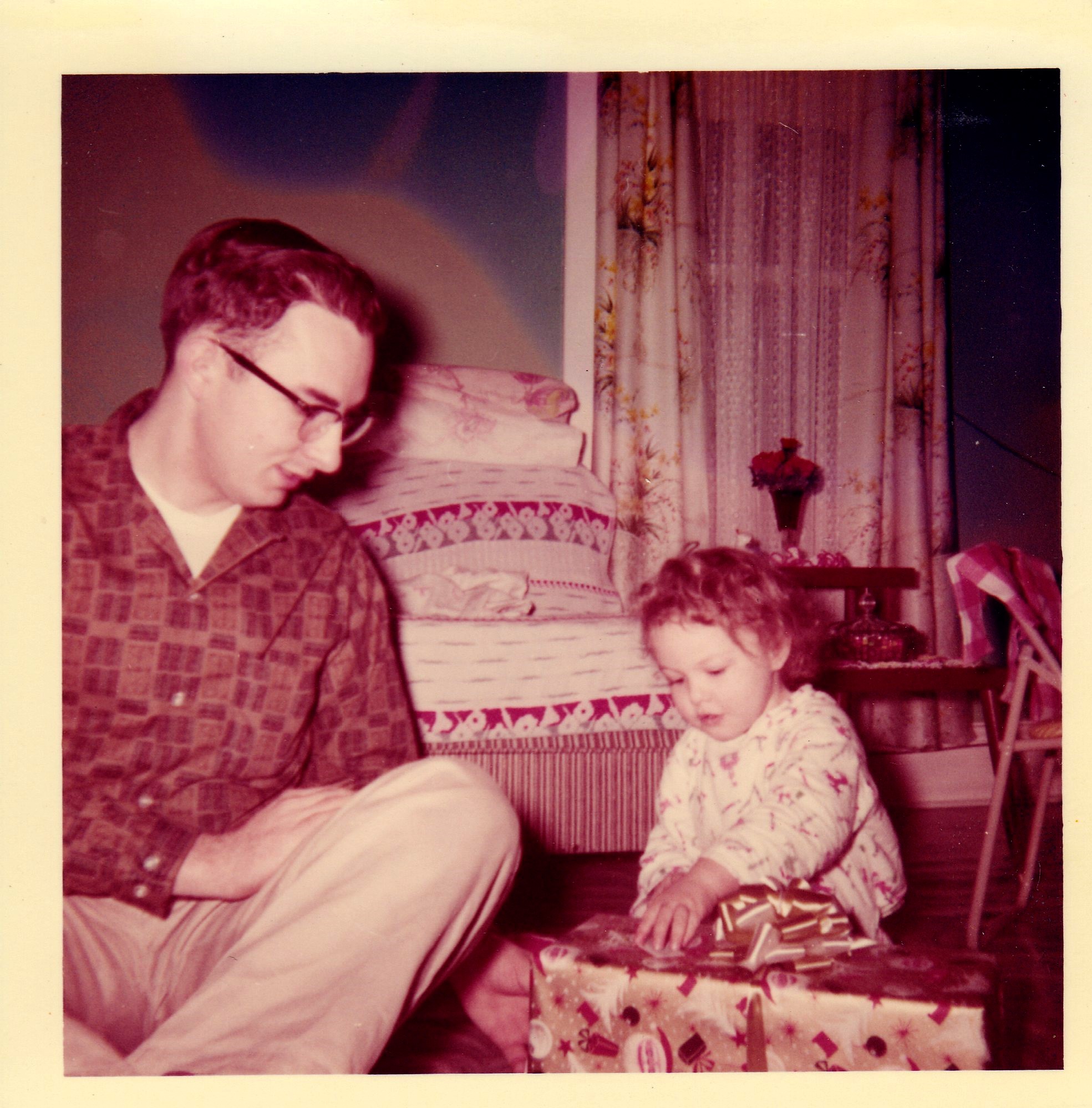
Author as a toddler with her father on Christmas

When Hallmark began their yearly dated ornaments, my mother started a tradition of purchasing a dated ornament each year for my sister and me. When I married, I had a wonderful collection of ornaments for my tree. I continued the tradition with my own children and now my grandchildren. Although I sold most of my ornaments in an estate sale when I left my home to live and travel full time in a motorhome, I have been buying some ornaments, plus making photo ornaments of places I visit. Someday, when I stop traveling, I will once again have a Christmas tree and decorate it with my travel memories.

My mother did not enjoy baking, but every year, she made sugar cookies cut into shapes for my sister and me to decorate. As a child, I loved the red cinnamon candies, so I used them for the bell clappers, reindeer noses, and plenty when decorating Christmas trees. When my kids were little, we also decorated sugar cookies, and they were also heavy-handed with red cinnamon dots. To this day, I love sugar cookies, especially at Christmas time.

Author at Christmas, five years old
Author on Christmas, age five.
Notice the tinsel on the Christmas tree

While I don’t have a lot of other Christmas tradition memories, we always went “up north,” meaning to Traverse City, Michigan, to visit both sets of grandparents during the holidays. We stayed with my maternal grandparents and would go to the tree lot to purchase and decorate a tree for their house. One year, my dad laid the tree we bought between the snowmobiles on the trailer. As he was driving, he suddenly realized the tree was missing! We never found it as we returned to the tree lot; the guy running the lot gave us our next tree for free. I remember my dad saying he hoped whoever picked it up couldn’t afford one.

When it comes to childhood memories, who can forget the splendor of seeing the tree on Christmas morning with all the gifts below it and stockings full of goodies. The beauty of the gifts sparkling under the lights, the anticipation of what is inside each wrapped package that Santa brought. That is the magic of Christmas, the memories of childhood.

As an adult, it is the anticipation of seeing your child’s face when they experience the season’s magic and the pleasure of knowing you made it possible. That is because Santa lives in every one of us; we create the magic.

Let me here about some of your magical Christmas memories in the comment box below.

Leave a comment

Filed under celebration, children, Family, Holidays, kids, Life is a Melting Pot, memoir, winter

Summer Visit With Grandkids

My grandkids are 17, 11, and 8, and with me only seeing them once a year, I enjoy taking them on individual outings, plus a few family activities. Our stay in Michigan was longer this year, so I was on the go with various outings. Keep reading if you’re looking for things to do with kids in the Clare/Harrison, Michigan, area!

We started our visit by meeting my daughter, Caroline, husband, Rob, and the kids for dinner at Budd Lake Bar & Restaurant. After dinner, they came over to Hidden Hills Family Campground to visit. Kids’ interests are ever-changing, so I had lists of possible activities. I was surprised at some of the things they passed over and others they selected.

Corbin is 11 and spends most of his time playing video games. He is also harder to appease with activity selections. I wasn’t surprised when he picked Valley Lanes Family Entertainment Center for two of his outings. This complex contains bowling, putt-putt, an escape room, a pool, a laser maze challenge, bumper cars, an arcade, a pinball alley, and laser tag. They also have an on-site restaurant where we enjoyed lunch during both visits.

On our first trip there, we spent quite a bit of time in the arcade. Corbin was surprised I could “ride” a motorcycle so well, not realizing I had ridden the real thing before his birth. I enjoyed watching Corbin play a large selection of games that did not exist when I was hitting the arcades as a teen or when my kids were young. We enjoyed playing air hockey and skee ball, two throwbacks to my day. I spent a lot of time in arcades in the 1970s, so this was a fun outing.

Corbin also elected to go bowling, and we rolled three games on each trip. I hadn’t bowled in years and didn’t do well, but we had fun. When I was a teen, all scorekeeping was by pencil and paper. Now it is automated, including a variety of game selections and cartoons that cheer you on or laugh at your blunders. Quite a change!

On our second trip, Corbin decided to do the laser maze. They had a video screen outside the room, so I could watch his progress, which required navigating over and under laser beams to reach a specific spot in the back, hitting a button, and then navigating the maze again to the front and hitting the ending button. It displays your time and the number of lasers you broke. I chuckled when he said he would make a good burglar, as he only broke six lasers. I said I wouldn’t rely on that; it only takes one to set off alarms that call the cops.

Corbin’s other selected outing was to a water park. Since he had been to the one in Mt. Pleasant a few times, I took him to Zehnders Splash Village in Frankenmuth.  Water slides aren’t my thing, but I enjoyed watching Corbin play in the pools, relax in the hot tub, float the lazy river, shoot down a water slide, and other activities. Our tickets were for five hours in the park. Afterward, we enjoyed lunch in the hotel restaurant before leaving.

Corbin is interesting. He appears to be a self-absorbed video gamer, but when he talks, you can tell there is much more going on in his brain than people realize. He uses intellectual phrasing when presenting his opinion and absorbs a lot of information on a variety of subjects.

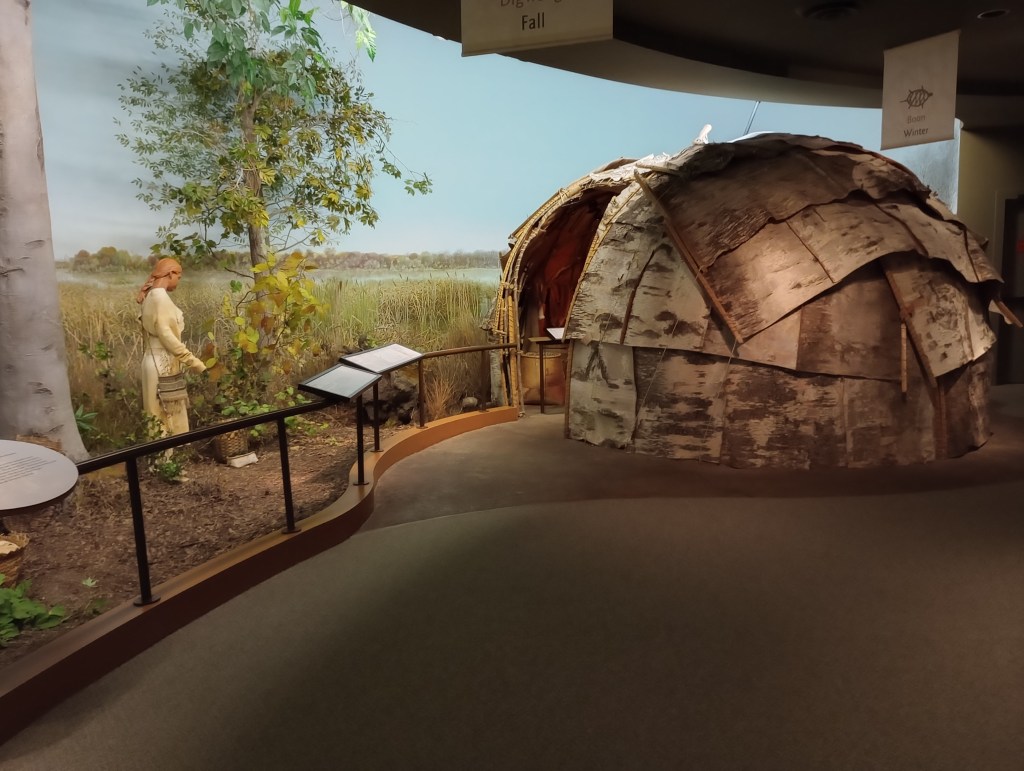
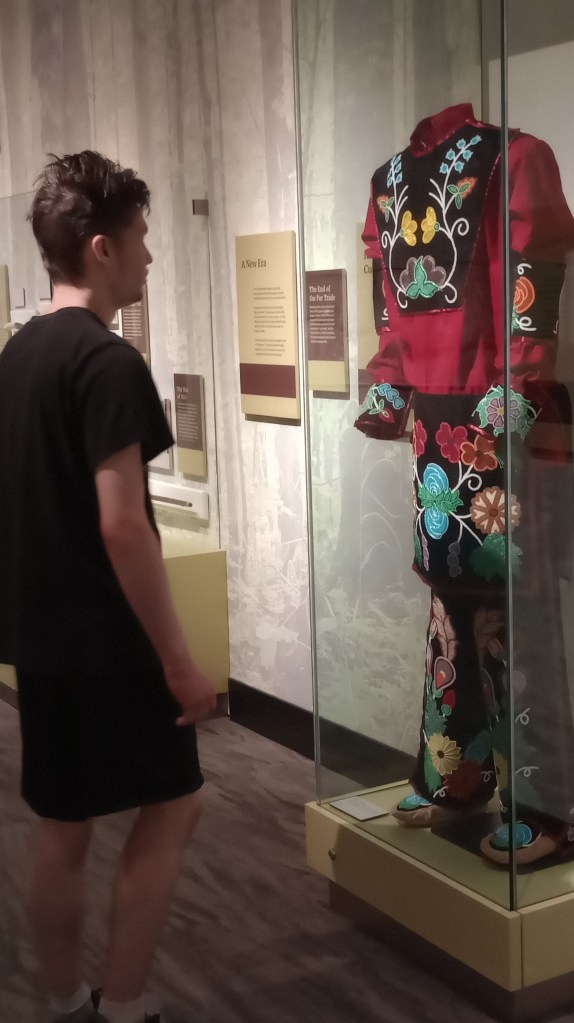
Austin is 17 and likes history and museums. We enjoyed three different locations on a wide range of topics. The first was to the Ziibiwing Center of Anishinabek Culture and Lifestyle. The museum has 15 areas in their permanent exhibit area about the Saginaw Chippewa Indians. It was interesting to learn about the Chippewa way of life and the oppressive things done to their culture over the centuries. Austin expressed disgust at the horrible ways Native American people were treated in the past.

Austin suggested the Michigan Heroes Museum in Frankenmuth. This very interesting and unique spot opened in 1987, focusing on Michigan’s military and space heroes. It covers ten wars dating back to the Civil War, ending with Operation Enduring Freedom in Afghanistan and Operation Iraqi Freedom in Iraq. There are more than 900 Michigan veterans featured in exhibits.

The information is beautifully displayed in individual showcases about each person and includes some of their personal items. Three permanent galleries are dedicated to Michigan Astronauts and Space Pioneers, Service Cross Recipients, and the nation’s largest collection of Medals of Honor. When viewing a showcase that deals depicts how the Nazis destroyed the lives of innocent people, Austin commented on the horrible way the Nazis behaved. His comments made it apparent he had likely studied this subject in school.

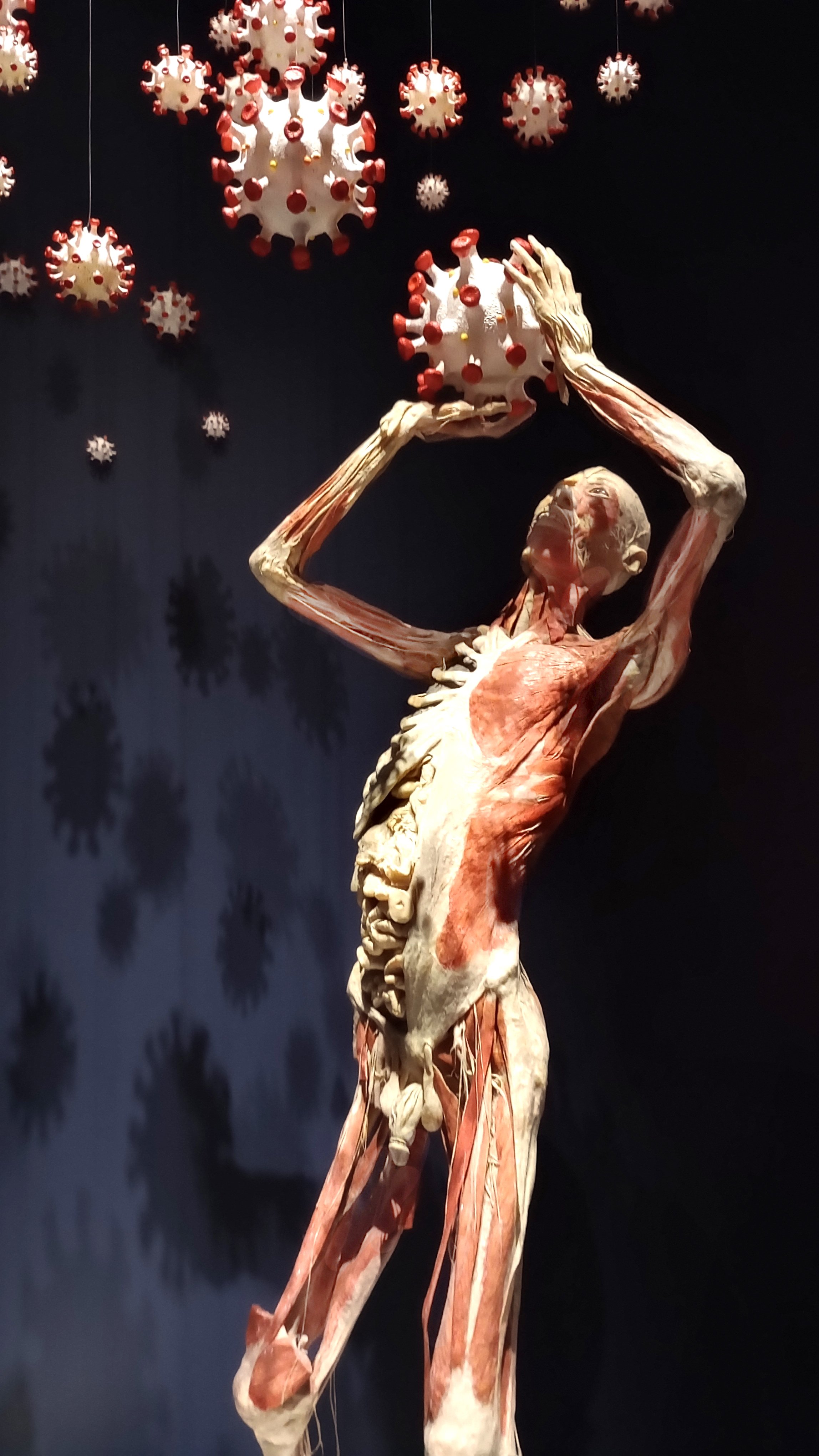
Austin’s third outing was to the Longway Planetarium and Sloan Museum of Discovery. We were early for our planetarium show and mentioned it when I was purchasing a book in their gift shop. It was pouring rain outside, so the cashier gave us complimentary tickets to the show before ours. It was a different topic than the one we had purchased, and it was interesting. Sloan Museum is a hands-on learning experience. Austin is aging out of the museum but enjoyed the activities and suggested we go to the Real Bodies special exhibit. 

Presented by Hurley Medical Center, Real Bodies contains real human specimens preserved to show how the human body works. This is more than skeletons; it includes muscles, lungs, heart, and more in beautiful exhibits. I highly recommend this exhibit, but only cell phone photography is allowed.

In touring the museums with Austin, it was interesting how much information he has absorbed about history from school or the reading he enjoys doing on his own. I was also surprised at his interest in the military, as I had not been aware of that.

ALEXANDRIA (Alex) is 8 and a girly girl, talkative and opinionated tomboy. This is why she has such a wide range of activities. We went to Day Escape and Spa for mani-pedis, her first. The salon enjoyed Alex because she was inquisitive and knew what she wanted. They said many of the young girls that come in won’t respond to their questions. Alex was stepping forward, voicing her desires. We walked into the pedicure room, and her tech asked if she wanted to select from a shelf that had mermaid polish on it. Alex looked at the display and said, uh, no, and turned to a large display of available polish. She pointed to three different colors she wanted; she made a different selection for her fingernails.

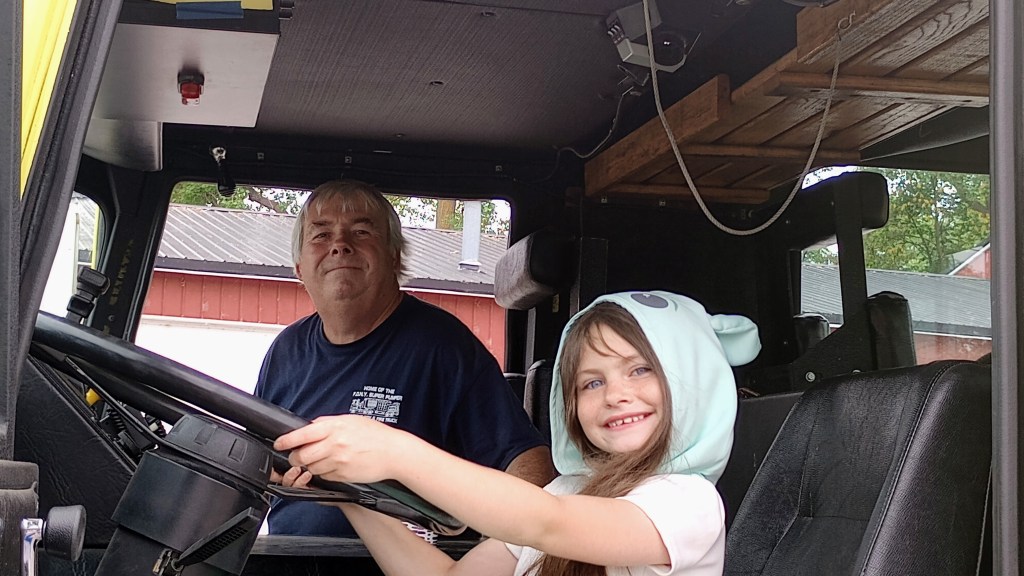
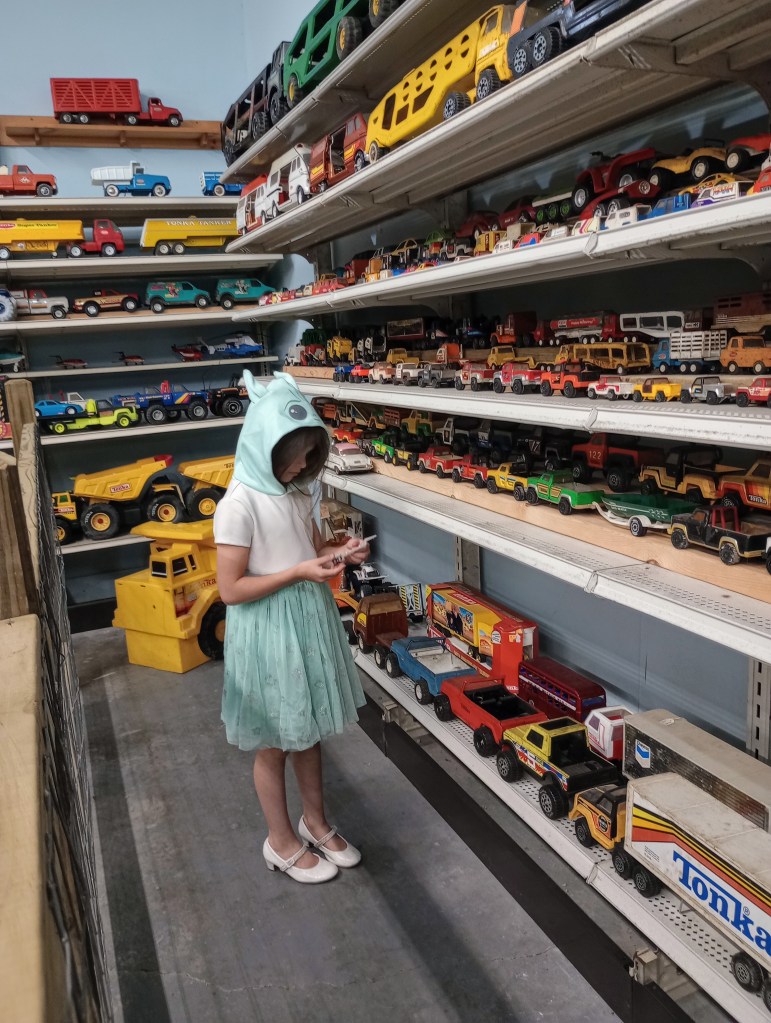
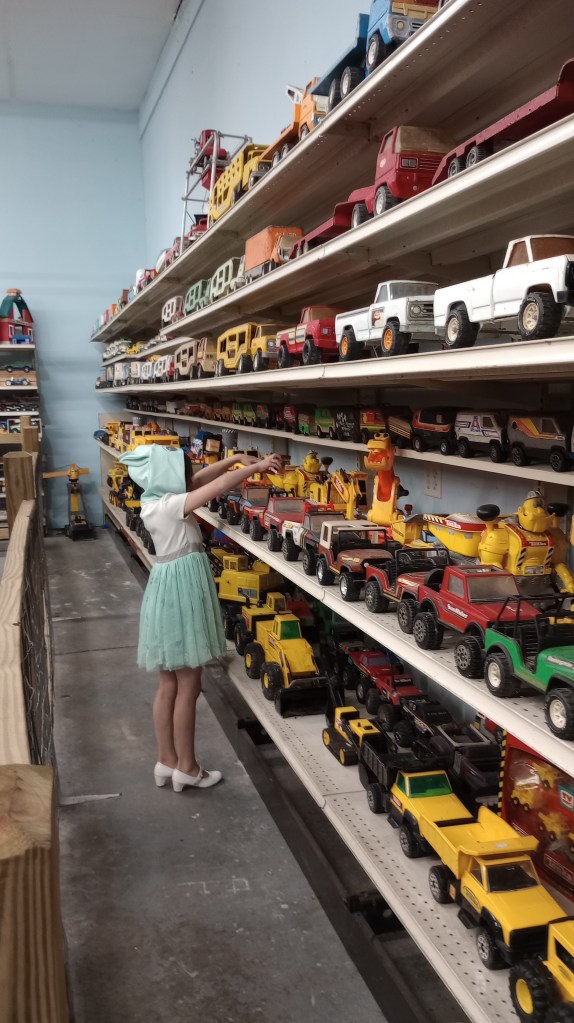
I was surprised when Alexandria selected the Antique Toy and Firehouse Museum for one of her outings. I had put that on Corbin’s list of possibilities because he has always liked vehicles, but he passed on the option. The museum has more than 60 motorized firetrucks, the largest collection in the world, and includes the FDNY Super Pumper, considered the T-Rex of fire engines. They also have over 12,000 antique and collectible toys.

Alex wore a dress and heels, catching the eye of museum docent Dave by asking him a question. Dave toured us through the museum, letting her into a gated area where antique toys were on shelves, encouraged her to climb up into all the firetrucks, which were labeled “do not climb, and told her when she was done looking around, she was going to drive a real firetruck—which she did!  Alex drove a 38-foot firetruck with me in the passenger seat; Alex sat on Dave’s lap in the driver’s seat. We went around a rural block twice, with her turning the steering wheel and blowing the air horn when she saw people. I asked Dave how often they take kids out like that, and he said never; Alex is the only one. Definitely a once in a once-in-a-lifetime, memorable experience.

Alex selected Valley Lanes for one of her outings. Given the age difference between her and Corbin, the selection of games she made was different, and we had a lot of fun. Alex wanted to play miniature golf, which was an interesting 18 holes. I attempted to keep score, but I’m not sure if all the swings one of us took got counted.

I also took each of the kids for their own day of lunch and shopping for a few school outfits. Austin was in and out of the dressing room on his own, and other than showing me one outfit, he pretty much just told me whether they fit or not. It was hard shopping for Corbin as he has definite likes and dislikes, and the majority of clothes in his size were in his dislike category. Alexandria is very opinionated about what she likes. The only problem is her taste is in the older-looking girls’ section, but she is tiny and still wears little girl sizes for most things. She enjoyed trying on clothes, and it was like a modeling show as she posed for me to photograph each outfit.

In addition to my individual outings with the kids, we had a couple family outings. These were harder to fit in because Caroline works 6-7 days a week. We did manage to coordinate an outing with all three kids to Bronner’s Christmas Wonderland in Frankenmuth. Bronners is the world’s largest year-round Christmas store, covering 2.2 acres plus 27 acres of landscaped grounds. If you are ever in Frankenmuth, Michigan, this is a must-see.

We also went on the Bavarian Belle Riverboat cruise. This is a one-hour cruise down the Cass River on a stern-driven paddlewheel riverboat and includes narration about the history of Frankenmuth. After the cruise, we shopped our way back through River Plaza to the car.

Another family outing was to the Children’s Zoo in Saginaw. Opened in 1929, this small zoo covers only 10 acres but has some interesting displays and over 150 animals. It’s a perfect spot for those who want to visit a zoo that doesn’t require a full day and miles of walking. We finished up with a late lunch at Saginaw Old Town Junction, where the kids wanted to sit upstairs with an overlook of the floor below. The food was good, and I shouldn’t have been surprised when Austin ate a half-pound hamburger with fries and then finished his sister’s fries. I forgot how much teen boys can consume!

We enjoyed visiting the Clare Historical Museum complex, which includes a museum, historic log home, blacksmith shop, and historical school. It was amazing how small the homes were where people raised many children. Entire homes were smaller than the family room in many of today’s houses. Ringing the school bell was comical, as Alexandria is so lightweight that the cord pulled her up off the floor as it rang. This is an off-the-beaten-path museum that is interesting and well worth the trip.

The final get-together with the family was a buffet meal at Ponderosa Steak House in Clare, which ended way too soon. It was a fun summer, and I always look forward to spending time with the kids.

I don’t miss the Michigan winters—I winter in Yuma, Arizona—but I miss the days when I lived a mile from the kids and had them at my house frequently. They grow up quickly!

Leave a comment

Filed under Activities, children, Discoveries, education, events, Family, grandchildren, kids, Life is a Melting Pot, Michigan, play, summer, tourism, travel, vacation

What Makes a Reader?

A recent conversation with three children ages seven, eight, and 16 made me wonder what makes some people like reading when others don’t. I used to think it was parental influence, but that doesn’t hold true because kids from the same family can have different preferences.

I considered whether children who struggled in school with the language arts became non-readers and those who grasped those subjects easily became avid readers. That also isn’t true. I know people who were strong language arts students but are non-readers and people who struggled in school but enjoy reading.  

With no scientific studies to support or deny my theory, I decided it must be related to a person’s desire to escape reality—readers of fiction and fantasy or a thirst for knowledge—non-fiction and historical readers. Some memorial readers have compassion for learning about the struggles and accomplishments of others. 

In coming to this theory, I looked mainly at my reading habits and then considered those of others. I realized that what a person absorbs from reading impacts how they think, sometimes for a lifetime.

We read books to find out who we are. What other people, real or imaginary, do and thin and feel...is an essential guide to our understanding of what we ourselves are and may become.  Ursula K. LeGuin

The Pew Research Center interviewed people who had read a book in the prior 12-month period. Their interviews revealed that 26% enjoy learning, gaining knowledge, and discovering information. The pleasure of escaping reality and becoming immersed in another world was the reason 15% gave.

Other reasons, in lesser amounts, include relaxation, the variety of topics they can find, spiritual enrichment, the mental challenge of reading, and the physical properties of a book—the feel and smell. I can relate to the last one because I like the look and feel of a book in my hands rather than reading on a device.

The Pew Research findings are comparable to my theory. An article on ReadingWise, What Impact Can Reading Have on Personality? comports with my view that reading books can impact personality. People, especially children, gather life experiences through the books they select. They learn about other cultures, personalities, social classes, gender, etc. This learning can make them more empathetic toward people who are different from them.

Not only does reading impact the child, teen, or young adult’s personality and social skills, but it can also influence what they select as their career, activities they participate in as an adult, and how they view home life. Some books I read as a child, teen, and young adult influenced the genres I read now, what is important to me as an adult, some career choices, and how I view some controversial topics.

Nancy Drew Mysteries by Carolyn Keene were written for female readers between the third and sixth grades. As a child, I read this series, borrowing from the local library and devouring several a week. As an 18-year-old teen detective in the 1930s, Nancy’s ability to sleuth out the answer to different occurrences at a time when women didn’t hold careers in such “dangerous” situations was intriguing. Her independence and bravery probably inspired many females to surpass the gender-expected roles.

I enjoyed reading these books, trying to figure out the mystery along with Nancy, and it created in me a lifetime love of mysteries and crime stories. It also inspired my love of conducting research.

Making a tremendous impact on my viewpoint regarding abortion is My Darling, My Hamburger by Paul Zindel. Published in 1969, the young adult novel covers four teenage friends, romance, the decision to engage in sex, contraception, loneliness, and communication. When Liz becomes pregnant, her boyfriend speaks to his father and then gives her $300 to get what at that time was called a back-door abortion. Abortions were illegal, so the medical care was less than pristine, with procedures done on the sly. This often led to complications or death.

In the book, Liz starts bleeding profusely during the car ride home from her abortion. The entire scenario impacts not only the girl who endured this horrific illegal abortion but also destroyed the friendship group.

Reading this book as a young teen impacted my viewpoint on abortion for life. As an adult, I have always been pro-life but also pro-choice. I believe that a person, especially under circumstances such as sexual abuse of a child or an adult rape, deserves the right to decide whether to abort during the first trimester of the pregnancy.

The only thing that has changed in my mind over time is due to advancements in medical technology. I do not condone aborting a pregnancy when the child can sustain life outside the womb.

True Crime and/or True Detective magazines were in our home, belonging to my parents. As a child, I loved devouring these magazines full of true crime stories. While they were probably not the best reading material for someone so young, they influenced my preference for true crime and legal books.

Agatha Christie is a well-known mystery writer, and as I outgrew the Nancy Drew books, books by this author became a favorite selection. During this same time, I also enjoyed Alfred Hitchcock’s writingsI primarily read fiction during my early-mid teen years, and these were my primary focus.

Harriet Tubman and the Underground Railroad is a title I remember ordering from Scholastic and reading in elementary school. This non-fiction book influenced my future love of non-fiction and interest in reading about the oppression of enslaved people and blacks.

Black Like Me is a non-fiction/memoir written in 1961 by journalist John Howard Griffin. Griffin, a white man, had his skin temporarily darkened and traveled to the Deep South to learn what it was like to live under the terms of segregation. It was amazing how he was treated very differently when living as a black man vs. how he was treated after allowing his skin to lighten and was again regarded as white. It is a real eye-opener on how badly people judge others based on the color of their skin.

Sybil was published in 1973, and I read it around age 13 following its release. This is the true story of a female being treated for dissociative identity disorder. Sybil had 16 separate personalities, likely developed as a coping mechanism due to severe physical and sexual abuse by her parents. This book influenced my opposition to child abuse, and in high school, I did a term paper on abuse.

F. Lee Bailey wrote The Defense Never Rests in 1971, and I read it as a young teen shortly after publication. F. Lee Bailey was a well-known criminal defense attorney, representing clients such as Albert DeSalvo (the Boston Strangler) and Patty Hearst. In the book, he discusses many of the cases he defended. This book impacted my interest in the law and helping criminal defendants.  

It is not enough to simply teach children to read; we have to give them something worth reading. Something that will stretch their imaginations - that will help them make sense of their own lives and encourage them to reach out toward people whose lives are quite different from their own.  Katherine Paterson.

There are many others, but these immediately came to mind when I thought about books from my youth. Those I remember after over fifty years most likely influenced my outlook on life. What is their impact on my life?

I was a community opinion columnist for The Times Herald in Port Huron for several years, expressing my opinion on controversial issues. I am currently working on a book about CPS taking my granddaughters and adopting them out to strangers rather than my husband and me. I have given testimony before legislative committees regarding the problems with the Michigan sex offender registry, and I went back to school in my 50s and became a paralegal. I am now considering becoming a CASA (Court Appointed Special Advocate), which means advocating for children who are in foster care.

My reading is almost 100% memoir and non-fiction. I live and travel full-time in an RV and buy books from the areas I visit. Learning about the history of places I visit is enjoyable.

What do you read? Did what you read as a child and teen influence your life choices? Share your thoughts below.

Leave a comment

Filed under assumptions, career, children, decisions, Discoveries, education, exploration, impressions, Life is a Melting Pot

What Is Professional Photography?

I recently visited the Real Bodies special exhibit by Hurley Medical Center at the Sloan Museum in Flint, Michigan. The sign said no professional photography, which means personal use only. I started through the exhibit, and after taking a few pictures, a worker told me no professional photos. I responded no problem, personal use only. She then said I couldn’t use my DSLR camera, only my cell phone. Their position was that my Nikon D750 camera designated the photos as professional, and I couldn’t use it. When I told them that is discriminatory because I use that camera for personal photography, I was told that is their policy. 

 What is wrong with this? The photographer’s knowledge of photography combined with the way the photographs are being used designates them as professional images. The type of camera is, to a certain degree, irrelevant.

To achieve professional quality, you must understand the basics of composition, depth of field, clarity, and lighting. You can achieve professional-quality images by utilizing all your cell phone camera features. You can also produce low-quality photos with a high-end DSLR if you don’t understand how to use your camera and the rules of photography.

The photo on the left is a before shot taken with my cell phone using the standard default camera settings inside the Real Bodies exhibit at Sloan Museum. The photo on the right is after editing in Photoshop to lighten the heavy shadows caused by exhibit lighting.

The problem I ran into at the Sloan Museum is one I have encountered elsewhere, as have other DSLR camera users. I planned to tour the Van Hoosen Farm Museum in Rochester, Michigan. The sign said admission was $5.00, but the clerk told me it would be $50 to enter. When I pointed out the $5.00 entry fee, she told me I had to pay a $50 professional fee because I was carrying a professional camera—I had my DSLR. I have used SLR cameras since the early 1980s and did no professional shooting at that time.  The girl told me to pay $50, or I wouldn’t get in. I walked out the door.

There is one place in Michigan that got it right. There was no camera discrimination when attending the Blue Water Sandfest in Port Huron. This organization understands professional photography; they posted notices that if you plan to use any photographs professionally, you must have written permission and follow their publication guidelines. This company understands the photographer, and their usage of the images makes it professional photography, not the camera style.

So how do you determine who is a professional photographer? Having a good camera is not the determining factor. Most professional photographers use a DSLR around clients because people think the camera makes a person a professional. However, in a recent survey by Suite48Analytics, 13% of professional photographers say they take at least 50% of their work-related photographs using a smartphone, 24% use it to take less than half of all professional pictures, and 31% use their cell phones more for professional photography than in prior years. The only limitation a modern cell phone has is resolution. If printing the photographs in a large format, a cell phone isn’t going to meet quality standards. Cell phone quality is sufficient if images are only for online or small format use.

The before photo on the left was taken with my cell phone using standard default camera settings inside the Real Bodies exhibit in the Sloan Museum. To achieve the photo on the right, I edited the picture in Photoshop to lighten the shaded areas created by the exhibit lighting.

So what determines whether a person is a professional photographer? It depends on what standards you use. The most common determining factor is whether the person earns between 50% to 100% of their income from photography. In other words, to be a professional, photography is your full-time career. By that definition, I am not a professional photographer.

Another manner of determining whether or not a person is a professional is whether or not they have accomplished at least one of the following:

  • Has given a photography presentation
  • Has received recognition in a national photography contest
  • Has sold their photographs in an art show or art studio
  • Has a website displaying photographs for sale
  • Has organized or directed a photography field trip
  • Has published photographs in newspapers, magazines, or books

I qualify as a professional if you use this second group of criteria. You may wonder why, if I qualify as a professional, the policy against using a DSLR camera bothers me. The reason is the policy discriminates against anyone using a good camera. The policy should be based on how the photo is used after creation.

The worker at the Real Bodies exhibit told me I can use my cell phone photographs in any manner I choose. I said, “So I can use them on Facebook, blogs, or other writings?” She said yes because they aren’t professional photographs.

Now a legal question comes to mind. Since I took “unprofessional” photos with my cell phone, can I use them to accompany a magazine or newspaper article? According to the worker, I can. I don’t think that is what Hurley Medical Center’s intent is, but that is the message being given because of inappropriate wording on their signage and poorly informed workers.

The problem is that Sloan Museum and Hurley Medical Center assume a professional photographer cannot get a quality image from a cell phone. A professional-quality photograph from a phone is easy when you adjust the camera settings. Sloan Museum/Hurley Medical Center, Van Hoosen Museum, and other places that want to prevent the professional use of photographs should display signage that photography is for personal use only and not for professional purposes. They could also state that for professional use, written permission is necessary.

 The above before and after photos were taken in the Real Bodies exhibit at Sloan Museum. The image on the left shows a distracting acrylic display case and reflections that detract from the subject of the photo. The image on the right is after editing in Photoshop to remove the reflection and case, allowing the subject of the photo to stand out.

What is a professional photograph? It is an image being used for business, marketing, available for sale, or used to accompany articles written for magazines, newspapers, etc. In other words, the photographer aims to generate profit with the photo.

The bottom line is that businesses must understand the difference between camera style and professional usage. A lack of understanding may lead to people using images in an unintended manner.

Those hiring a professional photographer need to understand the difference between a person with an expensive-looking camera shooting in automatic/jpeg format and a professional. Professionals know how to produce an image that stands out and process it using Lightroom, Photoshop, or another pro-level image editing system to tweak it into the best photograph possible.

If you want to take good photographs, learn the basics of composition, lighting, depth of field, and exposure, plus how to use your camera to achieve the desired results. Purchasing an expensive camera will not help you take better pictures. If you buy a DSLR and leave it in the “auto” setting, you might as well use an inexpensive point-and-shoot or cell phone. If you invest in a DSLR, learn to shoot manually, preferably in raw, and edit in Photoshop for the best quality image.

2 Comments

Filed under assumptions, employment, hobbies, Life is a Melting Pot, Michigan, Photography, work

How Wedding Traditions Came to Exist

An average of 2.4 million weddings occur in the U.S. annually, or about 5,000 per day. When planning a wedding, most couples incorporate several traditions, including a wedding shower, an engagement party, the father giving away the bride, tossing the bouquet, going on a honeymoon, and more.

Have you ever wondered how these traditions came to be? I was surprised to learn that many derive from superstition, monetary transactions, and the transfer of female ownership. Once I started reading about these traditions, I wanted to know more. The list is long, so I’ve made it easy to skim down and find the practices you are curious about. I hope you end up like me, wanting to learn about them all.

Engagement Party— In ancient Greece, the engagement party was a financial contract between the bride’s father and the man she would be marrying. The bride was not present during the business agreement. An ordinary party was held by the bride-to-be’s father, during which the bride’s father would announce his daughter’s engagement to everyone in attendance. The bride was often just as surprised as the guests to learn she was to be married. Marriages were not based on love until the late 1700s, and even after that time, arranged marriages continued. In some cultures, they still exist today.

Dowry—The original purpose of a dowry was for the groom to compensate the bride’s family for losing her labor and reproductive potential. Sometime before the Ancient Roman period, the custom reversed, with the bride’s family giving a dowry to the new husband’s family to help support her and the expense of setting up a new household. It is believed that the modern tradition of the bride’s family paying for the bulk of the wedding is an evolved practice that replaces the dowry system.

Engagement Ring—This tradition goes back to ancient Rome, when women would wear a ring of bone, copper, flint, iron, or ivory to signify a business contract or that an affirmation of love and obedience had been made. This was derived from the ancient Egyptian practice of using a ring of hemp or reeds to signify eternity.

It was in 850 CE when the official purpose of an engagement ring was introduced by Pope Nicholas I. He declared the ring to represent a man’s intent to marry. Although rings adorned with diamonds were not popular until the 1940s, the first diamond appeared on an engagement ring in 1477. That is when the Archduke Maximilian of Austria proposed to Mary of Burgundy with a stone setting in the shape of the letter M.

In the 15th Century, gimmel rings served the purpose of engagement. This set of three rings was used, with the bride and groom each wearing one ring during the engagement. On the wedding day, the two bands were connected with the third, and all were worn by the bride as her wedding set.

Diamond engagement rings became popular and ornate during Victorian times because of Queen Victoria’s love of diamond jewelry. Although diamond engagement rings have been in the U.S. since 1840, they did not gain popularity until 1947. That is when the British company, De Beers, was mining diamonds in South Africa and launched an advertising campaign, “A diamond is forever.” This sales ploy skyrocketed diamond sales for wedding engagement rings.

Bachelor Party—The bachelor party dates to the 5th century B.C. when ancient Spartans devised a celebration of the groom’s last night as a single man. The term bachelor meant a young knight or student with a bachelor’s degree and first appeared in Canterbury Tales in the 14th century.

The term bachelor party was first used in 1922 in a Scottish publication, meaning a “jolly old party.” The modern parties were traditionally black-tie dinners hosted by the groom’s father to honor and toast the groom. They did not become the current parties of beer, strippers, and drugs until the 1980s.

Popular Saying—The traditional saying about what a bride must wear on her wedding day is based on a 19th-century Old English rhyme in Lancashire. There is a reason behind each item in the phrase:

Something old— traditionally a personal gift from the bride’s mother, usually symbolizing wisdom for married life.

Something new—symbolizes the establishment of a new family created by the marital union.

Something borrowed—by borrowing something from a happily married woman, the bride is borrowing marital bliss to carry into her new union.

Something blue—The robes of pagan Roman maidens had blue trim on their borders, symbolizing modesty, fidelity, and love. For Christians, blue symbolizes the purity of the Virgin Mary.

And a sixpence for your shoe—often left out of the rhyme, and the British coin is no longer in production. The purpose was to bring prosperity to the newlyweds. 

Bridal Gift Registry—This was started by a Marshall Field’s store in Chicago in 1924. It was a marketing pitch that allowed brides to select their fine china and silver for the big day. This successful advertising campaign soon gained popularity throughout the county, with many businesses expanding on the idea to include other items the newlyweds would need.

Bridal/Wedding Shower—Showers date back to 16th century Holland. The bridal shower is a dowry alternative that began when a bride’s father was too poor to provide a dowry. It was also held if the bride’s father opposed the union.

The tradition is based on a Dutch story about a high-society girl falling in love with a poor miller’s son. The girl’s family objected because of the miller’s low class, but she insisted on marrying him. The girl’s father said he would withhold her dowry as punishment for her refusal to marry the wealthy pig farmer he chose for her.

To help the couple in their misfortune, the bride’s friends showered her with gifts as a dowry substitute. Touched by the generosity of his daughter’s friends, the father finally agreed to the marriage. This began the tradition of a bride’s family and friends showering her with gifts before a wedding.

Bridal showers grew in popularity in the U.S. during the late Victorian era. Upper-class society ladies saw them as an opportunity to celebrate, gossip, and exchange gifts, thoughts, and food for the bride-to-be. Gifts were usually modest, simple, useful household goods the bride would need in her new home, including bed linens, kitchen items, China, and more. By the 1930s, the tradition had extended to middle and lower-class families.

A bridal shower is thrown for the bride and traditionally attended only by females. A wedding shower is a modern version of the shower. It is thrown for the couple and includes the groom in the party and opening of gifts. Guests may also be mixed gender.

Rehearsal Dinner—The dinner may be an evolution of an event that occurred hundreds of years ago when attending a wedding meant days of travel. The night before the wedding, the manor house, castle, hut, or tent would be packed with friends, relatives, and emissaries needing to be fed. Out of necessity, a meal would be held the night before the wedding. This was also wrapped in superstition. The belief was that if those attending the dinner were loud and rambunctious, they would scare away evil spirits trying to destroy the couple’s chance of having a happy life.

Today the rehearsal dinner follows the wedding rehearsal. I couldn’t find anything about when wedding rehearsals began, which appears to be strictly an American tradition. Rehearsals may have begun as wedding parties grew, allowing everyone to become familiar with exactly what would occur during the ceremony to hopefully prevent any glitches.

Not Seeing the Bride Before the Wedding—Before the 18th century, pre-arranged marriages were common. It was considered unlucky for a bride and groom to see each other before the wedding because the groom might back out of the arrangement if he saw the bride-to-be and didn’t like her appearance. This is also one reason for the veil.  

Bridal Veil—The veil establishes that a woman is spoken for and disguises the bride so evil spirits wishing to harm the couple will not recognize the bride. It also was a way of securing the marriage contract. Many brides and grooms met for the first time on their wedding day at the altar. The veil was only lifted after the ceremony, so the groom could not back out of the wedding if he didn’t like his wife’s appearance.  

Giving Away the Bride—This practice dates back to when women were the property of men.  Women were unable to live independently of men, could not own property, have a job, or inherit money. They belonged first to their fathers, then their husbands, and if their husband died, their sons.

By walking his daughter down the aisle and giving her in marriage, the father transferred ownership of his daughter to her new husband. This dates back to when an engagement was a business transaction, not an act of love between two people. By being at the wedding ceremony and presenting his daughter in marriage, the father ensured the wedding would take place, fulfilling his part of the agreement.

Wedding Ceremony and Vows— God established marriage in the garden with Adam and Eve based on a covenant promise in Genesis 2:24, which defines marriage as joining two into one. The traditional wedding vows we are familiar with are not in the bible but are based on biblical principles.

The first recorded evidence of a marriage ceremony uniting a man and woman is around 2350 B.C. in Mesopotamia. Over several hundreds of years, marriage evolved into an accepted union by Romans, Greeks, and Hebrews. The primary purpose was to bind women to men, guaranteeing that a man’s children were his biological heirs. The father would hand over his daughter and say, “I pledge my daughter for the purpose of producing legitimate offspring.” If a wife failed to produce offspring, her husband could give her back and marry someone else.

The first mention of marriage vows was in a prayer book from the Medieval Church in England, written in 1549. The book has marriage vow examples that modern vows have incorporated. If you would like to learn more about the different areas of traditional wedding vows and where in the bible they stem from, check out this article on Wedding Wire.

Wedding Rings—Ancient Egyptians were the first to exchange rings made of braided reeds and hemp. They placed them on the fourth finger of the left hand because of their belief that a ‘vein of love’ ran from that finger to the heart. The circle of the ring also was symbolic of an endless circle of eternal love with no end, the promise of bonding forever.

Ancient Romans and Greeks wore rings of ivory, bone, or leather. Wealthy people began creating rings of gold and silver for their marriage commitments. Romans believed the left hand to be unholy and untrustworthy, so they placed their wedding rings on the right hand. The right hand serves as a symbol of loyalty, honor, and trust. Today there are about 20 countries where married couples place their rings on the right hand.

The first diamond wedding ring was recorded in the will of a widow who died in 1417. The oldest surviving diamond ring is from the late 100s CE in Rome when diamonds were valued for their harness rather than brilliance.

Men’s Wedding Rings—Wedding rings for men didn’t become popular until WWII. It was then soldiers wore them as a way to remember their wives back home. Many of the weddings in 1942 were quick, taking place within a week of the announcement because of a soldier being deployed.

The tradition of soldiers wearing wedding rings continued through the Korean War. The practice eventually caught on for non-soldiers as well.

Bridal Party—While the purpose of the bride and groom is clear, why do we have all the other members of the bridal party? What was their original purpose?

BridesmaidsIn ancient Rome, bridesmaids protected the bride. They would all wear the same dress as the bride to confuse evil spirits and prevent them from finding the bride. This prevented the couple from being cursed on their wedding day. Roman law also required ten witnesses to every wedding, so there would be five bridesmaids and five groomsmen.

GroomsmenDerived from an ancient tradition of kidnapping a bride, a man would employ his friends to help him fight other warriors and prevent the bride’s family from finding the couple. Because weddings were a business transaction rather than a union of love, the groom needed an excellent swordsman to retrieve a runaway bride or fend off a bride’s angry family not approving the marriage. The term Best Man referred to the quality of a man’s swordsmanship, and the groom’s main warrior companion was the equivalent of today’s best man. 

Flower GirlIn ancient Rome, a young virgin would carry sheaths of wheat, believed to bring well-being and good fortune to a newly married couple. Over time the sheaths of wheat were replaced by flowers scattered along the bride’s path to the altar.

Ring BearerIn Victorian times, a pageboy would carry the bride’s train down the aisle, along with a prayer book. During this time, Victorians began displaying the ring on a small pillow to show their wealth. Pillows were expensive, luxury items that only the elite members of society could afford. Over time, the pageboy carried the ring pillow down the aisle. That tradition evolved into today’s ring bearer.

Witnesses to the Wedding—Ancient Roman law required ten witnesses to be present at a wedding. At that time, the legal witnesses were all men, but the bride was also escorted by female attendants. Not only did witnesses watch the marriage ceremony, but they also witnessed the consummation of the couple on their wedding night.

Yes, the newlyweds had sex in the presence of witnesses. This was usually done with the bed curtains closed and the observers on the room’s outer edges. If the marriage was not consummated, it could be declared null and void, and the couple granted an annulment. The witnesses were present to confirm the couple had sex, forming an unbreakable union. In modern times, witnesses only have to sign a marriage license as confirmation that a couple has legally married.

Unity Candle – The unity candle became popular in the second half of the 20th century in American Christian weddings. This is attributed to a 1981 General Hospital episode where a couple used a unity candle. The candle symbolizes the merging of two individuals, creating a blended family.

Sealed With a Kiss—This tradition began in Ancient Rome when marriage was a contract. Instead of signing your name, you confirmed your commitment to the agreement with a kiss. It was believed that by binding the marriage with a kiss, the couple exchanged spirits, sending part of themselves into their spouse, binding them as one. 

Bridal Bouquet—Ancient Greeks and Romans carried aromatic herbs, garlic, and grains to drive away evil spirits and bad luck during the wedding. Floral garlands the bride and groom wore symbolized a new beginning and hopes of fertility, fidelity, and happiness. Some bouquets included rosemary for loyalty, wheat for fertility, ivy for an unbreakable bond, heather, thistle, thyme, or basil for protection, and dill as an aphrodisiac. Carrying aromatic flowers was also a way for brides to mask their body odor before frequent bathing was practiced.

Bouquet Toss—Tossing of the bridal bouquet dates back to 14th century England when unmarried women tried to rip off pieces of a bride’s dress or flowers to gain some of her good luck, hoping to become the next one married. The bride would toss her bouquet into the crowd and run for safety to prevent being mobbed. 

By the 1800s tossing the bouquet became a wedding tradition, with single women wanting to catch the bouquet as a sign of good luck for their future marriage. At that time, marriage was the only way a woman could bring her family out of poverty.

Garter Toss—Garters were originally a necessity, holding up the stockings of both men and women. The toss dates back to the same safety problem in England and France when guests would try to rip off a piece of the bride’s clothing for luck. To protect his bride, the groom would take his new wife’s garter and throw it out into the crowd, and the couple would escape.

Receiving Line—I couldn’t find any information on when this practice began and assume it was a tradition before wedding receptions were a standard part of weddings. The receiving line immediately after a wedding is the couple’s first opportunity to “receive” guests as a married couple. The line usually includes the bride and groom, their parents, and members of the wedding party. It provides each guest a moment with the newlyweds to offer congratulations. It also ensures that the couple can personally thank each of their guests for attending.

Reception—Wedding receptions were not frequently held until the early 1960s. Before that time, if a reception was held, it was usually a casual affair at the home of the bride’s parents with cake and punch.

Carry Bride Over Threshold— This tradition goes back to ancient Rome when the groom dragged a bride unwilling to leave her parent’s over the threshold of her new home.

In medieval Europe, it was believed that brides were vulnerable to the invasion of evil spirits through the soles of their feet. To protect his new wife, the groom would carry her through the front door.

Later, it was believed that if a bride tripped entering her new home, it would bring bad luck to the marriage. The groom carried his new wife across the threshold to prevent her from tripping.

Tying Cans to Car Bumper—This custom dates back to sixteenth-century France and early twentieth-century Appalachian customs. The idea is to harass newlyweds on their wedding night through a noisy celebration with friends and neighbors banging pots and pans, singing, and making noise outside the couple’s window.  Eventually, the newlyweds would invite everyone in for refreshments.  It is believed that tying cans to the back of a newly married couple’s vehicle is an adoption of the noisy shivaree.

Wedding Dances—Many wedding party dances are popular, and I wondered how they all came into existence.

The First Dance dates back to 17th-century Europe when formal balls were popular. It was customary for the guest of honor or person of the highest social status to lead the first dance. This led to the tradition of a married couple having their first dance at a wedding.

The dance is the couple’s first cooperative and joint endeavor, symbolizing the consummation of the wedding. Their manner of dance, expression, and steps reveal the harmony between the bride and groom.

The Father-Daughter Dance dates back to when marriages were arranged as a monetary contract rather than love. The father-daughter dance was a final demand of the bride’s father on his daughter before her husband became the most important man in her life. After the father-daughter dance, the bride could dance with her new husband, whom she had likely just met. 

In modern society, the father-daughter dance usually occurs after the bride and groom have first danced together. It now symbolizes the bride’s love and appreciation of her father.

The Mother-Son Dance is a modern addition to a wedding reception. It is comparable to the father-daughter dance and allows a groom to show his love and appreciation for his mother.

Bride Changing Last Name—The practice of a woman taking her husband’s last name dates back to the Middle Ages when societies were becoming organized. Under English common law, women were barely acknowledged and had no legal rights. The concept of coverture was the basis of a woman taking a man’s last name in marriage. Coverture was the legal status of a married woman. Because women had no legal identity, coverture placed them under their husband’s protection and identity.  

Women were under the control of their fathers and then their husbands. They had no legal ability to make contracts, own a business, or own property. They had no legal rights to their possessions, clothing, children, or their bodies, and marriage rape was legal. If their husbands sent them out to perform labor, the husband collected the wages.

Within the U.S., the first break in coverture took place under the Married Women’s Property Act of 1848. Over time that act underwent amendments so that women could eventually attend school, obtain driver’s licenses, work, and vote. It took a long time for women to gain rights. Women in the U.S. could not get a driver’s license, passport, or register to vote if they didn’t take their husband’s last name. Marital rape did not become illegal until the 1970s.

Though no longer legally bound to take their husband’s last name, about 70% of women follow the tradition. This makes it easy for a married couple and their offspring to show daily unity.

Wedding Cake—In ancient Rome, wheat cakes were broken over a bride’s head to promote fertility. It later became customary to stack the wheat cakes on top of each other, and the bride and groom were challenged to kiss over the tower without knocking it over. If successful, they would enjoy a life of good fortune.

In modern times, white cake symbolizes purity.  The joint task of the bride and groom cutting the cake represents their first joint task of married life, and feeding it to each other symbolizes the commitment they are making to each other.

Saving the top layer was originally for use at their future child’s christening. The bride was expected to be pregnant within the first year of marriage. The top layer is now used to celebrate the couple’s first marriage anniversary.

Tie The Knot—Handfasting dates back to ancient Celtic times and is a spiritual ritual of tying a bride’s and groom’s hands together during the wedding ceremony. The phrase “tying the knot” stems from binding the couple’s hands together during this ceremony with colored cords to symbolize their union of love.

For a three-cord handfasting, the colors of white for purity, blue for fidelity, and red for passion were braided together. Other colors include green for fertility and growth, purple for spiritual strength, and gold for wisdom.

The couple’s hands are not released until the marriage is complete. In modern times, a couple says their vows while bound together, then finish the ceremony with rings. Historically, the binding remained in place after the wedding ceremony, and the couple was escorted to the bedchamber to consummate their union. It was believed that if the couple survived the day bound together, they would survive their marriage together.

Throwing Rice—Marriage was traditionally seen as a way of building a family and increasing a person’s assets. Ancient Romans often threw wheat or oat seeds, which meant the birth of new life. The change to rice was likely because it was often available and low cost. Whichever grain was used, it symbolized fertility and prosperity. Tossing grain over newlyweds signified good luck and best wishes toward producing babies and good harvests.

Honeymoon—The term honeymoon dates back to the 5th century when the calendar was represented in moon cycles. After marriage, a couple would drink mead, an alcoholic beverage made from honey, during their first moon of marriage. Drinking the fermented honey liquor under the moon was believed to boost fertility and increase the odds of producing children early in the union.

The American honeymoon tradition dates back to 19th century Great Britain when relatives could not always attend the wedding. The newly married couple would travel by train and carriage to visit those unable to attend. This was called a bridal tour and often lasted for weeks or months.

Not Married? Be glad it isn’t 1860 to 1880 when the term Spinster was used to describe women who never married. During that time period, eleven percent of the American female population didn’t marry. This was probably because of the Civil War, which killed 600,000 men.  It was during this period that women began obtaining a college education. The male opinion was that a female college graduate would be a poor homemaker.

Were you surprised at how many traditions deal with monetary transactions, ownership of women, and superstition? Let me know what you think in the comments below.

1 Comment

Filed under celebration, events, Family, habit, impressions, Life is a Melting Pot, marriage, time

Looking Forward Means Looking Back

One of the downfalls of living and traveling full-time in an RV is only seeing my grandchildren once a year. While planning my 2023 travels and time in Michigan, I find my mind reminiscing back to the fun I had last summer with my grandchildren, Austin, Corbin, and Alexandria.

My 2022 visit was a fast-moving nine-day visit. I decided that because of the difference in their ages and interests and not having much time with them, it would be fun to do a couple of things together in the nine days I was there. I also wanted special one-on-one time so each child got their own day.

I took the three of them to a small, local railroad museum. The museum was interesting but didn’t hold their attention for long, so I suggested ice cream. I was surprised to learn Corbin doesn’t like ice cream, so he got a pop to drink instead. I thought it was cool when an Amish horse and buggy came down the street as we ate our ice cream at a picnic table.

When I commented on the horse and buggy, Corbin (age 12) informed me that the Amish do not believe in modern technology. To them seeing this is common, everyday stuff. I realized how much when I was on my way back to my campground and saw a horse and carriage tied up to a hitching post in front of Dollar General.

Alexandria (Alex)

Alexandria was the first to go solo, and her bubbly, social butterfly 7-year-old personality is always fun to watch. She is a girly girl, and that shines through when shopping for clothes. We went to the dressing room with six outfits to try on, and I told her we would buy two for school. That was a fantasy in my mind but turned out not reality.

After the try-on session, there was nothing Alex couldn’t wear, so I asked her which she wanted. She said she needed the grey flowered fleece pants and top because they are soft and warm. The yellow-flowered dress and leggings are necessary because it is bright and sunny. The third dress and leggings she wanted because it was cute. Oh, and by the way, Grandma, I need shoes. We were at Kohls and did go to the shoe department, but they didn’t have any in her size.

Here’s a comical side note—Alex recently informed her mom that she needed new shoes because when she went shopping with me, I wouldn’t buy her any! It has been seven months since I took her shopping. She never said anything to me about not getting them. Still, my daughter’s comment has me clued in about not making any mistakes this time because they will not be forgotten!

Alex selected McDonald’s for lunch, and she talked continuously through the entire meal. I had to tell her to stop talking and eat so we could get to the museum. The Mid-Michigan Children’s Museum is a fun, hands-on museum for kids 10 and under and has eleven galleries created around the school curriculum.

With everything from car driving, medical and dental areas, scientific activities, wall climbing, water activities, art center,  large tinker toy building, play kitchen area, play farm area, and more, she was on the go constantly. She took home artwork she made and a toy from the gift shop. We were there for about four hours and closed the place down.

Austin

Austin was 16, so his school shopping was in the young men’s department. I and several other mothers and grandmothers hung around the doorway of the men’s fitting room, checking on how the clothing looked on the teens trying on clothes for school. Heaven help the adult male who wants to try things on during school shopping season.

Austin got a couple of outfits for school, then selected McDonald’s for lunch. He is quieter, so conversation is at a minimum with him. After lunch, we went to the Castle Museum of Saginaw County History.

The museum has three levels of exhibits and displays, covering the Saginaw Sports Hall of Fame, lumbering, and automotive. There are some hands-on exhibits and many displays with informational cards to read. I’m sure there are things we missed or skimmed over when we were there. Their gift items are minimal, and Austin wasn’t interested in any of the items they had.

Corbin

Corbin, at age 12, loves astronomy, so I purchased tickets for a program at the Delta College Planetarium. We arrived a little early and explored the exhibits they had while waiting for the program to start. The program was interesting and designed for kids exploring space, but informative and interesting. The gift area had pencils and pencil toppers in an assortment of designs, so Corbin picked three sets for himself, then selected some for Austin and Alex.

After the program, we walked across the street to Wenonah Park, which displayed several flags. I was impressed that Corbin could list their origins; I didn’t know them. After spending a few minutes at the park, Corbin suggested we head to lunch—I guess he was hungry.

Corbin suggested Taco Bell, saying he thought I could use a break from McDonald’s. He was right, but I would have gladly gone if he suggested going there. As Corbin ate six cheese rollups, he got a huge thumbs up from me by saying, “People like us who aren’t fat can eat here.” I don’t meet the “not fat” classification, but it’s nice that Corbin views me that way.

After lunch, we went to Kohl’s, where we got him a couple of outfits for school. He was easy; he knew what he liked and wanted to wear.  The only dispute was when they didn’t have a character shirt in the right size, and he tried to convince me one that fit like a second skin was fine. I told him there was no way I was buying it in that size and that he would need to find something else.

Saying Goodbye

Paul and I met my cousin and her husband in Cadillac for lunch. Another day my daughter, Caroline, accompanied us on a trip to Traverse City, where we visited my grandparent’s farm, which is now Market 72, a public venue for events. We then met my other cousin and uncle for lunch.

The above is the farm of my paternal grandparents, Louise and Dominick King, built by my great-grandfather in 1918 on M-72 in Traverse City. You see the front and back of the house, the view of the barns from the back porch, and Caroline standing under weeping willow trees between the sideyard and one of the farming fields.

As my time came to an end, Paul and I went to dinner at Texas Roadhouse with my daughter, son-in-law, and three kids. The dinner was over too quickly. It was the last time I would see them for another year. I was moving the RV downstate to stay in Port Huron before heading south to Arizona. I took a few family photos of them and departed with sadness.

Austin, Rob, Caroline, Corbin, and Alexandria

Blake’s Family Day

After I left the Clare area and was in Port Huron, Caroline called and asked if I would like to attend Family Day at Blakes’s Big Red Apple in Macomb. My son-in-law has been working the Halloween weekends there for several years, so they always attend the employee family day. 

This was a fun outing, with a haunted hayride, a zombie paintball hayride (my son-in-law is a zombie), a 3-story haunted barn, a petting zoo, a pedal car track, and other activities. Of course, no trip to an apple orchard would be complete without purchasing apple cider, donuts, and caramel apples.

Alex leads the way, with Corbin and Austin following behind on the pedal vehicles. Corbin and Alex enjoy the bounce pads. Austin, Alexandria, and Corbin stand by the “How Tall This Fall?” display at Blake’s Big Red Apple.

And with that, my yearly visit with my grandchildren was officially over. Now I look forward to 2023 when I have booked a longer stay of six weeks in their area. I am looking forward to spending more time with them.

Leave a comment

Filed under children, Discoveries, events, Family, grandchildren, kids, Life is a Melting Pot, memoir, Michigan, play, summer, travel

Create a 2023 Success Plan

As we enter 2023, many people will be once again setting New Year’s resolutions. The problem is most of those resolutions are never met, and the list repeats itself year after year. Why is this?

A resolution is a firm decision to either do something or not do something. It is something that is resolved. Resolving means you are deciding to find a solution to a problem. The thought process that goes with the meaning of these words makes many people feel stressed. The terminology is more negative than positive.

I think you need to have the right mindset to accomplish what you set out to do. If you feel stress and negativity, you are already setting yourself up for failure.

Success is the measure of succeeding. It is a desired, favorable outcome. When someone sets a goal, they establish the end in which their efforts are directed. A plan is a method for achieving the end goal, the process you will use to succeed. This terminology has a positive tone to it.

Resolving to fix a problem does not motivate in the same way a plan to succeed at achieving a goal does. That is why I propose you tear up your list of resolutions and create a 2023 success plan.

Decide what you want to succeed at this year List small steps that lead you toward achieving your goal. Even if you don’t complete your task entirely, you can still check off the steps as you finish them. This shows accomplishments as you move toward succeeding at your goal.

Here’s to a successful 2023! Share your 2023 Success Plan below.

Leave a comment

Filed under assumptions, decisions, Life is a Melting Pot, mind