Category Archives: impressions
Why Didn’t the U.S. Adopt the Metric System? – Part 2 of a 3 Part Series

In Part 1, I explained how I became curious about the reasons the U.S. did not convert to the metric system at the same time Canada was making the change, leaving us as one of only three countries in the world that do not use the metric system of measurement. This section explains what Canada did to ensure it completed its commitment to switching from the Imperial to the Metric system during the late 1970s and early 1980s.

In January 1970, the “White Paper on Metric Conversion in Canada” established the Canadian government’s policy regarding its conversion to the metric system. The document specified that Canada would utilize a single, coherent measurement system based on metric units for all purposes. They then developed the “Weights and Measures Act” in 1971 to recognize the International System of Units (SI) for use in Canada. The “Consumer Packaging and Labeling Act” in 1971 required the use of the metric system on most consumer packaging labels.

The change from Imperial to Metric took time in Canada and began in the mid-1970s. I was a high school student in the United States and didn’t concern myself with what was going on in Canada. I do remember them telling us that we needed to learn the metric system because the country was changing to that form of measurement. I also recall that there were many objections to making the switch. We did incorporate some changes rather quickly, the main one being the switch to one- and two-liter bottles of soda. I don’t remember many other changes being made.

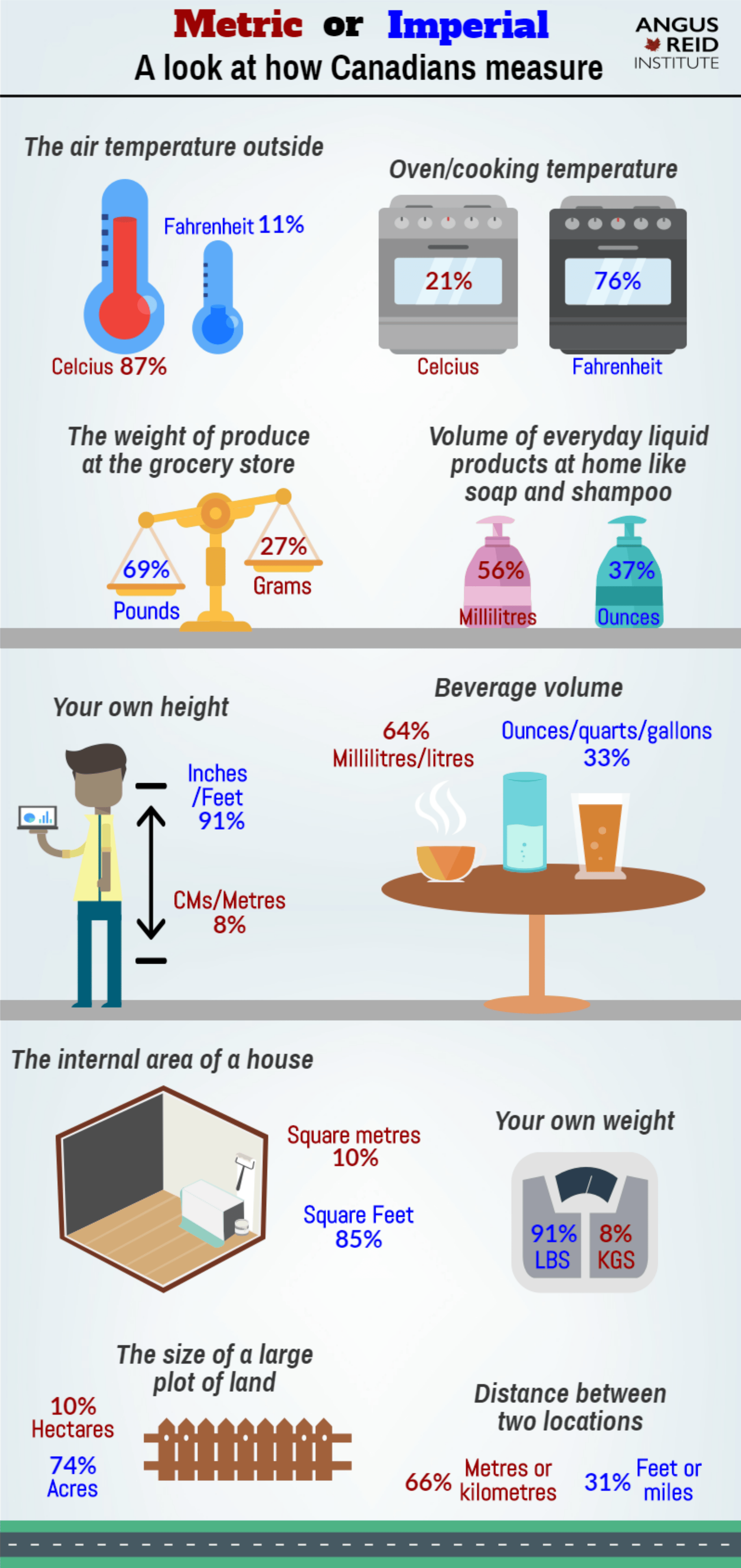
A look at how Canadians Measure

In Canada, things were rolling along at a gradual but steady pace:

  • Temperatures in Celsius beginning April 1, 1975
  • Rain and snowfall in millimeters and centimeters starting September 1975
  • Road signs showing speed limits in kilometers in September 1977
  • Speedometers and odometers in cars are manufactured in metric units beginning January 1979
  • Gas stations were pricing and dispensing gasoline and fuel in liters in 1979
  • Fabrics and home furnishings were required to be advertised and sold in meters and centimeters beginning in December 1980
  • Conversion of food weight measurements for advertising and pricing in metric units, starting December 1983.

We tend to assume Canada is solely metric, rather than the melting pot of systems that actually exist there. Canadians still use imperial units rather than metric in some areas. In 1985, Canada exempted some small businesses from the requirement of metric sales. Other requirements were also revoked, including the use of metric alone for measuring gasoline, diesel fuel, and home furnishings.

Even given these leniencies to a complete change, if you travel to Canada, be prepared for your speed limits and mileage signs to your next stop to be in kilometers, gasoline is sold in liters, and if grocery shopping, have a calculator/cell phone handy to make conversions from metric sizing to imperial sizing. This information is especially helpful when determining the size of ingredients for a recipe.

Being a lifelong resident of the United States, I didn’t delve as deeply into Canada’s history of its measuring system conversion as I did into my own country’s. Watch for Part III, where I’ll give the United States’ history and why it failed to complete the conversion.

Leave a comment

Filed under Canada, communication, decisions, education, employment, impressions, Life Changing, time

Super Bowl Advertising–Could the Cost Be Better Spent?

I recently heard a comment that a 30-second spot for advertising during the 2025 Super Bowl was $8 million. In addition to the game-time advertising, Fox Network, which aired the game, also sold pre-game ad slots for about $4.5 million each and post-game ad spots for around $4 million each. Fox sold out its ad inventory early. Some companies, including Busch Light, ran two ads during the game, doubling their costs.

Super Bowl advertising is expensive because the advertiser has the potential to reach about 100 million viewers. While the added revenue generated by these ads is great for the big-name companies that can afford it, I wonder how many people those companies could help by using those funds in another way, especially when I learned their actual bottom-line cost.

product advertising image

In 2025, 57 commercials aired during the game, earning the Fox Network approximately $456 million in game-time advertising revenue. The year 2025 was record-breaking, and the combination of pre-game, game-time, and post-game advertising generated almost $700 million in revenue for the network.

Fox makes that for the advertising spot, but the cost for the companies who advertise is considerably higher, and so is Fox Network’s revenue. The ad agency cost for Super Bowl work is an average of $3 million to $6 million, film production costs are $3 million to $4 million, and post-production work such as visual effects, sound, and editing is around $1 million. Music licensing expenses are between $3.5 million and $5 million.

Those advertising costs do not include the fees that must be paid for the ad spokesperson. A non-celebrity will run about $250,000, a B-list celebrity about $1 million, and a more realistic celebrity appearance is between $3.5 million and $5 million.

In addition to those production and celebrity costs, advertisers need to spend additional funds on digital and social media ads and any additional activations, which adds another $3 million to $10 million to the final cost.

Now, remember that $8 million 30-second ad? Fox Network requires advertisers to commit an additional $8 million for media commercial time for the upcoming year, which means that the 30-second spot is a $16 million commitment.

The final cost for purchasing a Super Bowl Ad is about $40 million per ad. With 57 ads sold during 2025, that works out to about two billion two hundred eighty million dollars ($2,280,000,000).  

I realize my thoughts about how that money could be better spent will never materialize because Super Bowl ads generate a lot of revenue for advertising companies. That doesn’t stop me from wondering what would happen if those companies produced low-cost commercials notifying watchers that rather than spend $40 million on creating an advertisement, they spent the minimum advertising contract and created a simple ad to inform consumers they have donated the difference in expenditures, approximately $24 million, to homeless shelters, food banks, soup kitchens, building low-income housing, natural disaster relief, etc.

If you saw an advertisement like that, would it make you more or less inclined to purchase their products? Think how beneficial this type of action could be to the citizens of this country. Making this country great means helping others improve their lifestyle and achieve success. Is a $40 million commercial helping America? Could those funds be used better elsewhere?

As of January 2024, the Department of Housing and Urban Development reported over 771,000 homeless people in the U.S. Reasons for this status include ending COVID-19 relief programs, higher housing costs, and immigration to big cities. People experiencing homelessness include almost 150,000 children under 18.  

According to the Working Poor Families Project, 47.5 million people in the U.S. live in low-income working families, including 23.5 million children. In 2011, more than four in 10 working families were low-income working families in Arkansas, Mississippi, and New Mexico. Between 2007 and 2011, low-income working families increased by 5% in Alaska, Arizona, California, Connecticut, Florida, Georgia, Illinois, Michigan, Nevada, and South Carolina. These families spend more than one-third of their income on housing and, in doing so, exceed the accepted guideline for affordable housing.

What are your thoughts? Please comment below.

Leave a comment

Filed under Coping, decisions, events, impressions, Life Changing, reality

What Makes a Reader?

A recent conversation with three children ages seven, eight, and 16 made me wonder what makes some people like reading when others don’t. I used to think it was parental influence, but that doesn’t hold true because kids from the same family can have different preferences.

I considered whether children who struggled in school with the language arts became non-readers and those who grasped those subjects easily became avid readers. That also isn’t true. I know people who were strong language arts students but are non-readers and people who struggled in school but enjoy reading.  

With no scientific studies to support or deny my theory, I decided it must be related to a person’s desire to escape reality—readers of fiction and fantasy or a thirst for knowledge—non-fiction and historical readers. Some memorial readers have compassion for learning about the struggles and accomplishments of others. 

In coming to this theory, I looked mainly at my reading habits and then considered those of others. I realized that what a person absorbs from reading impacts how they think, sometimes for a lifetime.

We read books to find out who we are. What other people, real or imaginary, do and thin and feel...is an essential guide to our understanding of what we ourselves are and may become.  Ursula K. LeGuin

The Pew Research Center interviewed people who had read a book in the prior 12-month period. Their interviews revealed that 26% enjoy learning, gaining knowledge, and discovering information. The pleasure of escaping reality and becoming immersed in another world was the reason 15% gave.

Other reasons, in lesser amounts, include relaxation, the variety of topics they can find, spiritual enrichment, the mental challenge of reading, and the physical properties of a book—the feel and smell. I can relate to the last one because I like the look and feel of a book in my hands rather than reading on a device.

The Pew Research findings are comparable to my theory. An article on ReadingWise, What Impact Can Reading Have on Personality? comports with my view that reading books can impact personality. People, especially children, gather life experiences through the books they select. They learn about other cultures, personalities, social classes, gender, etc. This learning can make them more empathetic toward people who are different from them.

Not only does reading impact the child, teen, or young adult’s personality and social skills, but it can also influence what they select as their career, activities they participate in as an adult, and how they view home life. Some books I read as a child, teen, and young adult influenced the genres I read now, what is important to me as an adult, some career choices, and how I view some controversial topics.

Nancy Drew Mysteries by Carolyn Keene were written for female readers between the third and sixth grades. As a child, I read this series, borrowing from the local library and devouring several a week. As an 18-year-old teen detective in the 1930s, Nancy’s ability to sleuth out the answer to different occurrences at a time when women didn’t hold careers in such “dangerous” situations was intriguing. Her independence and bravery probably inspired many females to surpass the gender-expected roles.

I enjoyed reading these books, trying to figure out the mystery along with Nancy, and it created in me a lifetime love of mysteries and crime stories. It also inspired my love of conducting research.

Making a tremendous impact on my viewpoint regarding abortion is My Darling, My Hamburger by Paul Zindel. Published in 1969, the young adult novel covers four teenage friends, romance, the decision to engage in sex, contraception, loneliness, and communication. When Liz becomes pregnant, her boyfriend speaks to his father and then gives her $300 to get what at that time was called a back-door abortion. Abortions were illegal, so the medical care was less than pristine, with procedures done on the sly. This often led to complications or death.

In the book, Liz starts bleeding profusely during the car ride home from her abortion. The entire scenario impacts not only the girl who endured this horrific illegal abortion but also destroyed the friendship group.

Reading this book as a young teen impacted my viewpoint on abortion for life. As an adult, I have always been pro-life but also pro-choice. I believe that a person, especially under circumstances such as sexual abuse of a child or an adult rape, deserves the right to decide whether to abort during the first trimester of the pregnancy.

The only thing that has changed in my mind over time is due to advancements in medical technology. I do not condone aborting a pregnancy when the child can sustain life outside the womb.

True Crime and/or True Detective magazines were in our home, belonging to my parents. As a child, I loved devouring these magazines full of true crime stories. While they were probably not the best reading material for someone so young, they influenced my preference for true crime and legal books.

Agatha Christie is a well-known mystery writer, and as I outgrew the Nancy Drew books, books by this author became a favorite selection. During this same time, I also enjoyed Alfred Hitchcock’s writingsI primarily read fiction during my early-mid teen years, and these were my primary focus.

Harriet Tubman and the Underground Railroad is a title I remember ordering from Scholastic and reading in elementary school. This non-fiction book influenced my future love of non-fiction and interest in reading about the oppression of enslaved people and blacks.

Black Like Me is a non-fiction/memoir written in 1961 by journalist John Howard Griffin. Griffin, a white man, had his skin temporarily darkened and traveled to the Deep South to learn what it was like to live under the terms of segregation. It was amazing how he was treated very differently when living as a black man vs. how he was treated after allowing his skin to lighten and was again regarded as white. It is a real eye-opener on how badly people judge others based on the color of their skin.

Sybil was published in 1973, and I read it around age 13 following its release. This is the true story of a female being treated for dissociative identity disorder. Sybil had 16 separate personalities, likely developed as a coping mechanism due to severe physical and sexual abuse by her parents. This book influenced my opposition to child abuse, and in high school, I did a term paper on abuse.

F. Lee Bailey wrote The Defense Never Rests in 1971, and I read it as a young teen shortly after publication. F. Lee Bailey was a well-known criminal defense attorney, representing clients such as Albert DeSalvo (the Boston Strangler) and Patty Hearst. In the book, he discusses many of the cases he defended. This book impacted my interest in the law and helping criminal defendants.  

It is not enough to simply teach children to read; we have to give them something worth reading. Something that will stretch their imaginations - that will help them make sense of their own lives and encourage them to reach out toward people whose lives are quite different from their own.  Katherine Paterson.

There are many others, but these immediately came to mind when I thought about books from my youth. Those I remember after over fifty years most likely influenced my outlook on life. What is their impact on my life?

I was a community opinion columnist for The Times Herald in Port Huron for several years, expressing my opinion on controversial issues. I am currently working on a book about CPS taking my granddaughters and adopting them out to strangers rather than my husband and me. I have given testimony before legislative committees regarding the problems with the Michigan sex offender registry, and I went back to school in my 50s and became a paralegal. I am now considering becoming a CASA (Court Appointed Special Advocate), which means advocating for children who are in foster care.

My reading is almost 100% memoir and non-fiction. I live and travel full-time in an RV and buy books from the areas I visit. Learning about the history of places I visit is enjoyable.

What do you read? Did what you read as a child and teen influence your life choices? Share your thoughts below.

Leave a comment

Filed under assumptions, career, children, decisions, Discoveries, education, exploration, impressions, Life is a Melting Pot

How Wedding Traditions Came to Exist

An average of 2.4 million weddings occur in the U.S. annually, or about 5,000 per day. When planning a wedding, most couples incorporate several traditions, including a wedding shower, an engagement party, the father giving away the bride, tossing the bouquet, going on a honeymoon, and more.

Have you ever wondered how these traditions came to be? I was surprised to learn that many derive from superstition, monetary transactions, and the transfer of female ownership. Once I started reading about these traditions, I wanted to know more. The list is long, so I’ve made it easy to skim down and find the practices you are curious about. I hope you end up like me, wanting to learn about them all.

Engagement Party— In ancient Greece, the engagement party was a financial contract between the bride’s father and the man she would be marrying. The bride was not present during the business agreement. An ordinary party was held by the bride-to-be’s father, during which the bride’s father would announce his daughter’s engagement to everyone in attendance. The bride was often just as surprised as the guests to learn she was to be married. Marriages were not based on love until the late 1700s, and even after that time, arranged marriages continued. In some cultures, they still exist today.

Dowry—The original purpose of a dowry was for the groom to compensate the bride’s family for losing her labor and reproductive potential. Sometime before the Ancient Roman period, the custom reversed, with the bride’s family giving a dowry to the new husband’s family to help support her and the expense of setting up a new household. It is believed that the modern tradition of the bride’s family paying for the bulk of the wedding is an evolved practice that replaces the dowry system.

Engagement Ring—This tradition goes back to ancient Rome, when women would wear a ring of bone, copper, flint, iron, or ivory to signify a business contract or that an affirmation of love and obedience had been made. This was derived from the ancient Egyptian practice of using a ring of hemp or reeds to signify eternity.

It was in 850 CE when the official purpose of an engagement ring was introduced by Pope Nicholas I. He declared the ring to represent a man’s intent to marry. Although rings adorned with diamonds were not popular until the 1940s, the first diamond appeared on an engagement ring in 1477. That is when the Archduke Maximilian of Austria proposed to Mary of Burgundy with a stone setting in the shape of the letter M.

In the 15th Century, gimmel rings served the purpose of engagement. This set of three rings was used, with the bride and groom each wearing one ring during the engagement. On the wedding day, the two bands were connected with the third, and all were worn by the bride as her wedding set.

Diamond engagement rings became popular and ornate during Victorian times because of Queen Victoria’s love of diamond jewelry. Although diamond engagement rings have been in the U.S. since 1840, they did not gain popularity until 1947. That is when the British company, De Beers, was mining diamonds in South Africa and launched an advertising campaign, “A diamond is forever.” This sales ploy skyrocketed diamond sales for wedding engagement rings.

Bachelor Party—The bachelor party dates to the 5th century B.C. when ancient Spartans devised a celebration of the groom’s last night as a single man. The term bachelor meant a young knight or student with a bachelor’s degree and first appeared in Canterbury Tales in the 14th century.

The term bachelor party was first used in 1922 in a Scottish publication, meaning a “jolly old party.” The modern parties were traditionally black-tie dinners hosted by the groom’s father to honor and toast the groom. They did not become the current parties of beer, strippers, and drugs until the 1980s.

Popular Saying—The traditional saying about what a bride must wear on her wedding day is based on a 19th-century Old English rhyme in Lancashire. There is a reason behind each item in the phrase:

Something old— traditionally a personal gift from the bride’s mother, usually symbolizing wisdom for married life.

Something new—symbolizes the establishment of a new family created by the marital union.

Something borrowed—by borrowing something from a happily married woman, the bride is borrowing marital bliss to carry into her new union.

Something blue—The robes of pagan Roman maidens had blue trim on their borders, symbolizing modesty, fidelity, and love. For Christians, blue symbolizes the purity of the Virgin Mary.

And a sixpence for your shoe—often left out of the rhyme, and the British coin is no longer in production. The purpose was to bring prosperity to the newlyweds. 

Bridal Gift Registry—This was started by a Marshall Field’s store in Chicago in 1924. It was a marketing pitch that allowed brides to select their fine china and silver for the big day. This successful advertising campaign soon gained popularity throughout the county, with many businesses expanding on the idea to include other items the newlyweds would need.

Bridal/Wedding Shower—Showers date back to 16th century Holland. The bridal shower is a dowry alternative that began when a bride’s father was too poor to provide a dowry. It was also held if the bride’s father opposed the union.

The tradition is based on a Dutch story about a high-society girl falling in love with a poor miller’s son. The girl’s family objected because of the miller’s low class, but she insisted on marrying him. The girl’s father said he would withhold her dowry as punishment for her refusal to marry the wealthy pig farmer he chose for her.

To help the couple in their misfortune, the bride’s friends showered her with gifts as a dowry substitute. Touched by the generosity of his daughter’s friends, the father finally agreed to the marriage. This began the tradition of a bride’s family and friends showering her with gifts before a wedding.

Bridal showers grew in popularity in the U.S. during the late Victorian era. Upper-class society ladies saw them as an opportunity to celebrate, gossip, and exchange gifts, thoughts, and food for the bride-to-be. Gifts were usually modest, simple, useful household goods the bride would need in her new home, including bed linens, kitchen items, China, and more. By the 1930s, the tradition had extended to middle and lower-class families.

A bridal shower is thrown for the bride and traditionally attended only by females. A wedding shower is a modern version of the shower. It is thrown for the couple and includes the groom in the party and opening of gifts. Guests may also be mixed gender.

Rehearsal Dinner—The dinner may be an evolution of an event that occurred hundreds of years ago when attending a wedding meant days of travel. The night before the wedding, the manor house, castle, hut, or tent would be packed with friends, relatives, and emissaries needing to be fed. Out of necessity, a meal would be held the night before the wedding. This was also wrapped in superstition. The belief was that if those attending the dinner were loud and rambunctious, they would scare away evil spirits trying to destroy the couple’s chance of having a happy life.

Today the rehearsal dinner follows the wedding rehearsal. I couldn’t find anything about when wedding rehearsals began, which appears to be strictly an American tradition. Rehearsals may have begun as wedding parties grew, allowing everyone to become familiar with exactly what would occur during the ceremony to hopefully prevent any glitches.

Not Seeing the Bride Before the Wedding—Before the 18th century, pre-arranged marriages were common. It was considered unlucky for a bride and groom to see each other before the wedding because the groom might back out of the arrangement if he saw the bride-to-be and didn’t like her appearance. This is also one reason for the veil.  

Bridal Veil—The veil establishes that a woman is spoken for and disguises the bride so evil spirits wishing to harm the couple will not recognize the bride. It also was a way of securing the marriage contract. Many brides and grooms met for the first time on their wedding day at the altar. The veil was only lifted after the ceremony, so the groom could not back out of the wedding if he didn’t like his wife’s appearance.  

Giving Away the Bride—This practice dates back to when women were the property of men.  Women were unable to live independently of men, could not own property, have a job, or inherit money. They belonged first to their fathers, then their husbands, and if their husband died, their sons.

By walking his daughter down the aisle and giving her in marriage, the father transferred ownership of his daughter to her new husband. This dates back to when an engagement was a business transaction, not an act of love between two people. By being at the wedding ceremony and presenting his daughter in marriage, the father ensured the wedding would take place, fulfilling his part of the agreement.

Wedding Ceremony and Vows— God established marriage in the garden with Adam and Eve based on a covenant promise in Genesis 2:24, which defines marriage as joining two into one. The traditional wedding vows we are familiar with are not in the bible but are based on biblical principles.

The first recorded evidence of a marriage ceremony uniting a man and woman is around 2350 B.C. in Mesopotamia. Over several hundreds of years, marriage evolved into an accepted union by Romans, Greeks, and Hebrews. The primary purpose was to bind women to men, guaranteeing that a man’s children were his biological heirs. The father would hand over his daughter and say, “I pledge my daughter for the purpose of producing legitimate offspring.” If a wife failed to produce offspring, her husband could give her back and marry someone else.

The first mention of marriage vows was in a prayer book from the Medieval Church in England, written in 1549. The book has marriage vow examples that modern vows have incorporated. If you would like to learn more about the different areas of traditional wedding vows and where in the bible they stem from, check out this article on Wedding Wire.

Wedding Rings—Ancient Egyptians were the first to exchange rings made of braided reeds and hemp. They placed them on the fourth finger of the left hand because of their belief that a ‘vein of love’ ran from that finger to the heart. The circle of the ring also was symbolic of an endless circle of eternal love with no end, the promise of bonding forever.

Ancient Romans and Greeks wore rings of ivory, bone, or leather. Wealthy people began creating rings of gold and silver for their marriage commitments. Romans believed the left hand to be unholy and untrustworthy, so they placed their wedding rings on the right hand. The right hand serves as a symbol of loyalty, honor, and trust. Today there are about 20 countries where married couples place their rings on the right hand.

The first diamond wedding ring was recorded in the will of a widow who died in 1417. The oldest surviving diamond ring is from the late 100s CE in Rome when diamonds were valued for their harness rather than brilliance.

Men’s Wedding Rings—Wedding rings for men didn’t become popular until WWII. It was then soldiers wore them as a way to remember their wives back home. Many of the weddings in 1942 were quick, taking place within a week of the announcement because of a soldier being deployed.

The tradition of soldiers wearing wedding rings continued through the Korean War. The practice eventually caught on for non-soldiers as well.

Bridal Party—While the purpose of the bride and groom is clear, why do we have all the other members of the bridal party? What was their original purpose?

BridesmaidsIn ancient Rome, bridesmaids protected the bride. They would all wear the same dress as the bride to confuse evil spirits and prevent them from finding the bride. This prevented the couple from being cursed on their wedding day. Roman law also required ten witnesses to every wedding, so there would be five bridesmaids and five groomsmen.

GroomsmenDerived from an ancient tradition of kidnapping a bride, a man would employ his friends to help him fight other warriors and prevent the bride’s family from finding the couple. Because weddings were a business transaction rather than a union of love, the groom needed an excellent swordsman to retrieve a runaway bride or fend off a bride’s angry family not approving the marriage. The term Best Man referred to the quality of a man’s swordsmanship, and the groom’s main warrior companion was the equivalent of today’s best man. 

Flower GirlIn ancient Rome, a young virgin would carry sheaths of wheat, believed to bring well-being and good fortune to a newly married couple. Over time the sheaths of wheat were replaced by flowers scattered along the bride’s path to the altar.

Ring BearerIn Victorian times, a pageboy would carry the bride’s train down the aisle, along with a prayer book. During this time, Victorians began displaying the ring on a small pillow to show their wealth. Pillows were expensive, luxury items that only the elite members of society could afford. Over time, the pageboy carried the ring pillow down the aisle. That tradition evolved into today’s ring bearer.

Witnesses to the Wedding—Ancient Roman law required ten witnesses to be present at a wedding. At that time, the legal witnesses were all men, but the bride was also escorted by female attendants. Not only did witnesses watch the marriage ceremony, but they also witnessed the consummation of the couple on their wedding night.

Yes, the newlyweds had sex in the presence of witnesses. This was usually done with the bed curtains closed and the observers on the room’s outer edges. If the marriage was not consummated, it could be declared null and void, and the couple granted an annulment. The witnesses were present to confirm the couple had sex, forming an unbreakable union. In modern times, witnesses only have to sign a marriage license as confirmation that a couple has legally married.

Unity Candle – The unity candle became popular in the second half of the 20th century in American Christian weddings. This is attributed to a 1981 General Hospital episode where a couple used a unity candle. The candle symbolizes the merging of two individuals, creating a blended family.

Sealed With a Kiss—This tradition began in Ancient Rome when marriage was a contract. Instead of signing your name, you confirmed your commitment to the agreement with a kiss. It was believed that by binding the marriage with a kiss, the couple exchanged spirits, sending part of themselves into their spouse, binding them as one. 

Bridal Bouquet—Ancient Greeks and Romans carried aromatic herbs, garlic, and grains to drive away evil spirits and bad luck during the wedding. Floral garlands the bride and groom wore symbolized a new beginning and hopes of fertility, fidelity, and happiness. Some bouquets included rosemary for loyalty, wheat for fertility, ivy for an unbreakable bond, heather, thistle, thyme, or basil for protection, and dill as an aphrodisiac. Carrying aromatic flowers was also a way for brides to mask their body odor before frequent bathing was practiced.

Bouquet Toss—Tossing of the bridal bouquet dates back to 14th century England when unmarried women tried to rip off pieces of a bride’s dress or flowers to gain some of her good luck, hoping to become the next one married. The bride would toss her bouquet into the crowd and run for safety to prevent being mobbed. 

By the 1800s tossing the bouquet became a wedding tradition, with single women wanting to catch the bouquet as a sign of good luck for their future marriage. At that time, marriage was the only way a woman could bring her family out of poverty.

Garter Toss—Garters were originally a necessity, holding up the stockings of both men and women. The toss dates back to the same safety problem in England and France when guests would try to rip off a piece of the bride’s clothing for luck. To protect his bride, the groom would take his new wife’s garter and throw it out into the crowd, and the couple would escape.

Receiving Line—I couldn’t find any information on when this practice began and assume it was a tradition before wedding receptions were a standard part of weddings. The receiving line immediately after a wedding is the couple’s first opportunity to “receive” guests as a married couple. The line usually includes the bride and groom, their parents, and members of the wedding party. It provides each guest a moment with the newlyweds to offer congratulations. It also ensures that the couple can personally thank each of their guests for attending.

Reception—Wedding receptions were not frequently held until the early 1960s. Before that time, if a reception was held, it was usually a casual affair at the home of the bride’s parents with cake and punch.

Carry Bride Over Threshold— This tradition goes back to ancient Rome when the groom dragged a bride unwilling to leave her parent’s over the threshold of her new home.

In medieval Europe, it was believed that brides were vulnerable to the invasion of evil spirits through the soles of their feet. To protect his new wife, the groom would carry her through the front door.

Later, it was believed that if a bride tripped entering her new home, it would bring bad luck to the marriage. The groom carried his new wife across the threshold to prevent her from tripping.

Tying Cans to Car Bumper—This custom dates back to sixteenth-century France and early twentieth-century Appalachian customs. The idea is to harass newlyweds on their wedding night through a noisy celebration with friends and neighbors banging pots and pans, singing, and making noise outside the couple’s window.  Eventually, the newlyweds would invite everyone in for refreshments.  It is believed that tying cans to the back of a newly married couple’s vehicle is an adoption of the noisy shivaree.

Wedding Dances—Many wedding party dances are popular, and I wondered how they all came into existence.

The First Dance dates back to 17th-century Europe when formal balls were popular. It was customary for the guest of honor or person of the highest social status to lead the first dance. This led to the tradition of a married couple having their first dance at a wedding.

The dance is the couple’s first cooperative and joint endeavor, symbolizing the consummation of the wedding. Their manner of dance, expression, and steps reveal the harmony between the bride and groom.

The Father-Daughter Dance dates back to when marriages were arranged as a monetary contract rather than love. The father-daughter dance was a final demand of the bride’s father on his daughter before her husband became the most important man in her life. After the father-daughter dance, the bride could dance with her new husband, whom she had likely just met. 

In modern society, the father-daughter dance usually occurs after the bride and groom have first danced together. It now symbolizes the bride’s love and appreciation of her father.

The Mother-Son Dance is a modern addition to a wedding reception. It is comparable to the father-daughter dance and allows a groom to show his love and appreciation for his mother.

Bride Changing Last Name—The practice of a woman taking her husband’s last name dates back to the Middle Ages when societies were becoming organized. Under English common law, women were barely acknowledged and had no legal rights. The concept of coverture was the basis of a woman taking a man’s last name in marriage. Coverture was the legal status of a married woman. Because women had no legal identity, coverture placed them under their husband’s protection and identity.  

Women were under the control of their fathers and then their husbands. They had no legal ability to make contracts, own a business, or own property. They had no legal rights to their possessions, clothing, children, or their bodies, and marriage rape was legal. If their husbands sent them out to perform labor, the husband collected the wages.

Within the U.S., the first break in coverture took place under the Married Women’s Property Act of 1848. Over time that act underwent amendments so that women could eventually attend school, obtain driver’s licenses, work, and vote. It took a long time for women to gain rights. Women in the U.S. could not get a driver’s license, passport, or register to vote if they didn’t take their husband’s last name. Marital rape did not become illegal until the 1970s.

Though no longer legally bound to take their husband’s last name, about 70% of women follow the tradition. This makes it easy for a married couple and their offspring to show daily unity.

Wedding Cake—In ancient Rome, wheat cakes were broken over a bride’s head to promote fertility. It later became customary to stack the wheat cakes on top of each other, and the bride and groom were challenged to kiss over the tower without knocking it over. If successful, they would enjoy a life of good fortune.

In modern times, white cake symbolizes purity.  The joint task of the bride and groom cutting the cake represents their first joint task of married life, and feeding it to each other symbolizes the commitment they are making to each other.

Saving the top layer was originally for use at their future child’s christening. The bride was expected to be pregnant within the first year of marriage. The top layer is now used to celebrate the couple’s first marriage anniversary.

Tie The Knot—Handfasting dates back to ancient Celtic times and is a spiritual ritual of tying a bride’s and groom’s hands together during the wedding ceremony. The phrase “tying the knot” stems from binding the couple’s hands together during this ceremony with colored cords to symbolize their union of love.

For a three-cord handfasting, the colors of white for purity, blue for fidelity, and red for passion were braided together. Other colors include green for fertility and growth, purple for spiritual strength, and gold for wisdom.

The couple’s hands are not released until the marriage is complete. In modern times, a couple says their vows while bound together, then finish the ceremony with rings. Historically, the binding remained in place after the wedding ceremony, and the couple was escorted to the bedchamber to consummate their union. It was believed that if the couple survived the day bound together, they would survive their marriage together.

Throwing Rice—Marriage was traditionally seen as a way of building a family and increasing a person’s assets. Ancient Romans often threw wheat or oat seeds, which meant the birth of new life. The change to rice was likely because it was often available and low cost. Whichever grain was used, it symbolized fertility and prosperity. Tossing grain over newlyweds signified good luck and best wishes toward producing babies and good harvests.

Honeymoon—The term honeymoon dates back to the 5th century when the calendar was represented in moon cycles. After marriage, a couple would drink mead, an alcoholic beverage made from honey, during their first moon of marriage. Drinking the fermented honey liquor under the moon was believed to boost fertility and increase the odds of producing children early in the union.

The American honeymoon tradition dates back to 19th century Great Britain when relatives could not always attend the wedding. The newly married couple would travel by train and carriage to visit those unable to attend. This was called a bridal tour and often lasted for weeks or months.

Not Married? Be glad it isn’t 1860 to 1880 when the term Spinster was used to describe women who never married. During that time period, eleven percent of the American female population didn’t marry. This was probably because of the Civil War, which killed 600,000 men.  It was during this period that women began obtaining a college education. The male opinion was that a female college graduate would be a poor homemaker.

Were you surprised at how many traditions deal with monetary transactions, ownership of women, and superstition? Let me know what you think in the comments below.

Leave a comment

Filed under celebration, events, Family, habit, impressions, Life is a Melting Pot, marriage, time

Restoring Relationships

Three years ago, I made a decision to take legal action against a family member. I did this with the support of other family members.  After exhausting all other options, a joint decision was made that I would be the “face” of the group, acting as the plaintiff when filing petitions.

The matter was resolved through mediation more than 14 months ago. A conversation with a family member on the opposing side at the end of the mediation left me with the hope of restoring the family relationship. Unfortunately, hope can die quickly when the other person is unwilling to let go of the past.

I am one of four cousins, and for years we have had an annual girls’ weekend. Three of us were willing to put the past behind us and move forward. No conversations, no explanations; just move forward and have a fun weekend. The person who was in attendance at the mediation was unwilling to do this.

She issued an ultimatum as a condition of getting together. No matter how much we told her it is in the past, let it go, she refused. She continued to push a false narrative about the situation.  Because of her unreasonable demands, two cousins left the instant message conversation, one of them blocking her completely.

Realizing her ultimatum backfired, the person sent a message demanding three conditions be met to reconcile. Those conditions were a demand that the three of us not partake in actions that she, her family members, and her family have been taking for the past 14 months. This includes violating the terms of the mediation agreement.

The matter ended with my two cousins and I refusing to reconcile under her conditions. They do not understand her hostility toward me. None of us understand her claims that I am too angry to reconcile when she is the one unwilling to move forward. While my relationship with my two cousins is solid, it is sad that reconciliation with the remaining person seems impossible.

Following the exchange, I sent the person a private message stating that I had let the matter go following the mediation and that if she cannot agree everyone makes mistakes and we start with a clean slate, that is her problem, not mine. She is still angry and refuses to move forward. It is her choice to throw away family, not mine.

As of today, she has not opened that message. She sent one of the other cousins a message, stating she “knows” my message is a rehash of the problems and she cannot emotionally cope with reading it. Assumptions can be a person’s downfall.

My cousins have no interest in seeing her at this time. It is sad that one person’s bad behavior has caused such conflict in the family. Those of us suffering the greatest impact of that behavior are the ones willing to move forward.

A couple months ago, I was looking forward to a fun girls’ weekend and the restoration of our family relationship. Now it is shattered even more than before. Part of me still hopes the relationship can be restored, but part of me doesn’t care. She is unwilling to acknowledge the wrong done to the family and move forward, or she is in denial because she was a participant in the bad treatment of the family. I don’t know which.

The situation got me thinking about steps for restoring a relationship. I decided to do a bit of research. One of the key elements to letting go of the past is accepting what you cannot control. You must take accountability for your part in the situation and focus on the lessons learned from the experience. You should also consider the following:

HAS THE PAIN BECOME COMFORTABLE? 

If people feel hurt for a lengthy period of time, they become accustomed to emotional pain. The pain becomes a familiar part of their identity, and they are unable to let it go. By staying angry at someone, they can remain distant and not deal with their true emotions.  

To move past this point, they need to consider whether there are secondary benefits to staying focused on the hurt. Does staying angry help them avoid resolving emotional pain? Resolving pain requires facing the reality of it.

Consider how your life would be if you moved forward, leaving the past in the past. What would change if you took a different outlook on the situation?

FEEL THE PAIN TO MOVE PAST IT

By bottling up emotions and thoughts about the hurt, you prevent healing. This means the hurt builds inside you, and you continuously focus on it and the harm it caused. Constantly thinking about the hurt may impact your mood, relationships, and ability to be productive.

To move forward, consider journaling your feelings, writing a letter to the person who hurt you (sending it is optional), and expressing your feelings to a friend, relative, or therapist.

BE ACCOUNTABLE

Acknowledge your participation in the situation. By accepting your part in the problem, you can let it go and move your attention to the present. By holding onto your pain, resentment, and bad memories, you experience the pain repeatedly. This keeps you stuck in the past and unable to move forward.

Even if the event was not your doing, you can still acknowledge that it happened. You can choose to move forward by moving away from the past in your mind, living a life you want, away from the emotional pain.

FOCUS ON LESSONS LEARNED

Focus on the lessons learned from the hurtful event. Consider the things you now know that you do not want to happen again. Think about the coping skills you acquired as you faced the challenges.

Realize that everything passes with time, and this hurt will too. Identify the skills, strengths, and knowledge you obtained from this hurtful event.

LET GO OF THE “WHAT IFS”

Some people are unable to let go of the past because they need to constantly review the “what ifs” of the situation. They constantly wonder if things would be different if they had taken different steps.

They review the things they should have done, could have done, and what might have happened under those circumstances. This constant review will not fix anything. It only prevents you from moving forward and away from the hurt.

FORGIVE OTHERS

You are unable to regain trust unless you assume control of your emotions. You must forgive to obtain emotional freedom. Until you are able to acknowledge that everyone makes mistakes, you cannot overcome your anger and resentment.

A lack of openness is often the culprit that leads to a breakdown in the relationship. If the other person is unwilling to work toward repairing a relationship by being open and honest about the situation that caused the hurt, that is a reflection on them, not you.

BE AWARE OF GASLIGHTING

Gaslighting is a type of manipulation in a relationship. It uses a variety of techniques for the purpose of exerting control over another person. The aggressor in the relationship uses lies, trivializing, diverting, discrediting, denial, guilt, and more to create a false narrative.

Gaslighting is a form of emotional abuse that is difficult to pick up on. Those who use it are good at side-stepping accountability. A person using this technique tries to convince other people that they are remembering things wrong or misinterpreting events. They try to manipulate others by presenting their own thoughts and feelings as the truth.

Some signs of gaslighting:

  • Telling people you said something you didn’t say
  • Claiming you didn’t say something you did.
  • Lying when it is not necessary
  • Cheating or acting in unethical ways
  • Getting people to take your side to make you look better
  • Getting the people on your side to turn against someone else
  • Rarely taking responsibility for your mistakes
  • Not apologizing for your mistakes
  • Running hot and cold for no obvious reason
  • Angering easily and/or starting fights to gain power
  • Using a person’s weakness to hurt them or gain power over them
  • Bullying and teasing, then saying you didn’t mean anything by it
  • Insisting on a double standard—you can act one way, others must behave in another way

Gaslighting can happen in any type of relationship. It is a common form of emotional abuse in relationships using gender-based stereotypes and is a form of domestic abuse.

THE BOTTOM LINE

The brunt of my findings is that relationships can be restored, but only if all parties are willing to move forward. If one person holds onto their anger, until that person works through their own feelings and emotions, they will be unable to resolve the relationship and will remain estranged.

I travel out of state most of the year, so there is only a short period when I can reconnect in person. It is unfortunate that this person is unwilling to move forward. Her anger has made the situation worse. That is something I cannot fix. The ball is in her court. Time will tell whether her relationship with the three of us can ever be restored.

Leave a comment

Filed under assumptions, communication, Coping, decisions, Family, friendship, impressions, Life is a Melting Pot, sisters

35 Unique Things About Michigan

Although I now travel and spend more time outside of my birth state than I do in it, Michigan still holds a place in my heart for its many unique qualities.

Michigan is the only state that consists of two peninsulas. The “mitten” is the lower peninsula and is where I grew up, in the “only Eaton Rapids on earth.” The mitten is surrounded by Lake Huron on the East, Lake Erie on the South, and Lake Michigan on the west. To access the upper peninsula (the U.P.) you need to cross the Straits of Mackinac, a 5-mile channel connecting Lake Huron to Lake Michigan. The north shore of the U.P. is on Lake Superior.

If that isn’t enough, here are 35 more things that make Michigan a very special place.

  1. Detroit is the Car Capital of the World. Home to the “big three,” Ford Motor Company, General Motors Corporation, and Chrysler LLC, the state handles 24% of all automotive manufacturing in the U.S.
  2. Michigan is the largest manufacturer of lithium-ion batteries in North America. The American Battery Solutions Inc. manufacturing facility is located in Lake Orion and employs more than 100 workers. In support of this the Governor is working to develop the nation’s first wireless charging infrastructure on public roads.
  3. Alpena is the home of the world’s largest cement plant. Lafarge Alpena has been in existence since 1907 and employs more than 200 workers.
  4. St. Clair is the home of Diamond Salt Company, established in 1886 when a new process for making salt was patented. It is the world’s largest marketer of salt, supplying salts for culinary use, manufacturing, agriculture, grinder, pool use, water softening, and ice control.
  5. Southwestern Michigan is home to the largest Dutch settlement in the United States, with almost 300,000 residents of Dutch heritage. Dutch residents are most prominent in the five counties of Allegan, Kalamazoo, Kent, Muskegon, and Ottawa.
  6. Rogers City boasts the world’s largest limestone quarry. The site is 7,000 acres, of which 3,000 acres are actively mined. The quarry has an anticipated lifespan of an additional 100 years.
  7. Elsie is the home of the world’s largest registered Holstein dairy herd. Green Meadow Farms is a family operation established in 1922. With 80 employees, they raise all livestock and do all field and crop work on their 8,000 acres. The farm has a milking herd of about 3,900 registered Holsteins.
  8. Enjoy the longest freshwater boardwalk in the world in St. Clair. The boardwalk is along the St. Clair River, an international border with Canada. The St. Clair River is one of the busiest waterways in the world with more than 5,000 ships traveling the water every year. With more freighter traffic than the Suez Canal and Panama Canal combined, it’s an excellent spot for freighter watching.
  9. Colon is the magic capitol of the world and home to Abbott’s Magic Company, the world’s largest manufacturer of magic supplies. The city has more than 30 magicians laid to rest in its cemetery, more than any other cemetery in the world.
  10. Michigan Sugar Company is the largest sugar factory east of the Mississippi river, the largest sugar refinery in Michigan, and the fourth largest sugar refinery in the United States.
  11. Michigan ranks #1 in state boat registrations. St. Clair County ranks #1 in the U.S. for the number of boat registrations per capita.  
  12. Port Huron is home to largest freshwater sailing event in the world. The annual Port Huron to Mackinac race began in 1919 and more than 200 boats enter the race each year.  
  13.  The state has about 54,800 farms covering 10 million acres and producing $6.5 billion in products yearly. Michigan is the largest producing region in the world for Montmorency tart cherries and Traverse City hosts the annual National Cherry Festival every July. The state is one of the top producers in the U.S. of grapes, apples, peaches, and blueberries.
  14. Livestock population is significant, with about one million cattle, 78,000 sheep, 3 million chickens, and one million hogs. Livestock products account for about 38% of all agricultural output.
  15. Sault Ste. Marie was founded in 1668 by Father Jacques Marquette, and it remains the third oldest remaining settlement in the United States
  16. In 1817 the University of Michigan was the first university established in any of the states. It was originally named Catholepistemiad and was located in Detroit. The name was changed in 1821 and the university moved to Ann Arbor in 1841.
  17. Michigan State University was founded in 1855 as the nation’s first land-grant university and served as the prototype for 69 land-grant institutions established under the Morrill Act of 1862. It was the first institution of higher learning in the nation to teach scientific agriculture.
  18. The Mackinac Bridge is one of the longest suspension bridges in the world. It spans 5 miles over the Straits of Mackinac and took 3 years to complete. It was opened to traffic in 1957
  19. Kellogg Company made Battle Creek the Cereal Capital of the World. The Kellogg brothers discovery of producing flaked cereal was an accident that sparked the beginning of the dry cereal industry.
  20. Vernors ginger ale was created in Detroit and is the first soda pop made in the United States. It was an accident. In 1862 pharmacist, James Vernor, was trying to create a new beverage. He was called away to serve in the civil war, leaving his “experiment” behind. When he returned four years later the drink in the oak case had developed a delicious ginger flavor and Vernors was born.
  21. The Detroit Zoo opened in 1928 and was the first zoo in America to feature cageless, open exhibits allowing animals to roam free. In 1968 the zoo’s Penguinarium was the world’s first zoo building designed exclusively for penguins. In 2001 it opened Wild Adventure Ride, the nation’s first zoo simulator, and the Arctic Ring of Life, the largest polar bear habitat in North America.
  22. Michigan is only place in the world with a floating post office. The J.W. Westcott II is the only boat in the world that delivers mail to ships while still underway. It has been operating 140 years.
  23. The state boasts 3,224 miles of freshwater shoreline, the longest in the world. It also has the longest shoreline of the 48 continuous states. There are an additional 11,037 inland lakes and 36,000 miles of streams.
  24. The state has 124 lighthouses and navigational lights. The oldest is the Ft. Gratiot Lighthouse, constructed in 1829.
  25. It is the first state to provide in the constitution for the establishment of public libraries in each township and city, set forth in Article XI, Section 14 of the Michigan Constitution of 1908. It was also the first state to guarantee every child the right to a tax-paid high school education.
  26. Isle Royal National Park shelters one of the largest moose herds in the U.S. The park is 206.73 square miles and is the 4th largest lake island in the world. As of 2019 the island was home to 14 wolves and 2,060 moose. The moose herd was 2,400 at its highest point in 1995.
  27. Upper Michigan Copper Country is the largest commercial deposit of native copper in the world. By the 1860s the upper peninsula was supplying 90% of America’s copper.
  28. Michigan fared worse than the rest of the country during the depression between 1930 and 1933. The state’s unemployment rate was 34%, while it was only 26% in the rest of the country. This is because out of work automotive workers were starving to death by the early 1930s.
  29. Michigan has the first auto-traffic tunnel built between two nations, the mile-long Detroit Windsor tunnel under the Detroit River was completed in 1930. This was the third underwater auto tunnel built in the United States.
  30. The world’s first submarine railway tunnel opened between Port Huron and Sarnia, Ontario in 1891. It is both the first submarine tunnel and the first international tunnel.
  31. In 1879 Detroit telephone customers were first in nation to be assigned phone numbers to facilitate handling calls.
  32. In 1929 Michigan State Police established the first state police radio system in the world
  33. Grand Rapids is home to the 24-foot Leonardo da Vinci horse, II Gavallo, the largest equestrian bronze sculpture in the Western Hemisphere.
  34. Michigan is the great lakes state because its shores touch four of the five great lakes. We get our name from the Ojibwa (Chippewa) Indian word meaning “large lake”
  35. Detroit is the birthplace of Motown Records. Motown artists include Tina Turner, Otis Redding, Diana Ross, Four Tops, The Supremes, Al Green, Gladys Knight & the Pips, Ray Charles, Curtis Mayfield, Lionel Richie, Bill Withers, The Commodores, Aretha Franklin, Michael Jackson, The Jackson 5, The Drifters, Smokey Robinson, James Brown, Stevie Wonder, Fats Domino, The Temptations, Marvin Gaye, and more.

    The state has even more interesting facts setting it apart from the rest of the country and world, but I had to stop somewhere. I hope you’ve enjoyed this glimpse of my home state.

    Share where you are from and what makes your home state unique.

Leave a comment

Filed under Activities, Blue Water Area, Discoveries, education, events, exploration, farm, Festivals, home, impressions, Lake St. Clair, Life is a Melting Pot, Michigan, nature, reality, tourism, travel, Upper Penninsula

Oldies Observations

We were unable to get any local stations while traveling this summer and found a TV station playing some prime-time oldies.  Watching shows from the past leads to some interesting observations. This includes the way people were portrayed in the ’50s, ’60s, and ’70s.

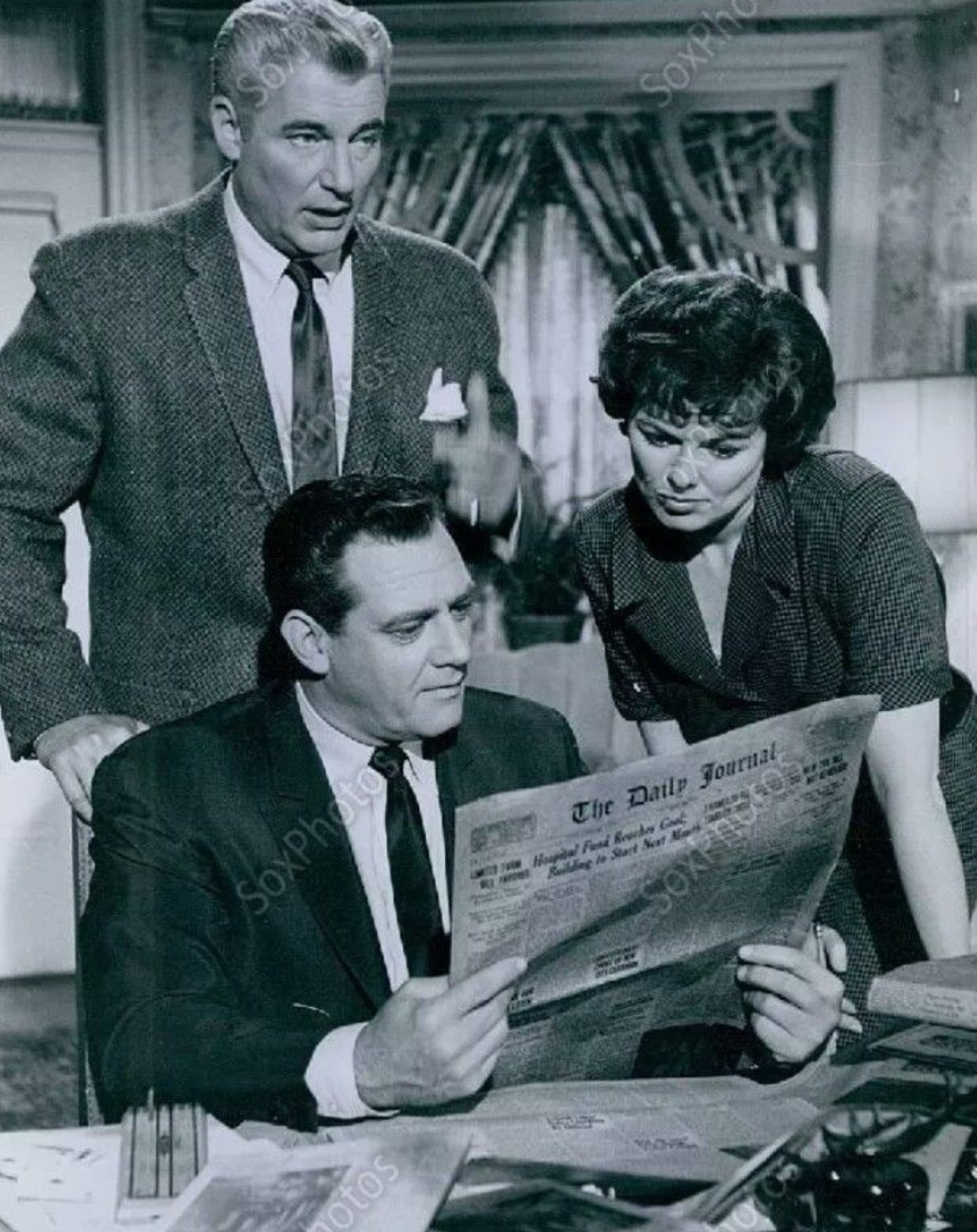
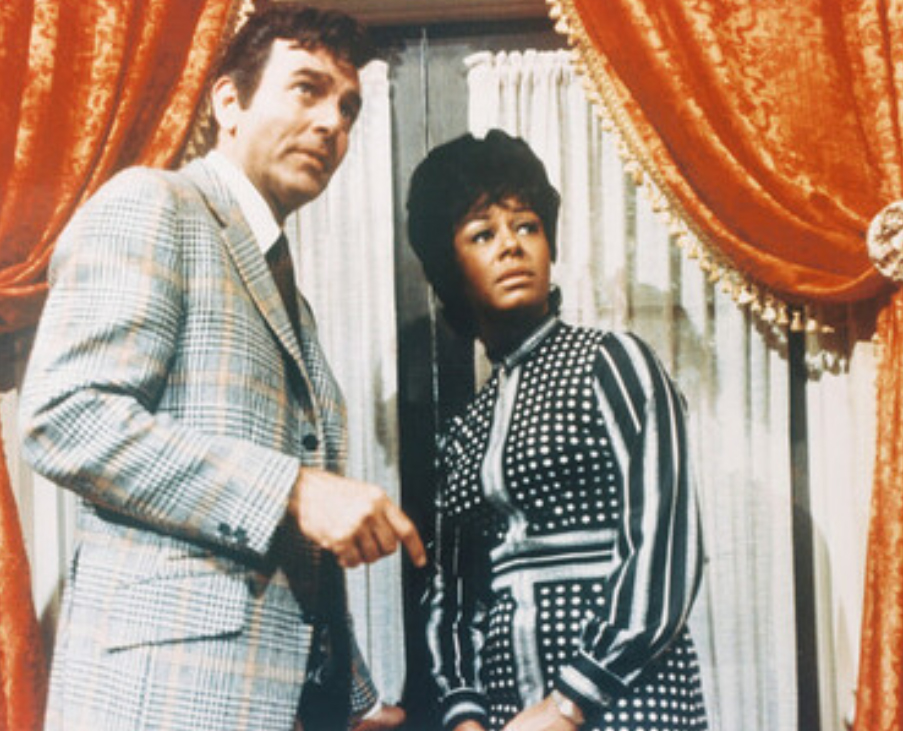
Perry Mason (1957-1966)

Perry Mason is an attorney who always wins his case. This almost always happens during a trial by showing that someone else in the courtroom is guilty of the crime his client is charged with. Through witness testimony he leads to the truth, and either the witness testifying or someone else in the courtroom inevitably stands up with an “I did it” announcement. Of course, once this announcement is made, Perry has won the case for his client.

Perry’s secretary/legal assistant, Della, is a smart, single woman who is always at Perry’s side. She sits in his office while they work, is there when he meets with clients or with his private investigator, Paul Drake. Della also goes to clients’ homes and attends special events or dinner appointments with Perry.

Della is portrayed as very intelligent and capable, but almost every other woman in every episode fits the “dumb blonde” profile. They appear very naive or lacking in intelligence. They are highly emotional and unable to cope with the slightest bit of stress.

Paul Drake Standing, Perry Mason at Desk as Della looks over Perry’s shoulder

Paul Drake is a private investigator that does work on every case Perry handles. Paul is always available at a moment’s notice. The same goes for Della. It appears neither Paul nor Della has a private life. Their entire existence revolves around Perry’s business needs.

It is a good show that I enjoy watching. The outcome is very predictable.

Mannix (1967-1975)

Mannix is a Los Angeles private detective. He is good-looking, drives a convertible, and women in mini-skirts are always after him. He has an attractive secretary, Peggy. Peggy is the widow of a police officer and is raising a young son on her own.  

At a moment’s notice, Peggy is always able to find a babysitter so she can work late, work weekends, stay with female clients overnight, and more.

Throughout every episode, Mannix will get into at least one fistfight, get shot at, and have his car run off the road. Remarkably he never gets a black eye but does sometimes suffer injuries. His car is always repaired quickly. The “bad guys” frequently show up at the office, putting Peggy in dangerous situations as well.

This is a fun one for finding errors where writers and producers didn’t check their facts. For example, in one episode Mannix was preventing a plane from leaving the ground. The pilot was knocked unconscious but still in the pilot’s seat. Mannix is standing by the pilot’s seat, leans over and pulls up the yoke, and turns it to the left. The plane turns to the left and stops. This would never have happened in real life.

Joe Mannix and secretary Peggy

Pulling back on the yoke in an airplane causes the plane to climb in altitude or lift off the ground if there is enough speed. Turning the yoke causes the plane to bank in flight, but does nothing on the ground.

When on the ground you turn the plane using the foot pedals, and you stop the plane by pushing the top of both foot pedals forward simultaneously. How do I know? I live with a pilot!

By the time we reached the 1970s, women in TV shows were being portrayed as intelligent and emotionally stable.  

Barney Miller (1975-1982)

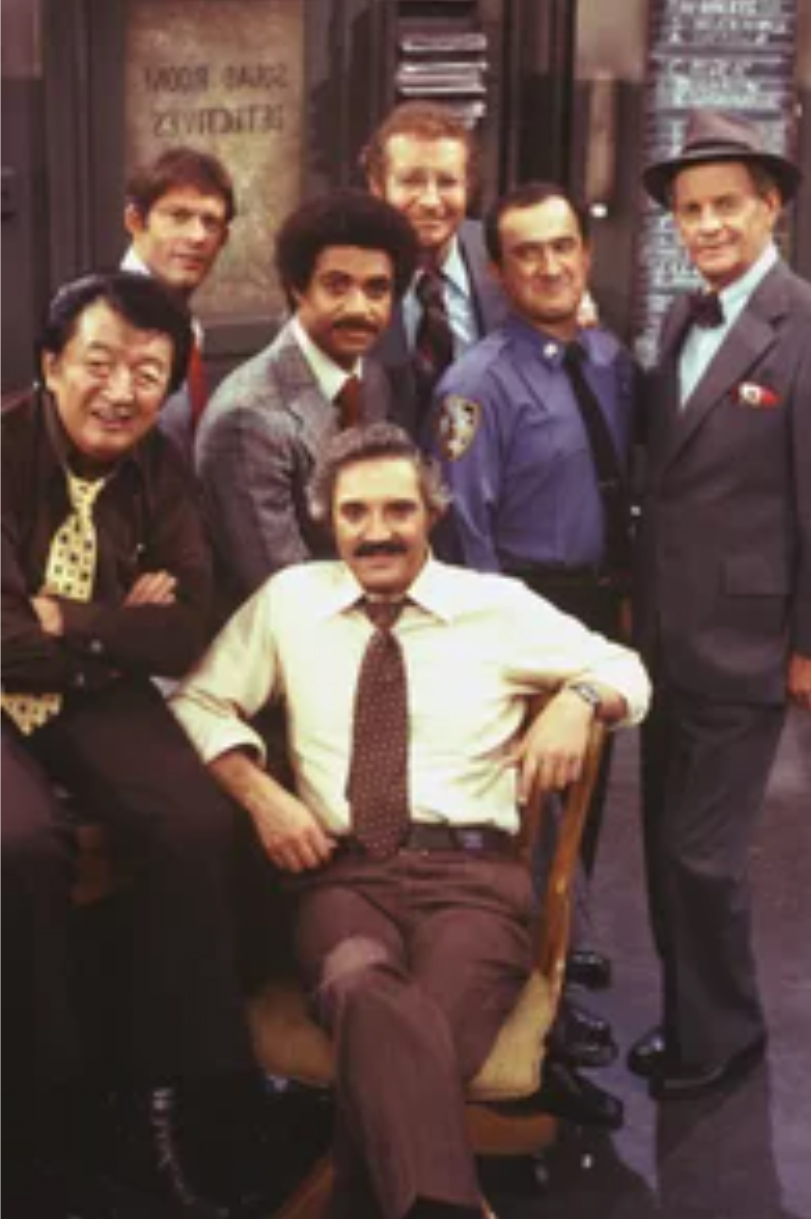
This is a comedy set in a New York City police station in Greenwich Village. The goofy situations the detectives deal with are so off-the-wall that you have to assume they represent real police incidents. The show’s characters are an ethical mixture of good-hearted, comical professionals who manage to get the job done.

Captain Barney Miller is in charge of the precinct. He is level-headed and serious about getting the job done, despite having a bunch of partially inept people working for him.

 “Wojo” is short for Wojciehowicz. True to the era’s habit of joking about Polish intelligence, Wojo is well-meaning, physically attractive to ladies, but lacking in intelligence. Although successful in getting the bad guys, he always manages to bumble something.

Harris is a good-looking, fashion-conscious, cultured black man who is aspiring to become a successful writer. He is always placing notes about incidents at the station into a mini-cassette recorder for use in his writing. Harris is the classy type who can fix you a perfect cup of tea and take you to the symphony.

Yemana is Japanese, introverted, and always reading and trying to avoid work. One of his “duties” is to make the coffee at the precinct, and it is horrible. He never makes a decent pot, yet everyone continues drinking it. He is also responsible for the filing, but no one can ever find anything he files.

Dietrich is a curly-haired blonde, brainy, and always able to fill everyone in on any subject they are discussing. He is the type of person you picture as a kid reading encyclopedias and enjoying homework.

Fish is on the edge of retirement and has a condition that always has him running to the bathroom. Married for years to Bernice, he constantly makes subtle complaints about her or marriage. Bernice always calls him at work for some goofy reason.

The cast of Barney Miller – Barney seated, from left to right Yemana, Wojo, Harris, Dietrich, Levitt, and Frank Lugar

Inspector Frank Luger is constantly stopping in, trying to catch the precinct doing something they shouldn’t. He is both annoying and likable at the same time.

Last but not least is Officer Carl Levitt. Levitt is still in uniform and delivers the mail daily. He wants to move into Barney’s department and become a detective. Levitt is constantly pointing out his achievements, no matter how small. He is also very sensitive about being shorter than the others and tries to stress when his shorter stature is beneficial.

I recently watched the final episode of the series from 1982. Although not a longtime watcher, it was a sad moment when everyone had to leave the precinct for the last time and go their own way.

What oldie TV shows do you enjoy watching?  
What are your observations when you go back and view old shows today?

Leave a comment

Filed under Discoveries, freindship, habit, impressions, Uncategorized

Not Smart Enough

Imagine back to when you were in the 8th grade, about 14 years old. You must make a decision that impacts the balance of your time in school. You can take a vocational program, which you attend to grade 12, or a university prep program, which you attend to grade 13.

Once you make your decision, you cannot change to the other program. Now, consider being that 8th grade boy and before you make that decision your school principal informs you that you aren’t “smart enough” for college, so you better go vocational.

That is the way school in Owen Sound, Ontario, Canada was in the mid-late 1950s when Paul Cannon attended. He followed the advice of his principal. The question is, after hearing the principal’s assessment of his abilities, what did Paul do with his life?

The Teen Years

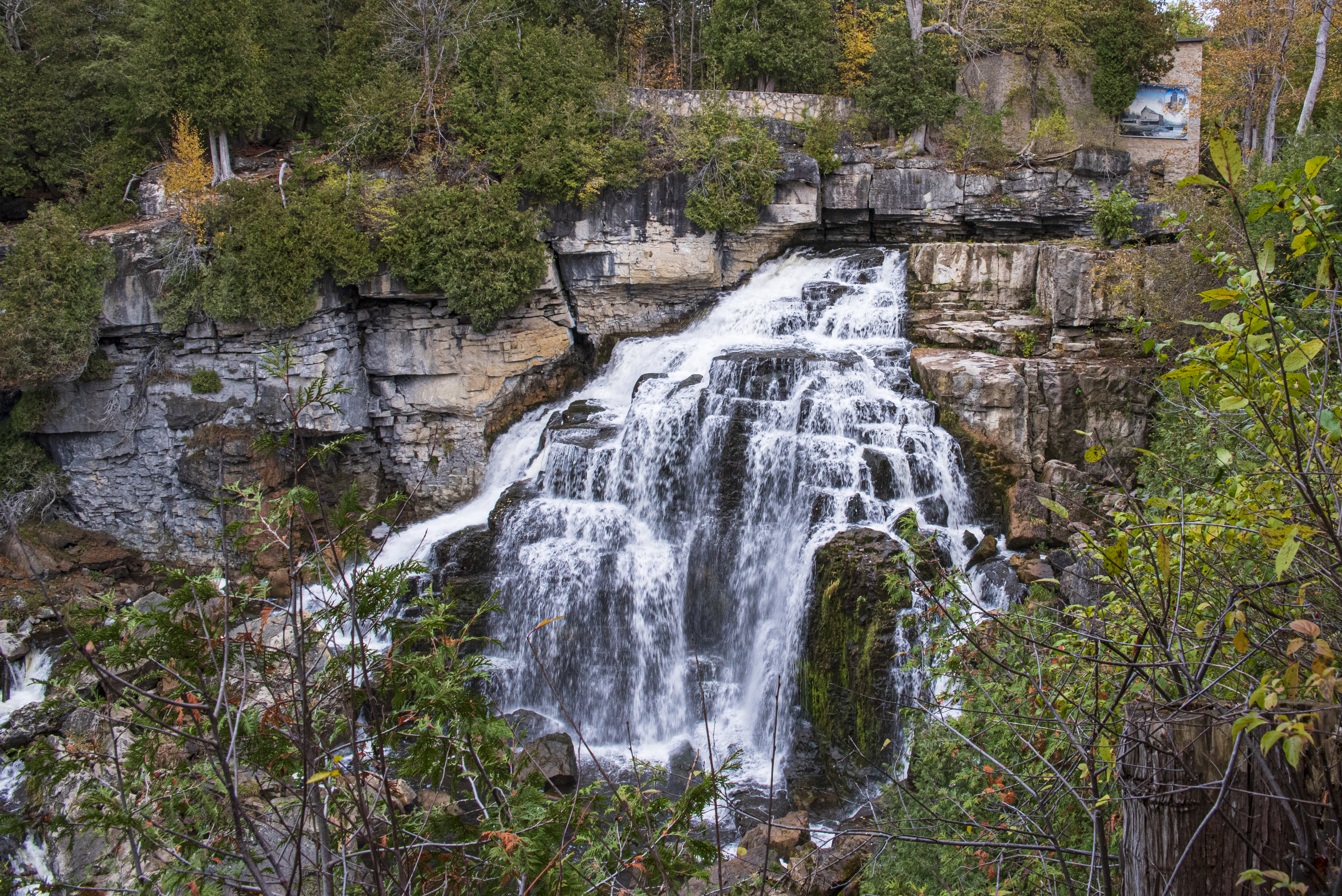
Paul was not afraid of water, and unbeknownst to his mother he and his friends would climb Inglis Falls in the summer. This was the largest of the four waterfalls in town and has a 59-foot cascade. I’ve seen in the fall with a slow flow of water. It is huge! 

Inglis Falls in Owens Sound, Ontario, Canada
Inglis Falls in Owens Sound, Ontario
Photo by Grace Grogan

When Paul was about 14-15 years old he became certified as both a swim instructor and a lifeguard. He worked as a lifeguard at the community pool and taught swimming to adults and children both there and at the YMCA.

Paul was interested in science and technology, and around age 16 he and three friends learned about an Army surplus store in Toronto selling non-working ham radios for parts. The store had ten radios, and they purchased them all. The intent was to build two or three operating ham radios from the parts, and they did!

Paul and his friends had fun communicating on the radios for about a year. None of the teens had taken the required test to become licensed ham radio operators so were broadcasting illegally. An officer tracked them down and removed the tubes, rendering the radios inoperable.  Years later as an adult Paul took the test and became a licensed ham operator.

Paul always had an interest in aviation and was a cadet in the Civil Air Patrol (CAP) in Canada growing up. The group’s intent was to introduce 12-19 year old students to flight. As a CAP cadet, Paul received education regarding citizenship, leadership, physical fitness and general aviation. In Canada today one out of every five pilots is an ex-air cadet and 67% of commercial airline pilots began as air cadets.

Bush Pilot

When Paul was 16-17 years old he got a summer job working for a bush pilot in a nearby town. That first summer Paul performed miscellaneous jobs and ran errands. When the summer ended the owner told Paul if he returned the following year the owner would teach Paul to fly.

Paul returned and became a bush pilot, flying a Beaver pontoon plane. Bush pilots fly in remote areas, and Paul’s job was to deliver supplies to cabins in the wilderness. You have probably seen this in movies where a plane lands on a body of water, docking near a cabin to leave supplies.

All pilots must learn how to read the weather, and because pontoon pilots land on water, they must also evaluate the water’s surface before touching down. Accommodations must be made for wind direction, the direction and speed of the current, and any obstacles that may affect their landing. Once on the water the pilot must follow all marine rules.

On one flight Paul was landing to leave supplies at a not-yet occupied cabin when the engine on his plane blew. Oil splattered the windshield and the plane stopped before he was near shore. Pontoon planes must carry a paddle for this type of situation. Paul shut down all systems on the plane, then climbed out to sit on one of the pontoons, straddling it like a horse. Paul then paddled his way to shore. If you think rowing a boat is difficult, try an airplane! 

There was no radio communication, so Paul unloaded the supplies into the cabin and hunkered down for the night. His boss had expected him back before dark, so when Paul didn’t return the owner went out the next morning, flying Paul’s route. When he spotted Paul’s plane, he touched down so see what was going on. Paul already had the cowling off the plane, but neither Paul nor his boss had the tools or knowledge to repair the engine.   

Beaver Pontoon Airplane
Photo by Grace Grogan

The owner said he would be back, and when he landed the second time he was accompanied by a mechanic and tools. The owner left Paul and the mechanic to work on the engine. The two spent another night at the cabin before repairs were complete. The plane Paul flew only had one seat, the pilot’s. Once the repairs were complete, the mechanic strapped himself onto the top of a cargo box in the plane and rode back with Paul.

Bush pilots are required to carry a bush pilot’s rifle because situations such as the one above or an unanticipated stop in the wilderness can put you in danger. If Paul was flying his route and saw severe weather ahead, he would land the plane and beach it. Using ropes he would tie the plane to trees to secure it during the storm. When performing these tasks, he always had to be on the lookout for bear.

Paul continued working as a bush pilot for a year after graduating high school, then left for Toronto to attend college.

Radio College           

Radio College of Toronto, Ontario trained students in electronic engineering technology and had a focus on tubes and digital electronics. Electronics technology was the wave of the future in the early 1960s.

While Paul was attending college, he lived in a boarding house with 17 other men. They were housed two to a room, with no locks on the room doors. The home was run by a single woman who ran a tight ship. She made all beds every day and washed the sheets once a week.

Board included breakfast and dinner Monday thru Friday. Paul quickly learned that when sharing a table with a large group of men there were no second helpings. You better get a sufficient amount the first time a dish went around the table. Lunch and weekends boarders were on their own for meals, but could use the kitchen and food she had as long as they cleaned up afterwards. This was a very different type of living than Paul had growing up as an only child.

One evening Paul and his roommate heard a knock on their door, which immediately flew open and in rushed the landlady. She didn’t say anything but hurried over and threw open the window, reached into her pocket to grab a pair of scissors and reached out. The next thing Paul heard was glass breaking on the sidewalk below. Apparently one of the borders owed the landlady money, and she suspected he might try to slip out. By cutting the string to the bundle of belongings the border was lowering from his third-story window, the landlady made it clear she knew what he was up to. No one knows if she collected the money owed her or just enjoyed a bit of revenge.

Paul rode the streetcar to and from college, and sometimes hitch hiked his way back to Owen Sound on weekends to visit his parents. If living in a boarding house and using public transportation bus wasn’t enough of a challenge, Paul was doing this on crutches. Paul played B-Team Hockey and did competition ski jumping. Unfortunately, he landed a jump wrong, breaking his ankle.

Paul quickly learned that in a time of need, crutches make a great weapon. One day Paul got off the streetcar and some guy, thinking he had one-up on Paul, knocked Paul’s books out of his hands. Paul may have been a bit disabled, but not unarmed. He swung one of his crutches around and clobbered the guy. A police officer saw the exchange, came over to pick up Paul’s books and make sure he was okay. When Paul left the scene his attacker was in the back of a police vehicle.

Using city transportation when dating was something Paul learned could be difficult. On one date Paul took a girl out, then escorted her home, staying to visit until about midnight. Big mistake!  When he got to the bus stop he had missed the last bus in that area, so he walked down to the next line, just in time to miss the last subway of the night. He ended up walking all night to get back to the boarding house. Thank goodness it happened on a Friday night, and he was able to sleep when he arrived there the next morning.

Work and Electronics

After graduating from Radio College, Paul took a position installing and repairing x-ray machines throughout Canada. This took him into every Canadian province, a position that nurtured his love of travel and photography. His goal was to emigrate into the United States, work his way west and eventually end up in Australia. He didn’t make it past Michigan.

Immigration into the United States took about a year. Paul needed to find a job that would hold the position for six months while he completed the immigration process. He was about 23 when he got his first job in Michigan doing the same thing as in Canada. Paul was living the bachelor’s life, driving a convertible and working in hospitals throughout the tri-state area of Michigan, Ohio, and Indiana, where there was plenty of female staff to date.

Many people do not realize that immigrants must register for the draft six months after they become permanent U.S. residents. Paul registered during the Vietnam era and knew how to fly the same type of plane being used in the war. Each year he was obligated to check in at the military office, and each time he met new criteria for a waiver so was never drafted.

Career Change

Paul was talking with an electrician and learned they made more money than Paul  was in the electronics field. Paul purchased code books and studied to become an electrician. Though not licensed, he got a job working for Morgan Electric. When a client requested a special electrical job, Paul volunteered for the assignment. The client was impressed with Paul’s work and offered him a job working for their company.

Paul made the job change. Always looking to advance, Paul later applied and got a job in skilled trades as an electrician at the Ford River Rouge plant. Unfortunately the plant did layoffs before Paul had 90 days in.

Needing work and the economy being bad, Paul took a job working on an ambulance. It was on-the-job training, they were not paramedics. The crew would perform basic first aid and transport patients to hospitals. This was during the 1967 Detroit riots and runs were often into dangerous areas. It wasn’t all bad though.

One run was to Governor Romney’s home. The governor’s wife had fallen and injured herself, requiring an ambulance transport. Paul also delivered two babies during his time on the ambulance. One laboring woman looked at him and said, “it’s my first” and he responded, “mine too.” 

When Paul’s father notified him Pittsburgh Glass Works was opening a plant in Owen Sound and needed skilled trades workers, Paul applied and was the first electrician hired. He moved back to Owen Sound and lived there for two years. The glass plant job gave him experience in trouble shooting factory machinery, which would pay off later.

When the economy improved Paul moved back to Michigan and took a position at Allied Chemical in Mount Clemens. An electrical inspector saw his work and volunteered to sponsor Paul for taking his journeyman’s test. You cannot take this test until you have verification of 10 years of experience working as an electrician and a sponsor. Paul passed the test and immediately began studying for his master’s license.

You must work as a journeyman for a minimum of two years before taking your master’s exam. When Paul reached the qualification period he took the test and became a master electrician. Paul then started his own electrical contracting business, Trojan Electric. This electrical contract work was in addition to his full-time employment. His business was lucrative enough to necessitate employing a work crew.

While working at Allied Chemical in Mt. Clemens, Paul saw an ad for skilled trades at the Ford Motor Company Paint Plant. Paul applied and went into Ford as a re-hire. He remained at Ford as an electrician in skilled trades for the balance of his working life, retiring out of the Ford Utica Trim plant.

Back to Flying

After Paul immigrated into the United States, he checked into getting his pilot’s license. The bush pilot Paul worked for never had him keep a pilot’s logbook, so there was no record of his time in the air. Paul had to start over. Lessons were easy because he knew how to fly, he just had to master landing on solid ground.

Pilots must learn navigation and weather patterns, plus cloud types and cloud levels for flight. Paul can look down the road when driving and recognize rain that is coming down but not reaching the ground. He can also see it ahead and predict the time the vehicle will drive into it. Navigational training allows him to know the direction he is driving based on the sun.

Paul purchased his own plane, a Cessna 177 RG (RG means retractable gear) and served as an adult member on the Civil Air Patrol (CAP). The Civil Air Patrol is an Auxiliary of the U.S. Air Force that was founded in 1941 to mobilize civilian aviation resources for the national defense.

Cessna 177 RC
Cessna 177 RG
Photo obtained off Internet

Paul underwent training in CAP to fly both counter drug operations and search and rescue. He enjoyed his time working on missions, which often ran one to two weeks at a time. He also volunteered his time working with CAP cadets, taking them up in his plane for a ride or assisting at special cadet outings. The CAP has the same officer ranks as the Air Force, and by the time Paul retired from service he had achieved the rank of Major.

Paul’s love of aeronautics led him to volunteer his time at the air show held each year in Oshkosh, Wisconsin. He worked in the sound center manning the sound control for the music and announcers during the air show. This required balancing the voice and music, plus timing the music for the air acrobatics of the plane.

Paul learned to be prepared for the unexpected. A woman was narrating her husband’s performance when his plane crashed. Her reaction was a blood-curdling scream into the microphone. Paul immediately cut the sound.

Paul enjoyed his time at the air show, meeting celebrities and working with pilots to time their music to their performance. It was a week of both work and fun, affording him full access to the air show grounds.

In His Free Time

When Paul was ready to move out of the city, he purchased five acres of property in St. Clair, Michigan and built a home. Paul was the contractor for the job. He ran all electrical wiring in the home and finished the interior. This included building the staircase leading to the second floor and installing all kitchen cabinets and countertops. He did this while working full-time at Ford Motor Company and running Trojan Electric.

In addition to volunteering his time with CAP, Paul participated in a computer club and remains a member of the Blue Water Shutterbugs Camera Club. Paul served as treasurer in both clubs. His photographs are sold on Alamy and Fine Art America, and for several years he sold them in fine art shows. Paul spent several years teaching photography, originally in a classroom setting, then one-on-one. He customized lessons to fit his student’s needs, including how to operate a camera, how to take better photographs, and how to process photos in Photoshop.

Paul Cannon now lives and travels throughout the United States and Canada in a 35-foot motorhome, towing a Jeep Rubicon. I am lucky to be living and traveling with him on his latest adventures. We enjoy visiting new places and navigating off-road trails. We produce videos of our adventures and share them on our YouTube Channel, Rolling Thru North America, Travel With US!

Not Smart Enough?

Can you imagine if Paul had only been “smart enough” for college what he might have done with his life? Maybe it is a good thing he did not attend a 4-year college. Paul may have not been ‘smart enough” in his principal’s eyes, but what he has accomplished in his 78 years of life has been diverse and interesting.

Writer’s Note:  This was originally written entirely from memory based on information I garnered from Paul over the past six years. After publication Paul read the above and advised me of some minor corrections needing to be made. Those changes have been made and the writing is now accurate.

Leave a comment

Filed under assumptions, Canada, career, children, decisions, Discoveries, education, employment, exploration, Full-Time RV, hobbies, home, impressions, Life Changing, Life is a Melting Pot, Michigan, Photography, time, travel

A Country at War With Itself

It is sad what the United States has become in just a short period of time. As we look at the destruction created by the looting and vandalism in the past few days, it is disturbing to see how much anger and hurt is harbored by so many of our citizens.

In truth, this is not a hurt or anger created by only George Floyd’s death, when a white officer pushed a knee into his neck for 8+ minutes, resulting in his death. This came only a few months after the killing of Ahmaud Arbery, who was attacked and gunned down by two white men while out for a jog. It took months for those men to be charged with a crime, and only after a video of the incident went viral on social media.

The protests being waged following Mr. Floyd’s death are the result of pent-up anger that has continued to grow as black people are disproportionately killed by white law enforcement officers.  Blacks make up 13% of the U.S. population, but are 2-1/2 times more likely to be killed by police.

What is further infuriating is that in many cases the officers are not charged for having committed a crime. If charged many are found not guilty.

A huge problem in this country is the blue wall of silence, also referred to as the blue code of honor. This is a silent code under which police officers stay silent, refusing to report other officers who exercise misconduct, criminal behavior, discrimination, police brutality, or any other unethical action. Body cameras and bystanders recording on their cell phone cameras are finally bringing some of this to light.

I was very pleased to see the Minneapolis Police Chief remove his hat and kneel at the spot where George Floyd’s life was taken, and also remove his hat when he answered their questions on the news. This shows him to be a person of moral and ethical character.

When questioned the police chief stated that he fired of all four officers because the other three officers, by not intervening, were complicit with Derek Chauvan having his knee in the neck of George Floyd for 8+ minutes, resulting in death. Derek Chauvin, who has been charged with 3rd degree murder and manslaughter.  The other officers have not been charged.

I have seen many cities where police officers are walking with demonstrators or kneeling with them in prayer. This shows that not all law enforcement condone the behavior of the bad, but it is not enough to heal the pain that has been going on for too long.

Obama Administration

It was only a short 12 years ago that this country reached a milestone when it elected Barack Obama as President of the United States. This country, with its horrible history of slavery, racial oppression and discrimination, had elected a black man into its highest-ranking position.  That said a lot for how far our country had come.

Barack Obama served for 8 years as president.  During his presidency there were several high-profile deaths of black Americans engaged in encounters with the police and protests led to rioting:

  • Oscar Grant, a black transit passenger, was shot by a white police officer. Riots broke out in Oakland, California. The officer, Johannes Mehserle was found guilty of involuntary manslaughter.
  • George Zimmerman was acquitted of murdering Trayvon Martin, a black teenager, and riots broke out in Los Angeles.
  • Manuel Diaz, a 25-year old black man, was shot to death when he ran from police. Destructive demonstrations broke out in Orange County, California.
  • Kimini Gray, a 16-year old, was killed by police after allegedly pointing a handgun at them. Riots broke out in Brooklyn, New York.

The Black Lives Matter movement began in 2013. It was created to give black people a voice in civil rights. Issues included a broken criminal justice system and a higher unemployment level among black Americans. Those problems still exist today.

Black Lives Matter believes in peaceful demonstrations. They do not participate nor do they encourage looting and violent acts like those taking place today.

George Floyd’s Two Autopsies

After the autopsy of George Floyd’s death indicated he died from underlying health conditions, not from the loss of breath created by a knee on his neck for 8+ minutes, people were angry and upset. His family ordered an independent autopsy.

That independent autopsy determined George Floyd’s death was caused by “asphyxiation from sustained pressure”. The difference in the two determinations makes one question whether the first medical examiner works frequently with the police and is part of the “code of blue.” Both medical examiners ruled the death a homicide.

Where We Stand on Race

In 2016 a survey showed 56% of white Americans said the race of a subject made no difference in the use of police force, but only 18% of black Americans believed that to be true.  More than 2/5 of black people said that police in their community made them feel more anxious than safe.

U.S. citizens, looking for change, elected Donald Trump in 2016. A non-politician, non-military, public figure who promised to Make America Great Again.  The question now comes to mind, Is America at War With Itself?

There continues to be racial divide in this country on how people are viewed based on the color of their skin. There is inequity that results in black people being disproportionately injured or killed by white police officers.   

The fact that we have protestors trying to storm the White House and destroying Secret Service vehicles says a lot about what a lot of Americans feel toward President Trump.

Where else in American history can you recall riots where Washington DC monuments were defaced?

Where the Treasury Department was attacked?

Where the White House was at risk of being breached by protestors? 

When Chopper One lands at the White House lawn and is greeted by protestors with their middle fingers raised? 

Why is former Vice President Joe Biden was out speaking with protestors while President Donald Trump is hiding in a bunker under the White House? 

Trump Administration and Racism

It is likely that a culmination of numerous factors has led to the anger displayed toward President Trump.  We are all familiar with his tweets that repeatedly insult people, make racial slurs, and instigate violent acts.  

American people have come to realize what a strong racist their President is. Mayors of cities undergoing riots have asked President Trump to be quiet. To stop posting comments on Twitter that instill violence. To stop posting racial comments from the 1968 racial riots.

It isn’t all about tweets and verbal comments. His tendency toward discrimination against those of non-white ethnicity screams out from his campaign and administration: 

  1. In 2016 there was a strong correlation between Trump campaign events and acts of violence. Data from the Anti-Defamation League showed that counties hosting Trump campaign rallies had more than double the hate crimes than similar counties that did not host a rally.
  2. Counties that voted for Donald Trump by the widest margins experienced the largest increase of reported hate crimes.
  3. Surrounding the election of Donald Trump, hate crimes peaked from October to December 2016 and continued through 2017. This was the second largest increase in hate crimes in 25 years. The highest increase in hate crimes followed September 11, 2011.
  4. Quinnipiac University released a poll that states 80% of African-American voters feel Donald Trump is a racist. 55% of Hispanics feel Trump is a racist, and 51% of all Americans feel he has racist views.
  5. In August 2019 President Donald Trump spoke at the 400th anniversary of the year slaves first arrived on American soil. His behavior prior to his arrival resulted in the Black Caucus of the Virginia legislature boycotting his appearance. In doing so they stated “It is impossible to ignore the emblem of hate and disdain that the President represents” and referred to his “repeated attacks on black legislators and comments about black communities” and they felt he was an “ill-suited” choice to commence that monumental period in American history.
  6. The Trump Administration is working to roll back President Barack Obama’s efforts to combat racial segregation. This roll-back would make it easier for banks to deny loans to black and Hispanic people. It would also make it easier for cities to confine families to minority neighborhoods.
  7. The Consumer Financial Protection Bureau has in 2020 proposed cutting back data collection that helps track discrimination in the mortgage market. In 2015 the Obama administration began tracking patterns of poverty and segregation with a checklist of 92 questions that had to be completed to access federal housing funds. The Trump administration is trying to eliminate that tracking system.  Of concern is that the Trump financial regulator could encourage banks to invest in inner city projects such as sporting arenas instead of loans that benefit local residents. 
  8. Black home ownership is at its lowest rate since segregation was legal. White rate is about 73% and black rate under 43%. 
  9. Housing discrimination complaints rose 8% in 2018, as reported by the National Fair Housing Alliance. This is the highest level since tracking started in 1995.

Trump Admnistration Civil and Human Rights Rollbacks

Between 2017 to 2020 there have been at least 79 Trump Administration Civil and Human Rights Rollbacks. Many of those rollbacks have a direct impact on low-income and racial minorities, which include:

*          In February 2017 President Trump signed three executive orders to fight crime, gangs, and drugs, and restore law and order, supporting the men and women of law enforcement. Civil rights organizations viewed these orders as vague and suspicious.

*          In August 2017 the Obama administration ban was lifted regarding the transfer of some military surplus items to domestic law enforcement, rescinding guidelines that had been created to protect the public from law enforcement’s misuse of military-grade weapons.

*          In August 2017 the Trump administration halted the EEOC rule that required large companies to reveal what they pay employees by sex, race, and ethnicity. The rule was intended to remedy unequal pay in American companies.

*          In September 2017 the Department of Justice ended the Community Oriented Policing Services Collaborative Reform Initiative. This program was created to build trust between police officers and the communities where they serve.

*          In February 2018 the Trump administration’s 2019 budget proposal denied critical health care to those in need. The funding was being diverted to funding the border wall.

*          In February 2018 the Trump Administration’s 2019 budget proposal eliminated the Community Relations Service which was established by the Civil Rights Act of 1964. Its purpose was to address discrimination, conflicts and tensions in communities around the country.

*          In 2018 The Office for Civil Rights at the U.S. Department of Education released a new Case Processing Manual that created a larger hurdle for people filing complaints. It allows for the dismissal of civil rights complaints based on the number of times an individual has filed.

*          In January 2019 the Trump administration was considering a roll-back of regulations that provide anti-discrimination protections to people of color, women and others.

*          In January 2019 it was reported that the Trump administration had stopped cooperating with and responding to UN investigators over potential human rights violations in the United States.

*          In April 2019 it was reported that the Trump administration would not nominate nor re-nominate anyone to the 18-member U.N. Committee on the Elimination of Racial Discrimination.

*          In January 2020 the Department of Housing and Urban Development issued a proposal that would gut the agency’s 2015 Affirmatively Furthering Fair Housing rule. HUD’s proposal would leave people of color, women, and protected communities already harmed by unfair and unequal housing policies at further risk.

Heal the Country

There is a very strong divide in this country. Racial discrimination and violence are at the heart of it. We are a country divided, and it needs to be healed. There is a Michael Jackson song that says in part: 

Heal the world
Make it a better place
For you and for me
And the entire human race
There are people dying
If you care enough for the living
Make a better place for you and for me

When Will it Stop?

We are now in our 7th day of protests, vandalism and looting. When will it stop? It is hard to say. We have had a President hiding in a bunker tweeting words that incite violence.  We have more than 37 cities in 22 states plus Washington DC destroyed.

It is time federal and state legislatures took action to make sure that the rights of every person in the United States are protected. Treatment and protection need to be equal regardless of whether a person is White, Hispanic, Middle Eastern, Muslim, Jewish, Black, or any other nationality.

This country was built by being accepting of all, a melting pot of immigrants that created a wonderfully diverse country. It is time laws were in place that guaranteed equal treatment for all. Until that is done and people are satisfied that their lives matter, history will continue to repeat itself.

Update:  As this writing was being finalized President Trump spoke in the Rose Garden.  Lafayette Park across from the White House was filled with peaceful protesters. Suddenly right before the speech law enforcement moved in, using tear gas and rubber bullets to force the peaceful protestors out of the park. Why?

It soon came to light. President Trump’s announced that he is deploying the 1807 law to deploy military then commented he was going to a special place.

Those peaceful protestors had been gassed and shot at by law enforcement because President Trump was walking through the park to St. John’s Church for a photo op.

Almost immediately the DC Episcopal Bishop denounced President Trump’s use of St. John’s Church as a prop. The Bishop stated that after having military police fire munitions against peaceful protestors President Trumps actions were an abuse of a sacred space.

And So We Continue

The anger continues. People want the remaining three officers involved in George Floyd’s murder charged. They want equal treatment by law enforcement. They want a justice system that is just.

It is up to the United States citizens to regain control of their country. It is time this country becomes what it was created to be, a melting pot. Many cultures living together, all on equal ground. Equal and just treatment for all races.

You may say I’m a dreamer, but I’m not the only one. I hope some day you’ll join us, and the world will be as one….from Imagine by John Lennon

1 Comment

Filed under assumptions, communication, Coping, death, decisions, events, Family, impressions, Life Changing, Life is a Melting Pot, reality

DOCUMENT YOUR PART IN HISTORY

I look around, the place has more people than normal for this time of year, but it is still pretty well emptied out. Why wouldn’t it be? Who wants to stay where the summer temperatures go as high as 120° Fahrenheit?

Yet, here I am. Our original plan was to leave here at the beginning of April and visit several national parks and scenic areas through several states before heading to Michigan to visit family. Then head south and west again, hitting Sault Lake City and Colorado Springs for photography and RV conferences before going for a three-month stay on South Padre Island, Texas, followed by winter back here in Yuma, Arizona.

Those plans have been crushed by the Coronavirus shutdowns. We have extended our stay here in Yuma until at least August 3rd. We are trying to secure reservations in Michigan for somewhere between mid-August to early October, but so far have not had any luck. The state is still locked down and the few campgrounds that are open do not have long-term spots available.

Time will tell if we travel, where we will be, and when we will get there. When you live full-time in an RV, campgrounds are an essential part of life.

We are living through an event that will be written about in history books. Have you recorded your stay-at-home location and changes in lifestyle? Have you noted the schools closing, people doing work-at-home because businesses closed, hospitals overrun with patients, people wearing face masks and gloves to protect those around them?

If you have young children, have you recorded their thoughts on what is going on around them? These are memories that may be forgotten over time but will be important to future generations.

This slideshow requires JavaScript.

Paul and I are hanging tight in Yuma, Arizona. I walked around the park and took snapshots of the camp, documenting the place that was full when we arrived in February and is now almost empty. A lot of the people here in the winter are Canadian snowbirds who were ordered to return to Canada in March or lose medical insurance due to the pandemic.

So where are you? Have you documented the event? Leave me your comments below.

Stay Safe!

Leave a comment

Filed under Activities, assumptions, backyard, Canada, communication, Coping, decisions, Discoveries, environmental, exploration, flowers, Full-Time RV, home, impressions, Life Changing, Life is a Melting Pot, memoir, Michigan, reality, spring, summer, time, tourism, travel, winter

Nature’s Palette

As you drive to the north end you encounter drifts of sand on the road, then a small sign points to Beach Access #6.  This access is outside the city limits and not maintained, but people use it every day.  The sand is thick, so a 4-wheel drive is necessary.  You maneuver through sand piles that will make you think of maneuvering deep snow if you are from the north.  Once you break free you are on a beautiful beach that you can drive for about 3 miles south and 26 miles north on the Gulf of Mexico.

It is the north drive that has the most to offer.  Every day is the same but different.  Nature creates an ever changing palette intermixed with human elements.   We enjoy driving in the edge of the water, but there is always a possibility a larger wave will come in and leave you a bit wet.  That is what happened to us one day when we had top off the jeep.  A wave hit the side coming in the driver’s side window and splashed so high it came down through the roof opening.

A trail of shells leads you down the beach, not only on the water’s edge, but also up near the dunes.  This is because during high tide the water is considerably higher on the beach, and high winds bring it in even further.   If you are lucky enough to be there on a high winds day not only will the waves be higher, but there will also be sand swirling off the dunes and flowing across the surface of the beach until it meets incoming waves,  giving a soft, mystic feel to everything.   The pounding waves provide a rhythmic music of nature as you drive.

Fishermen line their poles up along the water, sitting in lawn chairs waiting for their catch. some with BBQ grills set up to cook up their meal fresh.  We stopped to watch one bring in his catch, but it was soon discovered he had hooked a sting ray, which he cut his line from so that it could work its way back into the water.  Herons, gulls, pipers and pelicans congregate along the water’s edge, satisfying their hunger with the offerings of the water.

Visitors walk along with a bag in hand, searching for the perfect shell.  On occasion you will see a group of horseback riders from a nearby stable.  We came upon a driver in a car who was stuck in the soft sand along the surf.  We pulled him out with the Jeep’s power wench.  You may sometimes encounter nude sunbathers or swimmers.  Everyone is friendly, everyone waves.   The beach is a relaxing, fun place to be.

This slideshow requires JavaScript.

Landmarks, both natural and human-enhanced, mark your way.  Mile marker signs are mounted on the edge of the dunes so you know how far you have gone.  Some of my favorites include a log decorated to look like an alligator, a log with an upside down boot on it, a buoy that washed ashore, a container anchor that has been covered in graffiti, a piece of driftwood shaped like a sea serpent, and even a water rescue pod that has been decorated.  These items are constantly changing, impacted by nature and man, so each day brings a new look.  Sands drift and cover parts while winds uncover new discoveries.  The sea serpent log that was open and clear on our first visit now has sand over parts of it.  The water rescue pod was moved further onto the beach by the US Fish and Wildlife workers as it was sitting on the edge of a wildlife preserve.  A buoy that had drifted ashore was complete one day and missing its top a few days later.

I have enjoyed the time spent on the beach of South Padre Island, Texas.  I will miss nature’s palette of beauty and change when I have gone.  It will be interesting to see what items remain the same, what has disappeared, and what has been added by the time I return next year.

1 Comment

Filed under Activities, Discoveries, environmental, exploration, impressions, Life is a Melting Pot, nature, time, tourism, travel, vacation, Weather

SEVEN WEEKS AND ROLLING

This slideshow requires JavaScript.

Hard to believe it has been seven weeks since I started my new lifestyle of living on the road full time in a motor home (a/k/a full-time RV).  In that amount of time I have visited Ontario, Quebec, New Brunswick, Prince Edward Island and Nova Scotia, Canada and Bar Harbor/Acadia National Park, Maine in the United States.

One thing you have to do when living this way is be conservative, be flexible, and enjoy life.  Sometimes things go well, and other times the best laid plans can be foiled.  Highlights of my travels and learning curve:

  1. The best laid plans can be foiled when you make a day trip three hours away only to discover that town’s power is out and all businesses (including museum you wanted to visit) are closed.
  2. Pulling off for a quick lunch break takes more planning in a 35-foot motor home towing a vehicle than it does in a car.
  3. Ottawa, Ontario is the capitol of Canada and is a very interesting city, but bring your walking shoes.  There is one parking lot in the entire city and a lot of area to cover.   If you take a double decker bus tour it is a great way to get around, but you may end up with a tour guide who has a strong French accent and is difficult to understand.
  4. Canadians are very pro recycling The question in grocery stores is “Do you have your own bag?” not “paper or plastic?”  Some stores charge you for use of their bags.
  5. You can not stock up when items are on sale.  There is no extra room beyond the refrigerator and pantry.
  6. There is a large percentage of people in Canada who hang their laundry outside to dry….many on pulley-style clotheslines.
  7. When living in an RV, laundry is a necessary evil that must be done in a laundromat (most campgrounds have them) every 2-3 weeks.
  8.   You can live in a house for years and never wave at your neighbors, but in a campground everyone waves at everyone else.
  9. The architecture and culture of Quebec City, with its fortification wall, Citadelle, and French influence is like taking a step into another country.
  10. When you travel full time you need down time.  This is not a vacation, it is a lifestyle.
  11. When you give up on the road signs being true and think you will never see a moose, one shows up on the side of the road and you do not have the camera ready.
  12. No matter how many times you see them, the difference between high tide and low tide at the Bay of Fundy is amazing.  This is where you see the world’s largest tides.
  13. Getting your mail an average of once every four to six weeks takes planning so it arrives in a city where you plan to be at the appropriate time.
  14. A GPS can be your best friend and your worst enemy.  Our Trucker GPS in the RV took us down a road that had been re-done two years ago and no longer goes through — it is now a dead end.  When towing you cannot back up because it damages the tow unit, so we had to disconnect the jeep, turn the RV around and then re-connect before we could continue.  Of course it would have helped if Ellsworth, Maine had put up a “Dead-End” sign, as a woman on the road said it happens all the time and they have been after the city to do something.
  15. In many spots what is promoted as a “scenic drive” is overgrown with nothing to see.
  16. Convection oven cooking is not difficult, just different.  The three burners on the stove-top is much harder to adjust to as it does not easily accommodate large pans.
  17. I have not adjusted to the feel of the motor home when driving in high winds or uneven pavement.  That one is going to take some time!
  18. This is an awesome way to live and I’m glad I took the plunge and jumped in with both feet.

As time goes on I look forward to sharing more of my travel adventures with everyone.


Leave a comment

Filed under Activities, assumptions, Canada, Coping, decisions, Discoveries, environmental, exploration, freindship, friends, friendship, Full-Time RV, habit, home, impressions, Kitchen, Life Changing, Life is a Melting Pot, Meals, memoir, nature, Photography, reality, spring, summer, time, tourism, travel, vacation, winter, Writing

My First Week as a Nomad

My first six days as a Nomad were interesting, fun, and sometimes frustrating.  In many ways it feels more like a vacation rather than a lifestyle change.  It is relaxing and interesting, and sometimes not at all what is planned.  If I can experience all this in six days, I can’t imagine what the future will bring.

On Monday we left Port Huron, Michigan and traveled to Sault Ste. Marie, Ontario, Canada.  Our original plan was to stay only two nights, but after reviewing travel information about the surrounding area decided to extend our stay to a total of four days.

On Tuesday we visited the Bush Pilot Heritage Centre in Sault Ste. Marie.  Paul was a bush pilot when he lived in Owen Sound, Ontario as a teen so this was on his “hit list.”  The museum was interesting, with several planes on display inside the hanger where the museum is located.  We viewed two movies, the first was an “on board” experience with a bush pilot, and of course took the rider through a series of mistakes and mishaps that can happen on a plane, including an unexpected storm, dozing off with the plan on autopilot, and more.  The second movie was in 3D and took you into the heart of fighting forest fires.  You experienced time in flight with the commander of the entire firefighting operation, in flight with a pilot doing water drops, and on land with a ground firefighting crew.  Both movies are well worth the time it takes to view them.

A small town about four hours northwest of Sault Ste. Marie is the home of Winnie-the-Pooh, and houses a statue of Winnie, as well as a Winnie-the-Pooh and Railroad Museum.  I wanted to go there so a day trip was planned.  Part of the trip goes along the shore of Lake Superior, and we figured we would find photo ops along the way.  A visitor guide worker had told us about an off-road trail on that stretch which Paul wanted to check out.  We didn’t locate the trail she used, but did access a logging trail, which about 20 minutes in we decided was not offering any photo ops so turned around and continued on our journey.

We did find a couple spots to stop and take photographs of Lake Superior, and a small rapids and river we walked in and photographed.  It was interesting that this entire route had very few towns, gas stations, or any other type of business or rest area to stop at.    So scarce they were practically non-existent.  We saw a rest area/visitor center which made a good stop for a few minutes.  They had a small gift shop where Paul decided to pick up a couple energy bars to tie us over until lunch, which we planned to eat in White River.  That purchase turned out to be a very good decision.

This slideshow requires JavaScript.

We munched on our energy bars, and decided to stop for gas as we rolled into White River, because we would need it to make the full journey back to Sault Ste. Marie.  There were barriers up across the gas pumps and an attendant walked over and informed us that the pumps were not working because the entire town of White River had lost power and nothing was open.  We drove through town and took pictures of the Winnie-the-Pooh statue.  The attendant was correct, absolutely everything, including the museum we had just driven four hours to visit, was closed so we started our journey back.

Not too far south of White River was a small gas station with full-service pumps.  The attendant there shared that the last time White River lost power they were out for a week.  He also let us know that there was a restaurant on Hwy 17 just south of Wasmus where we could get lunch/dinner.  By now it was after 2:00 pm and we were definitely getting hungry.

We drove the two hours south and located the restaurant.  Our luck had not yet changed; on the front door hung a sign that they were closed until 5:00 pm.  It was only 4:30 so we decided to drive on.  We were not far from our campground when we found The Voyageur Lodge, which included a small restaurant.  The menu was limited, but the food very good.  Paul had an open face hamburger, which had gravy to which he added mushrooms and onions.  It normally included fries and coleslaw, but he switched the fries for onion rings, which he said were very good.  I opted for a fish sandwich which also came with fries.  The sandwich was made with whitefish which was lightly breaded and very nicely done.    We shared a butter tart for dessert, also very tasty.

Our final day in Sault Ste. Marie we drove into town and visited the historical canal sight.  At the end of the island was a swing damn, one of only nine built and the last in existence.  It is used in emergency situations if there is a problem with the lock.  This is also where the lock is located for small boats, and we were lucky enough to see two of the Soo Locks Tour boats use the lock at the same time.  The difference in elevation between Lake Superior and Lake Huron is 21 feet, so quite interesting to observe the lock in operation.   A nice way to finish out our stay.

Friday morning we said goodbye to Sault Ste. Marie and drove east through Ontario, stopping at a small campground in Lavigne, Ontario.  We are here only for two nights.  One day of rest and computer work before continuing our journey to Ottawa, the capitol of Canada, where we plan to spend four days.

We did take some time from our paperwork to photograph some very decorative scarecrow displays around town.  These have been prepared as part of a plowing competition in September. I finished out our last night in Lavigne with a walk around the park, taking a few photographs of Lake Nippising, which the campground is located on.

So far my life as a nomad has been interesting and relaxing, even if Winnie-the-Pooh’s hometown did leave me a bit frustrated.  I guess in this lifestyle you simply have to go-with-the-flow when rocks appear in the river.

Leave a comment

Filed under Activities, Canada, decisions, Discoveries, education, exploration, impressions, kids, Life is a Melting Pot, memoir, Michigan, nature, summer, tourism, travel, Upper Penninsula, vacation

Life is not meant to be lived in one place

I have reached the point of excitement.  My new lifestyle will soon be moving from life in an RV in my local area to actual life on the road.    I am now on my last two weeks of work, with the 16th of August being my final day.  I am training someone to take my place at work, will soon have the closing date on my house, and once that is completed we will set off on our new lifestyle.

This past weekend Paul and I opened up the “basement” storage in the motor home and got the last boxes out of my car and into the RV.  Not everything is sorted and organized the way we want, but I am at least officially in the motor home totally and completely.  The next two weeks will be a whirlwind of finishing up things at work and training my replacement, a doctor’s appointment, turning in my lease vehicle, finishing up paperwork, listing the second home I own for sale, and closing on the home I was residing in.   In someways the day when I can “hit the road” seems so far away, and yet so close.  Time passes quickly when trying to get everything finished in the final moments.  Trave as far and as long as you can

We are now starting to plan the first leg of our travels, and it is exciting and a bit nerve wracking at the same time.  I am semi-retiring prior to retirement age, so will need to do remote or seasonal work while on the road to supplement  the spousal pension I receive.  Until I have a steady income from remote or seasonal work  I will be concerned about finances.  That is just me.

At the same time, if I didn’t jump at this opportunity now to travel full-time I know I would regret it for years to come.  You only live once, so might as well make the most of it.  What are that chances that I will ever again run across the opportunity to live full time in a motor home traveling Canada and the United States with a person with whom I am compatible who is also a fellow photographer?

I hope this is a life style we can enjoy for several years.  The opportunity to experience a variety of cultures and the diversity of nature as we travel cross country is something I am looking forward to.  As I travel I plan to keep a journal about my travels.  I enjoy freelance writing and hopefully you will see my writing and/or photographs not only in this blog, but also in published magazines and journals.

If you have any “must see” locations in Canada or the United States, please share.

Leave a comment

Filed under career, communication, decisions, Discoveries, education, exploration, hobbies, impressions, Life Changing, Life is a Melting Pot, nature, reality, spring, summer, time, tourism, travel, vacation, winter, work, Writing

Writing to Relax

I have been, and continue to be, in the whirl-wind of trying to sort through 36+ years of belongings accumulated in my house and reduce the “keep” items down to what I can take with me in a 35-foot motor home, in which I will live and travel the United States and Canada.  Needless to say, this is a monumental task.  I am on the downside now, with only a few things left to complete, and the estate sale is scheduled May 2-6, 2019.

I have been sorting through old items, boxes never unpacked from when we moved here in February 2004, and family heirlooms, mementos and photographs.  Those special items I have painstakingly gone through and divided between my two adult children.  In the midst of all this my son has been moving out.  Between working long hours and moving about 45 minutes away, he has taken a long time in the process with a couple trailer loads of items still left to move.  This has made for a very stressful situation.   We are now down to “crunch time” as the estate seller will need to come into the home and get things priced.  My son made a comment about me pushing my sale back, but I refuse to do that.  I need to get my house emptied, ready for sale, and sold quickly.

closet cleaningI have spent weekend after weekend at home, sorting through all my current items and those in boxes, preparing for my estate sale.  Today I took some “me” time and attended the #RochesterWriters Spring Conference.  I enjoyed a day of informative keynote speakers and instructors, plus socializing with other writers.  It was time well spent, combining instruction in self-publishing with networking.   There is something about spending a day with other writers that inspires one to write.  Even though you haven’t seen me here in quite a while due to everything going on in my personal life, I find myself here tonight writing a quick blog, just to say hi and let you know I am still alive and kicking.
Once the sorting and packing is complete and I have moved into the RV, which will happen on or about April 23, 2019, you will begin to hear from me more often.  As I move into fall and begin to travel the country I plan to post travel blogs of my adventures, and hopefully expand into writing some travel articles for magazines as well.  What the future holds for me one can not be certain, but it will definitely be an adventure and a change in lifestyle.

1 Comment

Filed under Activities, assumptions, career, Cleaning, communication, decisions, Discoveries, events, Festivals, freindship, friends, friendship, habit, impressions, Life Changing, Life is a Melting Pot, reality, time, tourism, travel, Writing

Celebrate the Positive!

So here we are, ten days into the New Year.  What will it bring?  Has it been a good start?  What about resolutions?  Were they made?  Have they been broken?

My year started out in a variety of ways.  On New Year’s Eve my daughter and her family were driving north to visit family when she hit black ice and rolled her vehicle twice, ending up in the ditch.  The three children, ages 4, 8, and 12, were fine, as was her boyfriend.  My daughter slammed her elbow into the driver’s window and needed stitches, and she had a couple scratches on her face, but other than that no serious injuries.  Unfortunately the vehicle was totaled, and she only had PLPD insurance, so they are down to a single cab pickup with a family of five.  celebrate-small-success1

Here is where viewpoint is important.  Is it horrifying that they rolled….well, yes, the outcome could have been far worse.  Should everyone be upset that they are without a car and don’t have the ability to purchase another?  Of course that is a dilemma that must be dealt with.  However, the overall important thing is that no one suffered any severe, life-altering injuries, especially the children.   So, with that we can say that their New Year got off to a good start.  They came through a scary, dangerous accident without anyone being seriously hurt.   Celebrate the positive!

As for me, my New Year weekend was both work and relaxing.  I had a four-day weekend during which I never left the house.  I took down my tree, sorted and packed items to go to my kids, and also sorted and packed items for me to take when I downsize and others to go into my estate sale.  I came across things I had forgotten about, and spent some time looking at some old pictures of ancestors.   Some would consider a long weekend home alone and working on household tasks a lonely, sad existence.  I am on a time frame to get through all my belongings in preparation for downsizing and an estate sale this spring, so having a long weekend to work on my project was positive.  Celebrate the positive!

Every year I keep a list in my “notes” section on Facebook of the books I read that year.  My goal is always 52 (one per week), but I have never made that.  The best I have done is around 26.  Last year on the 14th of March I had only just finished my second book of the year.  This year I finished my first on the 4th of January and am more than halfway through my second.   I’m not holding my breath on making 52 for the year, but the odds are favorable so far.   Celebrate the positive!

So now ten days into the new year I sometimes look around me and wonder how I am ever going to get through everything I need to by the end of March.  I also worry about my son, who is trying to find a place to live as he is currently staying with me, being able to find a home and move out by the time needed.  On a positive note, he also has quite a few tubs packed with his belongings.  We can only hope that it all falls into place without a problem.  I’m not ready to celebrate yet, but I am trying to think positive.

How is your new year going so far?  Regardless of whether you have had downfalls or things to celebrate, remember to keep thinking positive.  A good attitude can get you through anything.

Leave a comment

Filed under celebration, communication, Family, grandchildren, Holidays, home, impressions, Life Changing, Life is a Melting Pot, reality, spring, vacation, winter, work

Don’t Overlook Life’s Small Joys

Quotes have a way of making you think, of getting you to take a step back and analyze things.  If you have been a reader of my blog for a while then you know that quotes frequently pop up as a topic for my blogs.  When life is especially stressful applying the thoughts in this simple quote I found can bring peace to an overly processed world.

Watch a sunrise once a year…..there is something absolutely beautiful about getting out of bed and watching the sun peak over the horizon in the morning.  This is especially true if you are near a body of water.  It is a refreshingly positive way to start the day.  Sunsets are beautiful as well, but if it has been a while since you’ve watched the sun rise, set the alarm and partake in the experience.   Refreshing!

Put marshmallows in your hot chocolate……this seems so ordinary.  So “take off the chill” normal happening in fall or winter.  Then it occurred to me that as I got older I would make a cup of instant hot chocolate, but somewhere along the line I stopped dropping in the marshmallows.  Forgo the whipped cream that has become commonplace, or worse the “naked” chocolate without any fattening additives, and go back to your youth.  Enjoy a few marshmallows melting in your hot chocolate.  Yummy!

Lie on your back and look at the stars…..remember being a child, laying on the ground and looking up at the stars, amazed at the pure beauty and wonder of them.  What a peaceful way to enjoy the nighttime sky.  So many of us live in the city hustle and bustle where there are always lights and we forget to look up at the beauty of the night sky.   As you are walking into your house after dark take the time to look up and enjoy glimmer of the moon and stars above you.  Heavenly!

Never buy a coffee table you can’t put your feet on…..being that I haven’t owned a coffee table in about thirty-seven years, I can’t say too much in this area.  I think this message has more to do with being comfortable your own home.   My parents always had a coffee table which held things like coasters, display pieces such as an antique photo viewer, or large coffee table books, but never a person’s feet!   As I prepare to downsize and move I am considering re-purposing my mother’s Lane cedar chest (the old fashioned hope chest) into a coffee table.  It would be convenient for storing afghans in the living room and could serve dual purpose as a coffee table.  Of course having owned reclining couches for several years, the idea of a coffee table may be defunct if I continue with that type of furniture.  At the same time the idea of a traditional couch with a table in front has its appeal.  Comfy!

Never pass up a chance to jump on a trampoline…..to me this says experience life, be adventurous.  While some of us may be able to climb onto and jump on a trampoline, others may not have the physical ability to do so.  Don’t let small limitations hold you back from what you can do.   Go forth and try new things, take risks.  Live life to the fullest and never pass up the opportunity to try something new.  Exhilarating!

Don’t overlook life’s small joys while searching for big ones…..this is something way too many of us do, especially when young and career oriented, which often overlaps with the time-filled days of raising children.  We get our mind set on not just keeping up with, but also exceeding “the Jones’s,” and in doing so miss out on a lot of life’s simple pleasures.   If you find yourself caught up in the rush-rush lifestyle a good way to rejuvenate is to take a walk with a child, or better yet spend an afternoon with one.  They will take you on an adventure of all the things you have forgotten to enjoy.  The pleasure of blowing bubbles, watching a butterfly, gathering stones from a beach, stomping in mud puddles, gathering fall leaves, the smell of flowers, the rustle of the wind in the trees, the joy of watching birds, or even playing with your shadow.  Relaxing!

I hope each of you reading this will take the time to do not only these things, but others that will bring you peace of mind and relaxation from the every day stresses of life.

Watch a Sunrise Once a Year

Leave a comment

Filed under Activities, assumptions, backyard, birds, children, Coping, Discoveries, environmental, exploration, Family, flowers, habit, impressions, Life is a Melting Pot, nature, spring, summer, winter

When was the last time…

…..you did something for the first time?

That is a line in a song I enjoy by Darius Rucker, just click here to hear it.  I was listening to the song and it got me to thinking about how we all develop set patterns of life.  We get up, go through the same routine during the day, go to bed, get up and repeat.

The song goes on to say “Yeah, let yourself go, follow that feeling, Maybe something new is what you’re needing, Like a real life, let your hair down, feel alive, When was the last time, you did something for the first time?”

Those are thoughts we should all put into action when our life is feeling a bit ho-hum.  It can be something major or something minor.  Just spice it up a bit to re-build your energy and enthusiasm for life.

In July I took a 10-day vacation when I flew to Alberta, Canada for the Calgary Stampede.  While it is not the first vacation I have ever taken, nor the first international flight (I flew to Mexico with a school group in 1978), it was my first time in Alberta, Canada and my first time attending the Calgary Stampede.   It was also the first true vacation I have taken since 2014.when-was-the-last-time-you-did-something-for-the-first-time-quote-1

I am currently in an active sort-of first time events project.  I have started doing some preliminary scouting of homes.  I am planning to downsize and packing and moving an entire home, not to mention selecting and purchasing a home entirely on my own will be a first.   When you have always done things with others, doing them on your own the first time is a different experience.

So, when you hear the question, When was the last time, you did something for the first time?  What is your answer?  What is on your bucket list?  Throw out some ideas….I may want to incorporate your ideas into my list.


Leave a comment

Filed under Activities, assumptions, decisions, Discoveries, exploration, habit, impressions, Life Changing, Life is a Melting Pot, mind, reality, time, tourism, vacation

Places I Have Been to For the Last Time

It is a bizarre thought, something that hadn’t really dawned on me.  Then someone considerably younger then me made a comment that he was wondering how many places he has already been for the last time.  He is only 30 years old!   I was baffled that such a thing had entered his mind.

When you go somewhere rarely do you think “this may be the last time I am ever here.”  The older you get, the more likely you are to consider such a possibility, but for the most part we humans have a tendency to expect things to always continue as they are, not realizing how precious that visit may be.

Think about places you remember with fondness, or maybe even with some sadness.  When you were there did it occur to you that it was the last time you would be there?  Maybe it did, maybe it didn’t.  When you start rolling that thought around in your head you realize how important it is to cherish every single moment of everything you do, because it may be the last time.

My grandparents house – my great-grandfather had built it when my grandmother was only six years old.  I grew up going to that house for visits with my grandparents and other family members.  After my grandfather passed, my grandmother continued to reside there until she was well into her 80’s.   I eventually got married, had children and took them to visit their great-grandmother in that house.  The last time I was inside the house the family was preparing for an estate sale following my grandmother’s death.  I can’t remember the last time I visited my grandmother in her house because one day she became ill, went to the hospital and then into assisted living, where she remained until she passed at age 94.  While the property was still in the family I would from time-to-time stop and walk around the outside of house and around the yard and barns, taking a few photos.  I knew it was for sale and had been for some time, but even then it never occurred to me that I might be walking on that property for the last time.  Eventually the house sold and my impromptu visits ended.

Cedar Point — a very popular amusement park in Sandusky, Ohio.  I used to love attending amusement parks, and we always went to one as part of our family vacations when our kids lived at home.  We sometimes attended them even without kids.  Then I was in a bad accident and ended up with severe vertigo.  I won’t go on amusement park rides ever again as I am fearful that the rapid movement of the rides might bring back the vertigo.  My favorite rides were always the fast spinning ones like the spider, swings, Himalaya, and other similar rides.  The last time I visited an amusement park or rode a ride it never occurred to me it would be the last time.

Scrapbook Memories in Chelsea, Michigan –  This was a huge scrapbook store that held 3-day crops several times a year.  My best friend, and I would meet there and attend the 3-day crops.  It was a wonderful time and something we did year after year.  Then one day we received notice that the owner had decided to leave the business and move out of state.  No one purchased the store and it closed.  Lots of memories of fun times in that store.

There are other places as well, my parent’s home where I was raised from the time I was in 1st grade until I got married and moved away.  My in-laws home that holds lots of fun memories.  The house my husband and I built in 1983 and then sold in 2004.  I’m sure if I sat and thought there are many others.  Will I ever go back to Disney World?  Will I someday get back to Hawaii?  When I was there years ago I assumed I would someday return, but in reality, will I ever?

Cherish the time you have at each place you visit, be it on a regular basis or only on  occasion.  You never know when circumstances will make it the last time.

What are the places you have been for the last time?

5 Comments

Filed under Activities, assumptions, decisions, Discoveries, exploration, impressions, Life Changing, Life is a Melting Pot, memoir, reality, time

The Note In My Windshield Wiper

I don’t know what was more disturbing, the fact that I never noticed the note in my windshield wiper, or the content of the note itself.

The fact that I hadn’t noticed it was disturbing because it was most likely put in their on Saturday, a day in which I had made several stops running errands.  Based on the “er” on the left of the note my guess is that the paper used came from Meijer, but for it to happen at that location also made no sense.

I was at work on Monday and one of the attorneys in our office came in and said “Grace, you have a nasty note on your car, a really nasty note.”

I could not understand why anyone would leave me a note, and my first assumption was that it had been put there while I was in the office.  The attorney had noticed it tucked under my windshield wiper blade, and the paper was a bit stiff and yellowed, as if it had been baking in the sun.

When I read the note I realized it had to have happened when I was running errands on Saturday, because early Saturday it had rained and the note showed no sign of having gotten wet.  I knew I had not bumped anyone’s car with mine, not even a door, so I was baffled at the note.  However, my instincts told me that, based on the wording, it was possible whoever wrote it may have done something to my vehicle in retaliation.  I walked outside and checked my car out all the way around — no damage, so that was a relief.note on car010

My mind then went through my day, trying to figure out the location.  Even though I was guessing at Meijer based on the red “er,” I still wanted to figure out where I may have been parked close enough to warrant such a note.

  • First stop, farmer’s market — parked in a muddy dirt lot, I was the end vehicle and a wide walking path between me and the vehicle next to me.  Definitely not there.
  • Second stop, Kohl’s.  I parked in a normal spot, but my vehicle was dead center on my spot and so were the cars on either side of me.  I don’t think that was a logical location.
  • Third stop was a pool supply store, very small and there were only two vehicles in the entire parking lot with plenty of space between.  Definitely not there.
  • Fourth stop was Sam’s Club.  I parked next to the cart corral, and because the car on my driver side was over the yellow line, I had to park extremely close to the cart corral and was closely watching my mirrors so they didn’t catch on the rack.  If the guy next to my driver’s side wrote the note, then he should have addressed it to himself for hogging part of my spot.
  • Fifth stop was Meijer.  This was the only location where I used my handicap plate and parked in a designated spot, which means there was ample room around both sides of my vehicle.  The note appears to be on Meijer paper, but I could not have touched another vehicle, so again baffled by the message.

After all this analyzing there are two conclusions.

  1.  If the damage to the writer’s vehicle was so bad it warranted the above note, why didn’t they contact the security of the store, or even contact the police?
  2. If their vehicle really was damaged in the parking lot, it is possible that another vehicle was parked beside them, damaged their car as they were leaving, and then I pulled in, parked beside them and got blamed for someone else’s actions.

The bottom line is I will never know the answer to who wrote the note and where it occurred.   Based on the wording I will say I am glad that I did not arrive at my vehicle as they were writing the note as it may have been a hostile encounter.  On the other hand, at least I would know when and where the note was left.  The mystery of the note in my windshield wiper will never be solved.


2 Comments

Filed under assumptions, communication, Discoveries, impressions, Life is a Melting Pot, Michigan, Mystery, reality, time