Category Archives: communication

Why Didn’t the U.S. Adopt the Metric System? – Part 3 of a 3 Part Series

In Part 1 of this series, I explained how I became curious about the planned conversions from the Imperial to the Metric systems of measurement in Canada and the United States. In Part II, I provided a history of Canada’s laws that enforced the conversion and where the country stands now in utilizing the Imperial versus Metric measuring systems. Now, let’s examine the United States’ history regarding the metric system, followed by my opinion on why it failed to implement the planned conversion.

The United States is a muddled mess when it comes to its measuring system. This inconsistency and lack of follow-through dates back to our founding fathers and continues through our failure to complete the transition to the metric system in the 1970s.

History:

 When the American Colonies were being formed, the Founding Fathers decided to use an antiquated measurement system they inherited from the British Empire. Article 1, Section 8, of the Constitution of the United States provided that Congress should have the power “to coin Money… and fix the Standard of Weights and Measures.” Thomas Jefferson, Secretary of State in 1790, endorsed the use of a decimal system of measurement. The only fear was that the United States would be unable to verify the metric units without sending a delegation to France, which would be costly.
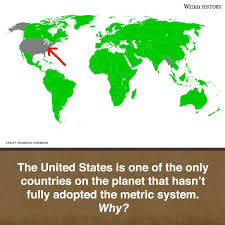
The metric system originated in France. The goal was to establish a uniform standard for all measurements and weights. The unit of length was a portion of the Earth’s circumference, and volume and mass were derived from the length unit. This was achieved by multiplying or dividing by 10 and its powers. Ten is much easier to work with than dividing by 16 (to convert ounces to pounds) or 12 (to convert inches to feet). The metric system is a decimal system with a base of 10, allowing for calculations by shifting the decimal point.

The French government officially adopted the metric system on April 7, 1795. A scientific conference was held from 1798 to 1799 to validate the system and design prototype standards, with representatives from Denmark, Italy, the Netherlands, Spain, and Switzerland in attendance. The adopted standards became official in France on December 10, 1799.

The United States was snubbed by France when it invited the other dignitaries to travel to Paris to learn the metric system in 1978. This snubbing was due to the U.S. entering into the Jay Treaty of 1796 with Great Britain, a French rival. France viewed this as a violation of its own treaty with the United States. It retaliated by seizing American merchant ships and refusing to invite them to the conference on the metric system.

The United States, having not taken part in this gathering, adopted the U.S. Customary System as our official form of measurement under Secretary of State John Quincy Adams in 1821. Part of the reason for this decision was fear that the metric system might fail following Napoleon Bonaparte’s reign during the early 19th century. Napoleon imposed the metric system on the countries he conquered, making it a symbol of French control. When European countries revolted against French control, they returned to their original means of measurement. Even with this revolt against France, the metric system continued to grow in popularity. By the end of the American Civil War in 1865, most of Europe had adopted the decimal-based measuring system.

The metric system was gaining popularity worldwide, and although we had not been invited to the 1798 gathering in France to learn about the system, President Andrew Johnson recognized its importance. In 1866, President Johnson signed the  Kasson Act, making it “lawful throughout the United States of America to employ the weights and measures of the metric system in all contracts, dealings, or court proceedings.”

France held another meeting of the world’s leading nations to discuss a new international version of the metric system, and the United States received an invitation and sent delegates. During the 1875 meeting, the United States and 16 other countries signed the Treaty of Metre, establishing the International Bureau of Weights and Measures. The treaty also created the International Committee for Weights and Measures to oversee the Bureau and the General Conference on Weights and Measures to consider and adopt changes. A lab in Sevres, near Paris, was selected to house the international metric standards. The U.S. received its copies of these documents in 1890.
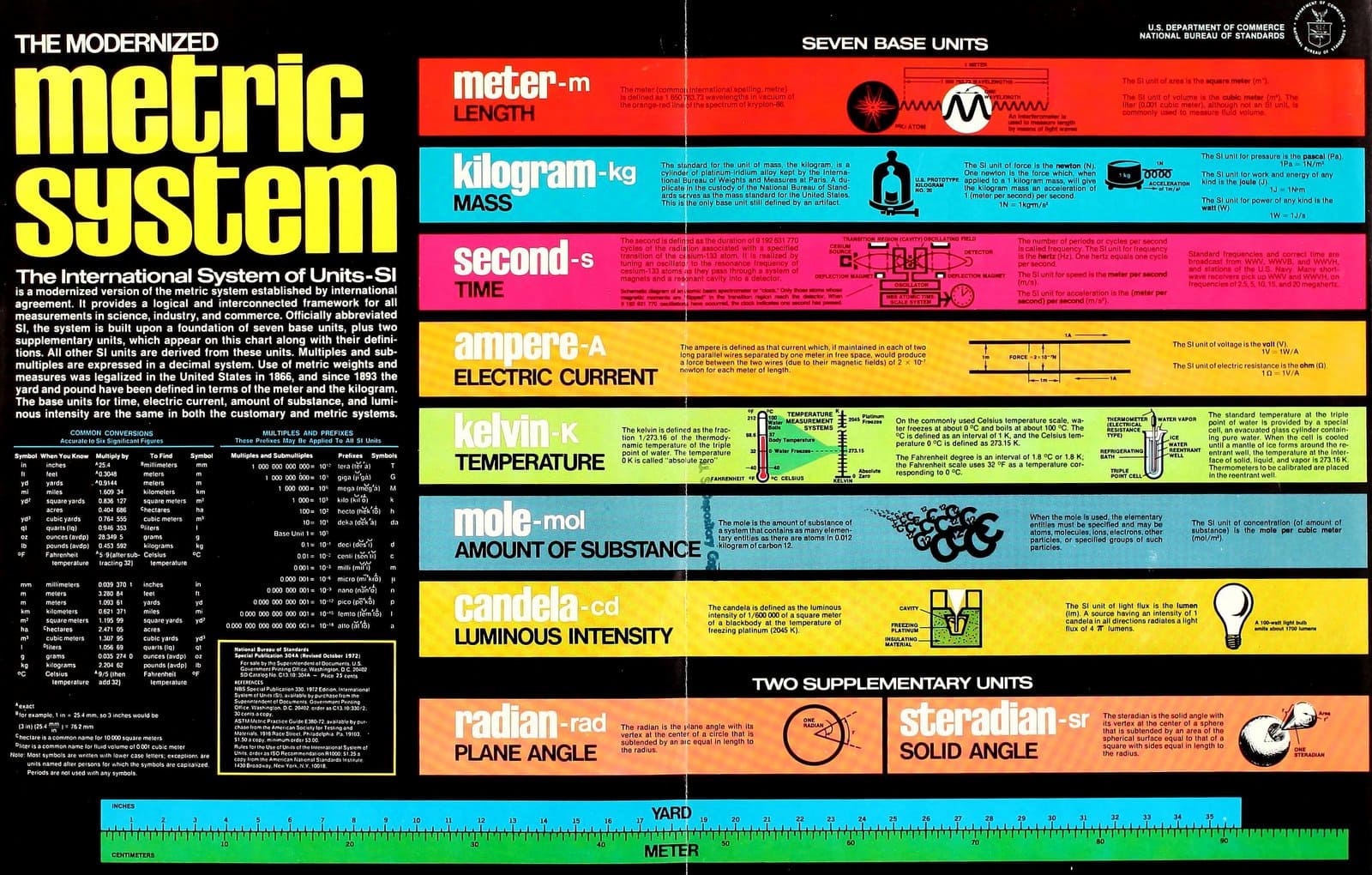
The Mendenhall Order of 1893 stipulated that the fundamental standards for length and mass in the U.S. would be based on metric units. This means the U.S. officially and legally recognized the metric system 159 years ago when Tomas Jefferson, in 1790, endorsed the decimal system of measurement. That standard was confirmed 132 years ago with the signing of the Mendenhall Order.

Current U.S. Standards

If you are like me, you probably read those last two dates and went “what!!!” If this has been our standard for over 132-159 years, why are we still not using the metric system? In my opinion, it is a combination of laziness, unwillingness to invest financially in the change, and, most importantly, lawmakers who were weak in committing to the change and developing a law that would mandate the conversion. Here is what happened that led me to that thought process:

Fast forward 78 years from the entry of the Mendenhall Order to 1971. The United States is still operating under the Customary Imperial system. The U.S. National Bureau of Standards recommended in 1971 that the U.S. transition to the metric system over the course of 10 years. This would mean that by 1981, the country would be fully converted to the metric system. The first problem was the weak law that enacted this process.

The Metric Conversion Act was signed into law by President Gerald Ford on December 23, 1975. It states that the metric system is “the preferred system of weights and measures for United States trade and commerce.” Still, it permits the U.S. customary units in all activities. It states that all conversions to metric are “completely voluntary” rather than establishing the 10-year deadline recommended by the U.S. National Bureau of Standards. Schools began teaching children the metric system, and some businesses made the change; however, the majority of conversions never took place.

Due to the U.S. failing to complete the conversion to the metric system, conducting business with foreign countries became more difficult. In 1988, the Omnibus Trade and Competitiveness Act amended the 1975 Metric Conversion Act. Federal agencies were now required to use the metric system in business activities, including procurement grants, by the end of the 1992 fiscal year. It designated the metric system as the preferred standard for trade and commerce and assigned the Federal Government the task of helping industry make a voluntary conversion to the metric system. The problem is that the conversion remains voluntary, and the private sector has no obligation to implement the change.

The result of these non-mandatory laws is that they left the United States out of sync with the rest of the world. It also means that some industries made partial or complete changes, while made no change at all. The United States is a hub of various measuring standards that are not mutually compatible.

Today, the U.S. uses the SI (International System of Units) on a daily basis. About 30% of products manufactured in the U.S. use metric units. Pharmaceuticals are all metric, and beverages show both U.S. customary and metric units. Film, tools, and bicycles are metric. U.S. coins & currency are produced using metric specifications. Wine and distilled spirits have been using only metric measurements since the early 1980s. Packaging uses metric units to provide net quantity, nutrition, and health-related information for prescription drugs, over-the-counter medications, vitamin supplements, and other products. The U.S. lighting sector uses metrics for light output (lumens), peak beam intensity (candela), beam distance (in meters), and impact resistance (in meters).

Understanding Imperial Standards

This article begins with Part 1, which explains my curiosity about how our current measures were established. I’ve taken a wide-ranging approach to the subject, due in part to my curiosity and love of history, and partly because I believe that to understand where we are, we must know where we came from.

While all this history is fascinating, it still didn’t answer my question of how the Imperial System of measurements was established. These measurements appear to date back to around 450 CE (Common Era; a secular version of AD). It was then that the Germanic tribes invaded England and established a system of measurement that remains in use today:

  • An inch (ynce) was the length of three (3) barleycorns.
  • A foot was initially based on the length of a human foot. This led to inconsistencies in measurement, so the 12-inch foot was officially codified by King Edward II, likely because 12 has more factors, making it easier to subdivide for carpentry and construction.
  • A yard was established as a 3-foot construction standard.
  • An acre means a field and was considered the size of a field that a farmer could plow in one day.
  • A gallon represents the volume equivalent to eight pounds of wheat.
  • A mile was established by the British Parliament as eight (8) furlongs, or 5,280 feet. A furlong was a length based on a single furrow in a plowed field and was standardized by England’s government around 1300.

The United States is the only industrialized nation that hasn’t made the metric system compulsory. While cost is one factor, the main reason is the failure of Congress to make the metric system mandatory in all 50 states, the District of Columbia, and all U.S. territories. The U.S. made the conversion voluntary in laws enacted in both 1866 and 1975. The country has failed to adopt a unified system of metric measurement for transactions that affect the lives of ordinary citizens.

This has led to a hubbub of mixed measuring standards:

  • A football field is measured in yards, but footraces are measured using meters.
  • Mechanics use horsepower to measure an automobile engine’s power, but the same engine’s displacement is in liters.
  • Air pressure is expressed in pounds per square inch, which is equivalent to millibars for air pressure aloft, and inches of mercury for surface atmospheric pressure.

In the U.S. Customary System, there are over 300 different units used to measure various physical quantities. The failure of Congress to make conversion to the metric system mandatory has resulted in the U.S. being a hodgepodge of imperial and metric systems.

Basic Measurement Conversions:

1 mile = 1.6 kilometers.
1 foot (12 inches) = 30 centimeters
1 inch is about 25 millimeters or 2.54 centimeters
1 yard (3 feet) is almost 1 meter
1 kilogram is just over 2 pounds
1 pound is about 454 grams
In the U.K., 14 pounds = 1 stone

Converting Fahrenheit to Celsius is easy:
0 degrees Celsius (°C) is equal to 32 degrees Fahrenheit (°F)
24 degrees Celsius is equal to 75 degrees Fahrenheit
To convert Celsius to Fahrenheit, use the formula of (c x 1.8) + 32

If you want to know more, you can use the World Wide Metric Conversion Calculator for converting pressure, temperature, length, weight, and volume. Just enter the measurement you have, and it will fill in all other boxes within that area.

In closing, should the United States have enacted firmer laws mandating the change to metric? Do you think it would be better if we were on the same measuring system as the rest of the world, or do you like being a stand-alone country using the U.S. Customary System adaptation of the British Imperial System? Share your thoughts in the comments below.

Leave a comment

Filed under assumptions, Canada, communication, decisions, Discoveries, education, habit, Michigan, reality, travel

Why Didn’t the U.S. Adopt the Metric System? – Part 2 of a 3 Part Series

In Part 1, I explained how I became curious about the reasons the U.S. did not convert to the metric system at the same time Canada was making the change, leaving us as one of only three countries in the world that do not use the metric system of measurement. This section explains what Canada did to ensure it completed its commitment to switching from the Imperial to the Metric system during the late 1970s and early 1980s.

In January 1970, the “White Paper on Metric Conversion in Canada” established the Canadian government’s policy regarding its conversion to the metric system. The document specified that Canada would utilize a single, coherent measurement system based on metric units for all purposes. They then developed the “Weights and Measures Act” in 1971 to recognize the International System of Units (SI) for use in Canada. The “Consumer Packaging and Labeling Act” in 1971 required the use of the metric system on most consumer packaging labels.

The change from Imperial to Metric took time in Canada and began in the mid-1970s. I was a high school student in the United States and didn’t concern myself with what was going on in Canada. I do remember them telling us that we needed to learn the metric system because the country was changing to that form of measurement. I also recall that there were many objections to making the switch. We did incorporate some changes rather quickly, the main one being the switch to one- and two-liter bottles of soda. I don’t remember many other changes being made.

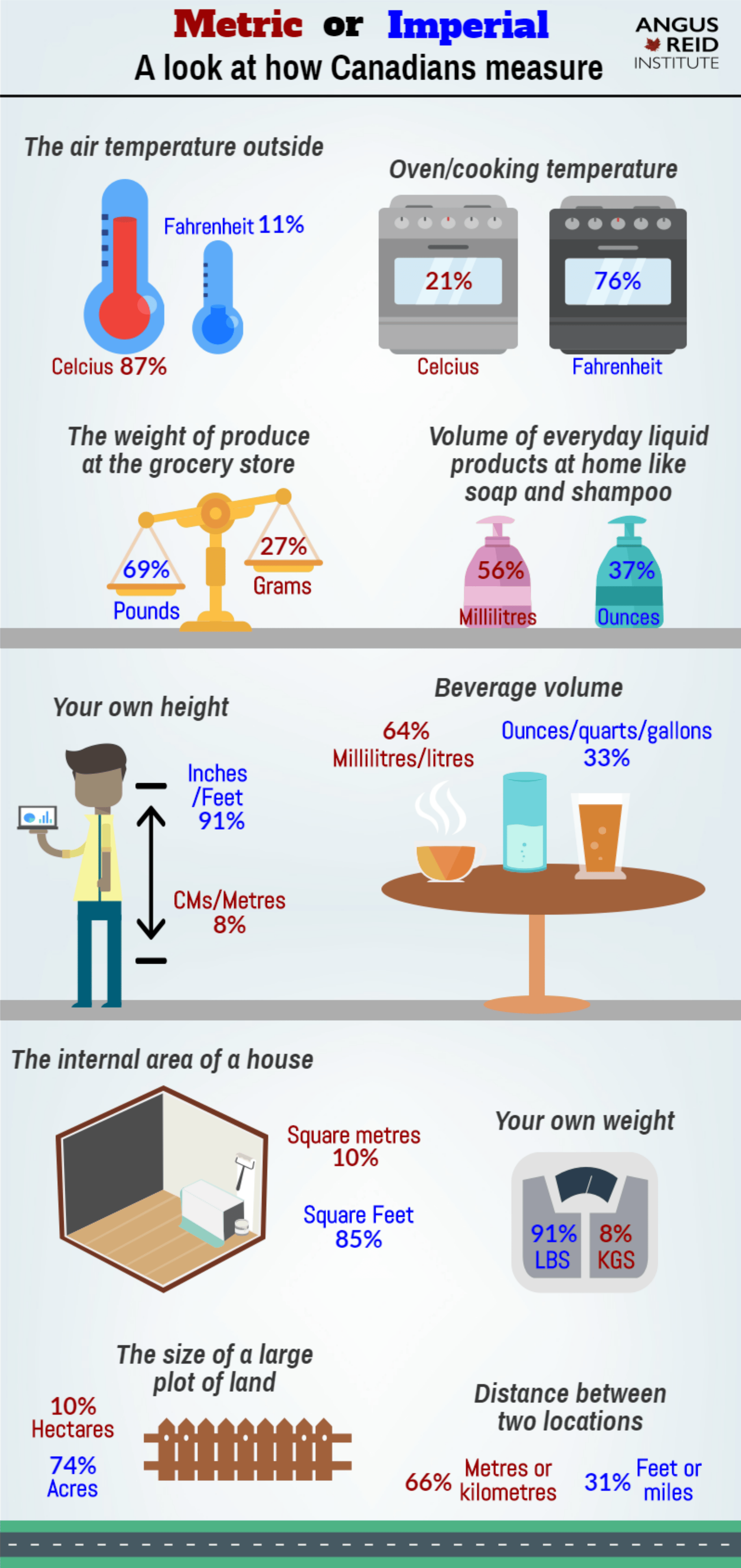
A look at how Canadians Measure

In Canada, things were rolling along at a gradual but steady pace:

  • Temperatures in Celsius beginning April 1, 1975
  • Rain and snowfall in millimeters and centimeters starting September 1975
  • Road signs showing speed limits in kilometers in September 1977
  • Speedometers and odometers in cars are manufactured in metric units beginning January 1979
  • Gas stations were pricing and dispensing gasoline and fuel in liters in 1979
  • Fabrics and home furnishings were required to be advertised and sold in meters and centimeters beginning in December 1980
  • Conversion of food weight measurements for advertising and pricing in metric units, starting December 1983.

We tend to assume Canada is solely metric, rather than the melting pot of systems that actually exist there. Canadians still use imperial units rather than metric in some areas. In 1985, Canada exempted some small businesses from the requirement of metric sales. Other requirements were also revoked, including the use of metric alone for measuring gasoline, diesel fuel, and home furnishings.

Even given these leniencies to a complete change, if you travel to Canada, be prepared for your speed limits and mileage signs to your next stop to be in kilometers, gasoline is sold in liters, and if grocery shopping, have a calculator/cell phone handy to make conversions from metric sizing to imperial sizing. This information is especially helpful when determining the size of ingredients for a recipe.

Being a lifelong resident of the United States, I didn’t delve as deeply into Canada’s history of its measuring system conversion as I did into my own country’s. Watch for Part III, where I’ll give the United States’ history and why it failed to complete the conversion.

Leave a comment

Filed under Canada, communication, decisions, education, employment, impressions, Life Changing, time

Why Didn’t the U.S. Adopt the Metric System? – Part 1 of a 3 Part Series

Listening to a weather forecast on a Canadian TV station, the temperatures are given in Celsius. Paul, who grew up in Canada, makes the mental conversion easily. Paul grew up using the Imperial system of measurement, which is used in the United States. After he was an adult and had immigrated to the U.S., Canada converted to the metric system. Paul is an electrician, a profession that uses the metric system of measurement. That, combined with his frequent travel to Canada, means he is familiar with both systems and believes the metric is a more accurate means of measurement.

Paul frequently comments that the U.S. was supposed to make the conversion to the metric system when Canada did, but failed to fulfill their promise. I recall being in grade school when we were told that the United States would adopt the metric system. I wondered how valid Paul’s repeated comment was, so I delved into researching the topic.

 Canada was making the transition at the same time and completed their conversion between 1970 and 1985. The United States never finished the conversion, despite agreeing to do so, and continues to use the Imperial System today. That made me wonder, why did Canada succeed, and we didn’t?

In my opinion, the U.S. failed to complete the conversion due to a lack of effort and unwillingness to invest in implementing the change. Businesses opposed the cost of having to retool and adjust standardized measurement systems, including bolts, pipes, and nuts, to metric measurements. The Metric Conversion Act of 1975 [ https://usma.org/laws-and-bills/metric-conversion-act-of-1975 ] made the metric system preferred, but not mandatory. This, combined with public resistance and the government’s inability to enforce the change, led to the failure to implement the change.

As of today, the United States is only one of three countries (the United States, Liberia, and Myanmar (Burma)) worldwide using the Imperial measurement system. The Imperial system [ https://www.britannica.com/topic/Imperial-unit ] (also known as the British Imperial system) originated from the British Empire, which ruled many areas of the world between the 16th and 19th centuries. Although the U.S. Founding Fathers made numerous changes in governing style when obtaining independence from Britain, they decided to maintain the Imperial system of measurement, despite the metric system growing in popularity.

A chart showing the Imperial vs Metric measurement and weight differences.

Rather than adopting it in its original state, the United States devised its own version of the Imperial system, known as the U.S. Customary System. It uses measurements of feet, pounds, and miles, but differs slightly from the British Imperial system. The most substantial difference is in volume:

  • The U.S. Customary fluid ounce is 29.573 ml; the British Imperial fluid ounce is 28.413 milliliters.
  • The U.S. Customary pint is 473.176 ml (16 fl. oz); the British Imperial pint is 568.261 ml (20 fl. oz).
  • The U.S. Customary quart is 0.94 L (32 fl. oz); the British Imperial quart is 1.13 L (40 fl. oz).
  • The U.S. Customary gallon is 3.78 L (128 fl. oz); the British Imperial gallon is 4.54 L (160 fl. oz).

The reason for creating the Customary version of the Imperial system was that the metric system was not yet fully developed. The Founding Fathers had a desire to establish a unique national identity and infrastructure, and tweaking the system to make it unique to the U.S. was their way of achieving this goal.

Myanmar (Burma) and Liberia use the Imperial system but are transitioning to the metric system; neither has a predicted completion date. Once their conversions are final, the U.S. will be the sole user of the Imperial system. In 2021, the British government announced plans to return to the Imperial system during its exit from the European Union. The changeover began but was abandoned in 2024 after consulting with the public and discovering overwhelming support for using metric units. They do still use the imperial system for things such as beer sales, road speed, and distance signs, and body measurements.

Although I found the metric system difficult to learn as a child, our government failed its citizens by not enforcing a complete change in the 1970s. A full conversion would have served business owners better in international trade negotiations and put us on equal terms with all foreign lands in understanding measurements when traveling.  

All countries worldwide, including the U.S., Myanmar, and Liberia, have adopted or legally sanctioned the International System of Units (SI), the modern form of the metric system. Canada and the United States are both melting pots of the Imperial and Metric measurement styles.

Watch for Part II and Part III in upcoming blogs, which will deal with the law and the Canadian conversion, the laws and the United States conversion, and where the United States stands today.

Leave a comment

Filed under Canada, communication, decisions, Discoveries, education, home, Life Changing, Life is a Melting Pot, Michigan, reality, travel, Weather

Cherishing Front Porches: Memories and Connections

When was the last time you sat on the front porch of your home, waving at your neighbors as they passed by, or inviting them up to chat and share a glass of lemonade? 

I have always loved front porches, the big kind that holds several chairs. When I lived in St Clair, Michigan, I rarely sat on my private patio in the back. I preferred the front porch, where I often sat reading a book until it got dark. I was not in a neighborhood, but on a state highway, so I only had cars buzzing by.

My love of sitting on the front porch is something I developed as a toddler. Back then, my grandmother was my babysitter. I remember sitting on the porch at various times of the day, watching the birds in the yard, migrant workers across the street playing, and watching the sun set. Red sky at morning, sailors take warning. Red sky at night, sailor’s delight. Hmm, wonder where I learned that?

The world made more sense when folks waved from the porch instead of arguing with strangers online.

As a teenager, my best friend in high school lived in a large, older home with a large front porch. I loved that porch! We would sit on it talking with friends, shouting out to cute guys that drove by, and just enjoying life. The house I grew up in only had a small stoop. I envied April, living in a home with a large porch that looked out over the street.

I no longer have a front porch. I always intend to sit outside on my lawn chair, and those times when I make it out there, I enjoy sitting in the fresh air and reading a book. I don’t get out as often as I want; life gets in the way, even in retirement. I, like many others, spend a good deal of time on social media, sharing trivial quotes, travel, pictures, news articles, and day-to-day activities with distant friends and family. I participate in public forums, where political discussions can turn hostile. People have lost the etiquette exercised during face-to-face conversations. It is so much easier to be insulting and rude when done through an electronic device.

That image takes me back to another time, when life was more relaxed and friendly. Kids played outside; they rang their friends’ doorbells to see if they could come out, rather than having scheduled play dates arranged and monitored by their parents. There were neighborhood block parties, where everyone got together, brought a dish to pass, and adults enjoyed socializing while the kids played. You knew your neighbors, and your neighbors knew you, and everyone got along. In my opinion, it was a better time.

Leave a comment

Filed under backyard, communication, Family, friendship, home, kids, Life is a Melting Pot, memoir, Michigan, parents, play, summer, time

Writing Prompts Are Everywhere

Friends connected to my personal page on Facebook know I have an addiction to what I refer to as image quotes. Little sayings and thoughts that hold deep meaning or inspire a laugh. They can also serve as writing prompts.

Just once, I want the opportunity to dramatically swipe everything off a table to make room for a giant map that I'll use to explain the plan.

Take, for example, the one to the left. You can picture this happening in a movie or in a book. What would be the reason for such a dramatic move in your own writing? Is it a treasure map, a guide to a search and rescue mission, or a plan for renovating a house? Let your imagination go as you put your thoughts on paper.

Years ago, when taking a course on writing for children, we were advised to save pictures from magazines we liked and put them into a book or folder for use as writing prompts. I probably still have that collection of magazine photos somewhere. I don’t think I could ever bring myself to toss them.

That may be why my phone is full of memes for sharing. I’ll admit that some are political, some inspirational, and some just fun, with the intention of evoking feelings and responses from a diverse range of people. When you are struggling with your writing, whether it’s a book, magazine article, or blog, flip through Pinterest, Facebook, magazines, or anywhere else you find inspirational images and save a few to inspire your stories.

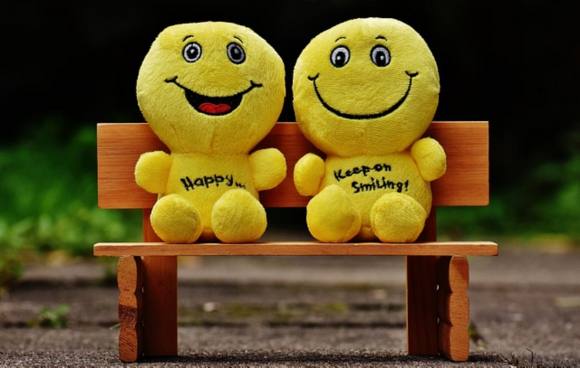
Happy and Keep on Smiling dolls sitting on a bench

Look at this cute image of two smiley-face dolls sitting on a bench. They display the words ‘Happy’ and ‘Keep Smiling,’ but what is their story? Why are they sitting on that bench? Are they friends? Siblings? Strangers? Write a story about them.

There are many thoughts out there on memes that create memories of the past. Anything from the sound of the National Anthem followed by all TV stations going off the air to the idea of having to run and answer the phone because it was connected to a wall with no caller ID or answering machine. You had to answer, or there was no way of knowing who it was or what they wanted.

The purpose of a writing prompt is to get your mind rolling. By taking the focus off writer’s block and getting the mind rolling, your thoughts will soon exceed the speed at which you can type them. Keep in mind, it is only a starting point, and your story can go as far away from that beginning as you want.

Some writers develop their writing, which begins with a prompt, into something they later publish. Others consider it throwaway writing, where it allows them to experiment with a variety of topics and techniques without worrying about perfection or failure.

I was in a writing group for a while, where they did a fun thing at each meeting. About half an hour before the meeting was scheduled to end, a writing prompt was given. It was usually a sentence or two or an image. We were then given 15 minutes of quiet writing time to craft a story based on that prompt. At the end of the writing period, we would go around the room and each person would read aloud what they had written. It was fun and engaging to see how stories that started from the same prompt varied significantly in content.

Another area of writing prompts is the ideas you come across when reading. A couple of years ago, I visited a museum in Chippewa Falls, Wisconsin, and purchased the book “The Grey Eagles of Chippewa Falls – A Hidden History of a Women’s Ku Klux Klan in Wisconsin” by John E. Kinville. The information about a woman’s Ku Klux Klan group inspired my curiosity and led to the sale of an article published in the Freshwater Reporter, “The troubling persistence of Michigan’s Ku Klux Klan” [ https://freshwater-reporter.com/wp-content/uploads/2024/02/FreshwaterReporter_Jan24-web-2.pdf ]

I have also had other articles published as a result of prompts I received while reading about history. A recent example was when I read “The Ice Cream Queen of Orchard Street” by Susan Jane Gilman. In the novel, she writes that the creation of soft serve ice resulted from a flat tire on an ice cream truck. My mind kept going back to that incident, so I looked it up, and she had taken creative liberties in the story, but the basis of fact was there. I used that prompt for an article that will be published in the upcoming issue of the Freshwater Reporter about the history of ice cream.

The possibilities are endless once you open your eyes and mind to the numerous prompts that are around you. It can be two children on a playground, a family dining out together, or an image of an older man on a tractor. It was the meme about sweeping everything off a table to make room for a map that inspired me to write this blog. I shared it on my personal Facebook page a week or so ago, but it kept creeping into my brain. I even started a story with it that became a throwaway, and that led to this article.

If you have been following my blog for a long time, you know it has been a while since I last wrote. The time between blog posts has been significantly stretched over the past few years. When I look back, I feel bad for getting wrapped up in life and not writing more. At the same time, my ‘Life is a Melting Pot’ life means that after swirling around in that pot, I have now grabbed onto the spoon, climbed up on the edge, ready to dive in with a broader variety of writings and more frequent posting.

If you have been with me for the long haul, Thank You! I hope you’ll enjoy the new format and pass my link along to your friends. If you are a new reader, Thank You! Please sign up to receive an email notice each time I post a new blog.

Leave a comment

Filed under communication, Life is a Melting Pot, Writing

Five Problems With Social Media

Social media ball with various images on it

When I was growing up, there was no social media. No one owned cell phones or computers, and phones were attached to a wall in our home.

Fast-forward to today; there are numerous social media platforms on which you can be active. While there are many positives to electronic vs personal contact, including regular contact with distant family and friends, there are also negatives. Here are five problems with social media.

1. Rude Behavior

People can hide behind the wall of a social media platform. Even those you know are more likely to behave rudely. When it is people with whom you have no personal relationship, bullying becomes even worse. When people converse in person, things you disagree with are politely disputed or let pass. Under the guise of a social media platform, people are more likely to insult and attack those with whom they disagree, referring to them as stupid, ignorant, old, or in any other way demeaning them.

According to an article in Psychology Today, anonymity contributes to rudeness and trolling. However, the lack of eye contact is the chief contributor to a person’s inability to control inappropriate behavior online. Before the advent of social media, people tended to be more courteous, even when disagreeing on specific points. Social media allows people to hide behind their computers and be aggressive and rude.

2. Time Spent/Wasted

The average user between 16 and 64 spends approximately 2.5 hours on social media platforms daily, with YouTube and TikTok experiencing the highest usage. That doesn’t sound like much out of 24 hours until you consider that it adds up to 14 to 17.5 hours per week that we no longer spend on other activities.

Even more concerning is that teens spend an average of 4.8 hours on social media daily.  That is over 33 hours a week! When you consider how easy it is for adults to fall into bad online behavior, think about how vulnerable teens are to cyberbullying and its impact on their self-esteem. Suicide rates among teens have increased during the social media era, and about 42% of teens admit that social media use keeps them from connecting with their friends in person.

3. Political Hostility

Before the advent of social media, politics adhered to the rules of proper etiquette. Etiquette traditionally held that three topics were never discussed in polite company–religion, politics, and money. Social media has eroded the belief in being courteous and following the rules of etiquette. This has impacted political discussions and encouraged people to become outright hostile toward those with differing beliefs.

A University of Michigan study found that political anger and cynicism are rising in the United States and democracies worldwide. Social media contains a lot of political information and news, but much of the content is toxic rather than factual. These toxic news streams are often hostile and insulting, which increases anger and bad behavior toward those with differing beliefs.

When was the last time you held a cordial exchange of political information on a social media platform with someone supporting an opposing candidate? It may start okay, but eventually, one person will become insultingly aggressive and argumentative. This undermines the ability to exchange information, leading commentators to prioritize presenting their side over engaging in an open-minded exchange of facts.

The problem is that algorithms reward hostile behavior because they perceive heated exchanges as more engaging. This shifts political attacks to the forefront of media platforms, increasing their visibility and distorting public opinion. People should conduct research using various sources rather than relying on social media when making decisions about election candidates or policies.

4. Cyberbullying and Cyber-Harassment

Cyberbullying is bullying that is done through SMS, text messaging, apps, gaming, or social media platforms. It encompasses sending, posting, and sharing false, negative, harmful, or mean content about another person. The information shared can be personal or private and is done with the intent to cause that person embarrassment or humiliation. This behavior can cross the line into criminal or otherwise unlawful behavior.

Examples of cyberbullying:

  • Sharing embarrassing pictures or videos online
  • Posting rumors on social media
  • Sharing someone else’s private information online
  • Threatening someone online
  • Creating fake accounts and posting information to embarrass someone

Cyber-harassment is behavior intended to torment the recipient. This occurs on public forums and is carried out by the harasser to seek peer approval or build their image to appear superior and vital.

Examples of cyber-harassment:

  • Threatening or harassing emails or instant messages
  • Using electronic technology to bully, harass, or intimidate
  • Spreading rumors
  • Sharing private information
  • Spreading hurtful information
  • Intentionally provoking or annoying someone online

Visit the Stopbullying.gov website to learn about the laws and policies against bullying in your state. Click on your state for additional information about state, commonwealth, and territory cyberbullying laws and policies. Seven states have laws only; most states have laws and policies.

5. Addiction

Although not formally recognized in the medical profession, social media is more addictive than cigarettes or alcohol. Addiction can lead to negative consequences that impact mental health. The main tell-sign is an obsessive need to check and update social media platforms frequently to the extent that it disrupts real-world relationships and activities.

It is easy to become addicted because social media platforms are designed to trigger the release of dopamine. This triggers a feeling of pleasure, reinforcing the desire to repeat the process. Any positive feedback received, such as likes, comments, and shares, validates and encourages repeat usage.

Signs that you may be addicted to social media include spending an exorbitant amount of time on your platforms, sometimes to the extent that you forgo other responsibilities or activities. Your reliance on social media may become so obsessive that you feel compelled to check it constantly, and any inability to do so leaves you feeling anxious and stressed. This can also lead to depression if you find yourself comparing your abilities with those of others online.

To manage your social media interactions for better mental health, set time limits for platform use and plan regular breaks when you engage in real-life relationships and activities. Establish times when social media is not accessed, such as during meals or when socializing with friends and family. It is also helpful to turn off notifications so you are not constantly distracted.

Social Media is here to stay. In 2005, only 5% of Americans were using social media; that number grew to 72% by 2021. Over 4.8 billion people worldwide are active on social media daily, and estimates are that by 2027, that number will reach six billion. It is essential to exercise caution when using the platform’s responsibility.  We must not allow ourselves to fall into a pattern of abuse toward others, nor should we tolerate such behavior from others. If you or someone you know becomes a victim of cyber harassment or bullying, report it to the appropriate legal authorities.

Leave a comment

Filed under communication, Coping, Family, habit, handicapp

Restoring Relationships

Three years ago, I made a decision to take legal action against a family member. I did this with the support of other family members.  After exhausting all other options, a joint decision was made that I would be the “face” of the group, acting as the plaintiff when filing petitions.

The matter was resolved through mediation more than 14 months ago. A conversation with a family member on the opposing side at the end of the mediation left me with the hope of restoring the family relationship. Unfortunately, hope can die quickly when the other person is unwilling to let go of the past.

I am one of four cousins, and for years we have had an annual girls’ weekend. Three of us were willing to put the past behind us and move forward. No conversations, no explanations; just move forward and have a fun weekend. The person who was in attendance at the mediation was unwilling to do this.

She issued an ultimatum as a condition of getting together. No matter how much we told her it is in the past, let it go, she refused. She continued to push a false narrative about the situation.  Because of her unreasonable demands, two cousins left the instant message conversation, one of them blocking her completely.

Realizing her ultimatum backfired, the person sent a message demanding three conditions be met to reconcile. Those conditions were a demand that the three of us not partake in actions that she, her family members, and her family have been taking for the past 14 months. This includes violating the terms of the mediation agreement.

The matter ended with my two cousins and I refusing to reconcile under her conditions. They do not understand her hostility toward me. None of us understand her claims that I am too angry to reconcile when she is the one unwilling to move forward. While my relationship with my two cousins is solid, it is sad that reconciliation with the remaining person seems impossible.

Following the exchange, I sent the person a private message stating that I had let the matter go following the mediation and that if she cannot agree everyone makes mistakes and we start with a clean slate, that is her problem, not mine. She is still angry and refuses to move forward. It is her choice to throw away family, not mine.

As of today, she has not opened that message. She sent one of the other cousins a message, stating she “knows” my message is a rehash of the problems and she cannot emotionally cope with reading it. Assumptions can be a person’s downfall.

My cousins have no interest in seeing her at this time. It is sad that one person’s bad behavior has caused such conflict in the family. Those of us suffering the greatest impact of that behavior are the ones willing to move forward.

A couple months ago, I was looking forward to a fun girls’ weekend and the restoration of our family relationship. Now it is shattered even more than before. Part of me still hopes the relationship can be restored, but part of me doesn’t care. She is unwilling to acknowledge the wrong done to the family and move forward, or she is in denial because she was a participant in the bad treatment of the family. I don’t know which.

The situation got me thinking about steps for restoring a relationship. I decided to do a bit of research. One of the key elements to letting go of the past is accepting what you cannot control. You must take accountability for your part in the situation and focus on the lessons learned from the experience. You should also consider the following:

HAS THE PAIN BECOME COMFORTABLE? 

If people feel hurt for a lengthy period of time, they become accustomed to emotional pain. The pain becomes a familiar part of their identity, and they are unable to let it go. By staying angry at someone, they can remain distant and not deal with their true emotions.  

To move past this point, they need to consider whether there are secondary benefits to staying focused on the hurt. Does staying angry help them avoid resolving emotional pain? Resolving pain requires facing the reality of it.

Consider how your life would be if you moved forward, leaving the past in the past. What would change if you took a different outlook on the situation?

FEEL THE PAIN TO MOVE PAST IT

By bottling up emotions and thoughts about the hurt, you prevent healing. This means the hurt builds inside you, and you continuously focus on it and the harm it caused. Constantly thinking about the hurt may impact your mood, relationships, and ability to be productive.

To move forward, consider journaling your feelings, writing a letter to the person who hurt you (sending it is optional), and expressing your feelings to a friend, relative, or therapist.

BE ACCOUNTABLE

Acknowledge your participation in the situation. By accepting your part in the problem, you can let it go and move your attention to the present. By holding onto your pain, resentment, and bad memories, you experience the pain repeatedly. This keeps you stuck in the past and unable to move forward.

Even if the event was not your doing, you can still acknowledge that it happened. You can choose to move forward by moving away from the past in your mind, living a life you want, away from the emotional pain.

FOCUS ON LESSONS LEARNED

Focus on the lessons learned from the hurtful event. Consider the things you now know that you do not want to happen again. Think about the coping skills you acquired as you faced the challenges.

Realize that everything passes with time, and this hurt will too. Identify the skills, strengths, and knowledge you obtained from this hurtful event.

LET GO OF THE “WHAT IFS”

Some people are unable to let go of the past because they need to constantly review the “what ifs” of the situation. They constantly wonder if things would be different if they had taken different steps.

They review the things they should have done, could have done, and what might have happened under those circumstances. This constant review will not fix anything. It only prevents you from moving forward and away from the hurt.

FORGIVE OTHERS

You are unable to regain trust unless you assume control of your emotions. You must forgive to obtain emotional freedom. Until you are able to acknowledge that everyone makes mistakes, you cannot overcome your anger and resentment.

A lack of openness is often the culprit that leads to a breakdown in the relationship. If the other person is unwilling to work toward repairing a relationship by being open and honest about the situation that caused the hurt, that is a reflection on them, not you.

BE AWARE OF GASLIGHTING

Gaslighting is a type of manipulation in a relationship. It uses a variety of techniques for the purpose of exerting control over another person. The aggressor in the relationship uses lies, trivializing, diverting, discrediting, denial, guilt, and more to create a false narrative.

Gaslighting is a form of emotional abuse that is difficult to pick up on. Those who use it are good at side-stepping accountability. A person using this technique tries to convince other people that they are remembering things wrong or misinterpreting events. They try to manipulate others by presenting their own thoughts and feelings as the truth.

Some signs of gaslighting:

  • Telling people you said something you didn’t say
  • Claiming you didn’t say something you did.
  • Lying when it is not necessary
  • Cheating or acting in unethical ways
  • Getting people to take your side to make you look better
  • Getting the people on your side to turn against someone else
  • Rarely taking responsibility for your mistakes
  • Not apologizing for your mistakes
  • Running hot and cold for no obvious reason
  • Angering easily and/or starting fights to gain power
  • Using a person’s weakness to hurt them or gain power over them
  • Bullying and teasing, then saying you didn’t mean anything by it
  • Insisting on a double standard—you can act one way, others must behave in another way

Gaslighting can happen in any type of relationship. It is a common form of emotional abuse in relationships using gender-based stereotypes and is a form of domestic abuse.

THE BOTTOM LINE

The brunt of my findings is that relationships can be restored, but only if all parties are willing to move forward. If one person holds onto their anger, until that person works through their own feelings and emotions, they will be unable to resolve the relationship and will remain estranged.

I travel out of state most of the year, so there is only a short period when I can reconnect in person. It is unfortunate that this person is unwilling to move forward. Her anger has made the situation worse. That is something I cannot fix. The ball is in her court. Time will tell whether her relationship with the three of us can ever be restored.

Leave a comment

Filed under assumptions, communication, Coping, decisions, Family, friendship, impressions, Life is a Melting Pot, sisters

Hindsight is 2020

While the age-old saying about hindsight being 20/20 is often used, the roll-over of the new year gives it an entirely new meaning. Regardless of what you personally think of the past year, there are likely some choices you would have made differently. This is true for any year, but especially given the horrific one we had.

Are there thing I would have changed?  Not many. I would not have remained in Yuma throughout the summer; day after day of 115 degree heat is too much! The choices we made kept us healthy, except for a couple rounds of illness I had in the middle of the summer so it was not a bad choice either.

I regret not getting back to Michigan to see my kids and grandchildren. Michigan was a roller coaster ride of what the Governor was going to keep open or shut down from week to week, so we decided not to risk it. We are looking forward to our upcoming travel plans.

While death, disruption, loss of income, and depression are what many will likely recall when they think back on the past year, there are also some positives that should come to the forefront:

  • More time together with your spouse/partner/significant-other or any other name you call the person you reside with
  • More time to do gardening, crafts, hobbies
  • Homemade food, especially baked goods became a normal day of life for many
  • Kids enjoyed being home with their parents and having more family time
  • Truly learning what your kids are studying in school if they were doing remote learning
  • Less air pollution from traffic meant cleaner air to breathe
  • Many people learned how easy and convenient it is to work from home
  • Companies may now decide to lower their overhead by having more people work from home on a regular basis
  • Everyone has become more tech savvy thanks to Zoom, Jitsi Meet, and Google Meet
  • Those who reside too far away to attend club meetings were brought “into the loop” through online meetings
  • Vacation doesn’t mean you have to travel far

As for me, I’ve spent my time writing, processing photos and videos, and have taken a real liking to adult coloring books.

Whatever the things are that stay-at-home orders and Covid-19 brought to you, remember hindsight is 2020 and you can now envision a bright future in 2021.

HAPPY NEW YEAR!

Leave a comment

Filed under Activities, career, celebration, children, communication, Coping, decisions, Discoveries, employment, Family, freindship, friends, friendship, grandchildren, hobbies, home, Illness, kids, Life Changing, Life is a Melting Pot, memoir, parents, play, reality, school, time, travel

5 Problems With Social Media

The most frequent use of our phones is social media. The average person picks up their phone 58 times per day, which includes sending or looking at text messages, checking email, placing calls, playing games, and social media. The total daily time spent on smart phones averages between three hours fifteen minutes to four and a half hours on their phone every day.

Social media is addictive. I became multi-connected for the purpose of promoting my photography and writing. The most addictive for many is Facebook, with a few others close behind.

What are the problems with social media?  Let’s take a look.

1.         Addiction

Social media is used for everything from personal connections to business promotions. It has become a necessity of life. The problem is many people are unable to walk away from it, even for a short period of time. Those are the addicts.

You see them everywhere. Have you ever been in a restaurant where people are sitting at a table together, but everyone is on their phone? Why are they unable to put down their phones and converse with each other?

We all know people who if you make a comment and tag them, they respond immediately regardless of whether it is morning, night, or the middle of their workday. They can’t resist the “ping” that tells them they have a notification for something.

Addiction came to my attention recently when I responded to a political question on Facebook. The poster said, “you didn’t answer within 12 hours.”  She had a time limit on when anyone could give an answer!

That shows she is addicted to social media and assumes everyone else lives their lives wrapped up in it as well. I hadn’t looked at Facebook posts within that amount of time so my answer was, to her, invalid due to being “late.”

I will admit, I sometimes will “share” things to Facebook without going into the program, so I probably fall into a posting habit trap.

2.         Brain Saturation

Social media is a means of sharing information that 50 years ago no one cared about. Do we really need to know that someone is out to dinner and where? Do we need to see a photograph of what they cooked for dinner? Is it important we know they got their hair cut, had a pedicure, got new glasses or went to the doctor?  

That is there life, not ours. This is the type of useless information we now know about everyone we are connected to. We are all guilty of sharing those tidbits at least part of the time. Probably now more than ever due to social distancing orders. Social media is now providing us with human connections that we are unable to get on a more personal level.

3.         Lack of Face-to-Face Interaction

While this is a benefit during the Covid-19 pandemic, it also creates social distancing. Zoom meetings are a wonderful way of connecting from the comfort of your own home, and remote work is great, especially when you live on the road as I do. The concern is whether we will become withdrawn from society as a whole.

Will face-time phone calls replace getting together? Will we remain socially distanced by having our conferences and meetings held remotely, or will we return to in-person gatherings that require more forethought and planning?  Hopefully it will become a combination of the two.

I think the virtual meetings have benefits. There are those who are unable to make it to in-person meetings due to health or distance. Those virtual meetings add personal human connections to their lives.  However I also think nothing can replace in-person interactions we have without the assistance of a computer or phone.

4.         Cyber-Bullies

Social media brings out the hostility in people. When you are not looking at someone face-to-face it is much easier to be rude. This has happened frequently during the presidential race, most likely inspired by our own president using social media to cyber-bully everyone from people in his own administration to leaders of foreign nations.

I have been called racist, old, a murderer (when discussing right-to-choose re abortion), idiot, ignorant, etc. all because of my political views. Would those same people have said those things to my face? Most likely not. Have I said things on social media I most likely would not have said in person? Yes.

The point is, social media provides a protective barrier that allows people to let down their guard and be rude to people in a way they otherwise would not be. This is especially true because the majority of people are connected through groups, etc. to people they never have and probably never will see in person. If you wouldn’t say it in person, you shouldn’t say it on social media.

5.         Personal Privacy

There are people that post all their personal issues online. If they have a fight with their spouse, it is out there. If they have an encounter with someone at the grocery store, they rant about it online. Have a dispute with your neighbor, it is out there for the world to see. Your child runs into a problem at school, everyone on Facebook knows about it.

People have lost their desire to keep private matters private. They no longer consult with their best friend for support, they now post it on social media for 200 of their closest acquaintances to chime in on and/or share with their social media acquaintances.

Everyone should give consideration to the delicacy of the information they are sharing about their personal relationships prior to posting.

So Where are We Now?

Social media is here to stay. We are a cyber-connected world now, and if you haven’t embraced it thus far, eventually you will be forced into it. The world revolves around our ability to be online for banking, paying bills, work, and communicating.

What social media platforms are you connected to? What are your favorites? What is it you like about them?  Enjoy cyber-life, but don’t forget about real life in the process.

My Social Media Platforms:

I invite you to check out some of my pages and subscribe to my blog and/or YouTube channel.

Facebook Photography Page – I share photographs I have available for sale, sometime videos I have posted onto YouTube, and other tidbits of information on my Times Gone By Photography Facebook page.

Facebook Grace Grogan, Writer Page – Where I share links the genealogy column I write for The Lakeshore Guardian, links to my blogs that are posted here on WordPress, and other things connected to writing.

Fine Art America – this is the place to view all my photographs I have available for sale, which can also be placed on various items such as shower curtains, throw pillows, mugs, beach towels, tote bags, etc.  

Fine Art America – Ron Grogan – This is the page my deceased husband had for viewing and selling his photography, which I continue to manage

Pinterest – a collection of tidbits, including links to my writing and photography

LinkedIn – my business profile, I also share my photography, blogs and genealogy column here. https://www.linkedin.com/in/grace-grogan-0870a433/

WordPress – this is where you will find my personal blog, Life is a Melting Pot 

Instagram – This is where I post photos, mostly pictures taken with my cell phone or older photos from the past.

Twitter – I am not a frequent user, but do share my videos, photographs, and blog here.   https://twitter.com/glgrogan?s=03

YouTube Channel – Rolling Thru North America Travel With US! is a joint page with Paul Cannon and contains videos and slide shows of our travels throughout North America.

Leave a comment

Filed under communication, decisions, freindship, friends, friendship, habit, Life is a Melting Pot, mind, reality

A Country at War With Itself

It is sad what the United States has become in just a short period of time. As we look at the destruction created by the looting and vandalism in the past few days, it is disturbing to see how much anger and hurt is harbored by so many of our citizens.

In truth, this is not a hurt or anger created by only George Floyd’s death, when a white officer pushed a knee into his neck for 8+ minutes, resulting in his death. This came only a few months after the killing of Ahmaud Arbery, who was attacked and gunned down by two white men while out for a jog. It took months for those men to be charged with a crime, and only after a video of the incident went viral on social media.

The protests being waged following Mr. Floyd’s death are the result of pent-up anger that has continued to grow as black people are disproportionately killed by white law enforcement officers.  Blacks make up 13% of the U.S. population, but are 2-1/2 times more likely to be killed by police.

What is further infuriating is that in many cases the officers are not charged for having committed a crime. If charged many are found not guilty.

A huge problem in this country is the blue wall of silence, also referred to as the blue code of honor. This is a silent code under which police officers stay silent, refusing to report other officers who exercise misconduct, criminal behavior, discrimination, police brutality, or any other unethical action. Body cameras and bystanders recording on their cell phone cameras are finally bringing some of this to light.

I was very pleased to see the Minneapolis Police Chief remove his hat and kneel at the spot where George Floyd’s life was taken, and also remove his hat when he answered their questions on the news. This shows him to be a person of moral and ethical character.

When questioned the police chief stated that he fired of all four officers because the other three officers, by not intervening, were complicit with Derek Chauvan having his knee in the neck of George Floyd for 8+ minutes, resulting in death. Derek Chauvin, who has been charged with 3rd degree murder and manslaughter.  The other officers have not been charged.

I have seen many cities where police officers are walking with demonstrators or kneeling with them in prayer. This shows that not all law enforcement condone the behavior of the bad, but it is not enough to heal the pain that has been going on for too long.

Obama Administration

It was only a short 12 years ago that this country reached a milestone when it elected Barack Obama as President of the United States. This country, with its horrible history of slavery, racial oppression and discrimination, had elected a black man into its highest-ranking position.  That said a lot for how far our country had come.

Barack Obama served for 8 years as president.  During his presidency there were several high-profile deaths of black Americans engaged in encounters with the police and protests led to rioting:

  • Oscar Grant, a black transit passenger, was shot by a white police officer. Riots broke out in Oakland, California. The officer, Johannes Mehserle was found guilty of involuntary manslaughter.
  • George Zimmerman was acquitted of murdering Trayvon Martin, a black teenager, and riots broke out in Los Angeles.
  • Manuel Diaz, a 25-year old black man, was shot to death when he ran from police. Destructive demonstrations broke out in Orange County, California.
  • Kimini Gray, a 16-year old, was killed by police after allegedly pointing a handgun at them. Riots broke out in Brooklyn, New York.

The Black Lives Matter movement began in 2013. It was created to give black people a voice in civil rights. Issues included a broken criminal justice system and a higher unemployment level among black Americans. Those problems still exist today.

Black Lives Matter believes in peaceful demonstrations. They do not participate nor do they encourage looting and violent acts like those taking place today.

George Floyd’s Two Autopsies

After the autopsy of George Floyd’s death indicated he died from underlying health conditions, not from the loss of breath created by a knee on his neck for 8+ minutes, people were angry and upset. His family ordered an independent autopsy.

That independent autopsy determined George Floyd’s death was caused by “asphyxiation from sustained pressure”. The difference in the two determinations makes one question whether the first medical examiner works frequently with the police and is part of the “code of blue.” Both medical examiners ruled the death a homicide.

Where We Stand on Race

In 2016 a survey showed 56% of white Americans said the race of a subject made no difference in the use of police force, but only 18% of black Americans believed that to be true.  More than 2/5 of black people said that police in their community made them feel more anxious than safe.

U.S. citizens, looking for change, elected Donald Trump in 2016. A non-politician, non-military, public figure who promised to Make America Great Again.  The question now comes to mind, Is America at War With Itself?

There continues to be racial divide in this country on how people are viewed based on the color of their skin. There is inequity that results in black people being disproportionately injured or killed by white police officers.   

The fact that we have protestors trying to storm the White House and destroying Secret Service vehicles says a lot about what a lot of Americans feel toward President Trump.

Where else in American history can you recall riots where Washington DC monuments were defaced?

Where the Treasury Department was attacked?

Where the White House was at risk of being breached by protestors? 

When Chopper One lands at the White House lawn and is greeted by protestors with their middle fingers raised? 

Why is former Vice President Joe Biden was out speaking with protestors while President Donald Trump is hiding in a bunker under the White House? 

Trump Administration and Racism

It is likely that a culmination of numerous factors has led to the anger displayed toward President Trump.  We are all familiar with his tweets that repeatedly insult people, make racial slurs, and instigate violent acts.  

American people have come to realize what a strong racist their President is. Mayors of cities undergoing riots have asked President Trump to be quiet. To stop posting comments on Twitter that instill violence. To stop posting racial comments from the 1968 racial riots.

It isn’t all about tweets and verbal comments. His tendency toward discrimination against those of non-white ethnicity screams out from his campaign and administration: 

  1. In 2016 there was a strong correlation between Trump campaign events and acts of violence. Data from the Anti-Defamation League showed that counties hosting Trump campaign rallies had more than double the hate crimes than similar counties that did not host a rally.
  2. Counties that voted for Donald Trump by the widest margins experienced the largest increase of reported hate crimes.
  3. Surrounding the election of Donald Trump, hate crimes peaked from October to December 2016 and continued through 2017. This was the second largest increase in hate crimes in 25 years. The highest increase in hate crimes followed September 11, 2011.
  4. Quinnipiac University released a poll that states 80% of African-American voters feel Donald Trump is a racist. 55% of Hispanics feel Trump is a racist, and 51% of all Americans feel he has racist views.
  5. In August 2019 President Donald Trump spoke at the 400th anniversary of the year slaves first arrived on American soil. His behavior prior to his arrival resulted in the Black Caucus of the Virginia legislature boycotting his appearance. In doing so they stated “It is impossible to ignore the emblem of hate and disdain that the President represents” and referred to his “repeated attacks on black legislators and comments about black communities” and they felt he was an “ill-suited” choice to commence that monumental period in American history.
  6. The Trump Administration is working to roll back President Barack Obama’s efforts to combat racial segregation. This roll-back would make it easier for banks to deny loans to black and Hispanic people. It would also make it easier for cities to confine families to minority neighborhoods.
  7. The Consumer Financial Protection Bureau has in 2020 proposed cutting back data collection that helps track discrimination in the mortgage market. In 2015 the Obama administration began tracking patterns of poverty and segregation with a checklist of 92 questions that had to be completed to access federal housing funds. The Trump administration is trying to eliminate that tracking system.  Of concern is that the Trump financial regulator could encourage banks to invest in inner city projects such as sporting arenas instead of loans that benefit local residents. 
  8. Black home ownership is at its lowest rate since segregation was legal. White rate is about 73% and black rate under 43%. 
  9. Housing discrimination complaints rose 8% in 2018, as reported by the National Fair Housing Alliance. This is the highest level since tracking started in 1995.

Trump Admnistration Civil and Human Rights Rollbacks

Between 2017 to 2020 there have been at least 79 Trump Administration Civil and Human Rights Rollbacks. Many of those rollbacks have a direct impact on low-income and racial minorities, which include:

*          In February 2017 President Trump signed three executive orders to fight crime, gangs, and drugs, and restore law and order, supporting the men and women of law enforcement. Civil rights organizations viewed these orders as vague and suspicious.

*          In August 2017 the Obama administration ban was lifted regarding the transfer of some military surplus items to domestic law enforcement, rescinding guidelines that had been created to protect the public from law enforcement’s misuse of military-grade weapons.

*          In August 2017 the Trump administration halted the EEOC rule that required large companies to reveal what they pay employees by sex, race, and ethnicity. The rule was intended to remedy unequal pay in American companies.

*          In September 2017 the Department of Justice ended the Community Oriented Policing Services Collaborative Reform Initiative. This program was created to build trust between police officers and the communities where they serve.

*          In February 2018 the Trump administration’s 2019 budget proposal denied critical health care to those in need. The funding was being diverted to funding the border wall.

*          In February 2018 the Trump Administration’s 2019 budget proposal eliminated the Community Relations Service which was established by the Civil Rights Act of 1964. Its purpose was to address discrimination, conflicts and tensions in communities around the country.

*          In 2018 The Office for Civil Rights at the U.S. Department of Education released a new Case Processing Manual that created a larger hurdle for people filing complaints. It allows for the dismissal of civil rights complaints based on the number of times an individual has filed.

*          In January 2019 the Trump administration was considering a roll-back of regulations that provide anti-discrimination protections to people of color, women and others.

*          In January 2019 it was reported that the Trump administration had stopped cooperating with and responding to UN investigators over potential human rights violations in the United States.

*          In April 2019 it was reported that the Trump administration would not nominate nor re-nominate anyone to the 18-member U.N. Committee on the Elimination of Racial Discrimination.

*          In January 2020 the Department of Housing and Urban Development issued a proposal that would gut the agency’s 2015 Affirmatively Furthering Fair Housing rule. HUD’s proposal would leave people of color, women, and protected communities already harmed by unfair and unequal housing policies at further risk.

Heal the Country

There is a very strong divide in this country. Racial discrimination and violence are at the heart of it. We are a country divided, and it needs to be healed. There is a Michael Jackson song that says in part: 

Heal the world
Make it a better place
For you and for me
And the entire human race
There are people dying
If you care enough for the living
Make a better place for you and for me

When Will it Stop?

We are now in our 7th day of protests, vandalism and looting. When will it stop? It is hard to say. We have had a President hiding in a bunker tweeting words that incite violence.  We have more than 37 cities in 22 states plus Washington DC destroyed.

It is time federal and state legislatures took action to make sure that the rights of every person in the United States are protected. Treatment and protection need to be equal regardless of whether a person is White, Hispanic, Middle Eastern, Muslim, Jewish, Black, or any other nationality.

This country was built by being accepting of all, a melting pot of immigrants that created a wonderfully diverse country. It is time laws were in place that guaranteed equal treatment for all. Until that is done and people are satisfied that their lives matter, history will continue to repeat itself.

Update:  As this writing was being finalized President Trump spoke in the Rose Garden.  Lafayette Park across from the White House was filled with peaceful protesters. Suddenly right before the speech law enforcement moved in, using tear gas and rubber bullets to force the peaceful protestors out of the park. Why?

It soon came to light. President Trump’s announced that he is deploying the 1807 law to deploy military then commented he was going to a special place.

Those peaceful protestors had been gassed and shot at by law enforcement because President Trump was walking through the park to St. John’s Church for a photo op.

Almost immediately the DC Episcopal Bishop denounced President Trump’s use of St. John’s Church as a prop. The Bishop stated that after having military police fire munitions against peaceful protestors President Trumps actions were an abuse of a sacred space.

And So We Continue

The anger continues. People want the remaining three officers involved in George Floyd’s murder charged. They want equal treatment by law enforcement. They want a justice system that is just.

It is up to the United States citizens to regain control of their country. It is time this country becomes what it was created to be, a melting pot. Many cultures living together, all on equal ground. Equal and just treatment for all races.

You may say I’m a dreamer, but I’m not the only one. I hope some day you’ll join us, and the world will be as one….from Imagine by John Lennon

1 Comment

Filed under assumptions, communication, Coping, death, decisions, events, Family, impressions, Life Changing, Life is a Melting Pot, reality

DOCUMENT YOUR PART IN HISTORY

I look around, the place has more people than normal for this time of year, but it is still pretty well emptied out. Why wouldn’t it be? Who wants to stay where the summer temperatures go as high as 120° Fahrenheit?

Yet, here I am. Our original plan was to leave here at the beginning of April and visit several national parks and scenic areas through several states before heading to Michigan to visit family. Then head south and west again, hitting Sault Lake City and Colorado Springs for photography and RV conferences before going for a three-month stay on South Padre Island, Texas, followed by winter back here in Yuma, Arizona.

Those plans have been crushed by the Coronavirus shutdowns. We have extended our stay here in Yuma until at least August 3rd. We are trying to secure reservations in Michigan for somewhere between mid-August to early October, but so far have not had any luck. The state is still locked down and the few campgrounds that are open do not have long-term spots available.

Time will tell if we travel, where we will be, and when we will get there. When you live full-time in an RV, campgrounds are an essential part of life.

We are living through an event that will be written about in history books. Have you recorded your stay-at-home location and changes in lifestyle? Have you noted the schools closing, people doing work-at-home because businesses closed, hospitals overrun with patients, people wearing face masks and gloves to protect those around them?

If you have young children, have you recorded their thoughts on what is going on around them? These are memories that may be forgotten over time but will be important to future generations.

This slideshow requires JavaScript.

Paul and I are hanging tight in Yuma, Arizona. I walked around the park and took snapshots of the camp, documenting the place that was full when we arrived in February and is now almost empty. A lot of the people here in the winter are Canadian snowbirds who were ordered to return to Canada in March or lose medical insurance due to the pandemic.

So where are you? Have you documented the event? Leave me your comments below.
Stay Safe!

Leave a comment

Filed under Activities, assumptions, backyard, Canada, communication, Coping, decisions, Discoveries, environmental, exploration, flowers, Full-Time RV, home, impressions, Life Changing, Life is a Melting Pot, memoir, Michigan, reality, spring, summer, time, tourism, travel, winter

Be Kind, Always Be Kind

If you find yourself getting frustrated with an elderly person, think of them like your grandmother or grandfather, then treat them accordingly. That is something in the midst of this pandemic people need to remember. Be kind to strangers – all strangers.

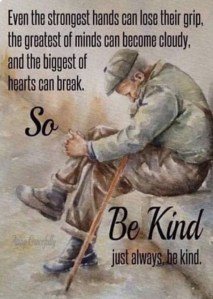
I recently read a post on Facebook, and when I saw this image quote “Even the strongest hands can lose their grip, the greatest of minds can become cloudy, and the biggest of hearts can break. So Be Kind, just always be kind.” I put the two of them together.

The story behind the Facebook post is that the person’s father went to the grocery store to pick up a few items. He did not realize that the aisles were one-way. It can happen to anyone. Arrows posted on the floor, but who looks there when shopping?

BLOG PHOTO

Instead of nicely mentioning it to him, someone snapped at him rudely, belittling him for his stupidity. Her father, feeling ashamed and humiliated, left his groceries in the cart and exited the store without purchasing any food. He did not go to another store. He went home without any food, fearful of making another mistake.

I was grocery shopping and went the wrong way today. I had the store memorized on the directional arrows, and today I was halfway down the first aisle when I realized they had changed them all. Probably because they realized they originally had them backward for the way people navigate through the store. It can happen to anyone.

I have noticed that men are more likely than women to go the wrong way when shopping. Why I don’t know, but 4 out of 5 times, if someone is going the wrong way it is a man. Usually as I’m passing, I’ll say “you’re going the wrong way.” When they look at me confused, I’ll point out the arrows. The normal response is “thanks.”

If you see any person not following the rules, it doesn’t mean they are stupid and uncooperative. They probably didn’t notice that something has changed. You can let them know without being rude.

I would assume the daughter of the elderly gentlemen above purchased his groceries for him. What if he didn’t have family nearby? What if there was no one to help? Was it worth the possibility of him going hungry because of someone’s superior attitude toward him?

Be kind to everyone, especially the elderly. Think of how you would want them to be treated if they were your grandmother or grandfather and act accordingly. Everyone deserves to be treated nicely.

4 Comments

Filed under assumptions, communication, Coping, decisions, Family, food, Life is a Melting Pot, Meals

Stay-at-Home Orders: 10 Positive Points

We have all been watching the fear of the unknown unfold before us with the Coronavirus spread throughout the world, but more closely to home here in the United States.

We all need a break from the chaos, and below I am going to give you 10 positive Points to the stay-home orders.

I am in a unique class of citizens. We do not have a “sticks and bricks” home, we live full-time in an RV. Stay-at-home orders affect us a bit differently. We elected to stay put in the RV park here in Yuma, Arizona until things calm down. Being in an area where temps average 107 in the summer is not our choice, but we feel it is the best alternative if things do not calm down before then.

When I think back to one year ago in April 2019 I was winding down on the sorting out of my house in the anticipation of moving into an RV full time. I was prepping for an estate sale, selling my home, leaving my full-time job, and hitting the road. By mid-August, those things had been accomplished.THINK POSITIVE IMAGE

I enjoyed a wonderful fall traveling in eastern Canada, and warm winter in southern Texas and Arizona. Our plans for this summer to hit some national parks before heading back to Michigan to visit family have been pitched. We don’t know when or if we will be able to travel to Michigan this year.

The Port Huron Township RV Park we stayed in last summer is closed indefinitely due to the coronavirus. The Port Huron Lapeer Road KOA is price gouging, charging $75 per night if you want to make a reservation. Under the circumstances, our plans are in limbo.

The coronavirus has been the main focus of news for the past couple of months and will likely be for the next few months ahead. We all need is a positive brain break during our stay-at-home time.  Here are some positives of the stay-at-home orders:

  1. You no longer need to set an alarm clock. Sleep in or get up early, your choice.
  2. You can dress however you want – casual, pajamas, the scroungy never-wear-in-public old clothes – whatever suits your fancy. You aren’t going anywhere, no one is visiting, so it’s all good.
  3. No need to wear makeup – who is going to see you?
  4. You can now read those books you purchased but never had time to read. Clean off that shelf and prepare for a literary shopping spree when the stay-home orders lift.
  5. There is plenty of time to do spring cleaning. Does anyone really do that anymore?
  6. Do the spring yard cleanup, plant flowers, ready the vegetable garden.
  7. Clean the junk drawer, the closet, or the basement. Think how neat and organized things will be once this pandemic is over.
  8. Lower gasoline expense – if you aren’t going anywhere you aren’t using any gas
  9. Skim through recipe books and try some new recipes. Think of all the money you save by not eating out, shopping, going to events and concerts.
  10. More time with your spouse, kids, significant other. Make art projects and play board games. Did out your old hobbies – woodworking, sewing, ceramics, stained glass – anything you used to do and normally don’t have time for.
  11. Sit on your porch or deck and enjoy the sun, listen to the birds, drink a glass of wine.

Use this stay-home time to enjoy life. Someday you will be able to look back and remember the brain break you were awarded in the midst of a pandemic.

1 Comment

Filed under communication, Coping, decisions, Discoveries, employment, Family, freindship, friends, friendship, Full-Time RV, hobbies, home, Illness, Life Changing, Life is a Melting Pot, mind, play, reality, spring, summer, time, tourism, travel, winter

Life is not meant to be lived in one place

I have reached the point of excitement.  My new lifestyle will soon be moving from life in an RV in my local area to actual life on the road.    I am now on my last two weeks of work, with the 16th of August being my final day.  I am training someone to take my place at work, will soon have the closing date on my house, and once that is completed we will set off on our new lifestyle.

This past weekend Paul and I opened up the “basement” storage in the motor home and got the last boxes out of my car and into the RV.  Not everything is sorted and organized the way we want, but I am at least officially in the motor home totally and completely.  The next two weeks will be a whirlwind of finishing up things at work and training my replacement, a doctor’s appointment, turning in my lease vehicle, finishing up paperwork, listing the second home I own for sale, and closing on the home I was residing in.   In someways the day when I can “hit the road” seems so far away, and yet so close.  Time passes quickly when trying to get everything finished in the final moments.  Trave as far and as long as you can

We are now starting to plan the first leg of our travels, and it is exciting and a bit nerve wracking at the same time.  I am semi-retiring prior to retirement age, so will need to do remote or seasonal work while on the road to supplement  the spousal pension I receive.  Until I have a steady income from remote or seasonal work  I will be concerned about finances.  That is just me.

At the same time, if I didn’t jump at this opportunity now to travel full-time I know I would regret it for years to come.  You only live once, so might as well make the most of it.  What are that chances that I will ever again run across the opportunity to live full time in a motor home traveling Canada and the United States with a person with whom I am compatible who is also a fellow photographer?

I hope this is a life style we can enjoy for several years.  The opportunity to experience a variety of cultures and the diversity of nature as we travel cross country is something I am looking forward to.  As I travel I plan to keep a journal about my travels.  I enjoy freelance writing and hopefully you will see my writing and/or photographs not only in this blog, but also in published magazines and journals.

If you have any “must see” locations in Canada or the United States, please share.

Leave a comment

Filed under career, communication, decisions, Discoveries, education, exploration, hobbies, impressions, Life Changing, Life is a Melting Pot, nature, reality, spring, summer, time, tourism, travel, vacation, winter, work, Writing

Writing to Relax

I have been, and continue to be, in the whirl-wind of trying to sort through 36+ years of belongings accumulated in my house and reduce the “keep” items down to what I can take with me in a 35-foot motor home, in which I will live and travel the United States and Canada.  Needless to say, this is a monumental task.  I am on the downside now, with only a few things left to complete, and the estate sale is scheduled May 2-6, 2019.

I have been sorting through old items, boxes never unpacked from when we moved here in February 2004, and family heirlooms, mementos and photographs.  Those special items I have painstakingly gone through and divided between my two adult children.  In the midst of all this my son has been moving out.  Between working long hours and moving about 45 minutes away, he has taken a long time in the process with a couple trailer loads of items still left to move.  This has made for a very stressful situation.   We are now down to “crunch time” as the estate seller will need to come into the home and get things priced.  My son made a comment about me pushing my sale back, but I refuse to do that.  I need to get my house emptied, ready for sale, and sold quickly.

closet cleaningI have spent weekend after weekend at home, sorting through all my current items and those in boxes, preparing for my estate sale.  Today I took some “me” time and attended the #RochesterWriters Spring Conference.  I enjoyed a day of informative keynote speakers and instructors, plus socializing with other writers.  It was time well spent, combining instruction in self-publishing with networking.   There is something about spending a day with other writers that inspires one to write.  Even though you haven’t seen me here in quite a while due to everything going on in my personal life, I find myself here tonight writing a quick blog, just to say hi and let you know I am still alive and kicking.
Once the sorting and packing is complete and I have moved into the RV, which will happen on or about April 23, 2019, you will begin to hear from me more often.  As I move into fall and begin to travel the country I plan to post travel blogs of my adventures, and hopefully expand into writing some travel articles for magazines as well.  What the future holds for me one can not be certain, but it will definitely be an adventure and a change in lifestyle.

1 Comment

Filed under Activities, assumptions, career, Cleaning, communication, decisions, Discoveries, events, Festivals, freindship, friends, friendship, habit, impressions, Life Changing, Life is a Melting Pot, reality, time, tourism, travel, Writing

Celebrate the Positive!

So here we are, ten days into the New Year.  What will it bring?  Has it been a good start?  What about resolutions?  Were they made?  Have they been broken?

My year started out in a variety of ways.  On New Year’s Eve my daughter and her family were driving north to visit family when she hit black ice and rolled her vehicle twice, ending up in the ditch.  The three children, ages 4, 8, and 12, were fine, as was her boyfriend.  My daughter slammed her elbow into the driver’s window and needed stitches, and she had a couple scratches on her face, but other than that no serious injuries.  Unfortunately the vehicle was totaled, and she only had PLPD insurance, so they are down to a single cab pickup with a family of five.  celebrate-small-success1

Here is where viewpoint is important.  Is it horrifying that they rolled….well, yes, the outcome could have been far worse.  Should everyone be upset that they are without a car and don’t have the ability to purchase another?  Of course that is a dilemma that must be dealt with.  However, the overall important thing is that no one suffered any severe, life-altering injuries, especially the children.   So, with that we can say that their New Year got off to a good start.  They came through a scary, dangerous accident without anyone being seriously hurt.   Celebrate the positive!

As for me, my New Year weekend was both work and relaxing.  I had a four-day weekend during which I never left the house.  I took down my tree, sorted and packed items to go to my kids, and also sorted and packed items for me to take when I downsize and others to go into my estate sale.  I came across things I had forgotten about, and spent some time looking at some old pictures of ancestors.   Some would consider a long weekend home alone and working on household tasks a lonely, sad existence.  I am on a time frame to get through all my belongings in preparation for downsizing and an estate sale this spring, so having a long weekend to work on my project was positive.  Celebrate the positive!

Every year I keep a list in my “notes” section on Facebook of the books I read that year.  My goal is always 52 (one per week), but I have never made that.  The best I have done is around 26.  Last year on the 14th of March I had only just finished my second book of the year.  This year I finished my first on the 4th of January and am more than halfway through my second.   I’m not holding my breath on making 52 for the year, but the odds are favorable so far.   Celebrate the positive!

So now ten days into the new year I sometimes look around me and wonder how I am ever going to get through everything I need to by the end of March.  I also worry about my son, who is trying to find a place to live as he is currently staying with me, being able to find a home and move out by the time needed.  On a positive note, he also has quite a few tubs packed with his belongings.  We can only hope that it all falls into place without a problem.  I’m not ready to celebrate yet, but I am trying to think positive.

How is your new year going so far?  Regardless of whether you have had downfalls or things to celebrate, remember to keep thinking positive.  A good attitude can get you through anything.

Leave a comment

Filed under celebration, communication, Family, grandchildren, Holidays, home, impressions, Life Changing, Life is a Melting Pot, reality, spring, vacation, winter, work

Bulleted Reunion

IMG_20180720_185225304I had the pleasure of attending my 40th High School Class Reunion in Eaton Rapids, Michigan this weekend.  The coordinators did a fabulous job of pulling the weekend together with a variety of activities to keep people on the move.  This was especially nice for those of us traveling in from out of town, especially those traveling from out-of-state.
This is my bulleted list of memories of the weekend.

  • Meet-and-Greet at Eaton Rapids Medical Center Conference Room.
  • Great desserts!
  • Friendly conversation with classmates.
  • Tammy (Ball) Albright’s face sign
  • Olive burgers and beer at Abies Bar
  • Woman’s bathroom is small with two toilets, no stalls.
  • Breakfast at Darb’s Patio, always yummy!
  • Glitch in planned tour of high school – Honor Society students are prepared to do tour, school is locked and they don’t have keys.
  • Classmate makes a couple calls and resolution is on the way.
  • Dave Johnson, teacher when we attended, later principal, now retired, has master key to school and comes to rescue, conducts the tour, and does an awesome job of sharing the way it was when we attended, and what changes have been done over the years.IMG_20180721_130944998_LL
  • Touring the high school after 40 years brings back memories, including these mentioned during tour:
    • The Cold Tongue
    • The smoking bathroom
    • Pep Rallies
    • After home game dances
    • Band/band camp
    • Typing class
    • 1-2-3 Roll’em Ferndock
    • World History class lectures in auditorium
    • Theater performances in auditorium
    • Mr. Phillips math classes
    • Mrs. Lohrke, English teacher
    • Mrs. Shimnoski and Mrs. Tuthill, Business/Secretarial Block teachers
    • Various athletes, coaches
    • Teachers and counselors now gone but long remembered
    • Library no longer has a comfy seating area of bean bag chairs, chairs, etc.
    • Senior Bench (now gone)
    • The former layout of the school compared to what it is now
  • Non-Reunion Activity:  Quick stop-over to visit with my sister for a couple hours
  • Walking a block to the Red Ribbon Hall for the reunion because I thought all  parking in front was taken; there were still open spots.
  • Some classmates’ appearance has hardly changed, very recognizable.
  • Some classmates have changed a lot — thank goodness for name tags!
  • Being surprised at how many people recognized me immediately.
  • Good food, good desserts.
  • Good conversation with old friends and classmates.
  • 1978 Graduate photo frame for shooting pics
    IMG_20180721_212645159
  • Fun slide show of “then and now” pictures of classmates.
  • Party Favors:  Eaton Rapids glass and notepad
  • The Red Ribbon Hall has very good acoustics = loud atmosphere.
  • A lot of us still drink, but not like we used to!
  • Many of us no longer “close down the bar” and left before the party was over.
  • Cell phones are great for event pics…I didn’t see a single “real” camera all weekend.
  • Facebook sharing of activities and photos on the ERHS Class of 1978 Page
  • Sad realization that we have lost 11 classmates, a nice memorial table was set up.
  • A quiz of things about our last year of school – presented by Mrs. Wheeler, former teacher.
  • Each classmate was to stand and give their name (maiden) now and where living…which grew as it went around the room to name, where living, married/years, occupation, children/grandchildren.
  • Amazing how many people have stayed in Eaton Rapids and/or the Greater Lansing area.
  • Surprised at how many have moved out of state, or resided in several states.

FB_IMG_1532145667519Time passes so quickly.  How is it we have already been out of school forty years?  Many thanks to classmates Julie and Jane Brenke, and their sister Jill, for organizing the reunion as well as several others who stepped in and assisted them.
 

2 Comments

Filed under Activities, anniversary, celebration, communication, education, events, freindship, friends, friendship, Life is a Melting Pot, memoir, Michigan, school, time

The Note In My Windshield Wiper

I don’t know what was more disturbing, the fact that I never noticed the note in my windshield wiper, or the content of the note itself.

The fact that I hadn’t noticed it was disturbing because it was most likely put in their on Saturday, a day in which I had made several stops running errands.  Based on the “er” on the left of the note my guess is that the paper used came from Meijer, but for it to happen at that location also made no sense.

I was at work on Monday and one of the attorneys in our office came in and said “Grace, you have a nasty note on your car, a really nasty note.”

I could not understand why anyone would leave me a note, and my first assumption was that it had been put there while I was in the office.  The attorney had noticed it tucked under my windshield wiper blade, and the paper was a bit stiff and yellowed, as if it had been baking in the sun.

When I read the note I realized it had to have happened when I was running errands on Saturday, because early Saturday it had rained and the note showed no sign of having gotten wet.  I knew I had not bumped anyone’s car with mine, not even a door, so I was baffled at the note.  However, my instincts told me that, based on the wording, it was possible whoever wrote it may have done something to my vehicle in retaliation.  I walked outside and checked my car out all the way around — no damage, so that was a relief.note on car010

My mind then went through my day, trying to figure out the location.  Even though I was guessing at Meijer based on the red “er,” I still wanted to figure out where I may have been parked close enough to warrant such a note.

  • First stop, farmer’s market — parked in a muddy dirt lot, I was the end vehicle and a wide walking path between me and the vehicle next to me.  Definitely not there.
  • Second stop, Kohl’s.  I parked in a normal spot, but my vehicle was dead center on my spot and so were the cars on either side of me.  I don’t think that was a logical location.
  • Third stop was a pool supply store, very small and there were only two vehicles in the entire parking lot with plenty of space between.  Definitely not there.
  • Fourth stop was Sam’s Club.  I parked next to the cart corral, and because the car on my driver side was over the yellow line, I had to park extremely close to the cart corral and was closely watching my mirrors so they didn’t catch on the rack.  If the guy next to my driver’s side wrote the note, then he should have addressed it to himself for hogging part of my spot.
  • Fifth stop was Meijer.  This was the only location where I used my handicap plate and parked in a designated spot, which means there was ample room around both sides of my vehicle.  The note appears to be on Meijer paper, but I could not have touched another vehicle, so again baffled by the message.

After all this analyzing there are two conclusions.

  1.  If the damage to the writer’s vehicle was so bad it warranted the above note, why didn’t they contact the security of the store, or even contact the police?
  2. If their vehicle really was damaged in the parking lot, it is possible that another vehicle was parked beside them, damaged their car as they were leaving, and then I pulled in, parked beside them and got blamed for someone else’s actions.

The bottom line is I will never know the answer to who wrote the note and where it occurred.   Based on the wording I will say I am glad that I did not arrive at my vehicle as they were writing the note as it may have been a hostile encounter.  On the other hand, at least I would know when and where the note was left.  The mystery of the note in my windshield wiper will never be solved.


2 Comments

Filed under assumptions, communication, Discoveries, impressions, Life is a Melting Pot, Michigan, Mystery, reality, time

Dreams + Action = Reality

How often we have a dream of something…a place to travel, an advancement in career, weight loss, or a lifestyle change.  Often whatever that dream may be seems so far off in the distance that we feel it is unachievable.   The problem is that we fail to create a plan of action.  Without a plan the dream is impossible, because without action the reality of the dream will never be achieved.

Some people formulate plans in their head.  Other people, like me, make lists and cross things off as accomplished.  Some are able to just dive in and start working without a plan of action.  Whatever works for you is fine, as long as it works.  Too often when a task seems overwhelming it is easy to let it slide; even if you have the list you never act on it.  Other times set-backs can throw us off balance or cause a backwards slide.  When that happens get your footing and push forward.

The Distance between dreams and realityI am dealing with dreams in various aspects of my life, and the reality is I have been slow in taking action, but every small step I make gives me a feeling of accomplishment and the desire to push forward….I just need to start doing it at a faster pace!

Each of my dreams deals with a different part of my life.  Each has a different game plan.  Each will be worked on and accomplished at different speeds, and some may need to be put on hold while I push to accomplish others.  That is okay.  Even putting some on hold can be part of the overall plan of action.  The important part is to act on the plan.

So, what are my Dreams + Action = Reality goals?

Asset Control:  This sounds strange, but I have inheritance money and/or assets that have not yet been distributed to me and I need to take whatever steps necessary so that all items are under my control.  I also have property and a motor home that I want to sell and need to push stronger to get those sales accomplished.  Once I have achieved those things, my asset control goal will be accomplished and I will be able to better fund my investments for a higher yield, which has a direct effect on my retirement funds.

Downsizing:  I decided some time ago that I need to downsize, and I have talked about it quite a bit, but the “action” part has been slow in coming.  This is most likely because it will be a tremendous change.  I will have to get rid of an overwhelming  amount of items accumulated over a 34 year marriage, sell move from my 4-bedroom colonial with the plan to purchase a 2-3 bedroom ranch-style condominium.  I am finding the action part is both time consuming and somewhat emotional as I will need to part with numerous possessions.  However, after cleaning out my parent’s home following their demise and having listened to several friends also go through the same thing, I realize that the majority of this stuff is not anything my kids are going to want and is just taking up space.  This is my number one priority and the first “dream” I have to make a “reality”.

Retirement:  Being a widow retirement can be very close, within the next three years, or in the distant future.  My full-retirement age of 67 is still ten years away.  My goal is to land somewhere in the middle, around age 62-63.  I know I cannot afford to stay in this house once I retire, and so the push to downsize is a necessity as much as a desire.  The sooner I downsize the faster I can save more money toward my retirement dreams and/or another dream.

Travel:  There are a lot of places I have not been to but want to see, both in this country and others.  While working I want to start taking short trips and seeing a bit of the country.  Once I retire I want to be able to travel much more extensively.  I am even debating whether I want to go ahead and fulfill a prior dream my deceased husband and I had…full time RV.  A friend of mine just started on his adventure, and in helping him get ready to head out I felt the desire come back to hit the road myself.  I have learned that  there are a lot of women driving Class A motor homes and towing vehicles, living the full-time life all by themselves  If they can do it, why can’t I.  Time will tell.

Writing and Photography:  These are both things I do now, but my life has been rather hectic the past few years and I do not have as much time for either of these areas as I would like.  I hope that once I have downsized, and most definitely once retired, that I can devote a considerable amount of time to both of these areas.   I have a book started that I plan to finish and other ideas bouncing around in my head for additional books.

As you read this you may have realized that my dreams are related to each other.  I need financial control of all my assets to achieve my other goals financially.  I need to complete the downsizing prior to retirement.  I need to retire to obtain more time for writing, photography, and travel.  Dreams + Action = Reality.  I better get busy!

I hope that while reading this you have started to formulate dreams and plans for action in your head.  What are your dreams?  I would love to hear about them in the comment section below.


Leave a comment

Filed under assumptions, career, Cleaning, communication, decisions, Discoveries, employment, exploration, Family, habit, hobbies, home, Life Changing, Life is a Melting Pot, mind, reality, time, travel, Writing

20 Facts About Me

I was in a fog and not sure what to write about, when I stumbled across something that was titled “20 Facts About Me.”  Now most of you don’t know me, so this will serve as a quick introduction to who I am.  If you do know me,  you may find some surprises here.   I’m just going to list random things as they come to mind.  Here goes nothing:

  1. I was born September 23rd, which means if you follow astrology I am a Libra and I fit the personality criteria.
  2. I have lived most of my life in unique places:
    a.  Born in Traverse City, Michigan — the Cherry Capitol of the World
    b.  Lived in Iron Mountain, Michigan, which has one of the highest artificially
    created ski jumps in the world.
    d.  From the time I was 6 until just before my 21st birthday I lived in Eaton
    Rapids, Michigan — the only Eaton Rapids on Earth and also once famous for
    its mineral springs.
    e.  I now live in St. Clair, Michigan, which has the longest fresh water boardwalk
    in the world and is located on the St. Clair River, one of the busiest shipping
    channels in the world.
  3. When I was a child I wanted to be an actress/movie star, a veterinarian, and a writer.
  4. I work full time as a paralegal, plus I am a photographer and a writer.
  5. I have never learned my multiplication tables.
  6. I hate personal confrontation but like to stir up controversy in my writing.
  7. I write a genealogy column for The Lakeshore Guardian and am an occasional opinion columnist for the Port Huron Times Herald.
  8. My favorite writer as a child was Nancy Drew, and as a teen I enjoyed reading Agatha Christie and Alfred Hitchcock.
  9. I now read a variety of genres, but primarily non-fiction.
  10. My favorite flavor of ice cream is vanilla.
  11. I was married for 34 years and widowed at age 55.
  12. I was once an avid collector of Precious Moments figurines.
  13. I am a scrapbooker.
  14. I am the mother of two (son and daughter) and have a total of six grandchildren, but unfortunately only have contact with three of them.
  15. I am writing a book about our families involvement with CPS and my husband and my battle with them when attempting to adopt two of our grandchildren.
  16. I love to travel and hope to do more once I reach retirement.
  17. I have a tendancy to become emotionally attached to possessions.
  18. For the past 37 years I have slept on, and still sleep on, a free-flow water bed.
  19. My house is filled with items my deceased husband picked up when going through people’s trash looking for metal scrap.
  20. I have a large collection of bookmarks, most of them obtained for free.

So those are my 20 items.  Nothing too off the wall or bizarre.  Just simple little things that reveal who I am.   What I learned from this, is that coming up with 20 things to list about myself was more difficult than I anticipated.  I’m sure once I post this more exciting, fun things will come to mind.  That is just how life goes.

Leave a comment

Filed under assumptions, communication, Discoveries, habit, hobbies, impressions, Life is a Melting Pot, memoir, reality, Writing