Category Archives: Michigan

I’m a Bookaholic

I’ll admit, I’m a bookaholic—a person with a deep love for reading and an insatiable desire to buy and collect books, or both. There are various other terms for people with this obsession, depending on how far they take it. For instance, a bibliophile loves physical books, viewing them as objects, while a lectiophile’s affection is for the act of reading in any form, be it books, magazines, blogs, etc. Tsundoku is a Japanese term for people who habitually buy books but never read them.

My book collection is not as extensive as it used to be, and that includes both read and unread volumes. When I lived in my house, I had tubs of read books I didn’t want to part with stored in my basement. In my bedroom there was a 7-foot bookshelf, double- and triple-stacked with unread books, and still I purchased more.

When I sold my house to live and travel full-time in a 35-foot motor home, I was forced to reduce my collection. It was a long, painful day of sorting and re-sorting until I reduced my collection down to fit into a plastic tub that would hold what I had room for. I laid out all the unread books on my bed and sorted them into two piles, the ones I could part with, the ones I wanted to keep. The “keep” pile didn’t fit into the plastic tub. I then took my “keep” pile and sorted it again into keep and part-with piles. I repeated this process about four times, each more painful than the prior one, before they finally fit into the plastic tub. Believe me, it was packed tight, filling every little space to get as many in as possible. 

Most of the books that didn’t make it into the plastic tub, went into my estate sale. Most of the tubs in my basement went into the estate, sale, but some books I gave to my kids. There were many good books, copies with author signatures, the complete works of Mark Twain, Poor Richard’s Almanacs, the original, hard cover set of The Chronicles of Narnia, all of the hardcover Children’s Book of the Month Club books from when my children were growing up, and more. I gave my son his favorite childhood book, Home for a Bunny, falling apart from continuous use.

 Now I own a park model, which is only 406 square feet of living space, so my storage options  are still tight. The RV Park where it is located has a free book exchange, and there are a lot of readers in the park. I regularly contribute books I’ve read and pick up books I haven’t read. My constant accumulation doesn’t stop there; I have a habit of buying books whenever I travel. My  newest obsession is visiting used bookstores, so I doubt I will ever run out of reading material.

Image shows the author's bookshelves inside their park model home. This provides a visual confirmation on the limited space they have for storage.
The bookshelves in my park model. The top right is almost empty because that is where I place the books as I finish reading them. When the shelf is full, I determine what to keep and put those into a tub in my shed, then donate the rest. The refilling of the shelf with read books begins again.

I recently stumbled across an article titled The Benefits of Buying Books You’ll Probably Never Read. I never purchase a book without the intent of reading it, but I know that I may not read it immediately, or a year from now, or five years from now. I sometimes own books that are 10+ years old before I read them.  Why? The topic is of interest to me, but I may not be in the mood to read it immediately. I like to “shop” my bookshelf to see what catches my eye as a read-now topic when selecting my next book. Remember that tub I brought from my home in 2019? Most of those books are still in it because I had an additional 15-20 books I brought and placed inside the RV for easy access, plus I purchase additional books every year during my summer travels. I periodically pull a few out of that plastic tub, but who knows when I’ll get through them all.

As I said above, I’m a bookaholic—a person with a deep love for reading and an insatiable desire to buy or collect books, or both. Because of my limited space, I no longer go to extremes —in my opinion — but others may dispute that. I consider myself a bookaholic who reads many but saves few. That said, the article about the benefits of buying books you’ll probably never read piqued my curiosity. This is especially true since I always thought it would be awesome to own a huge mansion with a designated library filled with books, along with a writing desk and comfy chairs near a fireplace for reading. I know —it’s a big dream for someone who has downsized into a small home.

I do love bookstores and museums, historical spots, and tourist attractions with book sections in their gift shops. Purchasing anywhere from 10 to 25 books while traveling is not unusual. Where do I fall mentally for this practice?

The Japanese Tsundoku practice has evolved to take on a positive connotation, with the act of surrounding yourself with books seen as a good thing. It indicates you have a fruitful relationship with knowledge and signals your need or desire for continuous discoveries and learning. Once I learned I’m mentally in good shape due to my book-buying habit, I decided to roam a bit further into this topic.

According to Psychology Today, the number and types of books you read can reveal insights into your intelligence, self-control, ambition, time management, and overall outlook on life. The article references a 2014 study published in Child Development that found that stronger early reading skills may predict higher verbal and nonverbal intelligence later.

A 2018 Pew Research Center study found that 67% of adults in the United States read an average of 12 books a year. Intelligent, highly successful adults are usually avid readers and far exceed the average. This is supported by the reading practice of well-known business people, such as Bill Gates, who reads about 50 books per year, and Elon Musk, who read the entire Encyclopedia Britannica by age nine and science fiction for over 10 hours a day as a child. Billionaire Warren Buffett spends an average of five to six hours per day reading. While the article only sighted successful men, I decided to delve into the female side of this.

Oprah Winfrey (mid-2025 ranked number one on Forbes list of America’s Richest Women Celebrities and number four on Forbes World’s Billionaires list) was reading by the time she was three and, like many top businesspeople, follows the 5-hour rule. This means reading at least one hour a day, or five hours a week.  Taylor Swift (ranked number nine on Forbes  World’s Celebrity Millionaires List 2025) is an avid reader and supporter of literacy and libraries. She was only 24-years old (she is now 35) when she partnered with Scholastic Books to make book donations to libraries in her hometown of Reading, Pennsylvania and current residence of Nashville, Tennessee.  Francoise Bettencourt Meyers is a French entrepreneur, philanthropist, writer, billionaire heiress, the second richest woman in the world. She is also an avid reader and the author of several books and is known for being a reclusive intellectual who spends her time at home reading and playing the piano.

While I haven’t yet achieved millionaire status (one can hope), my reading level usually meets the 5-hour rule. If things go according to plan, I have 1-1/2 to 2 hours of reading time every morning before Paul (my partner) gets up and turns on the TV, interrupting my quiet time. Depending on my schedule, I sometimes spend an hour or two outside reading in the afternoon, and a trip to the laundry mat gets me about two hours of reading time. If I’m alone for any meals throughout the day, I read while eating.
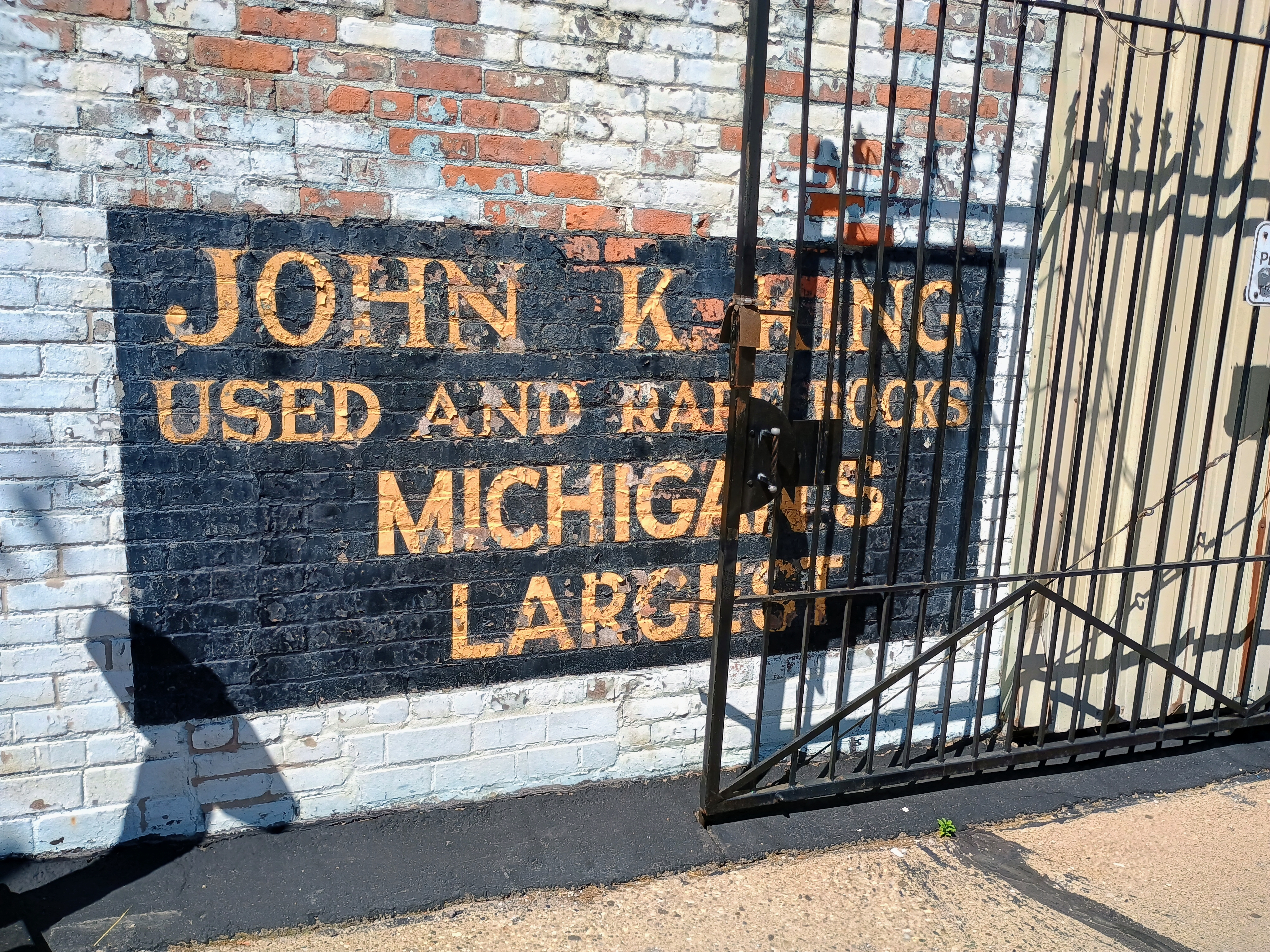
Painted on the brick of an old 4-story warehouse is the name John K. King Used and Rare Books Michigan's Largest.
Painted on the brick of an old 4-story warehouse building in Detroit, Michigan, is the name of the J. K. King Used and Rare Books, Michigan’s Largest. This is the largest used bookstore in the state, and well worth the visit.

For several years, I have kept a list of the books I read during the year. At the end of each year, I print the list and place it in the “All About Me” notebook I keep. The total number of books I read in a year range from 6 to 26. I’m going to beat that this year, as I’m already working on book 26 with two months of reading to go. Yippee! I love breaking my own record.

According to the Psychology Today article, I am an optimist. I don’t view my unread books as a burden or failure of self-control and time management. I see them as a future opportunity to engage with their content. I primarily read non-fiction, so most of my reading is a learning experience. I do blend a few pieces of fiction into the mix for fun. While I have more books than I could read in a year, collecting them is not compulsive hoarding, nor is it damaging to my social interactions.

With few exceptions, I now donate the majority of books I have read rather than keeping them, due to space limitations. I enjoy visiting used bookstores, where you can buy books at much lower prices. I maintain my membership with Barnes & Noble, though, because sometimes I have to purchase and read a new release. The Psychology Today article suggested slowing down the rate of acquisition and becoming more selective, not purchasing a new book until you’ve read one of a similar size. I don’t think that’s possible. I can’t wrap my head around such a ridiculous limitation.


Leave a comment

Filed under decisions, Discoveries, education, exploration, Full-Time RV, habit, hobbies, home, Life is a Melting Pot, memoir, Michigan, summer, time, travel

Why Didn’t the U.S. Adopt the Metric System? – Part 3 of a 3 Part Series

In Part 1 of this series, I explained how I became curious about the planned conversions from the Imperial to the Metric systems of measurement in Canada and the United States. In Part II, I provided a history of Canada’s laws that enforced the conversion and where the country stands now in utilizing the Imperial versus Metric measuring systems. Now, let’s examine the United States’ history regarding the metric system, followed by my opinion on why it failed to implement the planned conversion.

The United States is a muddled mess when it comes to its measuring system. This inconsistency and lack of follow-through dates back to our founding fathers and continues through our failure to complete the transition to the metric system in the 1970s.

History:

 When the American Colonies were being formed, the Founding Fathers decided to use an antiquated measurement system they inherited from the British Empire. Article 1, Section 8, of the Constitution of the United States provided that Congress should have the power “to coin Money… and fix the Standard of Weights and Measures.” Thomas Jefferson, Secretary of State in 1790, endorsed the use of a decimal system of measurement. The only fear was that the United States would be unable to verify the metric units without sending a delegation to France, which would be costly.

The metric system originated in France. The goal was to establish a uniform standard for all measurements and weights. The unit of length was a portion of the Earth’s circumference, and volume and mass were derived from the length unit. This was achieved by multiplying or dividing by 10 and its powers. Ten is much easier to work with than dividing by 16 (to convert ounces to pounds) or 12 (to convert inches to feet). The metric system is a decimal system with a base of 10, allowing for calculations by shifting the decimal point.

The French government officially adopted the metric system on April 7, 1795. A scientific conference was held from 1798 to 1799 to validate the system and design prototype standards, with representatives from Denmark, Italy, the Netherlands, Spain, and Switzerland in attendance. The adopted standards became official in France on December 10, 1799.

The United States was snubbed by France when it invited the other dignitaries to travel to Paris to learn the metric system in 1978. This snubbing was due to the U.S. entering into the Jay Treaty of 1796 with Great Britain, a French rival. France viewed this as a violation of its own treaty with the United States. It retaliated by seizing American merchant ships and refusing to invite them to the conference on the metric system.

The United States, having not taken part in this gathering, adopted the U.S. Customary System as our official form of measurement under Secretary of State John Quincy Adams in 1821. Part of the reason for this decision was fear that the metric system might fail following Napoleon Bonaparte’s reign during the early 19th century. Napoleon imposed the metric system on the countries he conquered, making it a symbol of French control. When European countries revolted against French control, they returned to their original means of measurement. Even with this revolt against France, the metric system continued to grow in popularity. By the end of the American Civil War in 1865, most of Europe had adopted the decimal-based measuring system.

The metric system was gaining popularity worldwide, and although we had not been invited to the 1798 gathering in France to learn about the system, President Andrew Johnson recognized its importance. In 1866, President Johnson signed the  Kasson Act, making it “lawful throughout the United States of America to employ the weights and measures of the metric system in all contracts, dealings, or court proceedings.”

France held another meeting of the world’s leading nations to discuss a new international version of the metric system, and the United States received an invitation and sent delegates. During the 1875 meeting, the United States and 16 other countries signed the Treaty of Metre, establishing the International Bureau of Weights and Measures. The treaty also created the International Committee for Weights and Measures to oversee the Bureau and the General Conference on Weights and Measures to consider and adopt changes. A lab in Sevres, near Paris, was selected to house the international metric standards. The U.S. received its copies of these documents in 1890.

The Mendenhall Order of 1893 stipulated that the fundamental standards for length and mass in the U.S. would be based on metric units. This means the U.S. officially and legally recognized the metric system 159 years ago when Tomas Jefferson, in 1790, endorsed the decimal system of measurement. That standard was confirmed 132 years ago with the signing of the Mendenhall Order.

Current U.S. Standards

If you are like me, you probably read those last two dates and went “what!!!” If this has been our standard for over 132-159 years, why are we still not using the metric system? In my opinion, it is a combination of laziness, unwillingness to invest financially in the change, and, most importantly, lawmakers who were weak in committing to the change and developing a law that would mandate the conversion. Here is what happened that led me to that thought process:

Fast forward 78 years from the entry of the Mendenhall Order to 1971. The United States is still operating under the Customary Imperial system. The U.S. National Bureau of Standards recommended in 1971 that the U.S. transition to the metric system over the course of 10 years. This would mean that by 1981, the country would be fully converted to the metric system. The first problem was the weak law that enacted this process.

The Metric Conversion Act was signed into law by President Gerald Ford on December 23, 1975. It states that the metric system is “the preferred system of weights and measures for United States trade and commerce.” Still, it permits the U.S. customary units in all activities. It states that all conversions to metric are “completely voluntary” rather than establishing the 10-year deadline recommended by the U.S. National Bureau of Standards. Schools began teaching children the metric system, and some businesses made the change; however, the majority of conversions never took place.

Due to the U.S. failing to complete the conversion to the metric system, conducting business with foreign countries became more difficult. In 1988, the Omnibus Trade and Competitiveness Act amended the 1975 Metric Conversion Act. Federal agencies were now required to use the metric system in business activities, including procurement grants, by the end of the 1992 fiscal year. It designated the metric system as the preferred standard for trade and commerce and assigned the Federal Government the task of helping industry make a voluntary conversion to the metric system. The problem is that the conversion remains voluntary, and the private sector has no obligation to implement the change.

The result of these non-mandatory laws is that they left the United States out of sync with the rest of the world. It also means that some industries made partial or complete changes, while made no change at all. The United States is a hub of various measuring standards that are not mutually compatible.

Today, the U.S. uses the SI (International System of Units) on a daily basis. About 30% of products manufactured in the U.S. use metric units. Pharmaceuticals are all metric, and beverages show both U.S. customary and metric units. Film, tools, and bicycles are metric. U.S. coins & currency are produced using metric specifications. Wine and distilled spirits have been using only metric measurements since the early 1980s. Packaging uses metric units to provide net quantity, nutrition, and health-related information for prescription drugs, over-the-counter medications, vitamin supplements, and other products. The U.S. lighting sector uses metrics for light output (lumens), peak beam intensity (candela), beam distance (in meters), and impact resistance (in meters).

Understanding Imperial Standards

This article begins with Part 1, which explains my curiosity about how our current measures were established. I’ve taken a wide-ranging approach to the subject, due in part to my curiosity and love of history, and partly because I believe that to understand where we are, we must know where we came from.

While all this history is fascinating, it still didn’t answer my question of how the Imperial System of measurements was established. These measurements appear to date back to around 450 CE (Common Era; a secular version of AD). It was then that the Germanic tribes invaded England and established a system of measurement that remains in use today:

  • An inch (ynce) was the length of three (3) barleycorns.
  • A foot was initially based on the length of a human foot. This led to inconsistencies in measurement, so the 12-inch foot was officially codified by King Edward II, likely because 12 has more factors, making it easier to subdivide for carpentry and construction.
  • A yard was established as a 3-foot construction standard.
  • An acre means a field and was considered the size of a field that a farmer could plow in one day.
  • A gallon represents the volume equivalent to eight pounds of wheat.
  • A mile was established by the British Parliament as eight (8) furlongs, or 5,280 feet. A furlong was a length based on a single furrow in a plowed field and was standardized by England’s government around 1300.

The United States is the only industrialized nation that hasn’t made the metric system compulsory. While cost is one factor, the main reason is the failure of Congress to make the metric system mandatory in all 50 states, the District of Columbia, and all U.S. territories. The U.S. made the conversion voluntary in laws enacted in both 1866 and 1975. The country has failed to adopt a unified system of metric measurement for transactions that affect the lives of ordinary citizens.

This has led to a hubbub of mixed measuring standards:

  • A football field is measured in yards, but footraces are measured using meters.
  • Mechanics use horsepower to measure an automobile engine’s power, but the same engine’s displacement is in liters.
  • Air pressure is expressed in pounds per square inch, which is equivalent to millibars for air pressure aloft, and inches of mercury for surface atmospheric pressure.

In the U.S. Customary System, there are over 300 different units used to measure various physical quantities. The failure of Congress to make conversion to the metric system mandatory has resulted in the U.S. being a hodgepodge of imperial and metric systems.

Basic Measurement Conversions:

1 mile = 1.6 kilometers.
1 foot (12 inches) = 30 centimeters
1 inch is about 25 millimeters or 2.54 centimeters
1 yard (3 feet) is almost 1 meter
1 kilogram is just over 2 pounds
1 pound is about 454 grams
In the U.K., 14 pounds = 1 stone

Converting Fahrenheit to Celsius is easy:
0 degrees Celsius (°C) is equal to 32 degrees Fahrenheit (°F)
24 degrees Celsius is equal to 75 degrees Fahrenheit
To convert Celsius to Fahrenheit, use the formula of (c x 1.8) + 32

If you want to know more, you can use the World Wide Metric Conversion Calculator for converting pressure, temperature, length, weight, and volume. Just enter the measurement you have, and it will fill in all other boxes within that area.

In closing, should the United States have enacted firmer laws mandating the change to metric? Do you think it would be better if we were on the same measuring system as the rest of the world, or do you like being a stand-alone country using the U.S. Customary System adaptation of the British Imperial System? Share your thoughts in the comments below.

Leave a comment

Filed under assumptions, Canada, communication, decisions, Discoveries, education, habit, Michigan, reality, travel

Why Didn’t the U.S. Adopt the Metric System? – Part 1 of a 3 Part Series

Listening to a weather forecast on a Canadian TV station, the temperatures are given in Celsius. Paul, who grew up in Canada, makes the mental conversion easily. Paul grew up using the Imperial system of measurement, which is used in the United States. After he was an adult and had immigrated to the U.S., Canada converted to the metric system. Paul is an electrician, a profession that uses the metric system of measurement. That, combined with his frequent travel to Canada, means he is familiar with both systems and believes the metric is a more accurate means of measurement.

Paul frequently comments that the U.S. was supposed to make the conversion to the metric system when Canada did, but failed to fulfill their promise. I recall being in grade school when we were told that the United States would adopt the metric system. I wondered how valid Paul’s repeated comment was, so I delved into researching the topic.

 Canada was making the transition at the same time and completed their conversion between 1970 and 1985. The United States never finished the conversion, despite agreeing to do so, and continues to use the Imperial System today. That made me wonder, why did Canada succeed, and we didn’t?

In my opinion, the U.S. failed to complete the conversion due to a lack of effort and unwillingness to invest in implementing the change. Businesses opposed the cost of having to retool and adjust standardized measurement systems, including bolts, pipes, and nuts, to metric measurements. The Metric Conversion Act of 1975 [ https://usma.org/laws-and-bills/metric-conversion-act-of-1975 ] made the metric system preferred, but not mandatory. This, combined with public resistance and the government’s inability to enforce the change, led to the failure to implement the change.

As of today, the United States is only one of three countries (the United States, Liberia, and Myanmar (Burma)) worldwide using the Imperial measurement system. The Imperial system [ https://www.britannica.com/topic/Imperial-unit ] (also known as the British Imperial system) originated from the British Empire, which ruled many areas of the world between the 16th and 19th centuries. Although the U.S. Founding Fathers made numerous changes in governing style when obtaining independence from Britain, they decided to maintain the Imperial system of measurement, despite the metric system growing in popularity.

A chart showing the Imperial vs Metric measurement and weight differences.

Rather than adopting it in its original state, the United States devised its own version of the Imperial system, known as the U.S. Customary System. It uses measurements of feet, pounds, and miles, but differs slightly from the British Imperial system. The most substantial difference is in volume:

  • The U.S. Customary fluid ounce is 29.573 ml; the British Imperial fluid ounce is 28.413 milliliters.
  • The U.S. Customary pint is 473.176 ml (16 fl. oz); the British Imperial pint is 568.261 ml (20 fl. oz).
  • The U.S. Customary quart is 0.94 L (32 fl. oz); the British Imperial quart is 1.13 L (40 fl. oz).
  • The U.S. Customary gallon is 3.78 L (128 fl. oz); the British Imperial gallon is 4.54 L (160 fl. oz).

The reason for creating the Customary version of the Imperial system was that the metric system was not yet fully developed. The Founding Fathers had a desire to establish a unique national identity and infrastructure, and tweaking the system to make it unique to the U.S. was their way of achieving this goal.

Myanmar (Burma) and Liberia use the Imperial system but are transitioning to the metric system; neither has a predicted completion date. Once their conversions are final, the U.S. will be the sole user of the Imperial system. In 2021, the British government announced plans to return to the Imperial system during its exit from the European Union. The changeover began but was abandoned in 2024 after consulting with the public and discovering overwhelming support for using metric units. They do still use the imperial system for things such as beer sales, road speed, and distance signs, and body measurements.

Although I found the metric system difficult to learn as a child, our government failed its citizens by not enforcing a complete change in the 1970s. A full conversion would have served business owners better in international trade negotiations and put us on equal terms with all foreign lands in understanding measurements when traveling.  

All countries worldwide, including the U.S., Myanmar, and Liberia, have adopted or legally sanctioned the International System of Units (SI), the modern form of the metric system. Canada and the United States are both melting pots of the Imperial and Metric measurement styles.

Watch for Part II and Part III in upcoming blogs, which will deal with the law and the Canadian conversion, the laws and the United States conversion, and where the United States stands today.

Leave a comment

Filed under Canada, communication, decisions, Discoveries, education, home, Life Changing, Life is a Melting Pot, Michigan, reality, travel, Weather

Cherishing Front Porches: Memories and Connections

When was the last time you sat on the front porch of your home, waving at your neighbors as they passed by, or inviting them up to chat and share a glass of lemonade? 

I have always loved front porches, the big kind that holds several chairs. When I lived in St Clair, Michigan, I rarely sat on my private patio in the back. I preferred the front porch, where I often sat reading a book until it got dark. I was not in a neighborhood, but on a state highway, so I only had cars buzzing by.

My love of sitting on the front porch is something I developed as a toddler. Back then, my grandmother was my babysitter. I remember sitting on the porch at various times of the day, watching the birds in the yard, migrant workers across the street playing, and watching the sun set. Red sky at morning, sailors take warning. Red sky at night, sailor’s delight. Hmm, wonder where I learned that?

The world made more sense when folks waved from the porch instead of arguing with strangers online.

As a teenager, my best friend in high school lived in a large, older home with a large front porch. I loved that porch! We would sit on it talking with friends, shouting out to cute guys that drove by, and just enjoying life. The house I grew up in only had a small stoop. I envied April, living in a home with a large porch that looked out over the street.

I no longer have a front porch. I always intend to sit outside on my lawn chair, and those times when I make it out there, I enjoy sitting in the fresh air and reading a book. I don’t get out as often as I want; life gets in the way, even in retirement. I, like many others, spend a good deal of time on social media, sharing trivial quotes, travel, pictures, news articles, and day-to-day activities with distant friends and family. I participate in public forums, where political discussions can turn hostile. People have lost the etiquette exercised during face-to-face conversations. It is so much easier to be insulting and rude when done through an electronic device.

That image takes me back to another time, when life was more relaxed and friendly. Kids played outside; they rang their friends’ doorbells to see if they could come out, rather than having scheduled play dates arranged and monitored by their parents. There were neighborhood block parties, where everyone got together, brought a dish to pass, and adults enjoyed socializing while the kids played. You knew your neighbors, and your neighbors knew you, and everyone got along. In my opinion, it was a better time.

Leave a comment

Filed under backyard, communication, Family, friendship, home, kids, Life is a Melting Pot, memoir, Michigan, parents, play, summer, time

Freshly Mown Grass: A Journey Back in Time

Do you ever smell a certain, familiar scent and suddenly remember a small art of your childhood you totally forgot about?

When I saw the question, “Do you ever smell a certain, familiar scent and suddenly remember a small part of your childhood you totally forgot about?” I knew instantly what it was…fresh mown grass.

Growing up in Michigan, I remember the smell of our freshly mown lawn on Saturday or Sunday summer afternoons. Once the yardwork was complete, Dad would come inside and watch the baseball game. This makes my memory multi-sensory, a combination of scent and sound.

The smell of freshly mown grass always takes me back to those summer afternoons, but it doesn’t feel complete without the sound of a baseball game playing on TV. Should I mention that this is an old-fashioned console TV that only receives four channels, has a TV antenna, and you had to walk over to the TV to change the channels or adjust the antenna? I know, I’m dating myself. That shows how far back this memory goes.

I don’t have any other scent-based memories that have such a substantial impact on me as freshly mowed grass. I will admit, if I hear a baseball game playing on TV, I miss the smell of grass. In my mind, they go together. What scent transports you back to your childhood? Share in the comments below.

Leave a comment

Filed under backyard, home, Life is a Melting Pot, memoir, Michigan, summer

Michigan Was a Slave-Holding State

I decided to share the link to an article published in the March-May edition of Michigan’s Freshwater Reporter. Michigan is known for being a free state that helped freedom seekers via the Underground Railroad. That information is accurate, but Michigan citizens also were slaveholders. You can learn more about this by checking out Michigan’s hidden history of slave ownership on page 4 of the Freshwater Reporter.

Leave a comment

Filed under assumptions, Coping, decisions, education, events, Life Changing, Life is a Melting Pot, Michigan

Summer Visit With Grandkids

My grandkids are 17, 11, and 8, and with me only seeing them once a year, I enjoy taking them on individual outings, plus a few family activities. Our stay in Michigan was longer this year, so I was on the go with various outings. Keep reading if you’re looking for things to do with kids in the Clare/Harrison, Michigan, area!

We started our visit by meeting my daughter, Caroline, husband, Rob, and the kids for dinner at Budd Lake Bar & Restaurant. After dinner, they came over to Hidden Hills Family Campground to visit. Kids’ interests are ever-changing, so I had lists of possible activities. I was surprised at some of the things they passed over and others they selected.

Corbin is 11 and spends most of his time playing video games. He is also harder to appease with activity selections. I wasn’t surprised when he picked Valley Lanes Family Entertainment Center for two of his outings. This complex contains bowling, putt-putt, an escape room, a pool, a laser maze challenge, bumper cars, an arcade, a pinball alley, and laser tag. They also have an on-site restaurant where we enjoyed lunch during both visits.

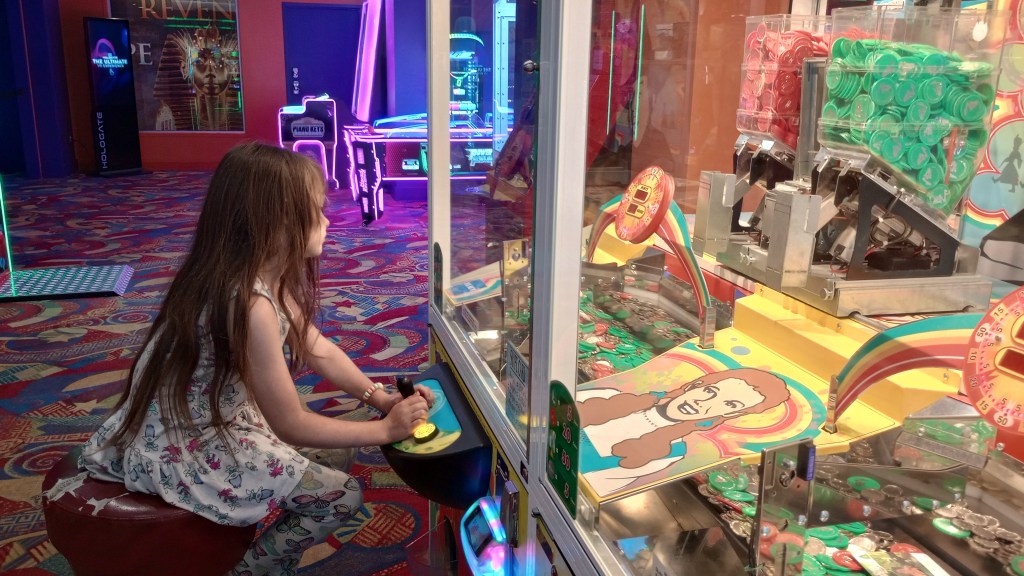
On our first trip there, we spent quite a bit of time in the arcade. Corbin was surprised I could “ride” a motorcycle so well, not realizing I had ridden the real thing before his birth. I enjoyed watching Corbin play a large selection of games that did not exist when I was hitting the arcades as a teen or when my kids were young. We enjoyed playing air hockey and skee ball, two throwbacks to my day. I spent a lot of time in arcades in the 1970s, so this was a fun outing.

Corbin also elected to go bowling, and we rolled three games on each trip. I hadn’t bowled in years and didn’t do well, but we had fun. When I was a teen, all scorekeeping was by pencil and paper. Now it is automated, including a variety of game selections and cartoons that cheer you on or laugh at your blunders. Quite a change!

On our second trip, Corbin decided to do the laser maze. They had a video screen outside the room, so I could watch his progress, which required navigating over and under laser beams to reach a specific spot in the back, hitting a button, and then navigating the maze again to the front and hitting the ending button. It displays your time and the number of lasers you broke. I chuckled when he said he would make a good burglar, as he only broke six lasers. I said I wouldn’t rely on that; it only takes one to set off alarms that call the cops.

Corbin’s other selected outing was to a water park. Since he had been to the one in Mt. Pleasant a few times, I took him to Zehnders Splash Village in Frankenmuth.  Water slides aren’t my thing, but I enjoyed watching Corbin play in the pools, relax in the hot tub, float the lazy river, shoot down a water slide, and other activities. Our tickets were for five hours in the park. Afterward, we enjoyed lunch in the hotel restaurant before leaving.

Corbin is interesting. He appears to be a self-absorbed video gamer, but when he talks, you can tell there is much more going on in his brain than people realize. He uses intellectual phrasing when presenting his opinion and absorbs a lot of information on a variety of subjects.

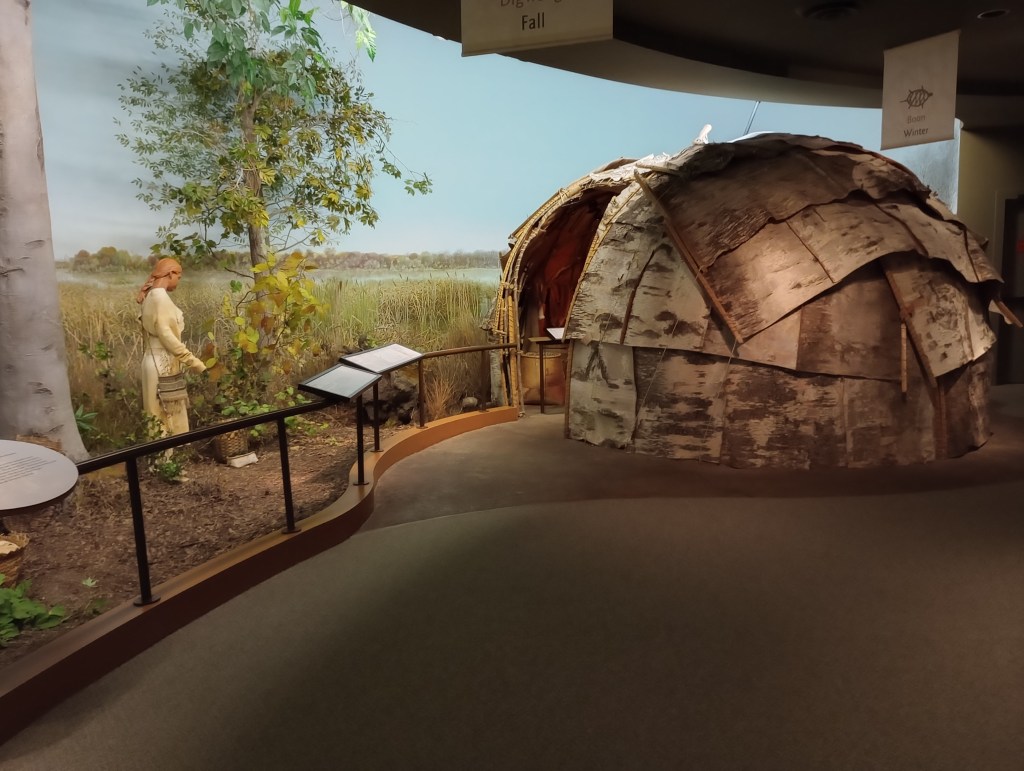
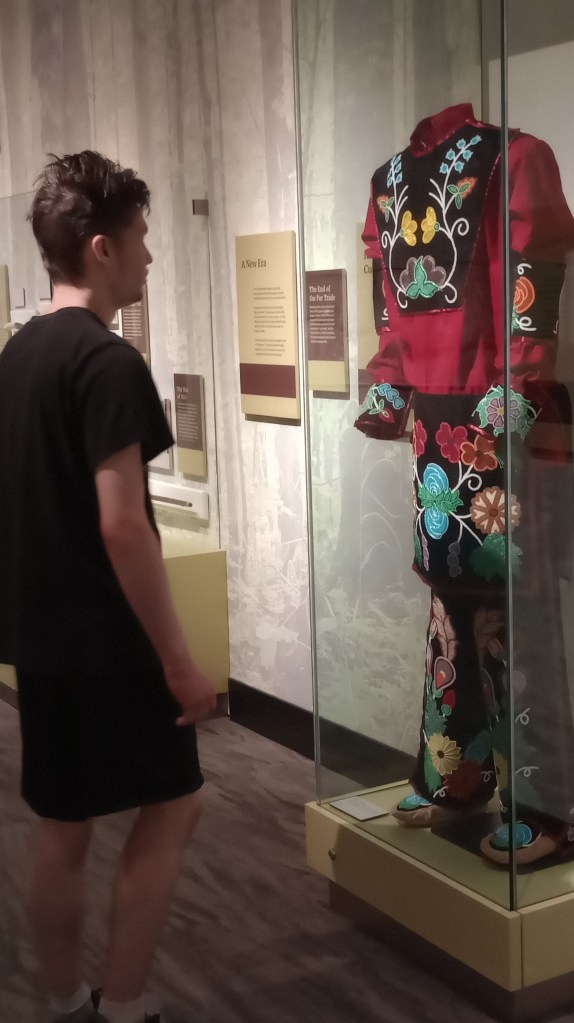
Austin is 17 and likes history and museums. We enjoyed three different locations on a wide range of topics. The first was to the Ziibiwing Center of Anishinabek Culture and Lifestyle. The museum has 15 areas in their permanent exhibit area about the Saginaw Chippewa Indians. It was interesting to learn about the Chippewa way of life and the oppressive things done to their culture over the centuries. Austin expressed disgust at the horrible ways Native American people were treated in the past.

Austin suggested the Michigan Heroes Museum in Frankenmuth. This very interesting and unique spot opened in 1987, focusing on Michigan’s military and space heroes. It covers ten wars dating back to the Civil War, ending with Operation Enduring Freedom in Afghanistan and Operation Iraqi Freedom in Iraq. There are more than 900 Michigan veterans featured in exhibits.

The information is beautifully displayed in individual showcases about each person and includes some of their personal items. Three permanent galleries are dedicated to Michigan Astronauts and Space Pioneers, Service Cross Recipients, and the nation’s largest collection of Medals of Honor. When viewing a showcase that deals depicts how the Nazis destroyed the lives of innocent people, Austin commented on the horrible way the Nazis behaved. His comments made it apparent he had likely studied this subject in school.

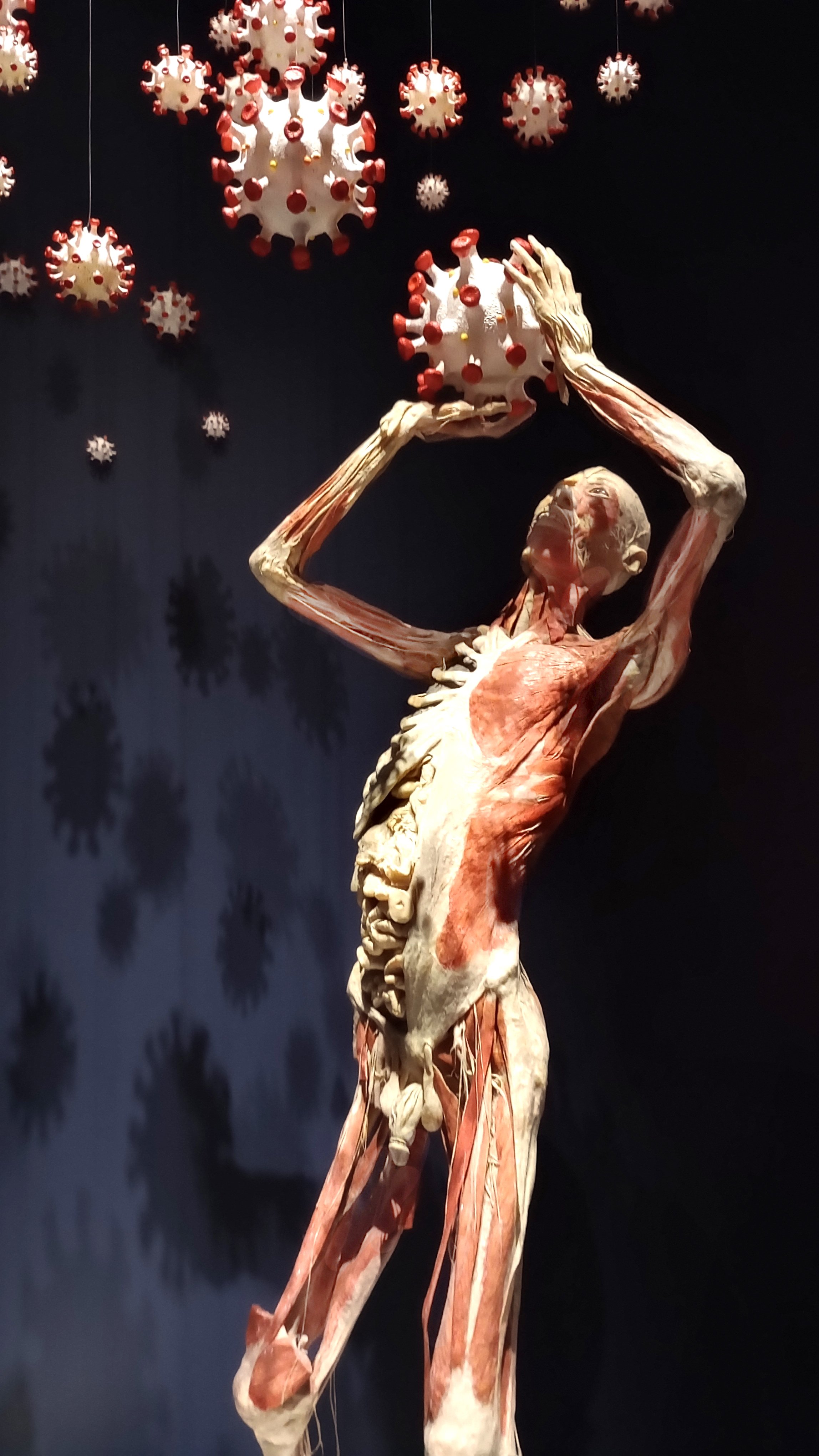
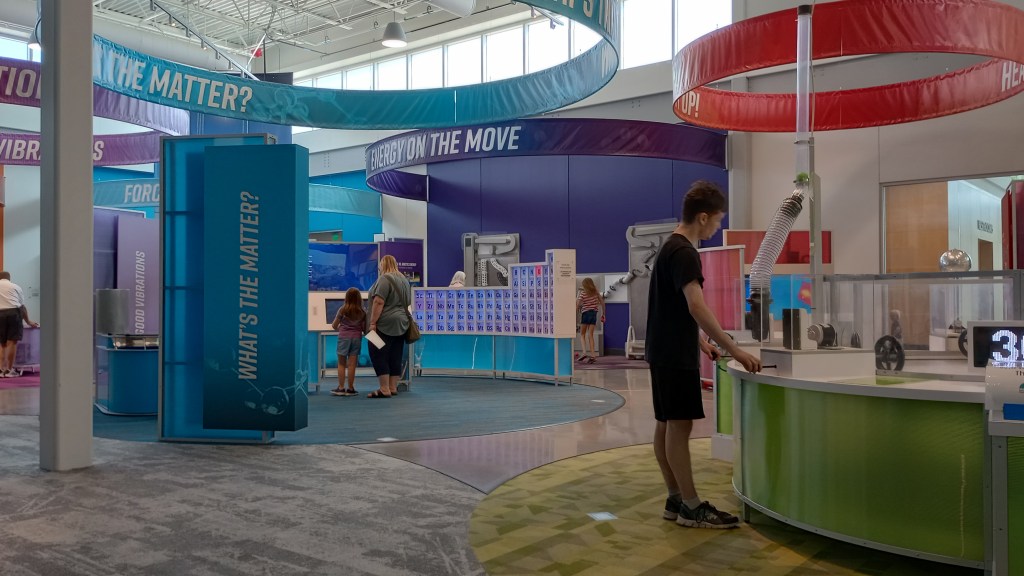
Austin’s third outing was to the Longway Planetarium and Sloan Museum of Discovery. We were early for our planetarium show and mentioned it when I was purchasing a book in their gift shop. It was pouring rain outside, so the cashier gave us complimentary tickets to the show before ours. It was a different topic than the one we had purchased, and it was interesting. Sloan Museum is a hands-on learning experience. Austin is aging out of the museum but enjoyed the activities and suggested we go to the Real Bodies special exhibit. 

Presented by Hurley Medical Center, Real Bodies contains real human specimens preserved to show how the human body works. This is more than skeletons; it includes muscles, lungs, heart, and more in beautiful exhibits. I highly recommend this exhibit, but only cell phone photography is allowed.

In touring the museums with Austin, it was interesting how much information he has absorbed about history from school or the reading he enjoys doing on his own. I was also surprised at his interest in the military, as I had not been aware of that.

ALEXANDRIA (Alex) is 8 and a girly girl, talkative and opinionated tomboy. This is why she has such a wide range of activities. We went to Day Escape and Spa for mani-pedis, her first. The salon enjoyed Alex because she was inquisitive and knew what she wanted. They said many of the young girls that come in won’t respond to their questions. Alex was stepping forward, voicing her desires. We walked into the pedicure room, and her tech asked if she wanted to select from a shelf that had mermaid polish on it. Alex looked at the display and said, uh, no, and turned to a large display of available polish. She pointed to three different colors she wanted; she made a different selection for her fingernails.

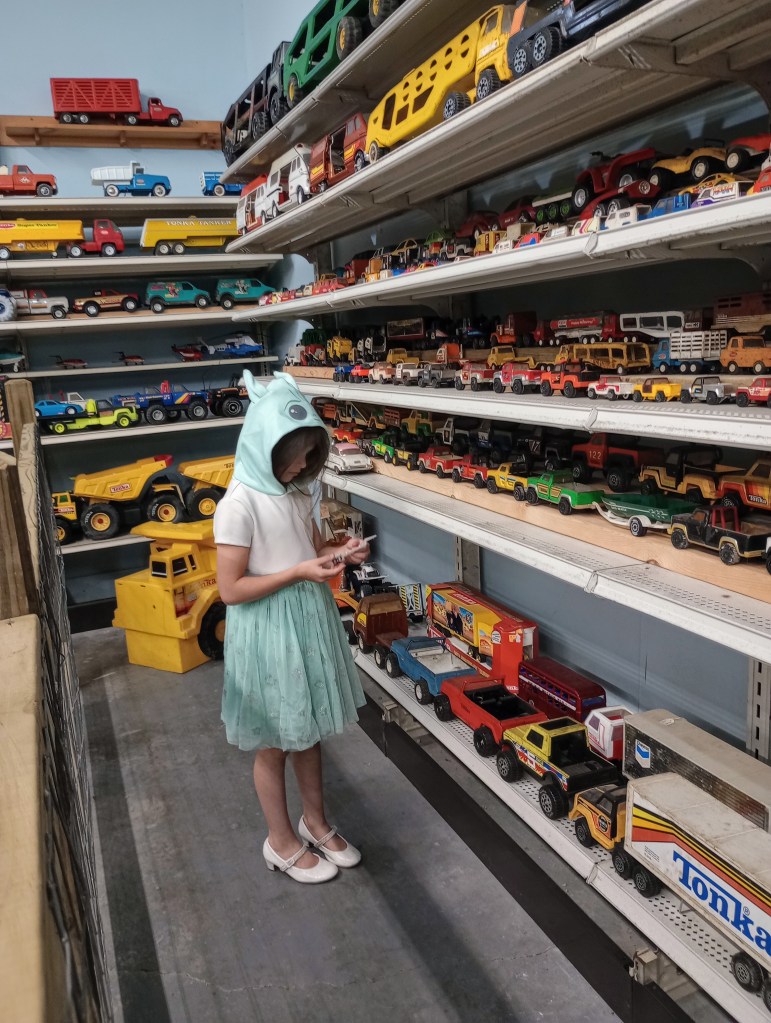
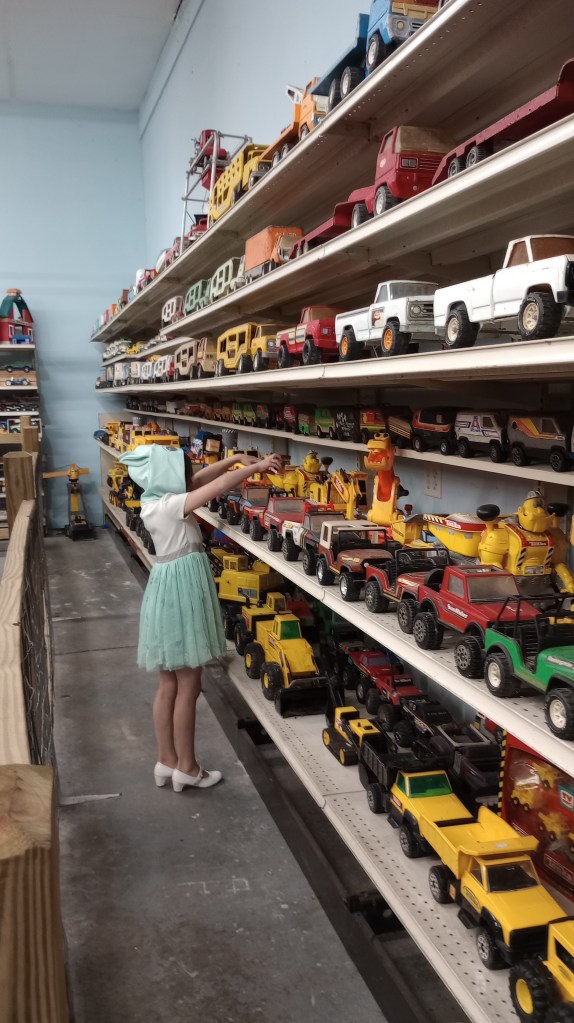
I was surprised when Alexandria selected the Antique Toy and Firehouse Museum for one of her outings. I had put that on Corbin’s list of possibilities because he has always liked vehicles, but he passed on the option. The museum has more than 60 motorized firetrucks, the largest collection in the world, and includes the FDNY Super Pumper, considered the T-Rex of fire engines. They also have over 12,000 antique and collectible toys.

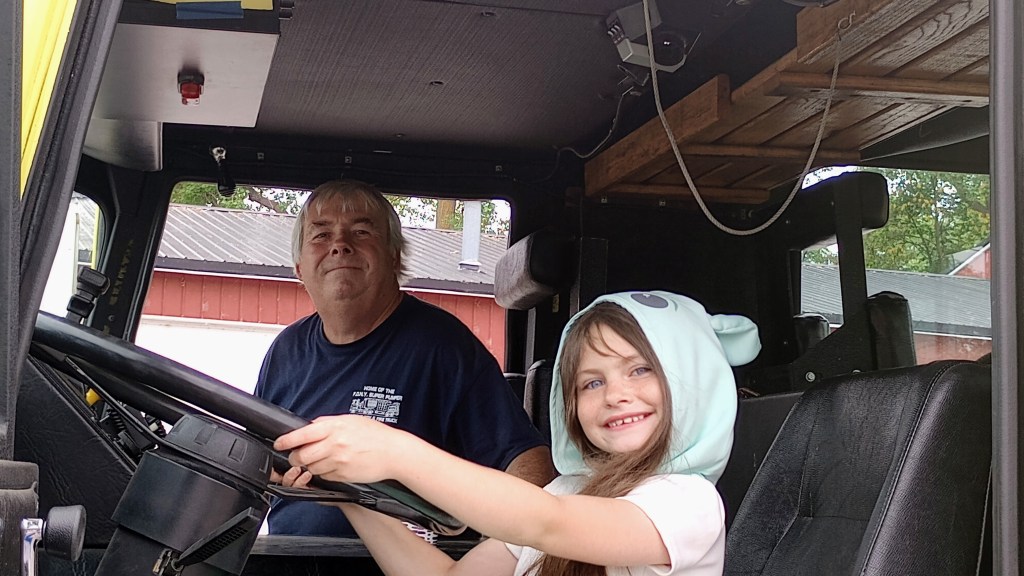
Alex wore a dress and heels, catching the eye of museum docent Dave by asking him a question. Dave toured us through the museum, letting her into a gated area where antique toys were on shelves, encouraged her to climb up into all the firetrucks, which were labeled “do not climb, and told her when she was done looking around, she was going to drive a real firetruck—which she did!  Alex drove a 38-foot firetruck with me in the passenger seat; Alex sat on Dave’s lap in the driver’s seat. We went around a rural block twice, with her turning the steering wheel and blowing the air horn when she saw people. I asked Dave how often they take kids out like that, and he said never; Alex is the only one. Definitely a once in a once-in-a-lifetime, memorable experience.

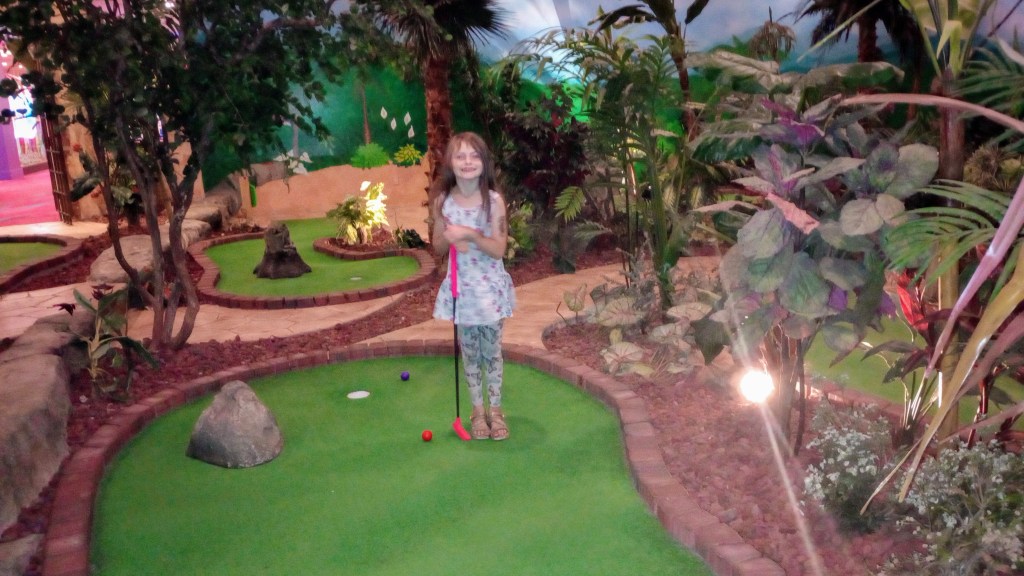
Alex selected Valley Lanes for one of her outings. Given the age difference between her and Corbin, the selection of games she made was different, and we had a lot of fun. Alex wanted to play miniature golf, which was an interesting 18 holes. I attempted to keep score, but I’m not sure if all the swings one of us took got counted.

I also took each of the kids for their own day of lunch and shopping for a few school outfits. Austin was in and out of the dressing room on his own, and other than showing me one outfit, he pretty much just told me whether they fit or not. It was hard shopping for Corbin as he has definite likes and dislikes, and the majority of clothes in his size were in his dislike category. Alexandria is very opinionated about what she likes. The only problem is her taste is in the older-looking girls’ section, but she is tiny and still wears little girl sizes for most things. She enjoyed trying on clothes, and it was like a modeling show as she posed for me to photograph each outfit.

In addition to my individual outings with the kids, we had a couple family outings. These were harder to fit in because Caroline works 6-7 days a week. We did manage to coordinate an outing with all three kids to Bronner’s Christmas Wonderland in Frankenmuth. Bronners is the world’s largest year-round Christmas store, covering 2.2 acres plus 27 acres of landscaped grounds. If you are ever in Frankenmuth, Michigan, this is a must-see.

We also went on the Bavarian Belle Riverboat cruise. This is a one-hour cruise down the Cass River on a stern-driven paddlewheel riverboat and includes narration about the history of Frankenmuth. After the cruise, we shopped our way back through River Plaza to the car.

Another family outing was to the Children’s Zoo in Saginaw. Opened in 1929, this small zoo covers only 10 acres but has some interesting displays and over 150 animals. It’s a perfect spot for those who want to visit a zoo that doesn’t require a full day and miles of walking. We finished up with a late lunch at Saginaw Old Town Junction, where the kids wanted to sit upstairs with an overlook of the floor below. The food was good, and I shouldn’t have been surprised when Austin ate a half-pound hamburger with fries and then finished his sister’s fries. I forgot how much teen boys can consume!

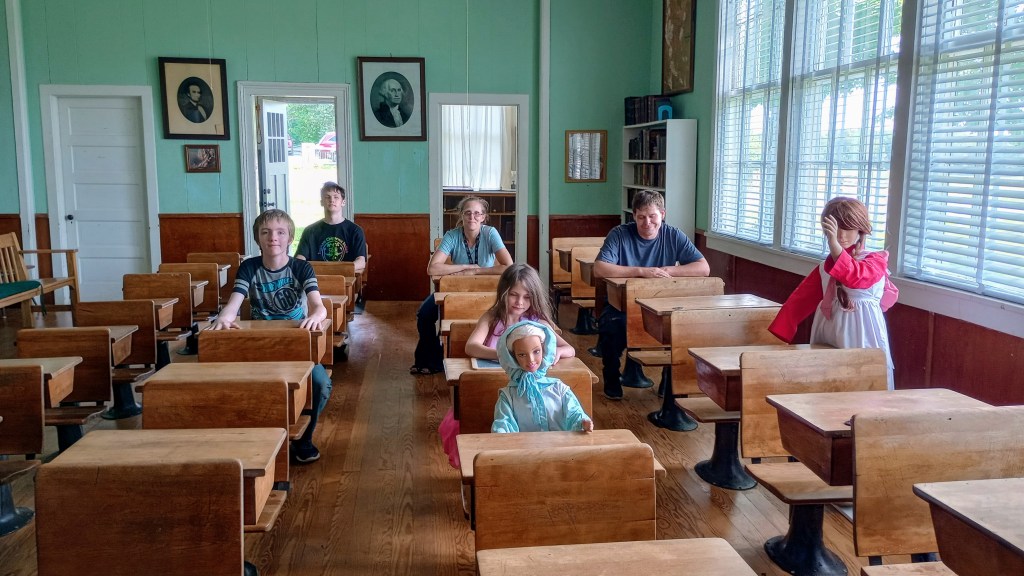
We enjoyed visiting the Clare Historical Museum complex, which includes a museum, historic log home, blacksmith shop, and historical school. It was amazing how small the homes were where people raised many children. Entire homes were smaller than the family room in many of today’s houses. Ringing the school bell was comical, as Alexandria is so lightweight that the cord pulled her up off the floor as it rang. This is an off-the-beaten-path museum that is interesting and well worth the trip.

The final get-together with the family was a buffet meal at Ponderosa Steak House in Clare, which ended way too soon. It was a fun summer, and I always look forward to spending time with the kids.

I don’t miss the Michigan winters—I winter in Yuma, Arizona—but I miss the days when I lived a mile from the kids and had them at my house frequently. They grow up quickly!

Leave a comment

Filed under Activities, children, Discoveries, education, events, Family, grandchildren, kids, Life is a Melting Pot, Michigan, play, summer, tourism, travel, vacation

What Is Professional Photography?

I recently visited the Real Bodies special exhibit by Hurley Medical Center at the Sloan Museum in Flint, Michigan. The sign said no professional photography, which means personal use only. I started through the exhibit, and after taking a few pictures, a worker told me no professional photos. I responded no problem, personal use only. She then said I couldn’t use my DSLR camera, only my cell phone. Their position was that my Nikon D750 camera designated the photos as professional, and I couldn’t use it. When I told them that is discriminatory because I use that camera for personal photography, I was told that is their policy. 

 What is wrong with this? The photographer’s knowledge of photography combined with the way the photographs are being used designates them as professional images. The type of camera is, to a certain degree, irrelevant.

To achieve professional quality, you must understand the basics of composition, depth of field, clarity, and lighting. You can achieve professional-quality images by utilizing all your cell phone camera features. You can also produce low-quality photos with a high-end DSLR if you don’t understand how to use your camera and the rules of photography.

The photo on the left is a before shot taken with my cell phone using the standard default camera settings inside the Real Bodies exhibit at Sloan Museum. The photo on the right is after editing in Photoshop to lighten the heavy shadows caused by exhibit lighting.

The problem I ran into at the Sloan Museum is one I have encountered elsewhere, as have other DSLR camera users. I planned to tour the Van Hoosen Farm Museum in Rochester, Michigan. The sign said admission was $5.00, but the clerk told me it would be $50 to enter. When I pointed out the $5.00 entry fee, she told me I had to pay a $50 professional fee because I was carrying a professional camera—I had my DSLR. I have used SLR cameras since the early 1980s and did no professional shooting at that time.  The girl told me to pay $50, or I wouldn’t get in. I walked out the door.

There is one place in Michigan that got it right. There was no camera discrimination when attending the Blue Water Sandfest in Port Huron. This organization understands professional photography; they posted notices that if you plan to use any photographs professionally, you must have written permission and follow their publication guidelines. This company understands the photographer, and their usage of the images makes it professional photography, not the camera style.

So how do you determine who is a professional photographer? Having a good camera is not the determining factor. Most professional photographers use a DSLR around clients because people think the camera makes a person a professional. However, in a recent survey by Suite48Analytics, 13% of professional photographers say they take at least 50% of their work-related photographs using a smartphone, 24% use it to take less than half of all professional pictures, and 31% use their cell phones more for professional photography than in prior years. The only limitation a modern cell phone has is resolution. If printing the photographs in a large format, a cell phone isn’t going to meet quality standards. Cell phone quality is sufficient if images are only for online or small format use.

The before photo on the left was taken with my cell phone using standard default camera settings inside the Real Bodies exhibit in the Sloan Museum. To achieve the photo on the right, I edited the picture in Photoshop to lighten the shaded areas created by the exhibit lighting.

So what determines whether a person is a professional photographer? It depends on what standards you use. The most common determining factor is whether the person earns between 50% to 100% of their income from photography. In other words, to be a professional, photography is your full-time career. By that definition, I am not a professional photographer.

Another manner of determining whether or not a person is a professional is whether or not they have accomplished at least one of the following:

  • Has given a photography presentation
  • Has received recognition in a national photography contest
  • Has sold their photographs in an art show or art studio
  • Has a website displaying photographs for sale
  • Has organized or directed a photography field trip
  • Has published photographs in newspapers, magazines, or books

I qualify as a professional if you use this second group of criteria. You may wonder why, if I qualify as a professional, the policy against using a DSLR camera bothers me. The reason is the policy discriminates against anyone using a good camera. The policy should be based on how the photo is used after creation.
The worker at the Real Bodies exhibit told me I can use my cell phone photographs in any manner I choose. I said, “So I can use them on Facebook, blogs, or other writings?” She said yes because they aren’t professional photographs.

Now a legal question comes to mind. Since I took “unprofessional” photos with my cell phone, can I use them to accompany a magazine or newspaper article? According to the worker, I can. I don’t think that is what Hurley Medical Center’s intent is, but that is the message being given because of inappropriate wording on their signage and poorly informed workers.

The problem is that Sloan Museum and Hurley Medical Center assume a professional photographer cannot get a quality image from a cell phone. A professional-quality photograph from a phone is easy when you adjust the camera settings. Sloan Museum/Hurley Medical Center, Van Hoosen Museum, and other places that want to prevent the professional use of photographs should display signage that photography is for personal use only and not for professional purposes. They could also state that for professional use, written permission is necessary.

 The above before and after photos were taken in the Real Bodies exhibit at Sloan Museum. The image on the left shows a distracting acrylic display case and reflections that detract from the subject of the photo. The image on the right is after editing in Photoshop to remove the reflection and case, allowing the subject of the photo to stand out.

What is a professional photograph? It is an image being used for business, marketing, available for sale, or used to accompany articles written for magazines, newspapers, etc. In other words, the photographer aims to generate profit with the photo.

The bottom line is that businesses must understand the difference between camera style and professional usage. A lack of understanding may lead to people using images in an unintended manner.

Those hiring a professional photographer need to understand the difference between a person with an expensive-looking camera shooting in automatic/jpeg format and a professional. Professionals know how to produce an image that stands out and process it using Lightroom, Photoshop, or another pro-level image editing system to tweak it into the best photograph possible.

If you want to take good photographs, learn the basics of composition, lighting, depth of field, and exposure, plus how to use your camera to achieve the desired results. Purchasing an expensive camera will not help you take better pictures. If you buy a DSLR and leave it in the “auto” setting, you might as well use an inexpensive point-and-shoot or cell phone. If you invest in a DSLR, learn to shoot manually, preferably in raw, and edit in Photoshop for the best quality image.

2 Comments

Filed under assumptions, employment, hobbies, Life is a Melting Pot, Michigan, Photography, work

Looking Forward Means Looking Back

One of the downfalls of living and traveling full-time in an RV is only seeing my grandchildren once a year. While planning my 2023 travels and time in Michigan, I find my mind reminiscing back to the fun I had last summer with my grandchildren, Austin, Corbin, and Alexandria.

My 2022 visit was a fast-moving nine-day visit. I decided that because of the difference in their ages and interests and not having much time with them, it would be fun to do a couple of things together in the nine days I was there. I also wanted special one-on-one time so each child got their own day.

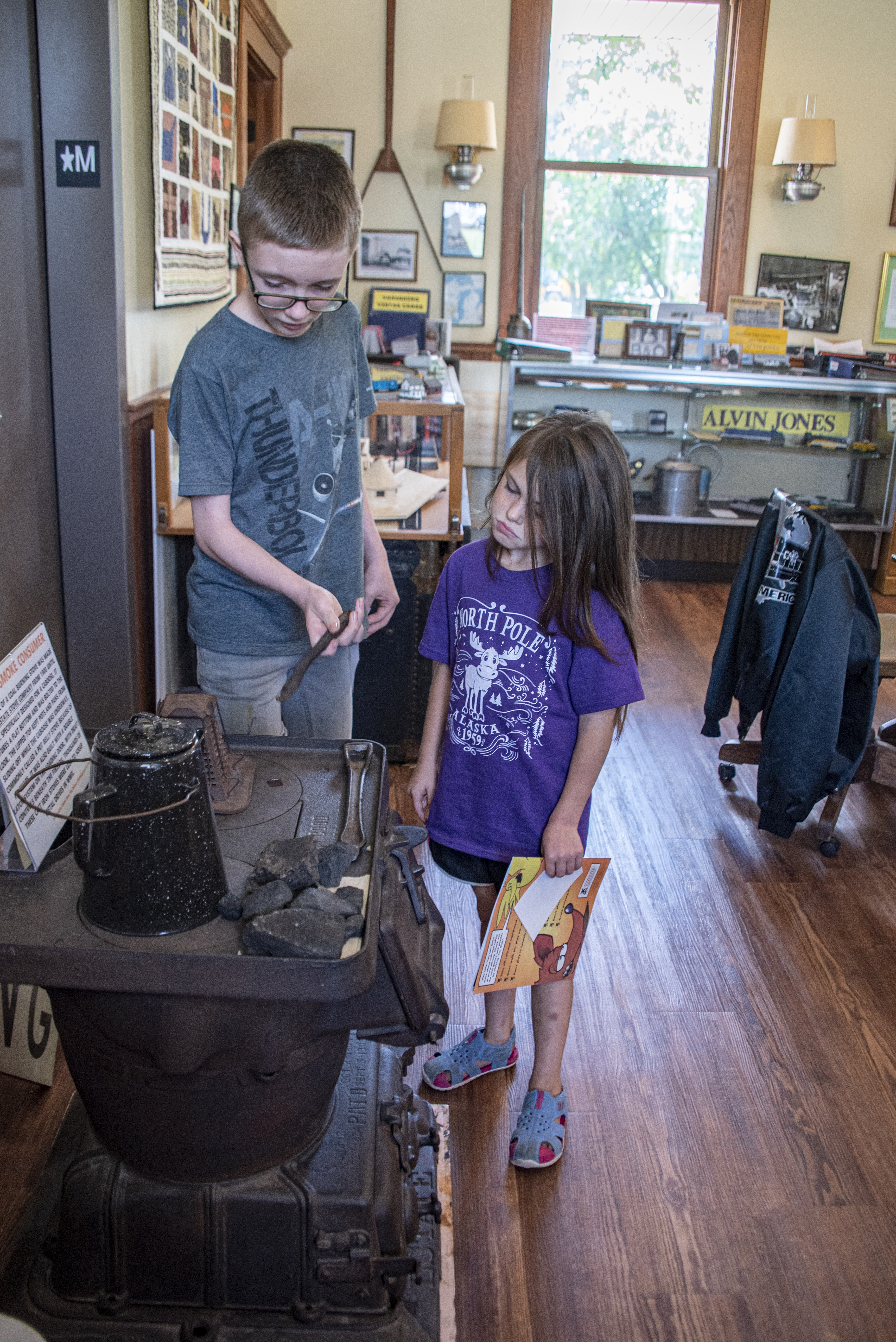
I took the three of them to a small, local railroad museum. The museum was interesting but didn’t hold their attention for long, so I suggested ice cream. I was surprised to learn Corbin doesn’t like ice cream, so he got a pop to drink instead. I thought it was cool when an Amish horse and buggy came down the street as we ate our ice cream at a picnic table.

When I commented on the horse and buggy, Corbin (age 12) informed me that the Amish do not believe in modern technology. To them seeing this is common, everyday stuff. I realized how much when I was on my way back to my campground and saw a horse and carriage tied up to a hitching post in front of Dollar General.

Alexandria (Alex)

Alexandria was the first to go solo, and her bubbly, social butterfly 7-year-old personality is always fun to watch. She is a girly girl, and that shines through when shopping for clothes. We went to the dressing room with six outfits to try on, and I told her we would buy two for school. That was a fantasy in my mind but turned out not reality.

After the try-on session, there was nothing Alex couldn’t wear, so I asked her which she wanted. She said she needed the grey flowered fleece pants and top because they are soft and warm. The yellow-flowered dress and leggings are necessary because it is bright and sunny. The third dress and leggings she wanted because it was cute. Oh, and by the way, Grandma, I need shoes. We were at Kohls and did go to the shoe department, but they didn’t have any in her size.

Here’s a comical side note—Alex recently informed her mom that she needed new shoes because when she went shopping with me, I wouldn’t buy her any! It has been seven months since I took her shopping. She never said anything to me about not getting them. Still, my daughter’s comment has me clued in about not making any mistakes this time because they will not be forgotten!

Alex selected McDonald’s for lunch, and she talked continuously through the entire meal. I had to tell her to stop talking and eat so we could get to the museum. The Mid-Michigan Children’s Museum is a fun, hands-on museum for kids 10 and under and has eleven galleries created around the school curriculum.

With everything from car driving, medical and dental areas, scientific activities, wall climbing, water activities, art center,  large tinker toy building, play kitchen area, play farm area, and more, she was on the go constantly. She took home artwork she made and a toy from the gift shop. We were there for about four hours and closed the place down.

Austin

Austin was 16, so his school shopping was in the young men’s department. I and several other mothers and grandmothers hung around the doorway of the men’s fitting room, checking on how the clothing looked on the teens trying on clothes for school. Heaven help the adult male who wants to try things on during school shopping season.

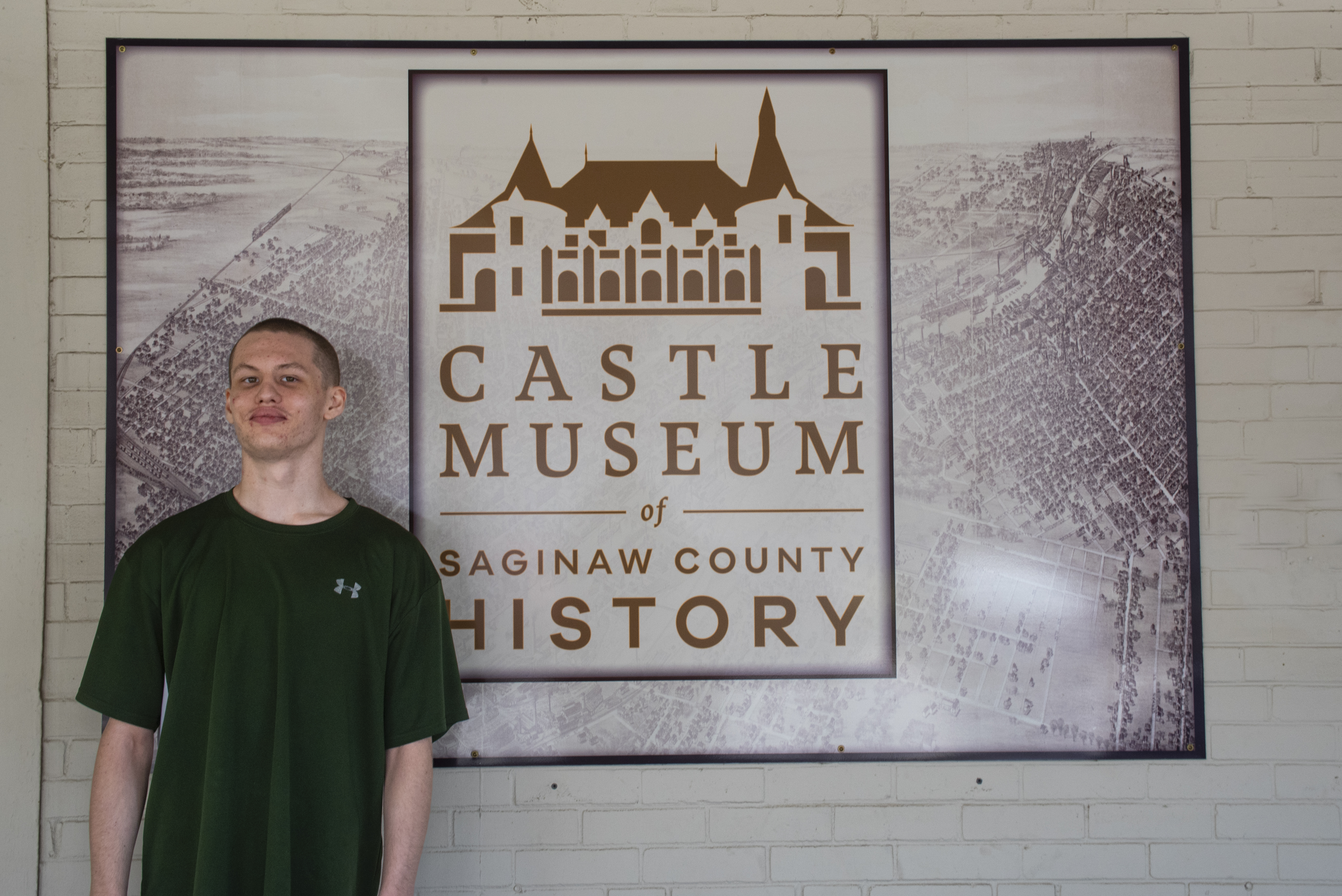
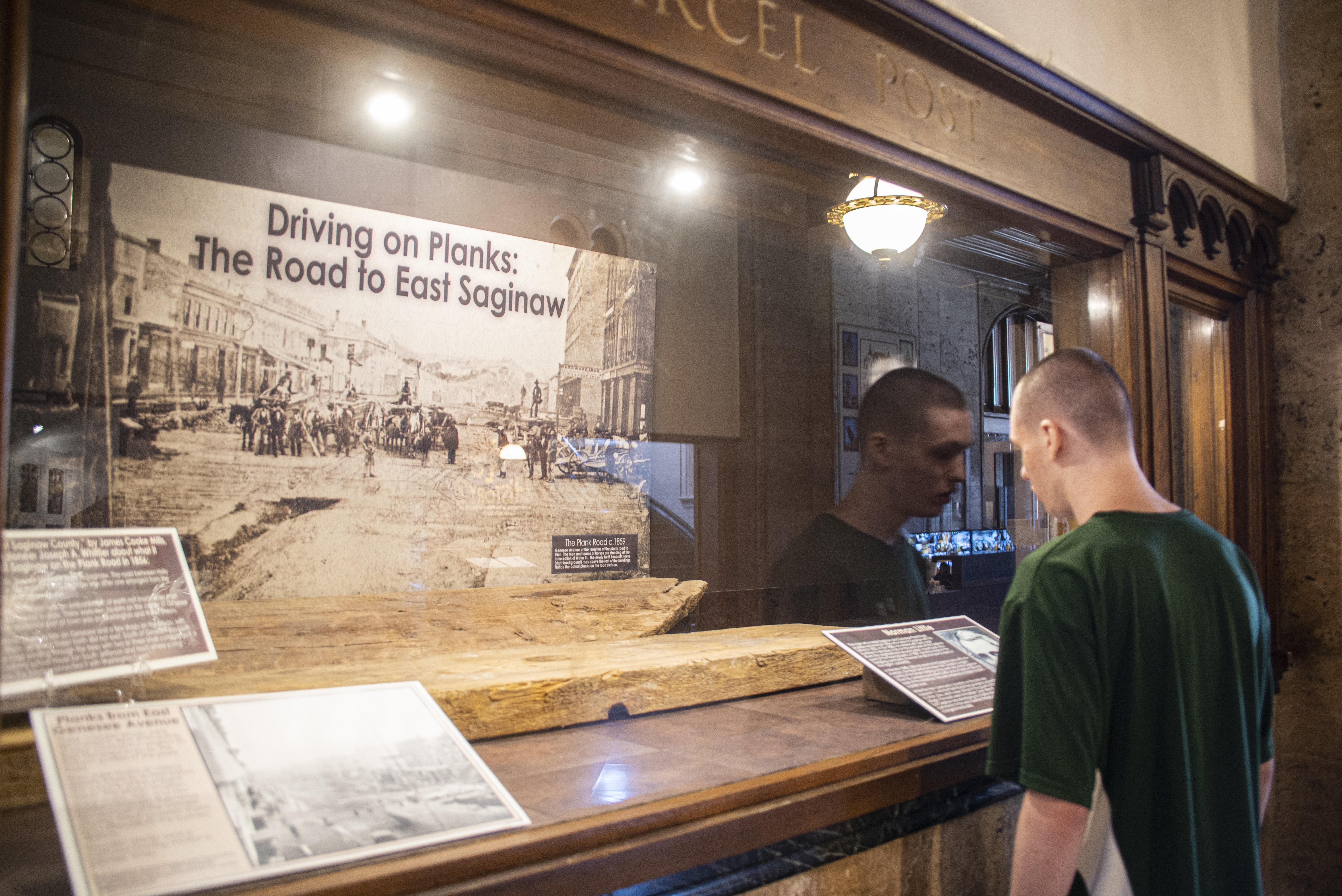
Austin got a couple of outfits for school, then selected McDonald’s for lunch. He is quieter, so conversation is at a minimum with him. After lunch, we went to the Castle Museum of Saginaw County History.

The museum has three levels of exhibits and displays, covering the Saginaw Sports Hall of Fame, lumbering, and automotive. There are some hands-on exhibits and many displays with informational cards to read. I’m sure there are things we missed or skimmed over when we were there. Their gift items are minimal, and Austin wasn’t interested in any of the items they had.

Corbin

Corbin, at age 12, loves astronomy, so I purchased tickets for a program at the Delta College Planetarium. We arrived a little early and explored the exhibits they had while waiting for the program to start. The program was interesting and designed for kids exploring space, but informative and interesting. The gift area had pencils and pencil toppers in an assortment of designs, so Corbin picked three sets for himself, then selected some for Austin and Alex.

After the program, we walked across the street to Wenonah Park, which displayed several flags. I was impressed that Corbin could list their origins; I didn’t know them. After spending a few minutes at the park, Corbin suggested we head to lunch—I guess he was hungry.

Corbin suggested Taco Bell, saying he thought I could use a break from McDonald’s. He was right, but I would have gladly gone if he suggested going there. As Corbin ate six cheese rollups, he got a huge thumbs up from me by saying, “People like us who aren’t fat can eat here.” I don’t meet the “not fat” classification, but it’s nice that Corbin views me that way.

After lunch, we went to Kohl’s, where we got him a couple of outfits for school. He was easy; he knew what he liked and wanted to wear.  The only dispute was when they didn’t have a character shirt in the right size, and he tried to convince me one that fit like a second skin was fine. I told him there was no way I was buying it in that size and that he would need to find something else.

Saying Goodbye

Paul and I met my cousin and her husband in Cadillac for lunch. Another day my daughter, Caroline, accompanied us on a trip to Traverse City, where we visited my grandparent’s farm, which is now Market 72, a public venue for events. We then met my other cousin and uncle for lunch.

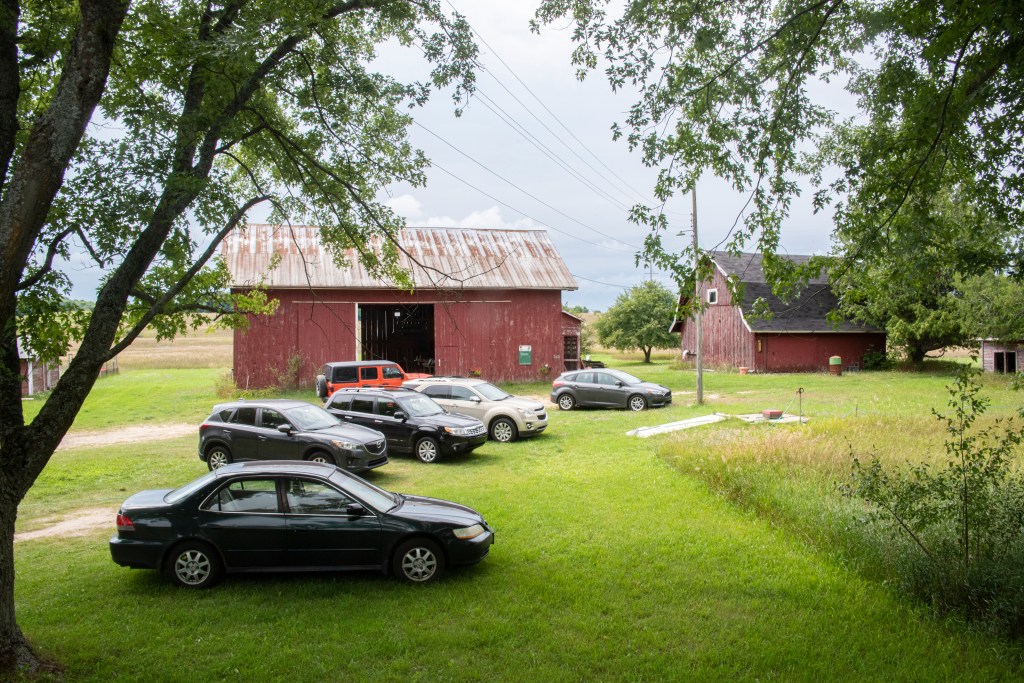
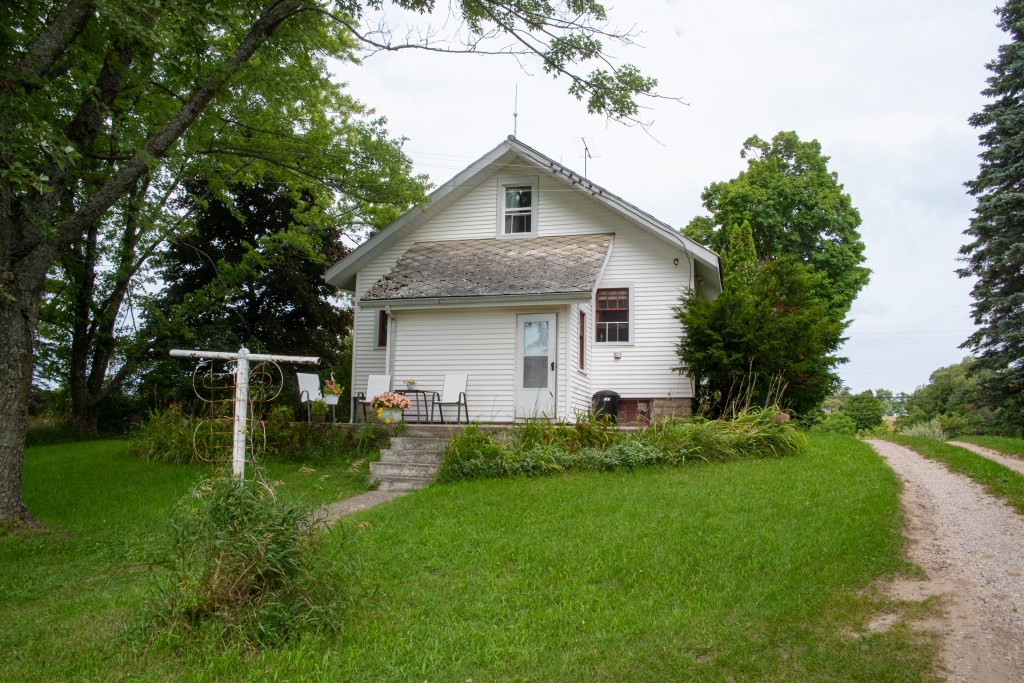
The above is the farm of my paternal grandparents, Louise and Dominick King, built by my great-grandfather in 1918 on M-72 in Traverse City. You see the front and back of the house, the view of the barns from the back porch, and Caroline standing under weeping willow trees between the sideyard and one of the farming fields.

As my time came to an end, Paul and I went to dinner at Texas Roadhouse with my daughter, son-in-law, and three kids. The dinner was over too quickly. It was the last time I would see them for another year. I was moving the RV downstate to stay in Port Huron before heading south to Arizona. I took a few family photos of them and departed with sadness.

Austin, Rob, Caroline, Corbin, and Alexandria

Blake’s Family Day

After I left the Clare area and was in Port Huron, Caroline called and asked if I would like to attend Family Day at Blakes’s Big Red Apple in Macomb. My son-in-law has been working the Halloween weekends there for several years, so they always attend the employee family day. 

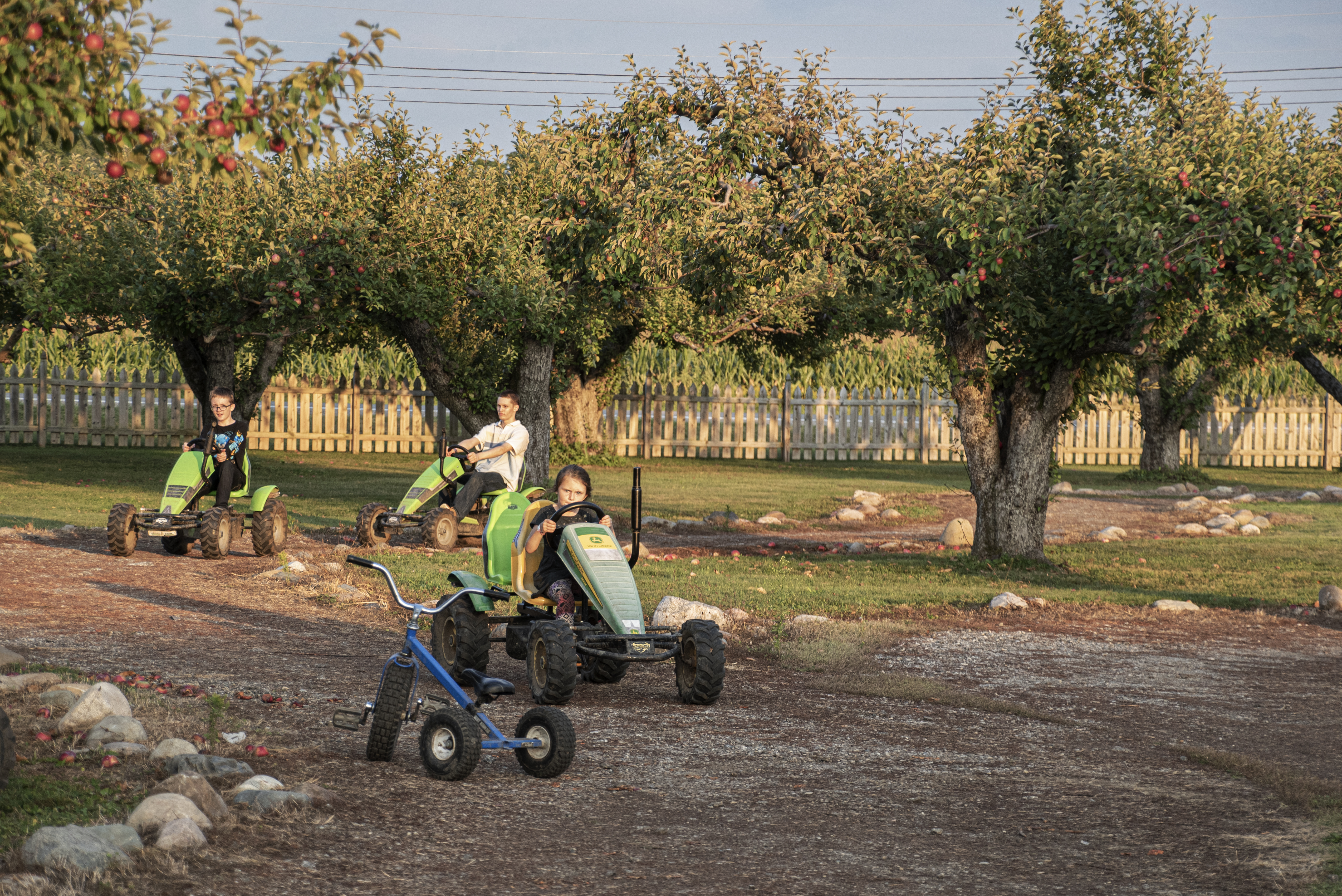
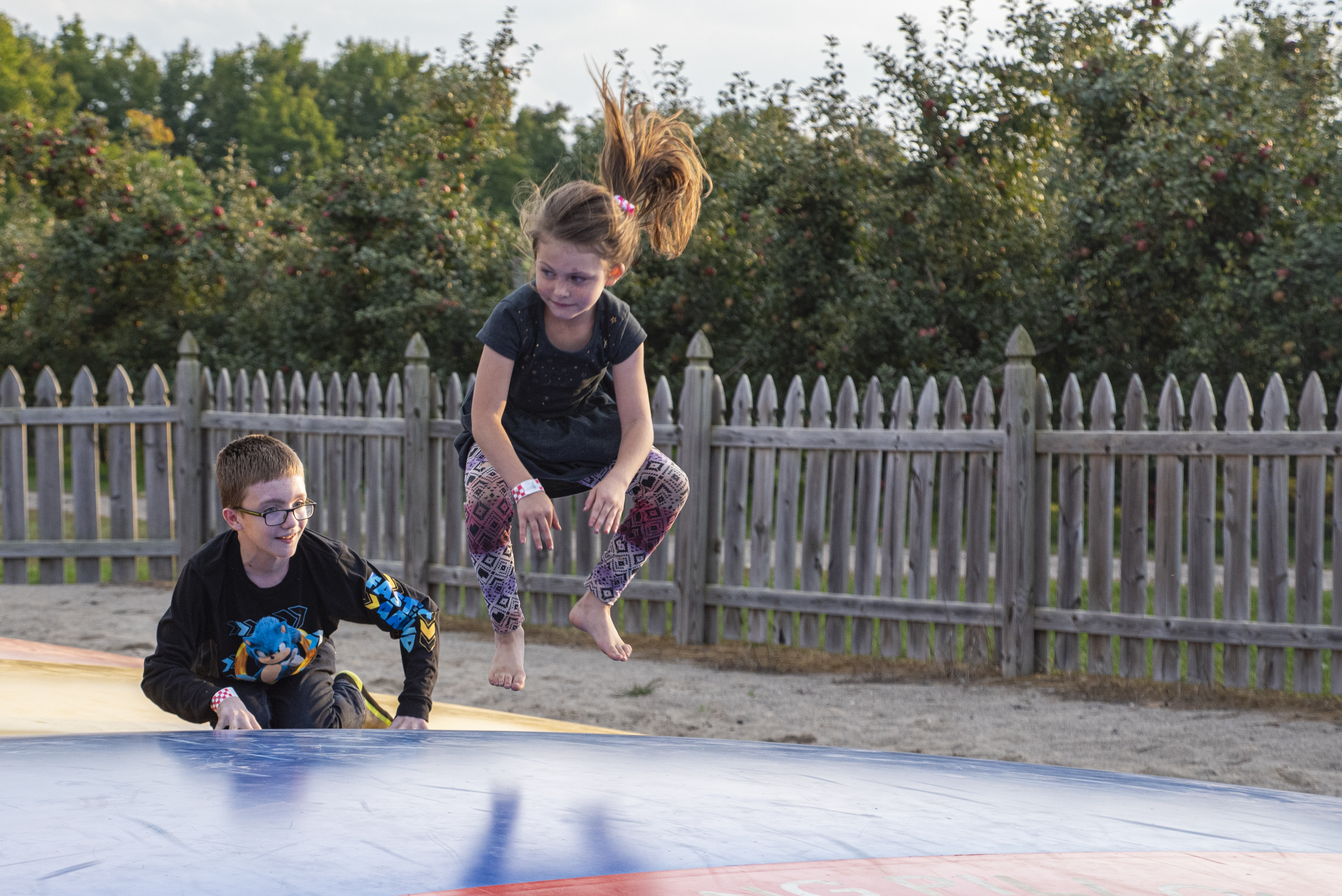
This was a fun outing, with a haunted hayride, a zombie paintball hayride (my son-in-law is a zombie), a 3-story haunted barn, a petting zoo, a pedal car track, and other activities. Of course, no trip to an apple orchard would be complete without purchasing apple cider, donuts, and caramel apples.

Alex leads the way, with Corbin and Austin following behind on the pedal vehicles. Corbin and Alex enjoy the bounce pads. Austin, Alexandria, and Corbin stand by the “How Tall This Fall?” display at Blake’s Big Red Apple.

And with that, my yearly visit with my grandchildren was officially over. Now I look forward to 2023 when I have booked a longer stay of six weeks in their area. I am looking forward to spending more time with them.

Leave a comment

Filed under children, Discoveries, events, Family, grandchildren, kids, Life is a Melting Pot, memoir, Michigan, play, summer, travel

35 Unique Things About Michigan

Although I now travel and spend more time outside of my birth state than I do in it, Michigan still holds a place in my heart for its many unique qualities.

Michigan is the only state that consists of two peninsulas. The “mitten” is the lower peninsula and is where I grew up, in the “only Eaton Rapids on earth.” The mitten is surrounded by Lake Huron on the East, Lake Erie on the South, and Lake Michigan on the west. To access the upper peninsula (the U.P.) you need to cross the Straits of Mackinac, a 5-mile channel connecting Lake Huron to Lake Michigan. The north shore of the U.P. is on Lake Superior.

If that isn’t enough, here are 35 more things that make Michigan a very special place.

  1. Detroit is the Car Capital of the World. Home to the “big three,” Ford Motor Company, General Motors Corporation, and Chrysler LLC, the state handles 24% of all automotive manufacturing in the U.S.
  2. Michigan is the largest manufacturer of lithium-ion batteries in North America. The American Battery Solutions Inc. manufacturing facility is located in Lake Orion and employs more than 100 workers. In support of this the Governor is working to develop the nation’s first wireless charging infrastructure on public roads.
  3. Alpena is the home of the world’s largest cement plant. Lafarge Alpena has been in existence since 1907 and employs more than 200 workers.
  4. St. Clair is the home of Diamond Salt Company, established in 1886 when a new process for making salt was patented. It is the world’s largest marketer of salt, supplying salts for culinary use, manufacturing, agriculture, grinder, pool use, water softening, and ice control.
  5. Southwestern Michigan is home to the largest Dutch settlement in the United States, with almost 300,000 residents of Dutch heritage. Dutch residents are most prominent in the five counties of Allegan, Kalamazoo, Kent, Muskegon, and Ottawa.
  6. Rogers City boasts the world’s largest limestone quarry. The site is 7,000 acres, of which 3,000 acres are actively mined. The quarry has an anticipated lifespan of an additional 100 years.
  7. Elsie is the home of the world’s largest registered Holstein dairy herd. Green Meadow Farms is a family operation established in 1922. With 80 employees, they raise all livestock and do all field and crop work on their 8,000 acres. The farm has a milking herd of about 3,900 registered Holsteins.
  8. Enjoy the longest freshwater boardwalk in the world in St. Clair. The boardwalk is along the St. Clair River, an international border with Canada. The St. Clair River is one of the busiest waterways in the world with more than 5,000 ships traveling the water every year. With more freighter traffic than the Suez Canal and Panama Canal combined, it’s an excellent spot for freighter watching.
  9. Colon is the magic capitol of the world and home to Abbott’s Magic Company, the world’s largest manufacturer of magic supplies. The city has more than 30 magicians laid to rest in its cemetery, more than any other cemetery in the world.
  10. Michigan Sugar Company is the largest sugar factory east of the Mississippi river, the largest sugar refinery in Michigan, and the fourth largest sugar refinery in the United States.
  11. Michigan ranks #1 in state boat registrations. St. Clair County ranks #1 in the U.S. for the number of boat registrations per capita.  
  12. Port Huron is home to largest freshwater sailing event in the world. The annual Port Huron to Mackinac race began in 1919 and more than 200 boats enter the race each year.  
  13.  The state has about 54,800 farms covering 10 million acres and producing $6.5 billion in products yearly. Michigan is the largest producing region in the world for Montmorency tart cherries and Traverse City hosts the annual National Cherry Festival every July. The state is one of the top producers in the U.S. of grapes, apples, peaches, and blueberries.
  14. Livestock population is significant, with about one million cattle, 78,000 sheep, 3 million chickens, and one million hogs. Livestock products account for about 38% of all agricultural output.
  15. Sault Ste. Marie was founded in 1668 by Father Jacques Marquette, and it remains the third oldest remaining settlement in the United States
  16. In 1817 the University of Michigan was the first university established in any of the states. It was originally named Catholepistemiad and was located in Detroit. The name was changed in 1821 and the university moved to Ann Arbor in 1841.
  17. Michigan State University was founded in 1855 as the nation’s first land-grant university and served as the prototype for 69 land-grant institutions established under the Morrill Act of 1862. It was the first institution of higher learning in the nation to teach scientific agriculture.
  18. The Mackinac Bridge is one of the longest suspension bridges in the world. It spans 5 miles over the Straits of Mackinac and took 3 years to complete. It was opened to traffic in 1957
  19. Kellogg Company made Battle Creek the Cereal Capital of the World. The Kellogg brothers discovery of producing flaked cereal was an accident that sparked the beginning of the dry cereal industry.
  20. Vernors ginger ale was created in Detroit and is the first soda pop made in the United States. It was an accident. In 1862 pharmacist, James Vernor, was trying to create a new beverage. He was called away to serve in the civil war, leaving his “experiment” behind. When he returned four years later the drink in the oak case had developed a delicious ginger flavor and Vernors was born.
  21. The Detroit Zoo opened in 1928 and was the first zoo in America to feature cageless, open exhibits allowing animals to roam free. In 1968 the zoo’s Penguinarium was the world’s first zoo building designed exclusively for penguins. In 2001 it opened Wild Adventure Ride, the nation’s first zoo simulator, and the Arctic Ring of Life, the largest polar bear habitat in North America.
  22. Michigan is only place in the world with a floating post office. The J.W. Westcott II is the only boat in the world that delivers mail to ships while still underway. It has been operating 140 years.
  23. The state boasts 3,224 miles of freshwater shoreline, the longest in the world. It also has the longest shoreline of the 48 continuous states. There are an additional 11,037 inland lakes and 36,000 miles of streams.
  24. The state has 124 lighthouses and navigational lights. The oldest is the Ft. Gratiot Lighthouse, constructed in 1829.
  25. It is the first state to provide in the constitution for the establishment of public libraries in each township and city, set forth in Article XI, Section 14 of the Michigan Constitution of 1908. It was also the first state to guarantee every child the right to a tax-paid high school education.

  26. Isle Royal National Park shelters one of the largest moose herds in the U.S. The park is 206.73 square miles and is the 4th largest lake island in the world. As of 2019 the island was home to 14 wolves and 2,060 moose. The moose herd was 2,400 at its highest point in 1995.
  27. Upper Michigan Copper Country is the largest commercial deposit of native copper in the world. By the 1860s the upper peninsula was supplying 90% of America’s copper.
  28. Michigan fared worse than the rest of the country during the depression between 1930 and 1933. The state’s unemployment rate was 34%, while it was only 26% in the rest of the country. This is because out of work automotive workers were starving to death by the early 1930s.
  29. Michigan has the first auto-traffic tunnel built between two nations, the mile-long Detroit Windsor tunnel under the Detroit River was completed in 1930. This was the third underwater auto tunnel built in the United States.
  30. The world’s first submarine railway tunnel opened between Port Huron and Sarnia, Ontario in 1891. It is both the first submarine tunnel and the first international tunnel.
  31. In 1879 Detroit telephone customers were first in nation to be assigned phone numbers to facilitate handling calls.
  32. In 1929 Michigan State Police established the first state police radio system in the world
  33. Grand Rapids is home to the 24-foot Leonardo da Vinci horse, II Gavallo, the largest equestrian bronze sculpture in the Western Hemisphere.
  34. Michigan is the great lakes state because its shores touch four of the five great lakes. We get our name from the Ojibwa (Chippewa) Indian word meaning “large lake”
  35. Detroit is the birthplace of Motown Records. Motown artists include Tina Turner, Otis Redding, Diana Ross, Four Tops, The Supremes, Al Green, Gladys Knight & the Pips, Ray Charles, Curtis Mayfield, Lionel Richie, Bill Withers, The Commodores, Aretha Franklin, Michael Jackson, The Jackson 5, The Drifters, Smokey Robinson, James Brown, Stevie Wonder, Fats Domino, The Temptations, Marvin Gaye, and more.

    The state has even more interesting facts setting it apart from the rest of the country and world, but I had to stop somewhere. I hope you’ve enjoyed this glimpse of my home state.

    Share where you are from and what makes your home state unique.

Leave a comment

Filed under Activities, Blue Water Area, Discoveries, education, events, exploration, farm, Festivals, home, impressions, Lake St. Clair, Life is a Melting Pot, Michigan, nature, reality, tourism, travel, Upper Penninsula

Not Smart Enough

Imagine back to when you were in the 8th grade, about 14 years old. You must make a decision that impacts the balance of your time in school. You can take a vocational program, which you attend to grade 12, or a university prep program, which you attend to grade 13.

Once you make your decision, you cannot change to the other program. Now, consider being that 8th grade boy and before you make that decision your school principal informs you that you aren’t “smart enough” for college, so you better go vocational.

That is the way school in Owen Sound, Ontario, Canada was in the mid-late 1950s when Paul Cannon attended. He followed the advice of his principal. The question is, after hearing the principal’s assessment of his abilities, what did Paul do with his life?

The Teen Years

Paul was not afraid of water, and unbeknownst to his mother he and his friends would climb Inglis Falls in the summer. This was the largest of the four waterfalls in town and has a 59-foot cascade. I’ve seen in the fall with a slow flow of water. It is huge! 

Inglis Falls in Owens Sound, Ontario, Canada
Inglis Falls in Owens Sound, Ontario
Photo by Grace Grogan

When Paul was about 14-15 years old he became certified as both a swim instructor and a lifeguard. He worked as a lifeguard at the community pool and taught swimming to adults and children both there and at the YMCA.

Paul was interested in science and technology, and around age 16 he and three friends learned about an Army surplus store in Toronto selling non-working ham radios for parts. The store had ten radios, and they purchased them all. The intent was to build two or three operating ham radios from the parts, and they did!

Paul and his friends had fun communicating on the radios for about a year. None of the teens had taken the required test to become licensed ham radio operators so were broadcasting illegally. An officer tracked them down and removed the tubes, rendering the radios inoperable.  Years later as an adult Paul took the test and became a licensed ham operator.

Paul always had an interest in aviation and was a cadet in the Civil Air Patrol (CAP) in Canada growing up. The group’s intent was to introduce 12-19 year old students to flight. As a CAP cadet, Paul received education regarding citizenship, leadership, physical fitness and general aviation. In Canada today one out of every five pilots is an ex-air cadet and 67% of commercial airline pilots began as air cadets.
Bush Pilot

When Paul was 16-17 years old he got a summer job working for a bush pilot in a nearby town. That first summer Paul performed miscellaneous jobs and ran errands. When the summer ended the owner told Paul if he returned the following year the owner would teach Paul to fly.

Paul returned and became a bush pilot, flying a Beaver pontoon plane. Bush pilots fly in remote areas, and Paul’s job was to deliver supplies to cabins in the wilderness. You have probably seen this in movies where a plane lands on a body of water, docking near a cabin to leave supplies.

All pilots must learn how to read the weather, and because pontoon pilots land on water, they must also evaluate the water’s surface before touching down. Accommodations must be made for wind direction, the direction and speed of the current, and any obstacles that may affect their landing. Once on the water the pilot must follow all marine rules.

On one flight Paul was landing to leave supplies at a not-yet occupied cabin when the engine on his plane blew. Oil splattered the windshield and the plane stopped before he was near shore. Pontoon planes must carry a paddle for this type of situation. Paul shut down all systems on the plane, then climbed out to sit on one of the pontoons, straddling it like a horse. Paul then paddled his way to shore. If you think rowing a boat is difficult, try an airplane! 

There was no radio communication, so Paul unloaded the supplies into the cabin and hunkered down for the night. His boss had expected him back before dark, so when Paul didn’t return the owner went out the next morning, flying Paul’s route. When he spotted Paul’s plane, he touched down so see what was going on. Paul already had the cowling off the plane, but neither Paul nor his boss had the tools or knowledge to repair the engine.   
Beaver Pontoon Airplane
Photo by Grace Grogan

The owner said he would be back, and when he landed the second time he was accompanied by a mechanic and tools. The owner left Paul and the mechanic to work on the engine. The two spent another night at the cabin before repairs were complete. The plane Paul flew only had one seat, the pilot’s. Once the repairs were complete, the mechanic strapped himself onto the top of a cargo box in the plane and rode back with Paul.

Bush pilots are required to carry a bush pilot’s rifle because situations such as the one above or an unanticipated stop in the wilderness can put you in danger. If Paul was flying his route and saw severe weather ahead, he would land the plane and beach it. Using ropes he would tie the plane to trees to secure it during the storm. When performing these tasks, he always had to be on the lookout for bear.

Paul continued working as a bush pilot for a year after graduating high school, then left for Toronto to attend college.

Radio College           

Radio College of Toronto, Ontario trained students in electronic engineering technology and had a focus on tubes and digital electronics. Electronics technology was the wave of the future in the early 1960s.

While Paul was attending college, he lived in a boarding house with 17 other men. They were housed two to a room, with no locks on the room doors. The home was run by a single woman who ran a tight ship. She made all beds every day and washed the sheets once a week.

Board included breakfast and dinner Monday thru Friday. Paul quickly learned that when sharing a table with a large group of men there were no second helpings. You better get a sufficient amount the first time a dish went around the table. Lunch and weekends boarders were on their own for meals, but could use the kitchen and food she had as long as they cleaned up afterwards. This was a very different type of living than Paul had growing up as an only child.

One evening Paul and his roommate heard a knock on their door, which immediately flew open and in rushed the landlady. She didn’t say anything but hurried over and threw open the window, reached into her pocket to grab a pair of scissors and reached out. The next thing Paul heard was glass breaking on the sidewalk below. Apparently one of the borders owed the landlady money, and she suspected he might try to slip out. By cutting the string to the bundle of belongings the border was lowering from his third-story window, the landlady made it clear she knew what he was up to. No one knows if she collected the money owed her or just enjoyed a bit of revenge.

Paul rode the streetcar to and from college, and sometimes hitch hiked his way back to Owen Sound on weekends to visit his parents. If living in a boarding house and using public transportation bus wasn’t enough of a challenge, Paul was doing this on crutches. Paul played B-Team Hockey and did competition ski jumping. Unfortunately, he landed a jump wrong, breaking his ankle.

Paul quickly learned that in a time of need, crutches make a great weapon. One day Paul got off the streetcar and some guy, thinking he had one-up on Paul, knocked Paul’s books out of his hands. Paul may have been a bit disabled, but not unarmed. He swung one of his crutches around and clobbered the guy. A police officer saw the exchange, came over to pick up Paul’s books and make sure he was okay. When Paul left the scene his attacker was in the back of a police vehicle.

Using city transportation when dating was something Paul learned could be difficult. On one date Paul took a girl out, then escorted her home, staying to visit until about midnight. Big mistake!  When he got to the bus stop he had missed the last bus in that area, so he walked down to the next line, just in time to miss the last subway of the night. He ended up walking all night to get back to the boarding house. Thank goodness it happened on a Friday night, and he was able to sleep when he arrived there the next morning.

Work and Electronics

After graduating from Radio College, Paul took a position installing and repairing x-ray machines throughout Canada. This took him into every Canadian province, a position that nurtured his love of travel and photography. His goal was to emigrate into the United States, work his way west and eventually end up in Australia. He didn’t make it past Michigan.

Immigration into the United States took about a year. Paul needed to find a job that would hold the position for six months while he completed the immigration process. He was about 23 when he got his first job in Michigan doing the same thing as in Canada. Paul was living the bachelor’s life, driving a convertible and working in hospitals throughout the tri-state area of Michigan, Ohio, and Indiana, where there was plenty of female staff to date.

Many people do not realize that immigrants must register for the draft six months after they become permanent U.S. residents. Paul registered during the Vietnam era and knew how to fly the same type of plane being used in the war. Each year he was obligated to check in at the military office, and each time he met new criteria for a waiver so was never drafted.

Career Change

Paul was talking with an electrician and learned they made more money than Paul  was in the electronics field. Paul purchased code books and studied to become an electrician. Though not licensed, he got a job working for Morgan Electric. When a client requested a special electrical job, Paul volunteered for the assignment. The client was impressed with Paul’s work and offered him a job working for their company.

Paul made the job change. Always looking to advance, Paul later applied and got a job in skilled trades as an electrician at the Ford River Rouge plant. Unfortunately the plant did layoffs before Paul had 90 days in.

Needing work and the economy being bad, Paul took a job working on an ambulance. It was on-the-job training, they were not paramedics. The crew would perform basic first aid and transport patients to hospitals. This was during the 1967 Detroit riots and runs were often into dangerous areas. It wasn’t all bad though.

One run was to Governor Romney’s home. The governor’s wife had fallen and injured herself, requiring an ambulance transport. Paul also delivered two babies during his time on the ambulance. One laboring woman looked at him and said, “it’s my first” and he responded, “mine too.” 

When Paul’s father notified him Pittsburgh Glass Works was opening a plant in Owen Sound and needed skilled trades workers, Paul applied and was the first electrician hired. He moved back to Owen Sound and lived there for two years. The glass plant job gave him experience in trouble shooting factory machinery, which would pay off later.

When the economy improved Paul moved back to Michigan and took a position at Allied Chemical in Mount Clemens. An electrical inspector saw his work and volunteered to sponsor Paul for taking his journeyman’s test. You cannot take this test until you have verification of 10 years of experience working as an electrician and a sponsor. Paul passed the test and immediately began studying for his master’s license.

You must work as a journeyman for a minimum of two years before taking your master’s exam. When Paul reached the qualification period he took the test and became a master electrician. Paul then started his own electrical contracting business, Trojan Electric. This electrical contract work was in addition to his full-time employment. His business was lucrative enough to necessitate employing a work crew.

While working at Allied Chemical in Mt. Clemens, Paul saw an ad for skilled trades at the Ford Motor Company Paint Plant. Paul applied and went into Ford as a re-hire. He remained at Ford as an electrician in skilled trades for the balance of his working life, retiring out of the Ford Utica Trim plant.

Back to Flying

After Paul immigrated into the United States, he checked into getting his pilot’s license. The bush pilot Paul worked for never had him keep a pilot’s logbook, so there was no record of his time in the air. Paul had to start over. Lessons were easy because he knew how to fly, he just had to master landing on solid ground.

Pilots must learn navigation and weather patterns, plus cloud types and cloud levels for flight. Paul can look down the road when driving and recognize rain that is coming down but not reaching the ground. He can also see it ahead and predict the time the vehicle will drive into it. Navigational training allows him to know the direction he is driving based on the sun.

Paul purchased his own plane, a Cessna 177 RG (RG means retractable gear) and served as an adult member on the Civil Air Patrol (CAP). The Civil Air Patrol is an Auxiliary of the U.S. Air Force that was founded in 1941 to mobilize civilian aviation resources for the national defense.

Cessna 177 RC
Cessna 177 RG
Photo obtained off Internet

Paul underwent training in CAP to fly both counter drug operations and search and rescue. He enjoyed his time working on missions, which often ran one to two weeks at a time. He also volunteered his time working with CAP cadets, taking them up in his plane for a ride or assisting at special cadet outings. The CAP has the same officer ranks as the Air Force, and by the time Paul retired from service he had achieved the rank of Major.

Paul’s love of aeronautics led him to volunteer his time at the air show held each year in Oshkosh, Wisconsin. He worked in the sound center manning the sound control for the music and announcers during the air show. This required balancing the voice and music, plus timing the music for the air acrobatics of the plane.

Paul learned to be prepared for the unexpected. A woman was narrating her husband’s performance when his plane crashed. Her reaction was a blood-curdling scream into the microphone. Paul immediately cut the sound.

Paul enjoyed his time at the air show, meeting celebrities and working with pilots to time their music to their performance. It was a week of both work and fun, affording him full access to the air show grounds.

In His Free Time

When Paul was ready to move out of the city, he purchased five acres of property in St. Clair, Michigan and built a home. Paul was the contractor for the job. He ran all electrical wiring in the home and finished the interior. This included building the staircase leading to the second floor and installing all kitchen cabinets and countertops. He did this while working full-time at Ford Motor Company and running Trojan Electric.

In addition to volunteering his time with CAP, Paul participated in a computer club and remains a member of the Blue Water Shutterbugs Camera Club. Paul served as treasurer in both clubs. His photographs are sold on Alamy and Fine Art America, and for several years he sold them in fine art shows. Paul spent several years teaching photography, originally in a classroom setting, then one-on-one. He customized lessons to fit his student’s needs, including how to operate a camera, how to take better photographs, and how to process photos in Photoshop.

Paul Cannon now lives and travels throughout the United States and Canada in a 35-foot motorhome, towing a Jeep Rubicon. I am lucky to be living and traveling with him on his latest adventures. We enjoy visiting new places and navigating off-road trails. We produce videos of our adventures and share them on our YouTube Channel, Rolling Thru North America, Travel With US!

Not Smart Enough?

Can you imagine if Paul had only been “smart enough” for college what he might have done with his life? Maybe it is a good thing he did not attend a 4-year college. Paul may have not been ‘smart enough” in his principal’s eyes, but what he has accomplished in his 78 years of life has been diverse and interesting.

Writer’s Note:  This was originally written entirely from memory based on information I garnered from Paul over the past six years. After publication Paul read the above and advised me of some minor corrections needing to be made. Those changes have been made and the writing is now accurate.

Leave a comment

Filed under assumptions, Canada, career, children, decisions, Discoveries, education, employment, exploration, Full-Time RV, hobbies, home, impressions, Life Changing, Life is a Melting Pot, Michigan, Photography, time, travel

Celebrating Traverse City’s Centennial 1947

I have always liked this photograph of my paternal grandparents, Louise Elizabeth (Lautner) King and Dominick King. They are wearing period dress for the celebration of Traverse City’s Centennial celebration in 1947. The photo made me wonder what the celebration and Traverse City were like in 1947. 

My grandmother was 35 years old, and my grandfather 44. They were the parents of three boys; my father was the youngest and would have been 5 years old that summer. Did they dress the boys in period outfits too?  I’ve never seen any photos to indicate they did.

Traverse City did not hold its annual Cherry Festival in 1947 because of the Centennial festivities. The majority of men in the area grew a beard in honor of the celebration. This photo is the only one I have ever seen of my grandfather with a beard.

Instead of having young “glamour girls” honored with the title of parade queen, the Traverse City Historical Society was assigned the task of finding an honorary Queen of the Centennial. The queen was to be someone who had lived in the area a lengthy amount of time and could portray the pioneering spirit of the celebration. I did not find anything to indicate who was awarded this honor. The only link I could find indicating information on the celebration required payment of a newspaper subscription and I chose not to.

For the Centennial at least three parades were planned. A children’s parade and pet parade on July 2nd, followed by the big parade on July 3rd. The big parade was planned as a purely historical parade. It was to be divided into sections with each segment portraying an episode or period in the history of the Traverse City community. It was to include floral floats, marching groups, old vehicles, Indians, lumberjacks and other items relative to the pioneer history.

Unable to locate information on the actual celebration, I decided to see what I could find out about the “period” clothing my grandparents are dressed in. The clothing my grandfather is wearing appears to be a tailcoat, which was squared off at the waste in front and cut into long tails at the back. Tail jackets were in style in the 1840’s, and it was fashionable to wear the jacket with lighter colored trousers, so it would have been fitting for their period costume.

The dress my grandmother is wearing is of a style I could not locate. I did find that synthetic dies had led to bright wild colors in clothing, though I don’t believe prints were generally used. Low sloping shoulders and bell-shaped skirts were in fashion, moving into a Gothic Revival style. Another article stated that a long-wasted bodice, narrow sleeves, and a full dome-shaped skirt that skimmed the floor were in style.

Because I could find nothing that resembled the dress my grandmother is wearing, I wonder if it were perhaps something she obtained from an older family member or friend, or whether she obtained a pattern and sewed the outfit on her own.

A Bit of History

In 1847 Traverse City was a small community which originated because a Reverend was looking for a place to settle with his family. The Reverend settled on the banks of the Boardman River. Traverse City remained an outpost until 1864, when the first road was built through the forest to the settlement.

In 1851 one of the owners of the Hannah, Lay & Co. Mill went to Washington DC and requested the new settlement have a post office called the Grand Traverse City. Because at that time Old Mission had a Grand Traverse Post Office, they shortened the name to Traverse City. In 1872 the railroad connected Traverse City to Grand Rapids.

Traverse City has been listed as the second best small town for travelers to visit in the United States. Each July during Cherry Festival, more than 500,000 people visit the town.  The festival was first held in 1926 and now features about 150 events and activities, 85% of which are free.

Between the festival, tourism and having some of the best wine in the Midwest, resident population in Traverse City is now around 15,785.

I have a lot of family history in Traverse City, and my grandmother’s ancestors were some of the original settlers to the area. I am glad she and my grandfather were able to participate in Traverse City’s Centennial Celebration held 73 years ago.

Leave a comment

Filed under anniversary, celebration, Family, Festivals, Life is a Melting Pot, memoir, Michigan, summer, time, tourism

DOCUMENT YOUR PART IN HISTORY

I look around, the place has more people than normal for this time of year, but it is still pretty well emptied out. Why wouldn’t it be? Who wants to stay where the summer temperatures go as high as 120° Fahrenheit?

Yet, here I am. Our original plan was to leave here at the beginning of April and visit several national parks and scenic areas through several states before heading to Michigan to visit family. Then head south and west again, hitting Sault Lake City and Colorado Springs for photography and RV conferences before going for a three-month stay on South Padre Island, Texas, followed by winter back here in Yuma, Arizona.

Those plans have been crushed by the Coronavirus shutdowns. We have extended our stay here in Yuma until at least August 3rd. We are trying to secure reservations in Michigan for somewhere between mid-August to early October, but so far have not had any luck. The state is still locked down and the few campgrounds that are open do not have long-term spots available.

Time will tell if we travel, where we will be, and when we will get there. When you live full-time in an RV, campgrounds are an essential part of life.

We are living through an event that will be written about in history books. Have you recorded your stay-at-home location and changes in lifestyle? Have you noted the schools closing, people doing work-at-home because businesses closed, hospitals overrun with patients, people wearing face masks and gloves to protect those around them?

If you have young children, have you recorded their thoughts on what is going on around them? These are memories that may be forgotten over time but will be important to future generations.

This slideshow requires JavaScript.

Paul and I are hanging tight in Yuma, Arizona. I walked around the park and took snapshots of the camp, documenting the place that was full when we arrived in February and is now almost empty. A lot of the people here in the winter are Canadian snowbirds who were ordered to return to Canada in March or lose medical insurance due to the pandemic.

So where are you? Have you documented the event? Leave me your comments below.

Stay Safe!

Leave a comment

Filed under Activities, assumptions, backyard, Canada, communication, Coping, decisions, Discoveries, environmental, exploration, flowers, Full-Time RV, home, impressions, Life Changing, Life is a Melting Pot, memoir, Michigan, reality, spring, summer, time, tourism, travel, winter

My First Week as a Nomad

My first six days as a Nomad were interesting, fun, and sometimes frustrating.  In many ways it feels more like a vacation rather than a lifestyle change.  It is relaxing and interesting, and sometimes not at all what is planned.  If I can experience all this in six days, I can’t imagine what the future will bring.

On Monday we left Port Huron, Michigan and traveled to Sault Ste. Marie, Ontario, Canada.  Our original plan was to stay only two nights, but after reviewing travel information about the surrounding area decided to extend our stay to a total of four days.

On Tuesday we visited the Bush Pilot Heritage Centre in Sault Ste. Marie.  Paul was a bush pilot when he lived in Owen Sound, Ontario as a teen so this was on his “hit list.”  The museum was interesting, with several planes on display inside the hanger where the museum is located.  We viewed two movies, the first was an “on board” experience with a bush pilot, and of course took the rider through a series of mistakes and mishaps that can happen on a plane, including an unexpected storm, dozing off with the plan on autopilot, and more.  The second movie was in 3D and took you into the heart of fighting forest fires.  You experienced time in flight with the commander of the entire firefighting operation, in flight with a pilot doing water drops, and on land with a ground firefighting crew.  Both movies are well worth the time it takes to view them.

A small town about four hours northwest of Sault Ste. Marie is the home of Winnie-the-Pooh, and houses a statue of Winnie, as well as a Winnie-the-Pooh and Railroad Museum.  I wanted to go there so a day trip was planned.  Part of the trip goes along the shore of Lake Superior, and we figured we would find photo ops along the way.  A visitor guide worker had told us about an off-road trail on that stretch which Paul wanted to check out.  We didn’t locate the trail she used, but did access a logging trail, which about 20 minutes in we decided was not offering any photo ops so turned around and continued on our journey.

We did find a couple spots to stop and take photographs of Lake Superior, and a small rapids and river we walked in and photographed.  It was interesting that this entire route had very few towns, gas stations, or any other type of business or rest area to stop at.    So scarce they were practically non-existent.  We saw a rest area/visitor center which made a good stop for a few minutes.  They had a small gift shop where Paul decided to pick up a couple energy bars to tie us over until lunch, which we planned to eat in White River.  That purchase turned out to be a very good decision.

This slideshow requires JavaScript.

We munched on our energy bars, and decided to stop for gas as we rolled into White River, because we would need it to make the full journey back to Sault Ste. Marie.  There were barriers up across the gas pumps and an attendant walked over and informed us that the pumps were not working because the entire town of White River had lost power and nothing was open.  We drove through town and took pictures of the Winnie-the-Pooh statue.  The attendant was correct, absolutely everything, including the museum we had just driven four hours to visit, was closed so we started our journey back.

Not too far south of White River was a small gas station with full-service pumps.  The attendant there shared that the last time White River lost power they were out for a week.  He also let us know that there was a restaurant on Hwy 17 just south of Wasmus where we could get lunch/dinner.  By now it was after 2:00 pm and we were definitely getting hungry.

We drove the two hours south and located the restaurant.  Our luck had not yet changed; on the front door hung a sign that they were closed until 5:00 pm.  It was only 4:30 so we decided to drive on.  We were not far from our campground when we found The Voyageur Lodge, which included a small restaurant.  The menu was limited, but the food very good.  Paul had an open face hamburger, which had gravy to which he added mushrooms and onions.  It normally included fries and coleslaw, but he switched the fries for onion rings, which he said were very good.  I opted for a fish sandwich which also came with fries.  The sandwich was made with whitefish which was lightly breaded and very nicely done.    We shared a butter tart for dessert, also very tasty.

Our final day in Sault Ste. Marie we drove into town and visited the historical canal sight.  At the end of the island was a swing damn, one of only nine built and the last in existence.  It is used in emergency situations if there is a problem with the lock.  This is also where the lock is located for small boats, and we were lucky enough to see two of the Soo Locks Tour boats use the lock at the same time.  The difference in elevation between Lake Superior and Lake Huron is 21 feet, so quite interesting to observe the lock in operation.   A nice way to finish out our stay.

Friday morning we said goodbye to Sault Ste. Marie and drove east through Ontario, stopping at a small campground in Lavigne, Ontario.  We are here only for two nights.  One day of rest and computer work before continuing our journey to Ottawa, the capitol of Canada, where we plan to spend four days.

We did take some time from our paperwork to photograph some very decorative scarecrow displays around town.  These have been prepared as part of a plowing competition in September. I finished out our last night in Lavigne with a walk around the park, taking a few photographs of Lake Nippising, which the campground is located on.

So far my life as a nomad has been interesting and relaxing, even if Winnie-the-Pooh’s hometown did leave me a bit frustrated.  I guess in this lifestyle you simply have to go-with-the-flow when rocks appear in the river.

Leave a comment

Filed under Activities, Canada, decisions, Discoveries, education, exploration, impressions, kids, Life is a Melting Pot, memoir, Michigan, nature, summer, tourism, travel, Upper Penninsula, vacation

Bulleted Reunion

IMG_20180720_185225304I had the pleasure of attending my 40th High School Class Reunion in Eaton Rapids, Michigan this weekend.  The coordinators did a fabulous job of pulling the weekend together with a variety of activities to keep people on the move.  This was especially nice for those of us traveling in from out of town, especially those traveling from out-of-state.
This is my bulleted list of memories of the weekend.

  • Meet-and-Greet at Eaton Rapids Medical Center Conference Room.
  • Great desserts!
  • Friendly conversation with classmates.
  • Tammy (Ball) Albright’s face sign
  • Olive burgers and beer at Abies Bar
  • Woman’s bathroom is small with two toilets, no stalls.
  • Breakfast at Darb’s Patio, always yummy!
  • Glitch in planned tour of high school – Honor Society students are prepared to do tour, school is locked and they don’t have keys.
  • Classmate makes a couple calls and resolution is on the way.
  • Dave Johnson, teacher when we attended, later principal, now retired, has master key to school and comes to rescue, conducts the tour, and does an awesome job of sharing the way it was when we attended, and what changes have been done over the years.IMG_20180721_130944998_LL
  • Touring the high school after 40 years brings back memories, including these mentioned during tour:
    • The Cold Tongue
    • The smoking bathroom
    • Pep Rallies
    • After home game dances
    • Band/band camp
    • Typing class
    • 1-2-3 Roll’em Ferndock
    • World History class lectures in auditorium
    • Theater performances in auditorium
    • Mr. Phillips math classes
    • Mrs. Lohrke, English teacher
    • Mrs. Shimnoski and Mrs. Tuthill, Business/Secretarial Block teachers
    • Various athletes, coaches
    • Teachers and counselors now gone but long remembered
    • Library no longer has a comfy seating area of bean bag chairs, chairs, etc.
    • Senior Bench (now gone)
    • The former layout of the school compared to what it is now
  • Non-Reunion Activity:  Quick stop-over to visit with my sister for a couple hours
  • Walking a block to the Red Ribbon Hall for the reunion because I thought all  parking in front was taken; there were still open spots.
  • Some classmates’ appearance has hardly changed, very recognizable.
  • Some classmates have changed a lot — thank goodness for name tags!
  • Being surprised at how many people recognized me immediately.
  • Good food, good desserts.
  • Good conversation with old friends and classmates.
  • 1978 Graduate photo frame for shooting pics
    IMG_20180721_212645159
  • Fun slide show of “then and now” pictures of classmates.
  • Party Favors:  Eaton Rapids glass and notepad
  • The Red Ribbon Hall has very good acoustics = loud atmosphere.
  • A lot of us still drink, but not like we used to!
  • Many of us no longer “close down the bar” and left before the party was over.
  • Cell phones are great for event pics…I didn’t see a single “real” camera all weekend.
  • Facebook sharing of activities and photos on the ERHS Class of 1978 Page
  • Sad realization that we have lost 11 classmates, a nice memorial table was set up.
  • A quiz of things about our last year of school – presented by Mrs. Wheeler, former teacher.
  • Each classmate was to stand and give their name (maiden) now and where living…which grew as it went around the room to name, where living, married/years, occupation, children/grandchildren.
  • Amazing how many people have stayed in Eaton Rapids and/or the Greater Lansing area.
  • Surprised at how many have moved out of state, or resided in several states.

FB_IMG_1532145667519Time passes so quickly.  How is it we have already been out of school forty years?  Many thanks to classmates Julie and Jane Brenke, and their sister Jill, for organizing the reunion as well as several others who stepped in and assisted them.

 

2 Comments

Filed under Activities, anniversary, celebration, communication, education, events, freindship, friends, friendship, Life is a Melting Pot, memoir, Michigan, school, time

The Note In My Windshield Wiper

I don’t know what was more disturbing, the fact that I never noticed the note in my windshield wiper, or the content of the note itself.

The fact that I hadn’t noticed it was disturbing because it was most likely put in their on Saturday, a day in which I had made several stops running errands.  Based on the “er” on the left of the note my guess is that the paper used came from Meijer, but for it to happen at that location also made no sense.

I was at work on Monday and one of the attorneys in our office came in and said “Grace, you have a nasty note on your car, a really nasty note.”

I could not understand why anyone would leave me a note, and my first assumption was that it had been put there while I was in the office.  The attorney had noticed it tucked under my windshield wiper blade, and the paper was a bit stiff and yellowed, as if it had been baking in the sun.

When I read the note I realized it had to have happened when I was running errands on Saturday, because early Saturday it had rained and the note showed no sign of having gotten wet.  I knew I had not bumped anyone’s car with mine, not even a door, so I was baffled at the note.  However, my instincts told me that, based on the wording, it was possible whoever wrote it may have done something to my vehicle in retaliation.  I walked outside and checked my car out all the way around — no damage, so that was a relief.note on car010

My mind then went through my day, trying to figure out the location.  Even though I was guessing at Meijer based on the red “er,” I still wanted to figure out where I may have been parked close enough to warrant such a note.

  • First stop, farmer’s market — parked in a muddy dirt lot, I was the end vehicle and a wide walking path between me and the vehicle next to me.  Definitely not there.
  • Second stop, Kohl’s.  I parked in a normal spot, but my vehicle was dead center on my spot and so were the cars on either side of me.  I don’t think that was a logical location.
  • Third stop was a pool supply store, very small and there were only two vehicles in the entire parking lot with plenty of space between.  Definitely not there.
  • Fourth stop was Sam’s Club.  I parked next to the cart corral, and because the car on my driver side was over the yellow line, I had to park extremely close to the cart corral and was closely watching my mirrors so they didn’t catch on the rack.  If the guy next to my driver’s side wrote the note, then he should have addressed it to himself for hogging part of my spot.
  • Fifth stop was Meijer.  This was the only location where I used my handicap plate and parked in a designated spot, which means there was ample room around both sides of my vehicle.  The note appears to be on Meijer paper, but I could not have touched another vehicle, so again baffled by the message.

After all this analyzing there are two conclusions.

  1.  If the damage to the writer’s vehicle was so bad it warranted the above note, why didn’t they contact the security of the store, or even contact the police?
  2. If their vehicle really was damaged in the parking lot, it is possible that another vehicle was parked beside them, damaged their car as they were leaving, and then I pulled in, parked beside them and got blamed for someone else’s actions.

The bottom line is I will never know the answer to who wrote the note and where it occurred.   Based on the wording I will say I am glad that I did not arrive at my vehicle as they were writing the note as it may have been a hostile encounter.  On the other hand, at least I would know when and where the note was left.  The mystery of the note in my windshield wiper will never be solved.


2 Comments

Filed under assumptions, communication, Discoveries, impressions, Life is a Melting Pot, Michigan, Mystery, reality, time

Maybe I’m related to Lucille Ball

It has been one of those weeks when you could take my life and drop it into an I Love Lucy sitcom and it would be perfect.  For those of you who are too young to remember, Lucille Ball was a wonderful comedy actress who stared in several shows that carried her name…I Love Lucy, The Lucy-Desi Comedy Hour, The Lucille Ball Show, and Here’s Lucy. 

The fun part of watching a Lucy show was that you just knew she was going to do something goofy, create a catastrophe out of something simple, and the audience would find themselves laughing hysterically at her antics.  It was a type of “if anything can go wrong, it will” and everyone loved watching.

lucille-ball-desi-arnaz-marriage-secrets-scandals-7

Lucille Ball- photo found on internet

Now we take my week.  Sunday I was fixing dinner and blew a circuit breaker.  I went downstairs, reset the circuit, continued fixing dinner and blew the same circuit again.  Before I could make a bee-line for the door the Master Electrician currently residing in my house stopped me.  I couldn’t reset that breaker, he had to analyze the situation.  Never mind that dinner is in the oven and that oven is no longer heating because it is on the blown circuit, the analysis had to be done first.  Once he had analyzed the situation and made his determination I was free to reset the breaker and continue with meal preparation.  However there was a glitch.  I had lost track of how much time the food had been in the oven, and while I was getting a detailed explanation on his process the fish became quite overcooked and hard.   Lets just say that meal left a lot to be desired.

Monday comes and I walk into work.  The bottom of my shoes must have been wet from the snow and when I hit the tile floor of the kitchen area my feet flew out from under me and I went down hard on the tile floor, hitting the back of my head on the refrigerator as I went down.  My startled scream was loud enough it brought all three men who were in the building running.  Why can’t clumsy things happen when there is no one around to see them?  Then once I am again on my feet I open the upper cupboard door to fix myself a cup of coffee and in the process hit myself in the head with the cupboard door.  How could I not have enough sense to move my head out of the way?   I’m still recovering from the injuries incurred that morning.

Tuesday was hectic but I seemed to make it through the day unscathed.  I fixed spaghetti for dinner and decided to have a bottle of wine with it.  Only I could manage to get the cork stuck up inside the corkscrew…but with a bit of persistence I got it back out.  Only a moment to recover on that one.

Wednesday, hump day, shouldn’t I be on a roll to recovery now?  Oh heck no.  I was planning to take a second car I have into the dealership for service.  A friend of mine gets all the snow off it, I go to hit the unlock button and open the door.  The battery was so dead the car doors would not unlock.  We finally got the door unlocked by inserting the key, but it was frozen shut!  There is only one door on the entire vehicle with a key hole,  so only one door we could work with.   I called the towing service I have, but after about 45 minutes on the phone they informed me that until I got the door unfrozen and open they would not be able to assist me.   I called the dealership and they advised me to pour hot water on it.  Four gallons of hot water later the door seamed to be devoid of ice, but it still would not budge an inch.   I called the dealership again to explain my problem.   The gentleman from service came out and by the time he arrived the hot water had seeped far enough in that the door opened.  The battery was still completely dead and had to be jumped, but at least the vehicle is now at the dealership.  Between a recall, service I scheduled and a warning light being on, it will be there a while.

If that wasn’t enough I had a meeting to attend Wednesday night, and without anything major happening I did manage to call a green frog orange and a woman named Donna I referred to as Phyllis.  I think because she has such a funny personality I was thinking of Phyllis Diller…..that’s my story and I’m sticking to it!

So today is Thursday and I didn’t have any disasters, just fumbles.  I was sitting at breakfast talking when my friend says “are you going in to late work today?”  Crap!  I made it…barely!  Then when fixing dinner the potatoes were a bit under-cooked and the seasoning on the salmon wasn’t bad, just something we weren’t particularly fond of.  The bagged salad turned out great!  I think I need a vacation.

Wait!  That is what I forgot about.  I booked a vacation, a real 11-day vacation including airline flights.  Then as I was reading the airline confirmation it said that you should check and make sure you don’t need a visa for the country you are traveling to.  I knew I don’t need a visa, but I clicked on the button anyway and discovered that when traveling to Canada by air they require you to have a passport that does not expire for at least six months after your last flight.  Mine expires five months after my last flight.  I thought I was good, only to discover I have to renew my passport.

Now mind you I have plenty of time, but it did not do the mind and stress level any good.  I found out I can renew by mail and located a local CVS that does passport photos.  I went there after work to have it done, but the girl taking the photos was short and the first two didn’t turn out right, then the camera battery died, then my eyes were looking off to the side.  It was the fourth or fifth photo before we got a good one.  I didn’t think I was ever going to get out of there.   So I now have the application completed and ready to take to the post office tomorrow.  Lets hope that goes as planned.

Tomorrow is Friday and I hate to speculate on what could possibly go wrong.  Hopefully nothing.  With any luck it will be a no-excitement, ho-hum boring day.  I wonder if Lucille Ball ever had an uneventful, boring day?

1 Comment

Filed under Activities, communication, Coping, decisions, Discoveries, employment, home, Life is a Melting Pot, Meals, Michigan, nutrician, reality, time, travel, vacation, winter, work

Does nature know when school starts?

Summer has been rolling along nicely here in Michigan.  The temperatures have been a bit up and down, but for this state that is normal.  For the most part though it was summer weather, summer wear — flip flops, shorts, tank tops, and sunblock.

Then it became the last week of August.  The temperature turned cooler, people were in a variety of clothing styles, an indication they weren’t quite sure what the weather was going to dole out and were making their best guess.  You would see someone in shorts, then someone in pants, a tank top then a sweatshirt, sandals then boots.  Why?  Because even though it wasn’t “cold” it felt that way to some.

Does nature know kids are going back to school and that temperatures must drop to get children in the mood for school?  Is this a system of reminding parents that if they haven’t purchased that exhaustive list of school supplies they need to handle it now?  How did the school schedule get established in the September to June rotation so that children are attending during the coldest months of the season?

I have learned that our traditional September to June school schedule was established at a time when the United States was a farm-based society and children had to help with spring planting and fall harvesting of crops.  The September to June schedule with three months off in the summer best suited the needs of children being able to help in the fields during the main production period with as little interference as possible in their education.

Even though we are no longer a farm-based society and industrialization has ended the time of children needing to be taken out of school to help with farm duties, the schedule has held pretty close to the traditional rotation for decades.  My statement thank teachers

A number of states have tried to increase the hours of a school day, lengthen the period of time that students attend, and some have attempted a year-round school schedule.  What many places have found is that increasing the number of hours a student attends also increases operating costs for the school district and many can not afford the increase.

The level of learning, length of time a student spends in school, methods for teaching, and every other aspect of education in this country is constantly being evaluated and changes made.   The length of the school year is normally determined by a specific number of days or hours of instruction. One hundred eighty days (180) is the minimum required by many states, five states require more than 180 days, and five states require less than 175 days.  Here in Michigan students are required to attend a minimum 180 days.

So what this all means is that it is now September and for the next 9-10 months there are certain times of day when we may be delayed by a school bus.  We will see children carrying backpacks loaded down with books, lunches, and a number of other necessities for school.   The rotation of school sports, PTO meetings, parent-teacher conferences, homework, report cards, and school breaks is now in session.  Whether nature knows it or not, the school year has begun.


Leave a comment

Filed under Activities, children, education, exploration, Family, farm, kids, Life is a Melting Pot, Michigan, nature, parents, school, summer, time, Weather

Matthaei Botanical Gardens

This past weekend I had the opportunity to visit Matthaei Botanical Gardens in Ann Arbor, Michigan.  If like me you enjoy taking photographs of flowers and/or nature, this is a wonderful place to visit.

Matthaei has several options to fit everyone’s needs or desires.  There are several trails that are open sunrise to sunset seven days a week, plus the conservatory, garden store, lobby and display gardens are open from 10:00 am to 8:00 pm.  Admission is free; they do have a donation box inside the conservatory, and there is a reasonable parking fee of only $1.50 per hour or a maximum of $5.00 per day.  With the size of the venue I opted to pay the daily rate immediately._DSC6631

I arrived at 8:30 am.  It was quiet, with only a few people quietly walking out onto some of the trails.  I grabbed my camera and tripod and decided to walk the Sue Reichert Discovery Trail, which circles Willow Pond.   This trail is only 4/10 of a mile, which they estimate to be a ten minute walk.  I meandered slowly, taking pictures and stretched it into almost an hour, taking time to sit down a couple times on benches that were available.

The difference in time is whether you walk like the average person or walk like a nature photographer, skimming the area for possible subjects to photograph.  Doing so can make a fast walk take quite a while and is why I prefer to partake in such places either alone or with other photographers who understand the time frame needed to fully enjoy the area.

I decided to do the outside gardens first, and in looking over the map not only did I not go up into the Children’s Garden, but I also missed the Perenial Garden, Grower’s Garden, MiSo House and Bonsai and Penjing Garden.  I started in the Gateway Garden, a relaxing spot with benches, rocking chairs and fountains.  I took photographs of flowers there, in the Marie Azary Bock Garden and in the Sitting Gardens before meandering down the Commons, which are bordered by two other gardens on the east and bench seating on the west.

The commons leads you into the Alexandra Hicks Herb Knot Garden.  Here you will find chipmunks scampering back and forth amongst the plants and sometimes climbing up on them as well, but trying to capture them in a photo is difficult.  They are quick little guys!  Once I completed my photo rounds of the herb garden I strolled between that and the perennial garden and went through a vine/plant covered tunnel which led to the opening of the children’s garden.  I had the option of going up into the children’s garden or taking a nature trail around the children’s garden.  What I opted to do was take a short trail not shown on the map into the Oak Openings Garden.

There was nothing to attract my photographer’s eye in the Oak Openings Garden with the exception of wild strawberry plants that had begun bearing fruit.  It was the bright red of the fruit that grabbed my eye as I looked down to scan the ground for photo subjects.  I followed the trail through the Upland Woodland Garden and across into the Wet Woodland Garden.  Unfortunately the hot weather we had been having left nothing  wet, it was, on that day, better termed a dry woodland.  Nothing caught my eye for photographs, so I proceeded into the Great Lakes Garden, which led me into one end of the Prairie Gardens, then the Coastal Gardens and back up where I started in the Gateway Garden.   Unfortunately a group was there partaking in the rocking chairs or I would have grabbed one for a nice relaxing break.

This slideshow requires JavaScript.

By now I had been wandering for a few hours and decided to take a snack break before visiting the Conservatory.  One thing to keep in mind, the conservatory does not sell meals, only a limited selection of snack food, candy and beverages.  If you plan to be at Matthaei Botanical Gardens for several hours you may want to consider packing a cooler with beverages and lunch or snack food.   I had not planned that far in advance, so I purchased a small trail mix and flavored water.  There are one or two small tables where you can sit inside to consume your snack, and there are also tables available outside on the deck.  Food and beverages are not allowed inside the conservatory.

The Conservatory has three main areas, the Tropical House, the Temperate House and the Desert House.  Here you will find many plants and blooms to view and/or photograph.  On this day there was a water Lilly in full bloom, Cocoa trees, pineapples growing, sausage trees with their “fruit” hanging in abundance, and numerous other flowers and plants.  The Desert House has the majority of their cactus growing in raised display beds, making it easy to enjoy and photograph the wide variety.  I’m sure this was also done to preserve the fingers of little ones who may be touring with their parents.  Some of those cactus spines are pretty long and wicked looking!

I spent about five hours touring the trail, gardens and conservatory, and I didn’t see it all.  Keep in mind I was walking slow, took several rest breaks on the numerous benches that are available throughout the property, and was taking photographs.  The average person might tour it at a much faster pace.

I would like to go back and walk some of the trails I chose to skip, plus with anything growing outside the gardens and trails are a constantly changing canvas with growing seasons and weather.  If going they do recommend appropriate footwear for walking the natural areas and that you stay on paths due to poisonous plants such as poison sumac and poison ivy growing in natural areas.  The Massauga rattlesnake also inhabits the area.  I did not encounter any slithering reptiles, but did enjoy the “music” of unseen frogs as I walked around the pond.

If you are in the Ann Arbor area I highly recommend a visit to University of Michigan’s Mattaei Botanical Gardens.


Leave a comment

Filed under Activities, birds, Botanical Gardens, bugs, Discoveries, education, environmental, exploration, flowers, insects, Life is a Melting Pot, Michigan, nature, nature center, Photography, spring, summer, tourism, travel, vacation

Sleep In Old-Fashioned Elegance

I arrived a few minutes past the designated check-in time.  Even though I was late and had to ring the bell I was greeted by Frank with a smile and friendly hello.  He gave me a set of keys to my room and the front door.   There was no pressure to immediately produce a credit card or sign paperwork.  I was told that would be handled at check-out.

Frank gave me a tour of the house so I would know where to find amenities such as a refrigerator, microwave, coffee and tea, and a plate of home baked cookies.   He pointed out a buzzer on the main floor that could be used to alert he and/or his wife, Cheryl, that assistance was needed.  Frank then carried my suitcase up the steps and showed me my room and bathroom.  Because my room had a private bathroom down a hall, plush robes were hanging in the closet to use if needed.

dsc_2927

MacLeod House features a large front porch with seating and group of apple and pear trees in the side yard.  A spacious back yard in this country setting provides a peaceful atmosphere for relaxing or sleeping.  Photo copyright 2016 Grace Grogan.

Cheryl came out to meet me before I left for dinner.  She provided me with the time range for breakfast, told me what she was planning to serve each of the days, and inquired as to whether I had any dietary restrictions and if the planned menu met with my approval.  It was friendly, relaxed, courteous.   There are no frazzled workers, elevator waits, loud kids or drunken patrons navigating the halls at 3 am.  It was peaceful, quiet, relaxing.

The home is decorated in antiques.  Furniture, photos, bedding, lamps, decorations, all reflect a bygone era.  It is as if you have stepped back to a time of elegance and beauty.  The old-style lamps in the bedroom give it a relaxing ambiance that no modern light will ever provide.  I enjoyed relaxing in one of the chairs in my room each night, munching on a cookie and reading for a bit.  When I was ready to climb into bed I flipped on the TV for a bit before dozing off.  There is no street noise, no traffic.  The quiet took me into a deep slumber.

Morning greeted me with a bathroom stocked with home-style towels, washcloths, bath rugs, and shower gel.  None of the harsh white, hotel style bath accessories and cosmetics carrying a hotel logo here.  On a table on the second floor landing are  brochures of local attractions and a basket of toiletries in case a guest is in need of something.

Once I was showered and dressed for my day I headed down to the dining area for breakfast.  I found one couple there enjoying their meal.  Another couple joined us a few minutes later.  Cheryl prepared our breakfasts as we arrived.  French toast with creme cheese and peaches, served with sausage links on day one, omelets and thick toast with jams on the second.  Coffee, tea, orange juice and water were available, as were breakfast breads.    It was pleasant talking with other guests, learning where everyone was from, how long they plan to stay, where they have dined in the area, and sights they have taken in.  A nice pleasant way to start the day.

This slideshow requires JavaScript.

By now you may realize that my stay was at a bed and breakfast, more specifically MacLeod House in Newberry, Michigan.  This was my first time staying at a B & B and I loved the experience.  I will definitely look into this type of lodging when traveling in the future.  Being a solo female traveler, I felt so much more secure in this environment than I do in a hotel or motel.    No large parking lots, elevator rides and long hallways to navigate alone.  It is a cozy, friendly atmosphere.

When I made my reservations I was told that I would need to change rooms from one night to the next due to a prior reservation.  It was handled easily with me packing up my bags before I left in the morning for my day out.  When the rooms were cleaned my bags were moved to the new room.  This turned out to be a wonderful opportunity because it allowed me to stay in two different rooms, each with their own unique decorating scheme.   My first night I was in the Rose Room, which I found cozy and inviting.  This room had a private bath down a small hall; room amenities included plush robes to use if needed.  My second night was in the Gold Room, which was a bit larger and had a private attached bath with a footed tub shower.  They also offer a suite, which I did not personally view.  I have no idea which room I will select the next time I visit that area, as each is unique and inviting.

Newberry is near many local attractions such as Taquamenon Falls, Oswald Bear Ranch, Ste. Saint Marie, and Pictured Rocks.  I highly recommend checking them out the next time you are traveling in Michigan’s upper peninsula.

MacLeod House
6211 County Road 441
Newberry, Michigan  49868
Phone:  (906) 293-3841
Email:  fcicala@up.net
Website:  Macleod House Bed and Breakfast


Leave a comment

Filed under Life is a Melting Pot, Michigan, reality, travel, Upper Penninsula, vacation