
A few weeks ago I decorated my Christmas tree with an assortment of carefully selected ornaments, those that had special significance or appeal. This will be my last “real” Christmas tree, at least for a few years. Most of my ornaments will be given away or sold. My snowman collection, which I have been accumulating for years, and many other things that say “holiday tradition” to me will be forsaken for a new adventure.
I have made the decision to downsize out of my house and into a motor home. When one goes from a house to an RV, most of your possessions must go, and that includes the majority of my holiday decorations, including my Christmas tree. Some will be given to my adult children, others will go into an estate sale for others to enjoy. 
When you decorate your tree each year, do you have ornaments that hold special meaning? Are there traditions you have carried on from your childhood? Long before Elf-On-A-Shelf became a fad, my mother always had an elf on her Christmas tree for good luck. When I got married I had to have an elf, and when my daughter found out I was downsizing she said “are you taking your elf?” This is the way that family traditions are handed down.
American Christmas traditions began around 1830 when an image from England of Queen Victoria and Prince Albert celebrating the holiday around a table-top tree was re-printed in American publications. The photo was widely published and by 1900 one in five Americans had a Christmas tree. The first trees were decorated with things such as nuts, popcorn strings, homemade trinkets, oranges and lemons. Newspapers and magazines encouraged Americans to purchase more elaborate decorations, and by 1870 ornaments were being imported from Germany.
German immigrants brought to America the tradition of putting lights, sweets, and toys on the branches of the tree. My tree has some glass-blown ornaments, Hallmark dated ornaments, birds, elves, glass balls, and ornaments from my youth. There are ornaments that were purchased as souvenirs, such as the Hot Air Balloon Fiesta, Washington DC, and the Calgary Stampede. There are memorial ornaments for my father, nephew, and husband. One year I was given an ornament that depicts two favorite things of mine…books and coffee. There is a special, sentimental feeling each year as these are brought back out and placed on the tree.
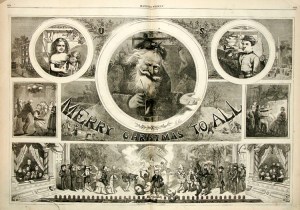 Along with tree decorating traditions, most of us grew up with the magic of Santa Clause. Saint Nicholas was a Christian holy person believed to have lived in the third century, who became known as a protector of children. The bearded, jolly Santa dressed in red that first appeared in Clement Moore’s A Visit from Saint Nicholas in 1820. Thomas Nast was an artist who’s first major depiction of Santa Claus in Harper’s Weekly in 1886 created the image we envision today. Nast contributed 33 Christmas drawings to Harper’s Weekly between 1863 to 1886, and Santa is seen or referenced in all but one. It is Nast who was instrumental in standardizing a national image of a jolly, kind and portly Santa dressed in a red, fur-trimmed suit delivering toys from his North Pole workshop.
Santa lives on today because he exemplifies dreams, hope, wishes and beliefs. In a world filled with stress, violence, poverty, and hunger, Christmas brings out the good in everyone. The thought that if you just believe, good things will happen. Christmas is magic, and if you don’t believe that, watch a child’s eyes on Christmas morning.

 Today I participated in two holiday traditions, a Christmas gathering for the Blue Water Shutterbugs Camera Club and the writing of my annual Christmas letter, which I do in lieu of a card. The writing of Christmas greetings and handling out of Christmas gifts are two areas where I recently learned the history of the tradition.
 --- LIFE IS A MELTING POT --- Grace Grogan...Writer, Photographer