Tag Archives: history

The History of Christmas Trees and Gift-Giving

As we approach Christmas, I had a photo from 2014 pop up on my Facebook Memories feed: the tabletop tree at my house in Michigan, with presents stacked around it for the grandchildren, is a sharp contrast to my skinny pencil tree in my park model in Arizona. I love having this tall skinny tree after six years living in a 35-foot motor home with no room for a tree.

My tree this year is not laden with gifts. I miss the fun of wrapping all those gifts, stuffing the stockings, and watching the kids unwrap them. There is nothing as beautiful as a dark room with a lit tree and gifts below it, and nothing as fun as watching kids open those gifts on Christmas.

Shows writer's table-top Christmas trees and presents sitting around on the floor.
My Christmas Tree in 2014 — gifts for my grandchildren and adult children

That made me wonder about the traditions of Christmas trees and gift-giving. The act of exchanging gifts began long before Christmas and was done during the winter solstice in ancient Rome, celebrated from December 17 to 23rd. The gifts were usually small figurines called Sigillaria, made of wax or pottery and designed to resemble gods or demigods. Then, during the new year celebrations, the Romans gave gifts of laurel twigs, gilded coins, and nuts in honor of the goddess of health and well-being.

It was in the early 4th century AD (January 1, 301 to December 31, 400) that the gift-giving custom was linked to the biblical Magi delivering presents of gold, frankincense, and myrrh to the baby Jesus.  This was co-mingled with the gift-giving tradition of the 4th-century bishop, Saint Nicholas. Saint Nicholas had a habit of secretly giving gifts, and he was the inspiration for Father Christmas and Santa Claus.

In the 16th century (1501-1600), the custom of giving gifts to children developed in Europe as a way of reducing rowdiness on the streets around this time of year. Parents used it to keep children away from the streets and from becoming corrupted. These actions resulted in Christmas becoming a private, domestic holiday rather than a public holiday of carousing.

Saint Nicholas was the inspiration for the Dutch Sinterklaas, with a festival that arose during the Middle Ages. The feast was to aid people experiencing poverty, especially by putting money in their shoes. This tradition developed, and by the 19th century, it had become secularized into him delivering presents. By this time, the Santa Claus of North America had developed.
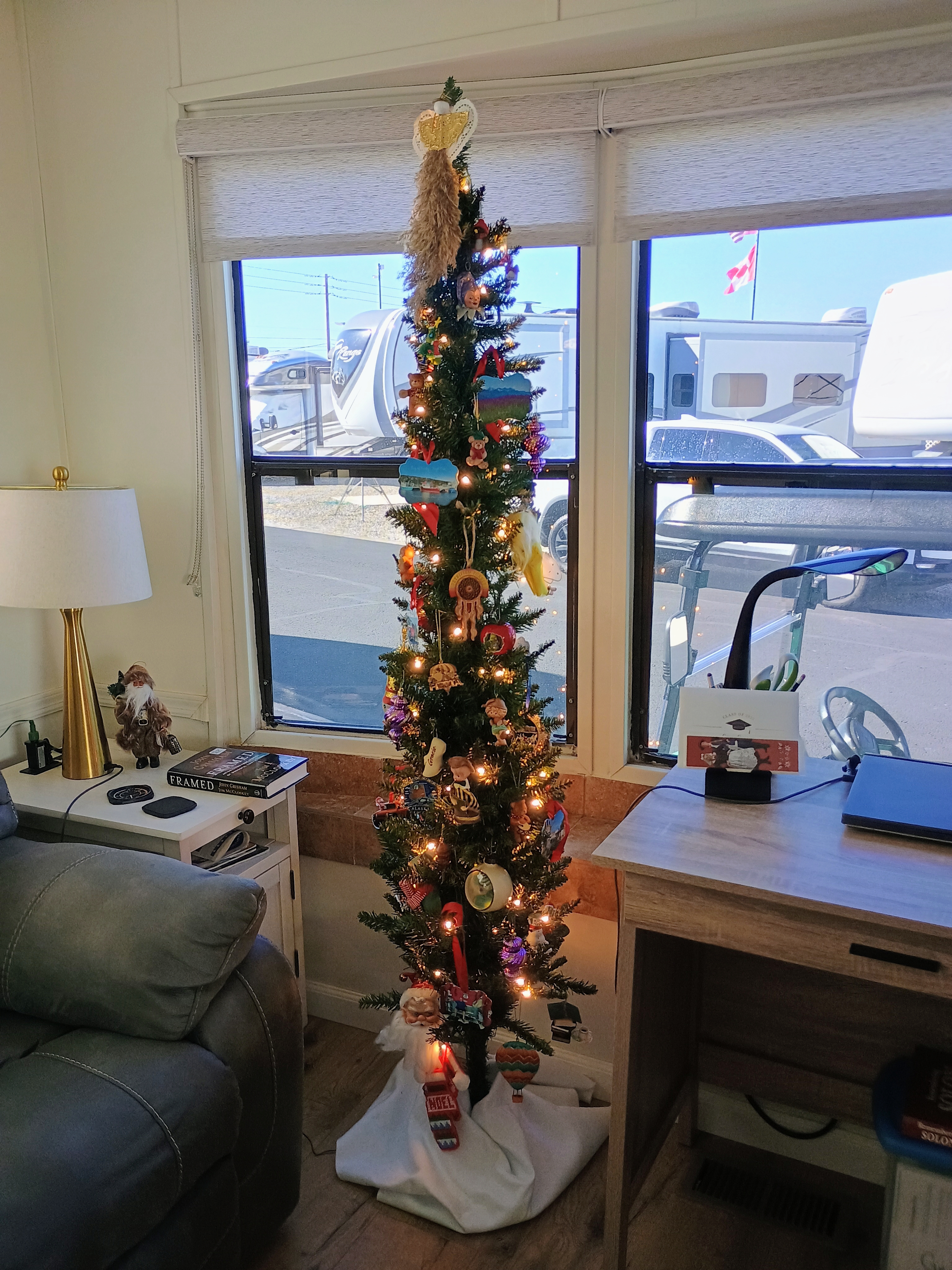
My 2025 slim pencil Christmas Tree

Now, the next question is, why do we place our gifts under a decorated tree? In ancient Rome, homes and temples were decorated with evergreen boughs for the winter solstice feast of Saturnalia. Celtics associated evergreens with everlasting life, and the Hebrews linked them with life and growth. In Han Dynasty China, evergreens symbolized resiliency, and the Norse people associated them with their sun god.

The Christmas tree tradition began in Germany in the 1500s. Evergreens were placed beside the medieval home’s entry, which grew into indoor trees covered with apples for the feast of Adam and Eve on December 24. The trees were also decorated with cookies and lit candles. Another tradition was the Christmas Pyramid, which was formed by wooden shelves that held Christian candles, figurines, evergreen branches, and a star.

The two traditions merged as the first decorated indoor Christmas tree. German immigrants brought the Christmas tree to the U.S. in the 1600s, but it did not become popular until the 19th century. What boosted its popularity was Prince Albert, Queen Victoria’s husband, who introduced Christmas trees to England in 1846. By the early 1900s, electricity made electric lights for trees possible, and they began decorating town squares.

Tree decorations began with simple, handmade items, and food was a popular decoration, with strings of berries, popcorn, and nuts along with cookies, marzipan, and apples. Mass production of ornaments, tinsel, beads, and “snow” batting in the 1900s developed into the intricate ornaments we see today.

The gifts under the Christmas tree began as small presents on the branches, but as the gifts grew larger and too heavy, people placed them under the tree instead.  

When giving or receiving a gift, remember the spirit in which the tradition developed: a representation of the Three Kings presenting gifts to baby Jesus. That tradition has become very commercialized, with U.S. consumers expected to spend $242 billion on holiday gifts in 2025.

Leave a comment

Filed under celebration, Festivals, Holidays, Life is a Melting Pot, winter

Why Didn’t the U.S. Adopt the Metric System? – Part 2 of a 3 Part Series

In Part 1, I explained how I became curious about the reasons the U.S. did not convert to the metric system at the same time Canada was making the change, leaving us as one of only three countries in the world that do not use the metric system of measurement. This section explains what Canada did to ensure it completed its commitment to switching from the Imperial to the Metric system during the late 1970s and early 1980s.

In January 1970, the “White Paper on Metric Conversion in Canada” established the Canadian government’s policy regarding its conversion to the metric system. The document specified that Canada would utilize a single, coherent measurement system based on metric units for all purposes. They then developed the “Weights and Measures Act” in 1971 to recognize the International System of Units (SI) for use in Canada. The “Consumer Packaging and Labeling Act” in 1971 required the use of the metric system on most consumer packaging labels.

The change from Imperial to Metric took time in Canada and began in the mid-1970s. I was a high school student in the United States and didn’t concern myself with what was going on in Canada. I do remember them telling us that we needed to learn the metric system because the country was changing to that form of measurement. I also recall that there were many objections to making the switch. We did incorporate some changes rather quickly, the main one being the switch to one- and two-liter bottles of soda. I don’t remember many other changes being made.

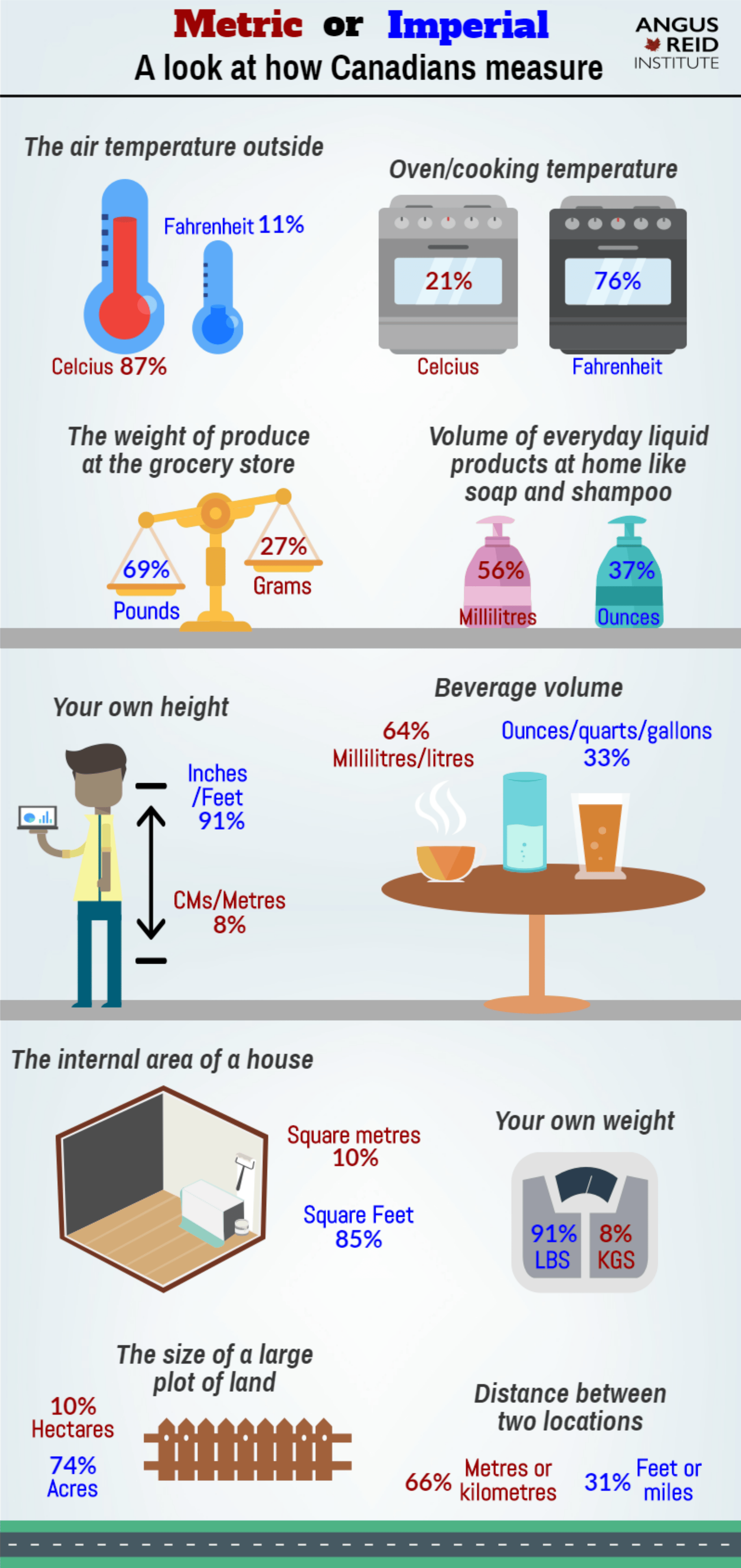
A look at how Canadians Measure

In Canada, things were rolling along at a gradual but steady pace:

  • Temperatures in Celsius beginning April 1, 1975
  • Rain and snowfall in millimeters and centimeters starting September 1975
  • Road signs showing speed limits in kilometers in September 1977
  • Speedometers and odometers in cars are manufactured in metric units beginning January 1979
  • Gas stations were pricing and dispensing gasoline and fuel in liters in 1979
  • Fabrics and home furnishings were required to be advertised and sold in meters and centimeters beginning in December 1980
  • Conversion of food weight measurements for advertising and pricing in metric units, starting December 1983.

We tend to assume Canada is solely metric, rather than the melting pot of systems that actually exist there. Canadians still use imperial units rather than metric in some areas. In 1985, Canada exempted some small businesses from the requirement of metric sales. Other requirements were also revoked, including the use of metric alone for measuring gasoline, diesel fuel, and home furnishings.

Even given these leniencies to a complete change, if you travel to Canada, be prepared for your speed limits and mileage signs to your next stop to be in kilometers, gasoline is sold in liters, and if grocery shopping, have a calculator/cell phone handy to make conversions from metric sizing to imperial sizing. This information is especially helpful when determining the size of ingredients for a recipe.

Being a lifelong resident of the United States, I didn’t delve as deeply into Canada’s history of its measuring system conversion as I did into my own country’s. Watch for Part III, where I’ll give the United States’ history and why it failed to complete the conversion.

Leave a comment

Filed under Canada, communication, decisions, education, employment, impressions, Life Changing, time

Why Didn’t the U.S. Adopt the Metric System? – Part 1 of a 3 Part Series

Listening to a weather forecast on a Canadian TV station, the temperatures are given in Celsius. Paul, who grew up in Canada, makes the mental conversion easily. Paul grew up using the Imperial system of measurement, which is used in the United States. After he was an adult and had immigrated to the U.S., Canada converted to the metric system. Paul is an electrician, a profession that uses the metric system of measurement. That, combined with his frequent travel to Canada, means he is familiar with both systems and believes the metric is a more accurate means of measurement.

Paul frequently comments that the U.S. was supposed to make the conversion to the metric system when Canada did, but failed to fulfill their promise. I recall being in grade school when we were told that the United States would adopt the metric system. I wondered how valid Paul’s repeated comment was, so I delved into researching the topic.

 Canada was making the transition at the same time and completed their conversion between 1970 and 1985. The United States never finished the conversion, despite agreeing to do so, and continues to use the Imperial System today. That made me wonder, why did Canada succeed, and we didn’t?

In my opinion, the U.S. failed to complete the conversion due to a lack of effort and unwillingness to invest in implementing the change. Businesses opposed the cost of having to retool and adjust standardized measurement systems, including bolts, pipes, and nuts, to metric measurements. The Metric Conversion Act of 1975 [ https://usma.org/laws-and-bills/metric-conversion-act-of-1975 ] made the metric system preferred, but not mandatory. This, combined with public resistance and the government’s inability to enforce the change, led to the failure to implement the change.

As of today, the United States is only one of three countries (the United States, Liberia, and Myanmar (Burma)) worldwide using the Imperial measurement system. The Imperial system [ https://www.britannica.com/topic/Imperial-unit ] (also known as the British Imperial system) originated from the British Empire, which ruled many areas of the world between the 16th and 19th centuries. Although the U.S. Founding Fathers made numerous changes in governing style when obtaining independence from Britain, they decided to maintain the Imperial system of measurement, despite the metric system growing in popularity.

A chart showing the Imperial vs Metric measurement and weight differences.

Rather than adopting it in its original state, the United States devised its own version of the Imperial system, known as the U.S. Customary System. It uses measurements of feet, pounds, and miles, but differs slightly from the British Imperial system. The most substantial difference is in volume:

  • The U.S. Customary fluid ounce is 29.573 ml; the British Imperial fluid ounce is 28.413 milliliters.
  • The U.S. Customary pint is 473.176 ml (16 fl. oz); the British Imperial pint is 568.261 ml (20 fl. oz).
  • The U.S. Customary quart is 0.94 L (32 fl. oz); the British Imperial quart is 1.13 L (40 fl. oz).
  • The U.S. Customary gallon is 3.78 L (128 fl. oz); the British Imperial gallon is 4.54 L (160 fl. oz).

The reason for creating the Customary version of the Imperial system was that the metric system was not yet fully developed. The Founding Fathers had a desire to establish a unique national identity and infrastructure, and tweaking the system to make it unique to the U.S. was their way of achieving this goal.

Myanmar (Burma) and Liberia use the Imperial system but are transitioning to the metric system; neither has a predicted completion date. Once their conversions are final, the U.S. will be the sole user of the Imperial system. In 2021, the British government announced plans to return to the Imperial system during its exit from the European Union. The changeover began but was abandoned in 2024 after consulting with the public and discovering overwhelming support for using metric units. They do still use the imperial system for things such as beer sales, road speed, and distance signs, and body measurements.

Although I found the metric system difficult to learn as a child, our government failed its citizens by not enforcing a complete change in the 1970s. A full conversion would have served business owners better in international trade negotiations and put us on equal terms with all foreign lands in understanding measurements when traveling.  

All countries worldwide, including the U.S., Myanmar, and Liberia, have adopted or legally sanctioned the International System of Units (SI), the modern form of the metric system. Canada and the United States are both melting pots of the Imperial and Metric measurement styles.

Watch for Part II and Part III in upcoming blogs, which will deal with the law and the Canadian conversion, the laws and the United States conversion, and where the United States stands today.

Leave a comment

Filed under Canada, communication, decisions, Discoveries, education, home, Life Changing, Life is a Melting Pot, Michigan, reality, travel, Weather

The Sweet History of Soft Serve Ice Cream

As the summer winds down, everyone needs to experience one more lickable twist of ice cream. Whether you prefer soft-serve or the old-fashioned hand-scooped variety, there is sure to be a flavor that will tempt your palate.

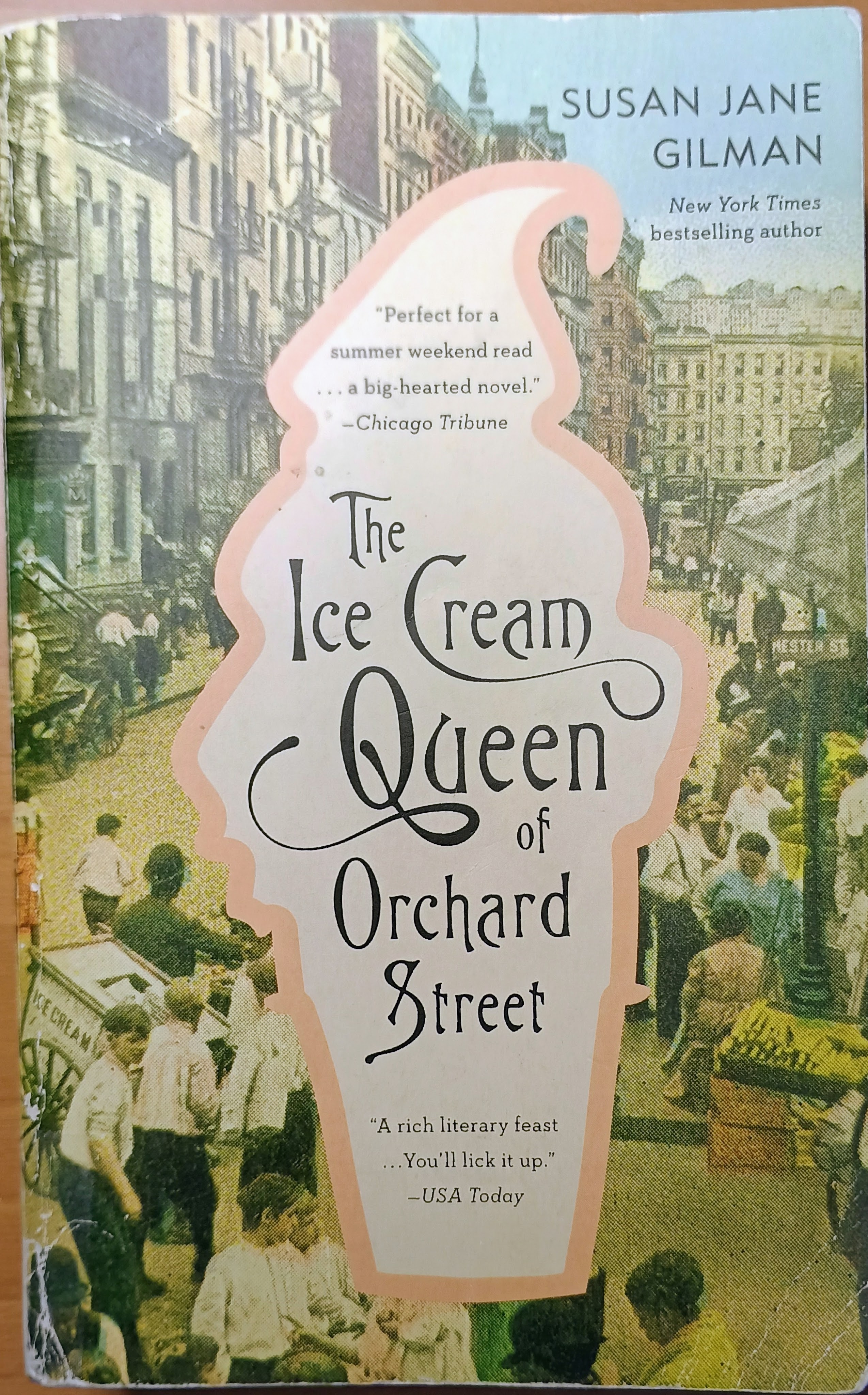
The Ice Cream Queen of Orchard Street is a novel that includes the history of ice cream.

I was reading The Ice Cream Queen of Orchard Street by Susan Jane Gilman and was intrigued by the story in the book about the discovery of soft serve ice cream. I wondered if it was fact or fiction, so I did some digging to get the full scoop. What I discovered is that the author intertwined creative non-fiction history about this discovery to set the scene for the story told in the novel.

When I find interesting topics, I like to share them. You can learn about the history of this tasty, lickable treat in my article, Twisted Tales of Soft Serve and Ice Cream, which begins on the cover of the August 27-September 16, 2025 edition of Michigan’s Freshwater Reporter.

Leave a comment

Filed under Diet, Discoveries, food, Life is a Melting Pot, summer

Michigan Was a Slave-Holding State

I decided to share the link to an article published in the March-May edition of Michigan’s Freshwater Reporter. Michigan is known for being a free state that helped freedom seekers via the Underground Railroad. That information is accurate, but Michigan citizens also were slaveholders. You can learn more about this by checking out Michigan’s hidden history of slave ownership on page 4 of the Freshwater Reporter.

Leave a comment

Filed under assumptions, Coping, decisions, education, events, Life Changing, Life is a Melting Pot, Michigan

DOCUMENT YOUR PART IN HISTORY

I look around, the place has more people than normal for this time of year, but it is still pretty well emptied out. Why wouldn’t it be? Who wants to stay where the summer temperatures go as high as 120° Fahrenheit?

Yet, here I am. Our original plan was to leave here at the beginning of April and visit several national parks and scenic areas through several states before heading to Michigan to visit family. Then head south and west again, hitting Sault Lake City and Colorado Springs for photography and RV conferences before going for a three-month stay on South Padre Island, Texas, followed by winter back here in Yuma, Arizona.

Those plans have been crushed by the Coronavirus shutdowns. We have extended our stay here in Yuma until at least August 3rd. We are trying to secure reservations in Michigan for somewhere between mid-August to early October, but so far have not had any luck. The state is still locked down and the few campgrounds that are open do not have long-term spots available.

Time will tell if we travel, where we will be, and when we will get there. When you live full-time in an RV, campgrounds are an essential part of life.

We are living through an event that will be written about in history books. Have you recorded your stay-at-home location and changes in lifestyle? Have you noted the schools closing, people doing work-at-home because businesses closed, hospitals overrun with patients, people wearing face masks and gloves to protect those around them?

If you have young children, have you recorded their thoughts on what is going on around them? These are memories that may be forgotten over time but will be important to future generations.

This slideshow requires JavaScript.

Paul and I are hanging tight in Yuma, Arizona. I walked around the park and took snapshots of the camp, documenting the place that was full when we arrived in February and is now almost empty. A lot of the people here in the winter are Canadian snowbirds who were ordered to return to Canada in March or lose medical insurance due to the pandemic.

So where are you? Have you documented the event? Leave me your comments below.

Stay Safe!

Leave a comment

Filed under Activities, assumptions, backyard, Canada, communication, Coping, decisions, Discoveries, environmental, exploration, flowers, Full-Time RV, home, impressions, Life Changing, Life is a Melting Pot, memoir, Michigan, reality, spring, summer, time, tourism, travel, winter

Celebrating Independence Day

I want to wish everyone a Happy 4th of July — the celebration of the birth of the United States of America.  Many people today do not understand the significance of the holiday, nor how it came to be celebrated in the manner it is.

I write a column for The Lakeshore Guardian and for the July 2017 I wrote about the history of our celebration and the changes that have taken place since the very first time festivities took place in the year of our independence, 1776.  You can read the column by clicking on Celebrating Independence Day, which will take you directly to my column.  While there feel free to click on Articles by Grace Grogan which will take you to a 4-page listing of the columns I have done for that paper.  There is no subscription fee for the paper so feel free to view at your leisure.

If for any reason you have difficulty using the links above, I have scanned and attached the Celebrating Independence Day column below, which you should be able to click on and enlarge for easier reading.

Wishing you all a wonderful, happy, 4th of July Celebration.

Celebrating Independence Day001


Celebrating Independence Day002

Leave a comment

Filed under celebration, events, Festivals, genealogy, Holidays, Life is a Melting Pot

Checkbook Challenged

Checkbook cover

Checkbook image obtained online.

Often we hear comments about how technology challenges the older generations.  Have you ever considered how challenging some basic, long ago established tasks that are not technology based can be to younger generations?  A prime example I recently encountered was the basics of using an everyday standard checkbook.

A gentleman I know who is in his mid twenties recently started his own business and decided it was time to get a checking account.  Sounds pretty simple doesn’t it?

Challenge No. 1:    He approaches me with checks and checkbook cover in hand, he couldn’t figure out how to get the checks into the checkbook cover.  I showed him how to slide the back of the checkbook pack into the plastic holder inside the checkbook cover, then advised him that the register goes into the other side.

His Response:  Register?  I wondered what that weird empty book was for.  Thought it looked rather useless and threw it in the drawer.

Challenge No. 2:    He approaches me with the register and checkbook cover.  The register and the plastic slip on the other side of the checkbook cover is slightly different from that of the checks.  How are you supposed to do this?  I put the register in and advised him that as the register gets written into, to make access to your current page easy use a paperclip to block open the pages.  Don’t you love the amazing technology involved in that step?

Challenge No. 3:   Things now appear to be going well.  Then his next question:  Is there a way to get deposit slips pre-printed so I don’t have to write them out all the time?

My Response:  Look at your pad of checks, all the way to the back.  Imagine his Surprise!  Deposit slips right there, pre-printed the entire time and he didn’t know it.

Realization:  He had asked the bank to bring him deposit slips because he didn’t have any (or so he thought).  They probably wondered why he wasn’t using the pre-printed ones.

Challenge No. 4:  First check written gets returned for not being properly filled out.  Why?  He used regular numbers on the amount line and didn’t sign the check.  Why didn’t he sign the check?  He didn’t know what that line at the bottom was for, it wasn’t labeled.    Why didn’t he write out the amount in word format?  He didn’t know he was supposed to.

How to Write a Check image obtained onliine.

How to Write a Check image obtained onliine.

Lesson Time:  How to properly fill out a check.  Numbers on the number line.  The amount written out in long form.  Example:  One Hundred Forty Dollars and 40/100’s.  Why can’t you just write out the words for the cents?  You could, but it may take too much space, and proper format is fraction form.

Now we are on a roll.  Deposits going in, checks being written in their proper format.  Check register being properly filled out.  What else could there be?

Discovery Time:  Grace!  Do you know you can write a check to yourself and then deposit it into your other bank account?  Umm, yes, but if it is at the same bank it is easier to just do an electronic transfer.

Transfer of information from check to register obtained online.

Transfer of information from check to register obtained online.

Realization:  Sometimes it is the little discoveries in life that make you happy!

Final Tip:    I asked him if he knows that once a month when the statement arrives you are supposed to balance the checkbook.  What does that mean?  You take the statement the bank sends and check off all deposits and checks that have cleared the bank.  Then write the “balance” from the statement down, add any deposits that have not cleared the bank, subtract any checks that have not cleared the bank, and the bottom line should match the balance on the statement.

His Response:  That sounds like too much work.  I just watch the balance through the month to see if it seems right.

Conclusion:  The old-fashioned way of doing banking by maintaining a physical checkbook, check register and handwritten checks lacks the technology required for students today to learn this basic life skill in high school, which is where I was taught.  In this automatic, fast-paced world the way in which something so basic was and is done amazes today’s young adults in a unique way and challenges them with having to handle a task without a computer, iPad or cell phone.

LET ME HERE FROM YOU:   Have you encountered challenges by not knowing how to do something the “old-fashioned” way?  Have you met someone who was facing challenges trying to deal with a non-technology based task?  I would love to hear what products or tasks have created a dilemma for the younger generation.


3 Comments

Filed under Activities, assumptions, career, employment, Life is a Melting Pot, reality, technology

WILD WEATHER PAST AND PRESENT

0441 Eagle in Nest-1

Bald Eagle, photo by Grace Grogan

Ice Jam, photo by Grace Grogan

Ice Jam, photo by Grace Grogan

Bald Eagle, photo by Grace Grogan

Bald Eagle, photo by Grace Grogan


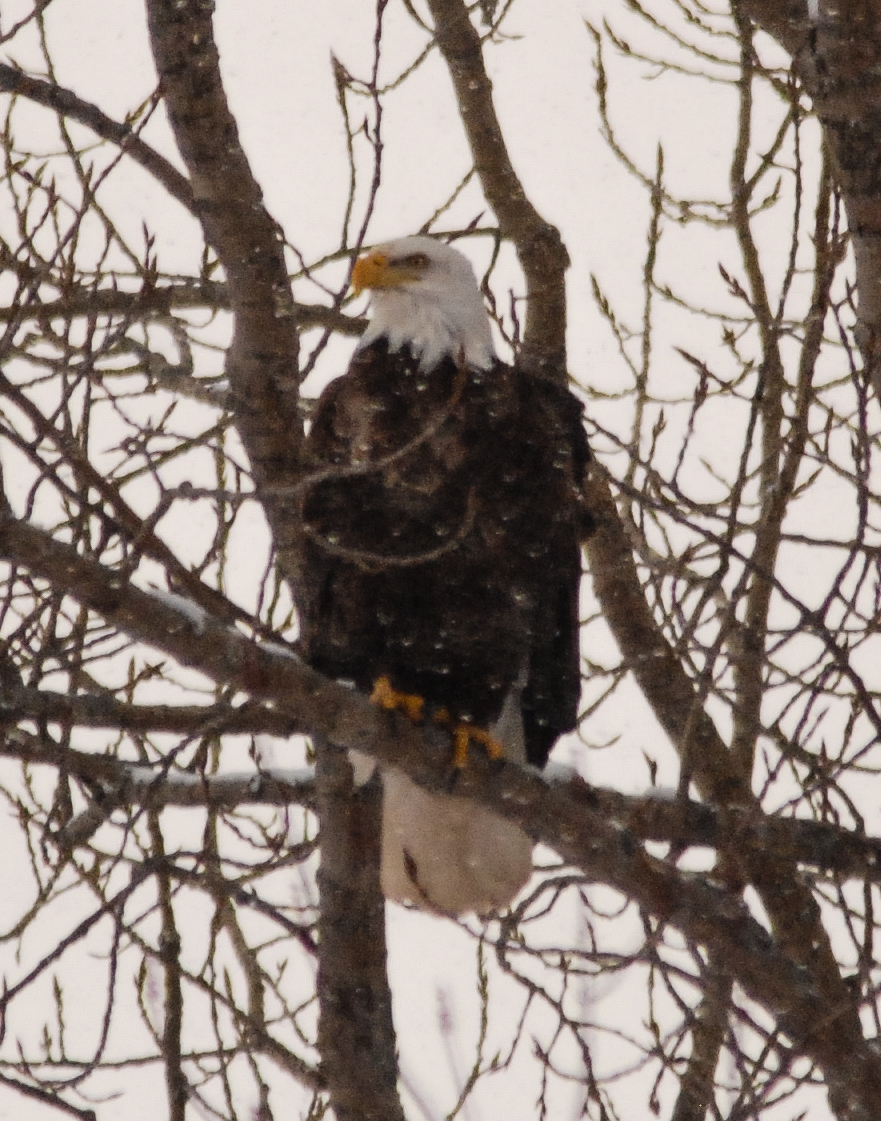
This past winter the United States experienced some wild weather, as have other parts of the world.  Here in the thumb of Michigan the ice coverage on the water resulted in a large number of eagles being seen on the river to the extent that they were written about in local newspapers.  The ice on the great lakes will help raise water tables that have been low for years while it has negatively affected the shipping industry as the ice cutters were unable to keep the shipping channels clear.  Bitter cold, snow and ice were encountered at unusual levels all across the country.

I recently watched a special on TV that dealt with the affects of global warming, the melting glaciers, and claimed this wild weather may be our new normal and may become worse.  Flooding, mud slides, earthquakes, hurricanes, could all progressively increase as the glaciers melt and our earth adjusts to the changes.  While I don’t discount scientific studies or the fact that industry and resulting pollution contribute to the changes, I also know that wild weather has been going on for centuries, prior to when modern industry existed.  Our ancestors encountered it without the modern means of communication to provide them with warnings or obtain assistance.  No telephones, automobiles,  or satellites, just the surprise of whatever happened and human determination to rebuild their lives after disaster.

It was April 12, 1934 when the weather observatory in Mount Washington, New Hampshire recorded a wind speed of 231 mph, but it was all the way back on January 22, 1885 when the temperature dropped to 50 degrees below zero at that same location.  Fifty below zero was also recorded in East Portal, Utah on January 5, 1913.  That was when the primary means of travel was horse and buggy and homes and homes were heated by fireplace or wood burning stoves.   Imagine traveling in an unheated carriage or having to go out and gather wood to heat your home in those temperatures.   Over the years bone-freezing temperatures have made their mark on history.    The coldest temperature in the 48 contiguous states was 70 below zero in Rogers Pass, Montana on January 20, 1954, but Prospect Creek, Alaska sets the record for the coldest temperature in the United States with 80 below zero on January 23, 1971.

Extreme temperatures on the positive side have also occurred in history.  It was way back on July 10, 1913 that Death Valley National Park was the world’s hottest place at 134 degrees.   It was surprising to learn that Fort Yukon, Alaska was 100 degrees on June 27, 1915.  There were several dates in the mid 1930’s that cities in the U.S. recorded temperatures at 118 degrees or higher, but it was way back on July 20, 1898 and August 10, 1898 that the towns of Prineville and Pendleton, Oregon reached 119 degrees.  As if that wasn’t hot enough on its own, that was before air conditioning or even electric fans.  Combined with the suits that men wore or the long sleeved, high-necked dresses with multiple layers of underclothing that women wore and you can only imagine how horribly uncomfortable it must have been for everyone.

Temperature certainly impacts our lives on a daily basis, but natural disasters have also occurred throughout history and at times when the modern warning systems, means of communicating a need for help or quick and easy transportation did not exist.   Imagine living in Johnstown, Pennsylvania in May 1889 and the fear, devastation and horrendous work of clean up after ten inches of rain fell in under 24 hours causing a dam to break.  Try to envision a 30-foot high wall of water traveling 40 mph  towards town and the residents unaware of what was bearing down on them.  That day more than 2,200 people were killed.  Just the need to get that many bodies buried before disease and the stench of decay set in would have been emotionally and physically exhausting.

If you ever visit Galveston, Texas you can tour the Moody Mansion, the only building left intact after a category 4 hurricane struck the island town on September 8, 1900.  With winds reaching 130 to 140 miles per hour and a storm surge of 15.7 feet hitting the island where elevation was only 8.7 feet, the hurricane destroyed 3,600 buildings and killed between 6,000 to 8,000 people, including 90 children from St. Mary’s Orphans Asylum.   Isaac’s Storm by Eric Larson brings the story of this attack by nature to life.

We watched what we considered to be unusual winter storm weather move across the United States this year.  In some ways history was repeating itself, but with our modern technology we were able to avoid the disastrous results such weather caused in the past.  It was March 11 and March 12, 1888 that 40-50″ of snow fell on Connecticut, Massachusetts, New Jersey and New York resulting in the death of over 400 people and causing 200 ships at sea to sink.   On  February 11, 1899 snow fell beginning in Florida all the way up the eastern seaboard, in one day dumping 20″ of snow in Washington DC and 34″ in New Jersey.    The book The Children’s Blizzard by David Laskin is a gripping tale of the blizzard that took place on January 12, 1888 in the Dakota Territory and Nebraska.   The storm came up fast and unexpectedly, dropping temperatures from above freezing to a 40 below windchill and leaving adults and school children stranded and lost, sometimes only a few feet from shelter.  A total of 235 people died in that storm.  Those who live in the Blue Water Area of Michigan are familiar with the Storm of 1913.  This blizzard, called a White Hurricane, took place on the great lakes November 7, 1913 sinking ships and killing many.

We now have exited winter and are approaching the season for tornadoes.  Hopefully history will not repeat itself with more natural disasters such as the May 7, 1840 tornado that hit Natchez, Mississippi killing 317 people.  There was no warning system of TV, radio, internet to warn those in its path.  There were 317 reported deaths from the tornado, but slaves were not counted and so the death toll was likely much higher.   St. Louis Missouri had a massive tornado rip through the downtown area on May 27, 1896 killing 255 people and injury about 1,000 others.  Over 8,800 buildings were damaged or destroyed.  St. Louis also experienced another massive hit on September 29, 1927 when a tornado tore apart more than 200 city blocks in a period of about four minutes.    The deadliest tornado in the United States took place on March 18, 1925 covering between 219 to 234 miles and leaving 695 dead and 2,027 injured.   This tornado traveled from southeastern Mississippi through the southern portion of Illinois and then into southwestern Indiana.  The tornado lasted for over three and a half hours with an average width of 3/4 of a mile and a speed of approximately 62 miles an hour and destroying approximately 15,000 homes that were in its path.

Looking back in history it is easy to determine that the wild weather of today may be of extreme proportions, but it is not new to this decade.  Massive storms have been happening for centuries and people have been enduring the hardships of destruction and recovery throughout history.   Wild weather can be found in the past, present and most likely will continue in the future.

2 Comments

Filed under birds, genealogy, Life is a Melting Pot, Uncategorized, Writing

EVOLUTION OF THE CLERICAL WORKER

Gregg Shorthand Used for taking dictation

Gregg Shorthand was used for taking dictation Click on the photo for a clearer view

One day this past week I was working at the computer and after juggling three phone calls in a row a client in our waiting area said “I wonder who had the first secretary.” It was an interesting thought. How far back does the use of office personnel go? While the answer to the question is interesting, the fun part of this was reminiscing about my own 35+ years in the clerical field and the changes that have occurred in that time.

Today the title of secretary is not commonly used. Administrative assistant, office manager, and executive assistant are some of the current positions held by office personnel.  Regardless of title the basic duties have not changed but the way they are performed has through advances in technology, education, and gender roles in the workforce.

It is believed secretaries existed prior to the establishment of the Roman Empire. Referred to at the time as “scribes” the position was held by educated men. As time progressed members of nobility and those who were wealthy and powerful used secretaries to serve as advisors, take dictation, handle correspondence, keep a schedule of appointments, and maintain accounting records.  By the late 1880s technology was advancing and office work required the ability to handle such modern conveniences as telephones, typewriters, and adding machines. It was during this time that women began to enter the work force and adapted well to handling of secretarial duties.  There was no equalization of pay and women were paid at about half the wage that a man earned for the same work. This made women financially beneficial to the employer. For men the position had been a stepping stone to higher, more prominent positions. Women were not considered capable of handling higher ranking managerial positions and were unable to advance beyond the clerical position. The employment of women in clerical positions expanded from approximately 2.5% of the work force in 1870, around 53% by 1930 and almost 80% by 1980. Since 1980 there has been no change in the number of women holding administrative support (clerical) positions.

My first office job was as clerk-typist for the Michigan Chapter, NASW, a position I obtained shortly after high school. In the 35+ years since I have worked for a variety of firms and my official title has included secretary to the president, administrative assistant, office manager, and paralegal. The required education for doing clerical work has changed and what was previously taught at the high school level is either obsolete or requires a college education.

When in high school I took clerical classes including Gregg shorthand, advanced typing, and “secretarial block,” an all-inclusive class designed to advance our office skills. We learned to operate a variety of business machines including the 10-key adding machine, the stencil machine, and worked to build our shorthand and typing skills.    Still a gender-based world, we were taught how to properly stand so as to appear attractive if taking dictation from a standing position.  Another element of the class included following our instructor at a fast pace down the halls as she gave dictation, so that we could follow an executive who was too busy to sit behind a desk when dictating.  I never encountered such an executive, but the training did make us accurate with our shorthand.

My training actually goes back to when I was in grade school and was one of 3-4 other female students selected to run the school office while the secretaries were at lunch, answering phones and running the ditto machine. If you are familiar with that piece of equipment, you know I am referring to the late 1960’s to early 1970’s. Shall I date myself? I learned to type in 8th grade on a manual typewriter, and when we moved to high school we were thrilled to be able to type on the electric IBM Selectric typewriter. Copies of correspondence were done by placing a piece of carbon paper between the letterhead and a piece of onion skin paper. Typewriter errors were corrected using correction tape or liquid paper.

My second office position in the early 1980s was for an importer, and my dictation was frequently transcribed onto a telex machine. A message was typed onto the machine using shortened words, eliminating vowels and other unnecessary letters to reduce the cost of transmission. The message was then sent overseas to suppliers and we would wait to receive a telex response, which printed out on paper for reading.   The use of computers and email communication did not yet exist.  By the time I was in my third office position the fax machine was a new device that required dialing a number on a regular telephone, then once the connection was made activating the fax machine and hanging up the telephone.  We also had new “word-processing” typewriters on which you could read one line of text on a small narrow screen located on the body of the typewriter and make corrections before it printed onto your paper.   We were thrilled to have such technologically advanced machines.  Eventually one computer was purchased and put in a central location to be shared by all six clerical workers.

Workers entering the clerical field today think nothing of having their own computer, internet connection, communicating by email and having access to fax machines and copy machines. Most have never used a typewriter and have no idea what Gregg shorthand is. While I would never give up the modern conveniences of today, it is fun to remember the joy and excitement of each new technological advancement and the ease each has added to the clerical workload.


1 Comment

Filed under Life is a Melting Pot, Uncategorized, Writing