We were unable to get any local stations while traveling this summer and found a TV station playing some prime-time oldies. Watching shows from the past leads to some interesting observations. This includes the way people were portrayed in the ’50s, ’60s, and ’70s.
Perry Mason (1957-1966)
Perry Mason is an attorney who always wins his case. This almost always happens during a trial by showing that someone else in the courtroom is guilty of the crime his client is charged with. Through witness testimony he leads to the truth, and either the witness testifying or someone else in the courtroom inevitably stands up with an “I did it” announcement. Of course, once this announcement is made, Perry has won the case for his client.
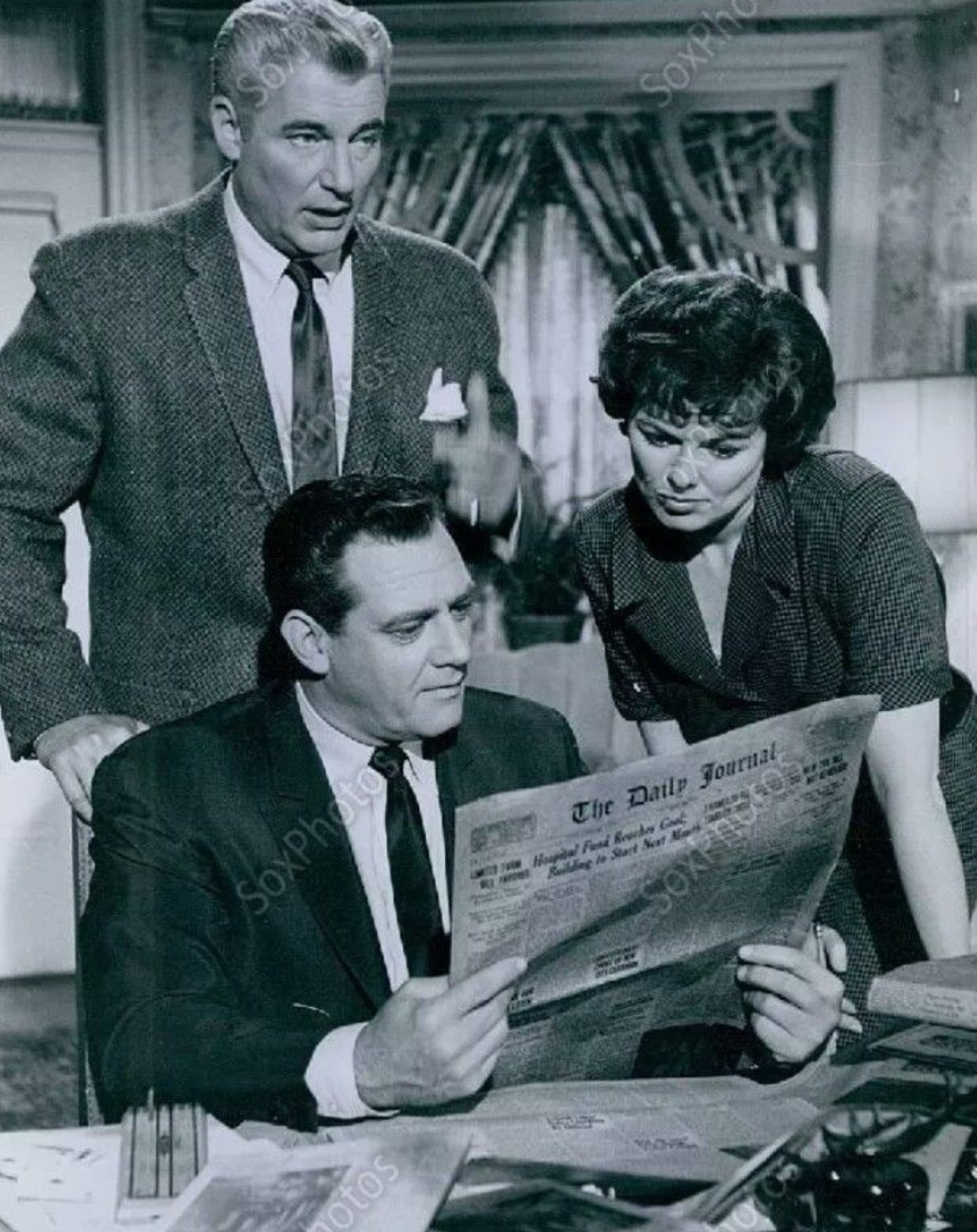
Perry’s secretary/legal assistant, Della, is a smart, single woman who is always at Perry’s side. She sits in his office while they work, is there when he meets with clients or with his private investigator, Paul Drake. Della also goes to clients’ homes and attends special events or dinner appointments with Perry.
Della is portrayed as very intelligent and capable, but almost every other woman in every episode fits the “dumb blonde” profile. They appear very naive or lacking in intelligence. They are highly emotional and unable to cope with the slightest bit of stress.
Paul Drake Standing, Perry Mason at Desk as Della looks over Perry’s shoulder
Paul Drake is a private investigator that does work on every case Perry handles. Paul is always available at a moment’s notice. The same goes for Della. It appears neither Paul nor Della has a private life. Their entire existence revolves around Perry’s business needs.
It is a good show that I enjoy watching. The outcome is very predictable.
Mannix (1967-1975)
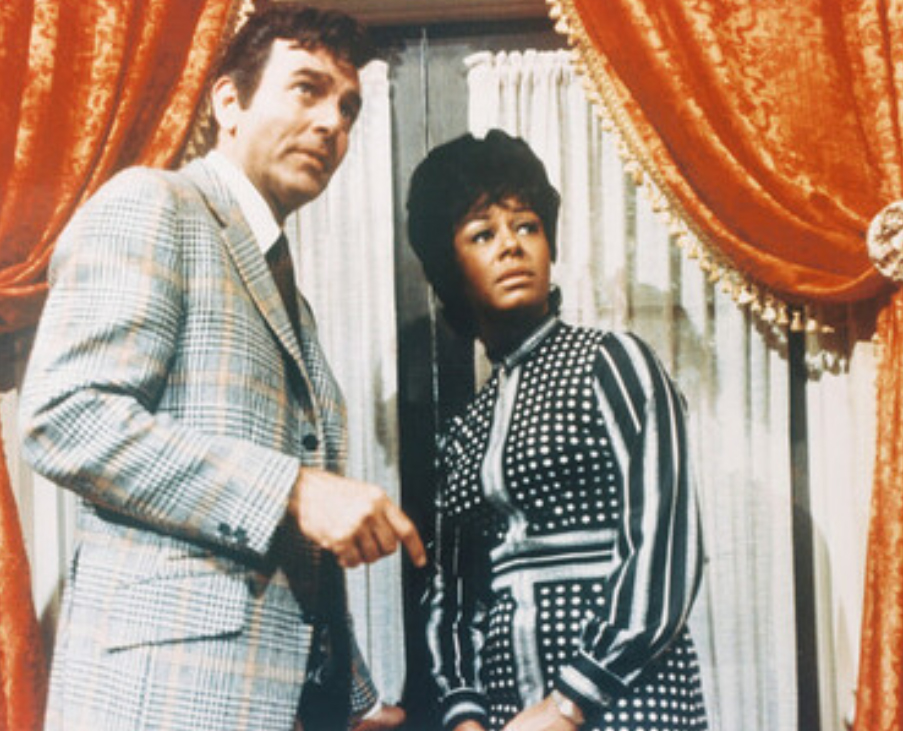
Mannix is a Los Angeles private detective. He is good-looking, drives a convertible, and women in mini-skirts are always after him. He has an attractive secretary, Peggy. Peggy is the widow of a police officer and is raising a young son on her own.
At a moment’s notice, Peggy is always able to find a babysitter so she can work late, work weekends, stay with female clients overnight, and more.
Throughout every episode, Mannix will get into at least one fistfight, get shot at, and have his car run off the road. Remarkably he never gets a black eye but does sometimes suffer injuries. His car is always repaired quickly. The “bad guys” frequently show up at the office, putting Peggy in dangerous situations as well.
This is a fun one for finding errors where writers and producers didn’t check their facts. For example, in one episode Mannix was preventing a plane from leaving the ground. The pilot was knocked unconscious but still in the pilot’s seat. Mannix is standing by the pilot’s seat, leans over and pulls up the yoke, and turns it to the left. The plane turns to the left and stops. This would never have happened in real life.
Joe Mannix and secretary Peggy
Pulling back on the yoke in an airplane causes the plane to climb in altitude or lift off the ground if there is enough speed. Turning the yoke causes the plane to bank in flight, but does nothing on the ground.
When on the ground you turn the plane using the foot pedals, and you stop the plane by pushing the top of both foot pedals forward simultaneously. How do I know? I live with a pilot!
By the time we reached the 1970s, women in TV shows were being portrayed as intelligent and emotionally stable.
Barney Miller (1975-1982)
This is a comedy set in a New York City police station in Greenwich Village. The goofy situations the detectives deal with are so off-the-wall that you have to assume they represent real police incidents. The show’s characters are an ethical mixture of good-hearted, comical professionals who manage to get the job done.
Captain Barney Miller is in charge of the precinct. He is level-headed and serious about getting the job done, despite having a bunch of partially inept people working for him.
“Wojo” is short for Wojciehowicz. True to the era’s habit of joking about Polish intelligence, Wojo is well-meaning, physically attractive to ladies, but lacking in intelligence. Although successful in getting the bad guys, he always manages to bumble something.
Harris is a good-looking, fashion-conscious, cultured black man who is aspiring to become a successful writer. He is always placing notes about incidents at the station into a mini-cassette recorder for use in his writing. Harris is the classy type who can fix you a perfect cup of tea and take you to the symphony.
Yemana is Japanese, introverted, and always reading and trying to avoid work. One of his “duties” is to make the coffee at the precinct, and it is horrible. He never makes a decent pot, yet everyone continues drinking it. He is also responsible for the filing, but no one can ever find anything he files.
Dietrich is a curly-haired blonde, brainy, and always able to fill everyone in on any subject they are discussing. He is the type of person you picture as a kid reading encyclopedias and enjoying homework.
Fish is on the edge of retirement and has a condition that always has him running to the bathroom. Married for years to Bernice, he constantly makes subtle complaints about her or marriage. Bernice always calls him at work for some goofy reason.
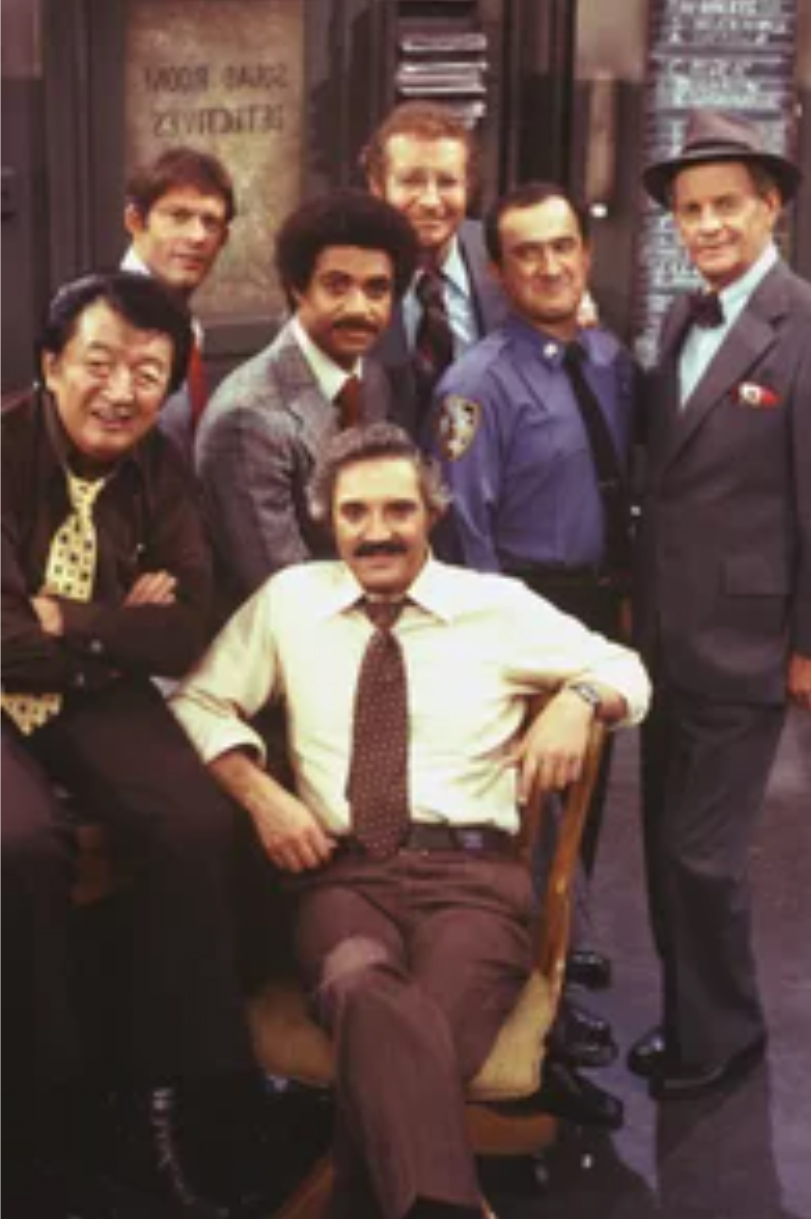
The cast of Barney Miller – Barney seated, from left to right Yemana, Wojo, Harris, Dietrich, Levitt, and Frank Lugar
Inspector Frank Luger is constantly stopping in, trying to catch the precinct doing something they shouldn’t. He is both annoying and likable at the same time.
Last but not least is Officer Carl Levitt. Levitt is still in uniform and delivers the mail daily. He wants to move into Barney’s department and become a detective. Levitt is constantly pointing out his achievements, no matter how small. He is also very sensitive about being shorter than the others and tries to stress when his shorter stature is beneficial.
I recently watched the final episode of the series from 1982. Although not a longtime watcher, it was a sad moment when everyone had to leave the precinct for the last time and go their own way.
What oldie TV shows do you enjoy watching? What are your observations when you go back and view old shows today?
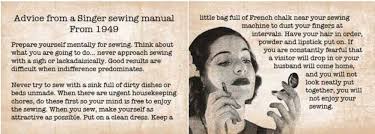
I recently came across Advice from a 1949 Singer Sewing Manual, which has been bouncing around on social media for years and has been verified as accurate. I think this speaks volumes about the era in which it was written.
Advice from a 1949 Singer Sewing Manual
How many women today would worry about having on a clean dress, their hair done, and with powder and lipstick applied for the chance encounter with a visitor stopping by while they were sewing? Even more so, the horror of horrors if their husband came home to discover they were not pristinely put together?
At the time the manual was written a woman’s position was to cater to her husband’s desires. She was to care for the home and children, and not be so forward as to pursue her own dreams or ambitions. After all, that would tax her brain beyond its perceived ability.
That got me to thinking about the 1960s and 1970s when I was growing up. Things were more forward-thinking then, or were they?
The 1960s
The 1960s were a time of change, the beginning of a revolution for women. Gone were the prim and proper dresses and pumps. Miniskirts and go-go boots were the things to be seen in. Long hair, headbands, and wild printed fabrics were in fashion.
In 1968 women protested against the Miss America Beauty Pageant, because not only was it sexist, but its core requirement was that the women be “of good health and of the white race. The requirements went on to state that Miss America was to represent what women are supposed to be, bland, apolitical, and inoffensive.
The push was on to equalize the rights of women with those of men. Women, in declaring their solidarity for equal rights, held public bra-burning events. Huge barrels labeled “freedom trash can” were available for women to toss their bras, panties, cosmetics, high heeled shoes, hair curlers, and any other possessions they considered to be “instruments of torture.”
By going braless women were gaining public attention for their cause. While many men didn’t agree with women having equal rights, they probably didn’t object to the bra-burning protests. This was the jump start for the no-bra fashion trend
The truth is, the 1960s and 1970s were an era of women striving to break out from under the control of men. They wanted recognition for their own abilities. I think one of the best attributes to the feeling of freedom for everyone was Woodstock. Three days of peace, love, and music held in August 1969.
Woodstock was not part of the women’s movement, but it was an event that rocked the nation. Over one million people made it to Woodstock, but only about half of those made it to the 3-day concert because of crowds and traffic jams.
If you don’t know what I’m referring to, it was flower children, hippies, middle class, upper class—an event all young people with an open mind and spirit wanted to be a part of. It moved people out of the restrictions of the past, away from the stress of the Vietnam War and the Civil Rights Movement, and forward into striving for newfound freedoms in the future.
I was too young to attend, but I remember seeing it on TV and my parents being disgusted at the sight of people in all modes of dress and undress, muddy, wet, sometimes naked, gathered in that huge field to listen to music and do drugs.
The 60s were just the beginning. I was surprised to learn recently how many freedoms women were denied throughout the 70s. Some had been resolved by the time I turned 18 in 1978, but it wasn’t without the tenacity of strong women pushing forward.
The 1970s
A prime example is the famous “Battle of the Sexes” which took place in 1973. Bobby Riggs was a No. 1 ranking 55-year old tennis champion. He was a male chauvinist who made a public claim that all women were inferior and that even at his age he could beat any woman in tennis.
Billie Jean King was a 29-year old female tennis player. She took Bobby Riggs up on his challenge. A tennis match between a male and female was unheard of, and hence the “Battle of the Sexes” name was born. The match was held on September 20, 1973.
Billie Jean beat Bobby 6-4, 6-3, 6-3. It would still be many years before women were recognized as equals in sports, but winning that match established women as professional athletes. It was also a huge victory for women’s rights.
Always Ask A Man
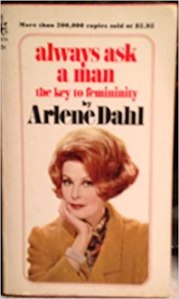
I remember when I was around 14-15 years old my mother gave me a book written in 1965. The book was Always Ask A Man: Arlene Dahl’s Key to Femininity. I don’t remember a lot about the book, but the title gives a pretty good indication of how non-forward thinking it was.
Always Ask a Man – The Key to Femininity
There is one section that still stands out in my mind. It appalled me as a teenager. The topic dealth with shopping for clothes.
If your husband or father went shopping with you, you should try on every outfit you are considering and model it for them. If they don’t like it, you don’t buy it. If the man does not go shopping with you, then upon your return home you model each outfit for them. If they don’t like it, you return it to the store.
I remember thinking “no way!” If I go shopping and like an outfit, I am buying it and wearing it. I am not submitting to some man’s ideas about my clothes. I don’t think I ever finished the book. Once I got to that point, I was done.
A few years later I read The Hite Report: A National Study of Female Sexuality, written by Shere Hite, published in 1976. I was probably around 16-18 years old when I read it. Shere Hite asked a lot of women intimate questions about their sexuality. The results were published in a 600-page book. My mother never said much about it, but I doubt she was pleased to see me reading it.
Moving Forward
A popular singer of the time, Helen Reddy, had a very popular song, I am Woman, which was released in 1971. It spoke to the fight for equal rights, one portion of the lyrics saying:
I am woman, hear me roar in numbers too big to ignore and I know too much to go back an’ pretend ‘Cause I’ve heard it all before And I’ve been down there on the floor No one’s ever gonna keep me down again
Even as laws changed, discrimination against women still took place in many areas. It was in the early to mid-1980s when applying for a job that I was asked 1) if I was married, 2) if I was pregnant, and 3) whether or not I planned to become pregnant.
It was illegal for the company owner to be asking those questions, and he knew it because he acknowledged it. He knew he had the upper hand, because I would be concerned about being denied employment if I refused to answer.
What did I do? I danced around the question. I was off the pill, but when asked about plans for pregnancy I replied, “if it happens it happens.” It happened.
Women’s clothing took on a very masculine look. If a woman wanted to make it in a man’s business world, they needed to dress like a man. Women wore pants suits with non-feminine blouses. That was the way to climb the corporate ladder.
Working Mother was a magazine launched in 1978 and written for women such as myself who were juggling full-time work with young children. Men were not adapted to this lifestyle and we were juggling daycare, household care, and full-time work.
On top of that, there was a division between the stay-at-home mom and the working mom. Those who did not work outside the home were looked down on. It was a common phrase to hear “oh, you only stay home, you don’t work?” It was because of this attitude that the term “Domestic Engineer” was developed by stay-at-home mothers.
Things have improved, but gender based discrimination still exists today. If you are curious about how far we’ve come, check out the list of Discrimination and Lack of Rights in the 1970s below.
Please leave me your comments below. Were you discriminated against? Did you participate in any of the women’s rights movements?
Discrimination and Lack of Rights in the 1970s
Financial
Have credit cardsin their own name—Women needed their husbands signature, and if unmarried a father or brother had to sign the application; banks could deny applications based on gender until the Equal Credit Opportunity Act passed in 1974
Could Not Open a Bank Account—Women were not allowed to open a bank account without their husband’s permission; men did not believe women could handle finances.
Educational
No Admittance to Military Academy—Women were denied admission because men believed women would not be able to make it through the academy; West Point admitted their first female in 1976 and four years later 61 females graduated from a military academy.
Could Not Receive Equal Education—Men felt that women could not handle the challenges of higher education, that they weren’t smart enough, and that they belonged in the kitchen, not school.
Could Not Attend Ivy League College—It was considered more important to educate males than females; Yale admitted its first woman in 1969, other ivy league colleges began to follow suit, but Columbia did not allow in a female until 1983.
Employment
Could Get Fired for Being Pregnant—The Pregnancy Discrimination Act of 1978 prevented this, but employers could give any other reason for their firing
No Paid Maternity Leave—Paid maternity leave first made news in 1969 when five states agreed women should be allowed to take time off around the time of birth, resulting in the Temporary Disability Insurance Act; today there are still hundreds of businesses that do not pay women for maternity leave.
No Protection for Sexual Harassment—It was not until 1977 that the U.S. Circuit Court of Appeals for Washington DC ruled that a woman could not be fired for refusing to provide sexual favors to her boss; the Equal Employment Opportunity Commission established a definition for sexual harassment in 1980 and it was 1986 when the U.S. Supreme Court agreed with that definition.
Could Not Apply for Any Job—Despite the 1964 Civil Rights Act, women could not find jobs beyond secretary or teacher before the 1970s; employers would find excuses other than gender to reject women applicants
Could Not Own a Bank—It was 1975 when the First Women’s Bank opened, becoming the first bank owned and operated by a female. The law did not initially accept the bank, but it was a milestone in the 1970s women’s rights movement.
Could Not Be Astronauts—NASA did not ban women, they simply did not allow them to interview, mainly because they only accepted military applications and the military did not accept women; In 1979 NASA began hiring women to train as astronauts and in 1983 Sally Ride was the first female to go up in space.
Could Not Be CEO of Fortune 500 Company—It was 1972 when Katharine Graham became the first female CEO of a Fortune 500 Company when she took the position at The Washington Post.
Could Not Be a Lawyer—There were a few women attorneys and judges, but it was not until the late 1960s and early 1970s they began being accepted into law schools more frequently; a study conducted at Cornell University found 90% of law firms refused to interview women applicants and most law schools would not admit women into their law programs.
Could Not Be A Judge—Some states had women judges prior to the 1970s, but it was rare and they were not paid at the standard rate; it was in the 1970s that the majority of the states began allowing women to serve as judges.
Serve on the Supreme Court—It was not until 1981 when Sandra Day O’Connor was seated on the Supreme Court that this 100% male dominated area was broken; other than that only three other women have served: Sonia Sotomayor, Ruth Bader Ginsburg, and Elena Kagan.
Medical
Get an abortion—in1970 Jane Roe claiming she had a right to abortion filed a lawsuit against Dallas County District Attorney Henry Wade in the Texas Federal Court; Roe won her case in 1973 when the Supreme Court deemed the banning of abortion unconstitutional
Receive the Morning After Pill—This was first available in the 1970s but difficult to obtain; it was not until 2006 that the FDA approved it for non-prescription behind-the-counter sales.
Receive the Birth Control Pill—The pill became available in the 1960s, but many states did not allow doctors to prescribe the pill, a woman was arrested for selling them which resulted in the 1965 Supreme Court decision that married women could receive birth control pills, but some states still did not allow their doctors to prescribe it until the 1970s.
Could Not Receive A Direct Medical Consultation—Rather than giving women a direct consultation on their health the doctor would speak to their husband because it was believed that the wife could not comprehend the doctor’s diagnosis and/or recommendations.
Relationships and Marriage
Refuse Sex from Husband—Women received very little protection from any type of spousal abuse; it was not until the Violence Against Women Act of 1994 that a woman received protection against any violent act from her husband, including rape and physical assault.
Could Not Divorce Because of Domestic Violence—The No-Fault Divorce Act of 1969 allowed women to request a divorce without proving wrongdoing of their husband; prior to that time women had to prove their husband was at fault, adultery being an acceptable reason, spousal abuse was not.
Interracial Marriage—This was illegal in most states until Loving v. Virginia in 1967 made it to the Supreme Court where it was ordered that denying couples interracial marriage was a violation of the Equal Protection and Due Process Clauses of the Fourteenth Amendment to the U.S. Constitution.
Living Together—Many states had laws against living together prior to marriage, and it was not until 2013 that all 50 states adopted laws allowing couples to legally reside together without being married
Could Not Adopt if Single—To adopt a baby a woman was required to have a male partner, even if the woman was wealthy, healthy, and could provide the child with a home, she was not allowed to adopt without a husband.
Other
Not Acknowledged for Running Boston Marathon—Katherine Switzer was the first woman to run in the marathon in 1967 for which she was spat on, taunted, and attacked; it was not until 1972 when Nina Kuscsik was one of the first women acknowledged for running.
Could Not Serve on Jury—Women on juries prior to 1970 was rare, and many states did not allow women jurors until 1973 when all 50 states ruled that females be allowed to serve as jurors.
Could Not Purchase Athletic Shoes—Women who desired athletic shoes had to purchase men’s shoes until the late 1970s and early 1980s; when women began to be recognized in the sports world female shoes became available.
No Voice in Their Work or Homelife—Men did not have to listen to what women had to say about their employment, civil rights, household matters, or their own bodies; women were expected to listen to their husband on how he wanted things done at home until sometime during the 1970s.
Unable to Participate in All Olympic Games—Women’s ability to participate began in the early 1900s but it was very limited; in 1976 ice dancing, basketball, rowing, and a few other events for women were added, in 2012 women’s boxing was added.
Discuss Sex—It was considered inappropriate and socially unacceptable for a woman to discuss sex prior to the 1970s; a book by Betty Friedan, The Feminine Mystique is believed to be a trendsetter in changing women’s behavior on this tabu subject.
Breastfeed in Public—This was not just controversial, it was not allowed; congress finally passed a law saying that a public place could not discriminate against women for breastfeeding because it was a violation of their equal rights
When I was starting this blog I struggled with a theme. Most people stick to one particular topic in their blogs, but I like to write about a variety of things because I am involved in a wide range of things in my daily life. That is when it hit me, my life is a melting pot of activities and that would be the topic and theme of my blog. LIFE IS A MELTING POT covers anything and everything. My activities as a photographer, our families involvement with CPS/DHS, travel, genealogy, family events, work, or any other topic that I feel is worthy of comment. I hope you enjoy the blog, comment often, and become a follower/subscriber.



 --- LIFE IS A MELTING POT --- Grace Grogan...Writer, Photographer