
Tag Archives: pew research center

I’m a Bookaholic

I’ll admit, I’m a bookaholic—a person with a deep love for reading and an insatiable desire to buy and collect books, or both. There are various other terms for people with this obsession, depending on how far they take it. For instance, a bibliophile loves physical books, viewing them as objects, while a lectiophile’s affection is for the act of reading in any form, be it books, magazines, blogs, etc. Tsundoku is a Japanese term for people who habitually buy books but never read them.

My book collection is not as extensive as it used to be, and that includes both read and unread volumes. When I lived in my house, I had tubs of read books I didn’t want to part with stored in my basement. In my bedroom there was a 7-foot bookshelf, double- and triple-stacked with unread books, and still I purchased more.

When I sold my house to live and travel full-time in a 35-foot motor home, I was forced to reduce my collection. It was a long, painful day of sorting and re-sorting until I reduced my collection down to fit into a plastic tub that would hold what I had room for. I laid out all the unread books on my bed and sorted them into two piles, the ones I could part with, the ones I wanted to keep. The “keep” pile didn’t fit into the plastic tub. I then took my “keep” pile and sorted it again into keep and part-with piles. I repeated this process about four times, each more painful than the prior one, before they finally fit into the plastic tub. Believe me, it was packed tight, filling every little space to get as many in as possible. 

Most of the books that didn’t make it into the plastic tub, went into my estate sale. Most of the tubs in my basement went into the estate, sale, but some books I gave to my kids. There were many good books, copies with author signatures, the complete works of Mark Twain, Poor Richard’s Almanacs, the original, hard cover set of The Chronicles of Narnia, all of the hardcover Children’s Book of the Month Club books from when my children were growing up, and more. I gave my son his favorite childhood book, Home for a Bunny, falling apart from continuous use.

 Now I own a park model, which is only 406 square feet of living space, so my storage options  are still tight. The RV Park where it is located has a free book exchange, and there are a lot of readers in the park. I regularly contribute books I’ve read and pick up books I haven’t read. My constant accumulation doesn’t stop there; I have a habit of buying books whenever I travel. My  newest obsession is visiting used bookstores, so I doubt I will ever run out of reading material.
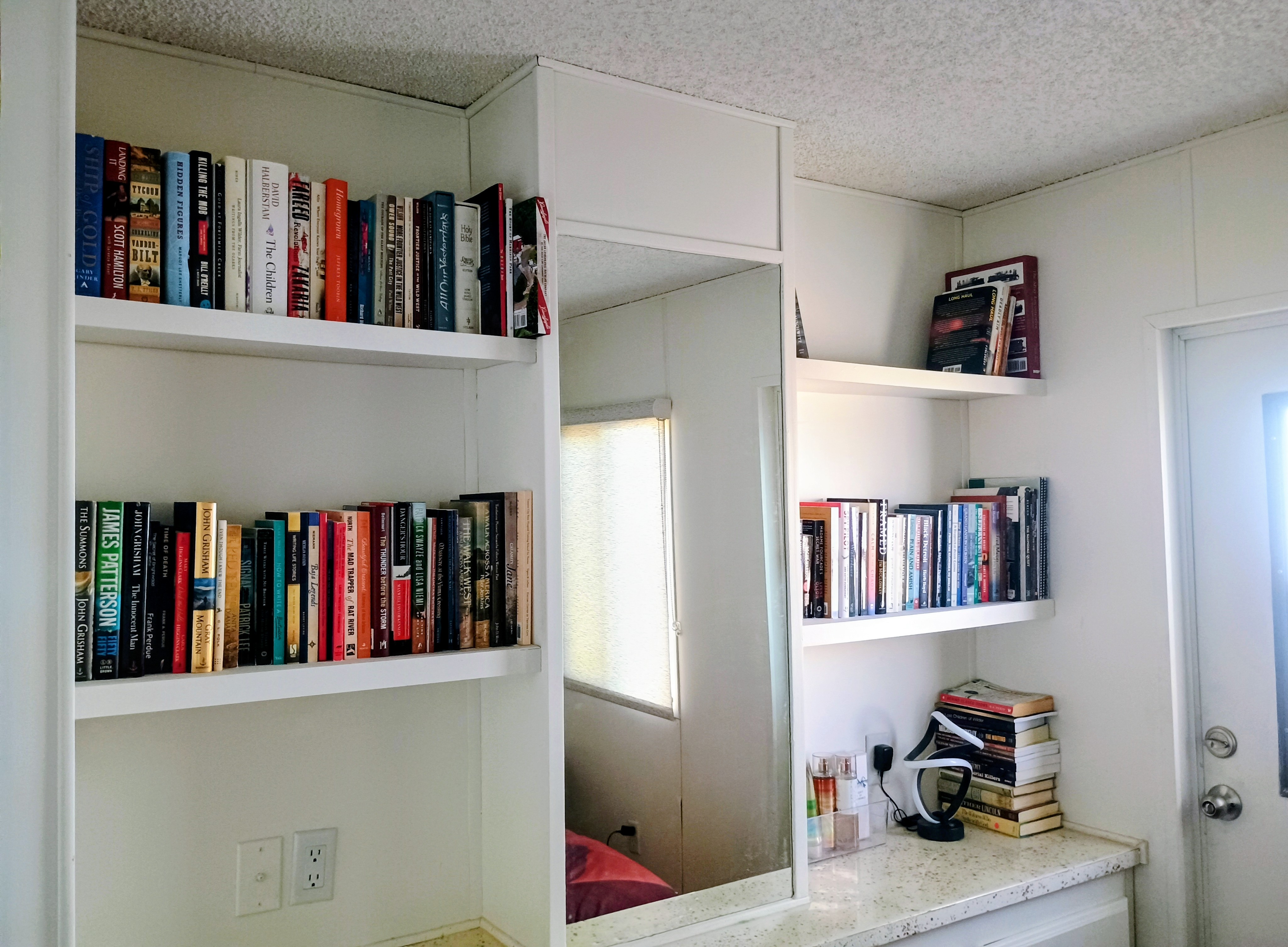
Image shows the author's bookshelves inside their park model home. This provides a visual confirmation on the limited space they have for storage.
The bookshelves in my park model. The top right is almost empty because that is where I place the books as I finish reading them. When the shelf is full, I determine what to keep and put those into a tub in my shed, then donate the rest. The refilling of the shelf with read books begins again.

I recently stumbled across an article titled The Benefits of Buying Books You’ll Probably Never Read. I never purchase a book without the intent of reading it, but I know that I may not read it immediately, or a year from now, or five years from now. I sometimes own books that are 10+ years old before I read them.  Why? The topic is of interest to me, but I may not be in the mood to read it immediately. I like to “shop” my bookshelf to see what catches my eye as a read-now topic when selecting my next book. Remember that tub I brought from my home in 2019? Most of those books are still in it because I had an additional 15-20 books I brought and placed inside the RV for easy access, plus I purchase additional books every year during my summer travels. I periodically pull a few out of that plastic tub, but who knows when I’ll get through them all.

As I said above, I’m a bookaholic—a person with a deep love for reading and an insatiable desire to buy or collect books, or both. Because of my limited space, I no longer go to extremes —in my opinion — but others may dispute that. I consider myself a bookaholic who reads many but saves few. That said, the article about the benefits of buying books you’ll probably never read piqued my curiosity. This is especially true since I always thought it would be awesome to own a huge mansion with a designated library filled with books, along with a writing desk and comfy chairs near a fireplace for reading. I know —it’s a big dream for someone who has downsized into a small home.

I do love bookstores and museums, historical spots, and tourist attractions with book sections in their gift shops. Purchasing anywhere from 10 to 25 books while traveling is not unusual. Where do I fall mentally for this practice?

The Japanese Tsundoku practice has evolved to take on a positive connotation, with the act of surrounding yourself with books seen as a good thing. It indicates you have a fruitful relationship with knowledge and signals your need or desire for continuous discoveries and learning. Once I learned I’m mentally in good shape due to my book-buying habit, I decided to roam a bit further into this topic.

According to Psychology Today, the number and types of books you read can reveal insights into your intelligence, self-control, ambition, time management, and overall outlook on life. The article references a 2014 study published in Child Development that found that stronger early reading skills may predict higher verbal and nonverbal intelligence later.

A 2018 Pew Research Center study found that 67% of adults in the United States read an average of 12 books a year. Intelligent, highly successful adults are usually avid readers and far exceed the average. This is supported by the reading practice of well-known business people, such as Bill Gates, who reads about 50 books per year, and Elon Musk, who read the entire Encyclopedia Britannica by age nine and science fiction for over 10 hours a day as a child. Billionaire Warren Buffett spends an average of five to six hours per day reading. While the article only sighted successful men, I decided to delve into the female side of this.

Oprah Winfrey (mid-2025 ranked number one on Forbes list of America’s Richest Women Celebrities and number four on Forbes World’s Billionaires list) was reading by the time she was three and, like many top businesspeople, follows the 5-hour rule. This means reading at least one hour a day, or five hours a week.  Taylor Swift (ranked number nine on Forbes  World’s Celebrity Millionaires List 2025) is an avid reader and supporter of literacy and libraries. She was only 24-years old (she is now 35) when she partnered with Scholastic Books to make book donations to libraries in her hometown of Reading, Pennsylvania and current residence of Nashville, Tennessee.  Francoise Bettencourt Meyers is a French entrepreneur, philanthropist, writer, billionaire heiress, the second richest woman in the world. She is also an avid reader and the author of several books and is known for being a reclusive intellectual who spends her time at home reading and playing the piano.

While I haven’t yet achieved millionaire status (one can hope), my reading level usually meets the 5-hour rule. If things go according to plan, I have 1-1/2 to 2 hours of reading time every morning before Paul (my partner) gets up and turns on the TV, interrupting my quiet time. Depending on my schedule, I sometimes spend an hour or two outside reading in the afternoon, and a trip to the laundry mat gets me about two hours of reading time. If I’m alone for any meals throughout the day, I read while eating.
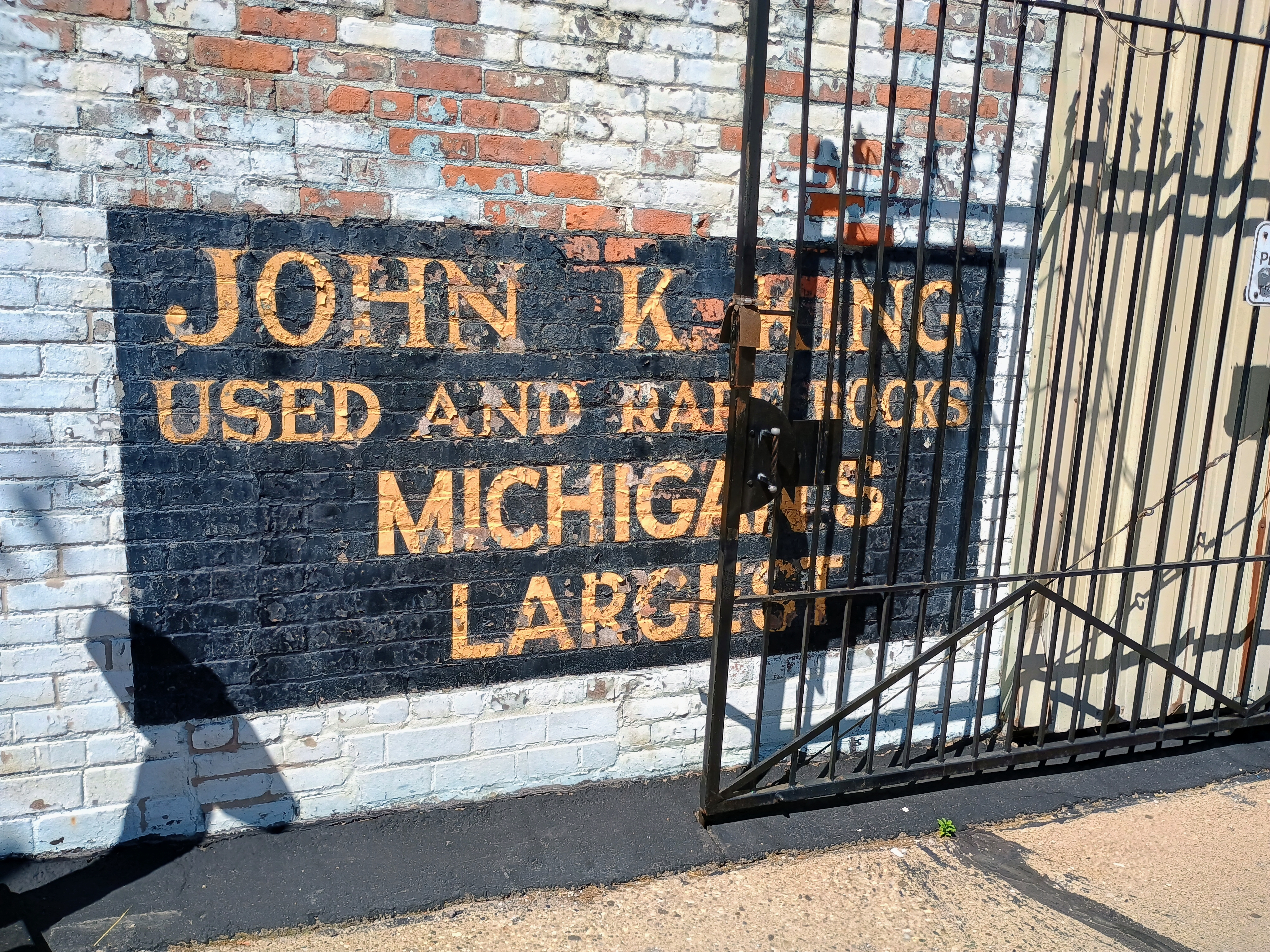
Painted on the brick of an old 4-story warehouse is the name John K. King Used and Rare Books Michigan's Largest.
Painted on the brick of an old 4-story warehouse building in Detroit, Michigan, is the name of the J. K. King Used and Rare Books, Michigan’s Largest. This is the largest used bookstore in the state, and well worth the visit.

For several years, I have kept a list of the books I read during the year. At the end of each year, I print the list and place it in the “All About Me” notebook I keep. The total number of books I read in a year range from 6 to 26. I’m going to beat that this year, as I’m already working on book 26 with two months of reading to go. Yippee! I love breaking my own record.

According to the Psychology Today article, I am an optimist. I don’t view my unread books as a burden or failure of self-control and time management. I see them as a future opportunity to engage with their content. I primarily read non-fiction, so most of my reading is a learning experience. I do blend a few pieces of fiction into the mix for fun. While I have more books than I could read in a year, collecting them is not compulsive hoarding, nor is it damaging to my social interactions.

With few exceptions, I now donate the majority of books I have read rather than keeping them, due to space limitations. I enjoy visiting used bookstores, where you can buy books at much lower prices. I maintain my membership with Barnes & Noble, though, because sometimes I have to purchase and read a new release. The Psychology Today article suggested slowing down the rate of acquisition and becoming more selective, not purchasing a new book until you’ve read one of a similar size. I don’t think that’s possible. I can’t wrap my head around such a ridiculous limitation.

Leave a comment

Filed under decisions, Discoveries, education, exploration, Full-Time RV, habit, hobbies, home, Life is a Melting Pot, memoir, Michigan, summer, time, travel

What Makes a Reader?

A recent conversation with three children ages seven, eight, and 16 made me wonder what makes some people like reading when others don’t. I used to think it was parental influence, but that doesn’t hold true because kids from the same family can have different preferences.

I considered whether children who struggled in school with the language arts became non-readers and those who grasped those subjects easily became avid readers. That also isn’t true. I know people who were strong language arts students but are non-readers and people who struggled in school but enjoy reading.  

With no scientific studies to support or deny my theory, I decided it must be related to a person’s desire to escape reality—readers of fiction and fantasy or a thirst for knowledge—non-fiction and historical readers. Some memorial readers have compassion for learning about the struggles and accomplishments of others. 

In coming to this theory, I looked mainly at my reading habits and then considered those of others. I realized that what a person absorbs from reading impacts how they think, sometimes for a lifetime.

We read books to find out who we are. What other people, real or imaginary, do and thin and feel...is an essential guide to our understanding of what we ourselves are and may become.  Ursula K. LeGuin

The Pew Research Center interviewed people who had read a book in the prior 12-month period. Their interviews revealed that 26% enjoy learning, gaining knowledge, and discovering information. The pleasure of escaping reality and becoming immersed in another world was the reason 15% gave.

Other reasons, in lesser amounts, include relaxation, the variety of topics they can find, spiritual enrichment, the mental challenge of reading, and the physical properties of a book—the feel and smell. I can relate to the last one because I like the look and feel of a book in my hands rather than reading on a device.

The Pew Research findings are comparable to my theory. An article on ReadingWise, What Impact Can Reading Have on Personality? comports with my view that reading books can impact personality. People, especially children, gather life experiences through the books they select. They learn about other cultures, personalities, social classes, gender, etc. This learning can make them more empathetic toward people who are different from them.

Not only does reading impact the child, teen, or young adult’s personality and social skills, but it can also influence what they select as their career, activities they participate in as an adult, and how they view home life. Some books I read as a child, teen, and young adult influenced the genres I read now, what is important to me as an adult, some career choices, and how I view some controversial topics.

Nancy Drew Mysteries by Carolyn Keene were written for female readers between the third and sixth grades. As a child, I read this series, borrowing from the local library and devouring several a week. As an 18-year-old teen detective in the 1930s, Nancy’s ability to sleuth out the answer to different occurrences at a time when women didn’t hold careers in such “dangerous” situations was intriguing. Her independence and bravery probably inspired many females to surpass the gender-expected roles.

I enjoyed reading these books, trying to figure out the mystery along with Nancy, and it created in me a lifetime love of mysteries and crime stories. It also inspired my love of conducting research.

Making a tremendous impact on my viewpoint regarding abortion is My Darling, My Hamburger by Paul Zindel. Published in 1969, the young adult novel covers four teenage friends, romance, the decision to engage in sex, contraception, loneliness, and communication. When Liz becomes pregnant, her boyfriend speaks to his father and then gives her $300 to get what at that time was called a back-door abortion. Abortions were illegal, so the medical care was less than pristine, with procedures done on the sly. This often led to complications or death.

In the book, Liz starts bleeding profusely during the car ride home from her abortion. The entire scenario impacts not only the girl who endured this horrific illegal abortion but also destroyed the friendship group.

Reading this book as a young teen impacted my viewpoint on abortion for life. As an adult, I have always been pro-life but also pro-choice. I believe that a person, especially under circumstances such as sexual abuse of a child or an adult rape, deserves the right to decide whether to abort during the first trimester of the pregnancy.

The only thing that has changed in my mind over time is due to advancements in medical technology. I do not condone aborting a pregnancy when the child can sustain life outside the womb.

True Crime and/or True Detective magazines were in our home, belonging to my parents. As a child, I loved devouring these magazines full of true crime stories. While they were probably not the best reading material for someone so young, they influenced my preference for true crime and legal books.

Agatha Christie is a well-known mystery writer, and as I outgrew the Nancy Drew books, books by this author became a favorite selection. During this same time, I also enjoyed Alfred Hitchcock’s writingsI primarily read fiction during my early-mid teen years, and these were my primary focus.

Harriet Tubman and the Underground Railroad is a title I remember ordering from Scholastic and reading in elementary school. This non-fiction book influenced my future love of non-fiction and interest in reading about the oppression of enslaved people and blacks.

Black Like Me is a non-fiction/memoir written in 1961 by journalist John Howard Griffin. Griffin, a white man, had his skin temporarily darkened and traveled to the Deep South to learn what it was like to live under the terms of segregation. It was amazing how he was treated very differently when living as a black man vs. how he was treated after allowing his skin to lighten and was again regarded as white. It is a real eye-opener on how badly people judge others based on the color of their skin.

Sybil was published in 1973, and I read it around age 13 following its release. This is the true story of a female being treated for dissociative identity disorder. Sybil had 16 separate personalities, likely developed as a coping mechanism due to severe physical and sexual abuse by her parents. This book influenced my opposition to child abuse, and in high school, I did a term paper on abuse.

F. Lee Bailey wrote The Defense Never Rests in 1971, and I read it as a young teen shortly after publication. F. Lee Bailey was a well-known criminal defense attorney, representing clients such as Albert DeSalvo (the Boston Strangler) and Patty Hearst. In the book, he discusses many of the cases he defended. This book impacted my interest in the law and helping criminal defendants.  

It is not enough to simply teach children to read; we have to give them something worth reading. Something that will stretch their imaginations - that will help them make sense of their own lives and encourage them to reach out toward people whose lives are quite different from their own.  Katherine Paterson.

There are many others, but these immediately came to mind when I thought about books from my youth. Those I remember after over fifty years most likely influenced my outlook on life. What is their impact on my life?

I was a community opinion columnist for The Times Herald in Port Huron for several years, expressing my opinion on controversial issues. I am currently working on a book about CPS taking my granddaughters and adopting them out to strangers rather than my husband and me. I have given testimony before legislative committees regarding the problems with the Michigan sex offender registry, and I went back to school in my 50s and became a paralegal. I am now considering becoming a CASA (Court Appointed Special Advocate), which means advocating for children who are in foster care.

My reading is almost 100% memoir and non-fiction. I live and travel full-time in an RV and buy books from the areas I visit. Learning about the history of places I visit is enjoyable.

What do you read? Did what you read as a child and teen influence your life choices? Share your thoughts below.

Leave a comment

Filed under assumptions, career, children, decisions, Discoveries, education, exploration, impressions, Life is a Melting Pot