Tag Archives: fiction

Writing Prompts Are Everywhere

Friends connected to my personal page on Facebook know I have an addiction to what I refer to as image quotes. Little sayings and thoughts that hold deep meaning or inspire a laugh. They can also serve as writing prompts.

Just once, I want the opportunity to dramatically swipe everything off a table to make room for a giant map that I'll use to explain the plan.

Take, for example, the one to the left. You can picture this happening in a movie or in a book. What would be the reason for such a dramatic move in your own writing? Is it a treasure map, a guide to a search and rescue mission, or a plan for renovating a house? Let your imagination go as you put your thoughts on paper.

Years ago, when taking a course on writing for children, we were advised to save pictures from magazines we liked and put them into a book or folder for use as writing prompts. I probably still have that collection of magazine photos somewhere. I don’t think I could ever bring myself to toss them.

That may be why my phone is full of memes for sharing. I’ll admit that some are political, some inspirational, and some just fun, with the intention of evoking feelings and responses from a diverse range of people. When you are struggling with your writing, whether it’s a book, magazine article, or blog, flip through Pinterest, Facebook, magazines, or anywhere else you find inspirational images and save a few to inspire your stories.

Happy and Keep on Smiling dolls sitting on a bench

Look at this cute image of two smiley-face dolls sitting on a bench. They display the words ‘Happy’ and ‘Keep Smiling,’ but what is their story? Why are they sitting on that bench? Are they friends? Siblings? Strangers? Write a story about them.

There are many thoughts out there on memes that create memories of the past. Anything from the sound of the National Anthem followed by all TV stations going off the air to the idea of having to run and answer the phone because it was connected to a wall with no caller ID or answering machine. You had to answer, or there was no way of knowing who it was or what they wanted.

The purpose of a writing prompt is to get your mind rolling. By taking the focus off writer’s block and getting the mind rolling, your thoughts will soon exceed the speed at which you can type them. Keep in mind, it is only a starting point, and your story can go as far away from that beginning as you want.

Some writers develop their writing, which begins with a prompt, into something they later publish. Others consider it throwaway writing, where it allows them to experiment with a variety of topics and techniques without worrying about perfection or failure.

I was in a writing group for a while, where they did a fun thing at each meeting. About half an hour before the meeting was scheduled to end, a writing prompt was given. It was usually a sentence or two or an image. We were then given 15 minutes of quiet writing time to craft a story based on that prompt. At the end of the writing period, we would go around the room and each person would read aloud what they had written. It was fun and engaging to see how stories that started from the same prompt varied significantly in content.

Another area of writing prompts is the ideas you come across when reading. A couple of years ago, I visited a museum in Chippewa Falls, Wisconsin, and purchased the book “The Grey Eagles of Chippewa Falls – A Hidden History of a Women’s Ku Klux Klan in Wisconsin” by John E. Kinville. The information about a woman’s Ku Klux Klan group inspired my curiosity and led to the sale of an article published in the Freshwater Reporter, “The troubling persistence of Michigan’s Ku Klux Klan” [ https://freshwater-reporter.com/wp-content/uploads/2024/02/FreshwaterReporter_Jan24-web-2.pdf ]

I have also had other articles published as a result of prompts I received while reading about history. A recent example was when I read “The Ice Cream Queen of Orchard Street” by Susan Jane Gilman. In the novel, she writes that the creation of soft serve ice resulted from a flat tire on an ice cream truck. My mind kept going back to that incident, so I looked it up, and she had taken creative liberties in the story, but the basis of fact was there. I used that prompt for an article that will be published in the upcoming issue of the Freshwater Reporter about the history of ice cream.

The possibilities are endless once you open your eyes and mind to the numerous prompts that are around you. It can be two children on a playground, a family dining out together, or an image of an older man on a tractor. It was the meme about sweeping everything off a table to make room for a map that inspired me to write this blog. I shared it on my personal Facebook page a week or so ago, but it kept creeping into my brain. I even started a story with it that became a throwaway, and that led to this article.

If you have been following my blog for a long time, you know it has been a while since I last wrote. The time between blog posts has been significantly stretched over the past few years. When I look back, I feel bad for getting wrapped up in life and not writing more. At the same time, my ‘Life is a Melting Pot’ life means that after swirling around in that pot, I have now grabbed onto the spoon, climbed up on the edge, ready to dive in with a broader variety of writings and more frequent posting.

If you have been with me for the long haul, Thank You! I hope you’ll enjoy the new format and pass my link along to your friends. If you are a new reader, Thank You! Please sign up to receive an email notice each time I post a new blog.

Leave a comment

Filed under communication, Life is a Melting Pot, Writing

What Makes a Reader?

A recent conversation with three children ages seven, eight, and 16 made me wonder what makes some people like reading when others don’t. I used to think it was parental influence, but that doesn’t hold true because kids from the same family can have different preferences.

I considered whether children who struggled in school with the language arts became non-readers and those who grasped those subjects easily became avid readers. That also isn’t true. I know people who were strong language arts students but are non-readers and people who struggled in school but enjoy reading.  

With no scientific studies to support or deny my theory, I decided it must be related to a person’s desire to escape reality—readers of fiction and fantasy or a thirst for knowledge—non-fiction and historical readers. Some memorial readers have compassion for learning about the struggles and accomplishments of others. 

In coming to this theory, I looked mainly at my reading habits and then considered those of others. I realized that what a person absorbs from reading impacts how they think, sometimes for a lifetime.

We read books to find out who we are. What other people, real or imaginary, do and thin and feel...is an essential guide to our understanding of what we ourselves are and may become.  Ursula K. LeGuin

The Pew Research Center interviewed people who had read a book in the prior 12-month period. Their interviews revealed that 26% enjoy learning, gaining knowledge, and discovering information. The pleasure of escaping reality and becoming immersed in another world was the reason 15% gave.

Other reasons, in lesser amounts, include relaxation, the variety of topics they can find, spiritual enrichment, the mental challenge of reading, and the physical properties of a book—the feel and smell. I can relate to the last one because I like the look and feel of a book in my hands rather than reading on a device.

The Pew Research findings are comparable to my theory. An article on ReadingWise, What Impact Can Reading Have on Personality? comports with my view that reading books can impact personality. People, especially children, gather life experiences through the books they select. They learn about other cultures, personalities, social classes, gender, etc. This learning can make them more empathetic toward people who are different from them.

Not only does reading impact the child, teen, or young adult’s personality and social skills, but it can also influence what they select as their career, activities they participate in as an adult, and how they view home life. Some books I read as a child, teen, and young adult influenced the genres I read now, what is important to me as an adult, some career choices, and how I view some controversial topics.

Nancy Drew Mysteries by Carolyn Keene were written for female readers between the third and sixth grades. As a child, I read this series, borrowing from the local library and devouring several a week. As an 18-year-old teen detective in the 1930s, Nancy’s ability to sleuth out the answer to different occurrences at a time when women didn’t hold careers in such “dangerous” situations was intriguing. Her independence and bravery probably inspired many females to surpass the gender-expected roles.

I enjoyed reading these books, trying to figure out the mystery along with Nancy, and it created in me a lifetime love of mysteries and crime stories. It also inspired my love of conducting research.

Making a tremendous impact on my viewpoint regarding abortion is My Darling, My Hamburger by Paul Zindel. Published in 1969, the young adult novel covers four teenage friends, romance, the decision to engage in sex, contraception, loneliness, and communication. When Liz becomes pregnant, her boyfriend speaks to his father and then gives her $300 to get what at that time was called a back-door abortion. Abortions were illegal, so the medical care was less than pristine, with procedures done on the sly. This often led to complications or death.

In the book, Liz starts bleeding profusely during the car ride home from her abortion. The entire scenario impacts not only the girl who endured this horrific illegal abortion but also destroyed the friendship group.

Reading this book as a young teen impacted my viewpoint on abortion for life. As an adult, I have always been pro-life but also pro-choice. I believe that a person, especially under circumstances such as sexual abuse of a child or an adult rape, deserves the right to decide whether to abort during the first trimester of the pregnancy.

The only thing that has changed in my mind over time is due to advancements in medical technology. I do not condone aborting a pregnancy when the child can sustain life outside the womb.

True Crime and/or True Detective magazines were in our home, belonging to my parents. As a child, I loved devouring these magazines full of true crime stories. While they were probably not the best reading material for someone so young, they influenced my preference for true crime and legal books.

Agatha Christie is a well-known mystery writer, and as I outgrew the Nancy Drew books, books by this author became a favorite selection. During this same time, I also enjoyed Alfred Hitchcock’s writingsI primarily read fiction during my early-mid teen years, and these were my primary focus.

Harriet Tubman and the Underground Railroad is a title I remember ordering from Scholastic and reading in elementary school. This non-fiction book influenced my future love of non-fiction and interest in reading about the oppression of enslaved people and blacks.

Black Like Me is a non-fiction/memoir written in 1961 by journalist John Howard Griffin. Griffin, a white man, had his skin temporarily darkened and traveled to the Deep South to learn what it was like to live under the terms of segregation. It was amazing how he was treated very differently when living as a black man vs. how he was treated after allowing his skin to lighten and was again regarded as white. It is a real eye-opener on how badly people judge others based on the color of their skin.

Sybil was published in 1973, and I read it around age 13 following its release. This is the true story of a female being treated for dissociative identity disorder. Sybil had 16 separate personalities, likely developed as a coping mechanism due to severe physical and sexual abuse by her parents. This book influenced my opposition to child abuse, and in high school, I did a term paper on abuse.

F. Lee Bailey wrote The Defense Never Rests in 1971, and I read it as a young teen shortly after publication. F. Lee Bailey was a well-known criminal defense attorney, representing clients such as Albert DeSalvo (the Boston Strangler) and Patty Hearst. In the book, he discusses many of the cases he defended. This book impacted my interest in the law and helping criminal defendants.  

It is not enough to simply teach children to read; we have to give them something worth reading. Something that will stretch their imaginations - that will help them make sense of their own lives and encourage them to reach out toward people whose lives are quite different from their own.  Katherine Paterson.

There are many others, but these immediately came to mind when I thought about books from my youth. Those I remember after over fifty years most likely influenced my outlook on life. What is their impact on my life?

I was a community opinion columnist for The Times Herald in Port Huron for several years, expressing my opinion on controversial issues. I am currently working on a book about CPS taking my granddaughters and adopting them out to strangers rather than my husband and me. I have given testimony before legislative committees regarding the problems with the Michigan sex offender registry, and I went back to school in my 50s and became a paralegal. I am now considering becoming a CASA (Court Appointed Special Advocate), which means advocating for children who are in foster care.

My reading is almost 100% memoir and non-fiction. I live and travel full-time in an RV and buy books from the areas I visit. Learning about the history of places I visit is enjoyable.

What do you read? Did what you read as a child and teen influence your life choices? Share your thoughts below.

Leave a comment

Filed under assumptions, career, children, decisions, Discoveries, education, exploration, impressions, Life is a Melting Pot

The Dog Ate My Homework

It was spring, sunshine streaming down, making everything warm, drawing me outside.  The smell of freshly cut grass made me stop, pause and breath deeply, enjoying the clean scent.   Someone had their windows open, I could hear a baseball game blasting on a TV.

My left arm wrapped around my textbook, American Government.  The page of questions to answer, sheets of loose-leaf paper and a pencil lay on top of the book.  At least I could enjoy the beautiful weather while I did my homework.

I saunter through the grass, enjoying the feel of it on my bare feet.  I pick a spot under the weeping cherry tree, its branches full of pink blossoms flow back and forth in the breeze.

I let go of the book and supplies in my arm and they drop to the ground, disturbing the green grass around them.  Not having been mowed yet, the blades of grass bend and curve around the folder and paper.

I cross my ankles and plop down beside my homework, landing in the grass in a cross-legged “Indian style” position.

I flip open the book and begin answering the questions…Name and define the branches of government.  What are the fundamental goals of political parties?  What is the Due Process Clause?  On and on through twenty questions.

I throw my pencil on top of my answers, lay back on the grass and stare at the sky.  The warm sun envelopes me and I slowly relax, closing my eyes.    I feel the breeze grow stronger, I hear the papers in the grass beside me rustle.  I open my eyes and sit up just as a gust of wind whips by, grabbing the sheet with my homework and whipping it up into the breeze.

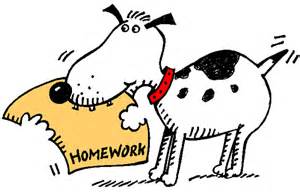
I spring to my feet but I’m not quick enough.  A dog goes running by and before I can move he catches my homework paper in his teeth as if it were a toy and continues running!  homework-in-dog-mouth

That little homework thief runs like mad, zig zagging down the road, through lawns, around bushes, dodging my attempts to catch him.  Panting, I stop to catch my breath and so does he, just far enough down the road that he can make another get-away when needed.   He watches me as if to say “ha-ha, beat you!”

I take a step toward the dog and he immediately takes off again.  Entering the park he continues at a full run until he gets to the edge of the river.  Dropping my homework at his feet, the dog stands guard over it, tongue hanging out as he pants.

The wind swirls around us, the paper flutters then lifts and before the homework thief could snatch it back I watch it fly out over the river, floating on the breeze.  The speed of the wind slows, the paper drops toward the water, then by luck it lands on a log floating down the river.

As long as the homework stays on the log and I can figure out a way to catch it and retrieve the paper it will be saved.   I walk along the water’s edge, keeping my eye on the log, watching it carry my homework farther and farther down river.

I hear a humm, and it is getting closer, louder.  Oh no!  This is not going to be good.  No, not that!   Hmmmmmmm, and sure enough, two jet skis come flying up river full throttle, zipping back and forth, creating a huge wake.  The water sloshes back and forth, rocking everything in its path.

The log that is transporting my homework rocks back and forth under the pressure of the rolling river water.  The log spins, twists, and my homework flies off the log and floats down into the cresting waves.  Soaked with water, it spins and twists in the beating waves, slowly sinking into the water until it is no longer visible.  Gone forever, wrecked and sunken at the bottom of the river.

So, that is why I don’t have my homework.  It was caught in the wind, stolen by a dog, carried to the river’s edge, blown out over the water and onto a log that got caught in the tossing and turning wake of jet skis and then sunk to its death in the bottom of the river.

The teacher looked at me in disbelief.  Eyebrows raised, lips pursed, and a grin slowly kept across her face.

“That story is so farfetched it has to be true.”

Now what do you think, did this really happen or do I have a very vivid imagination?


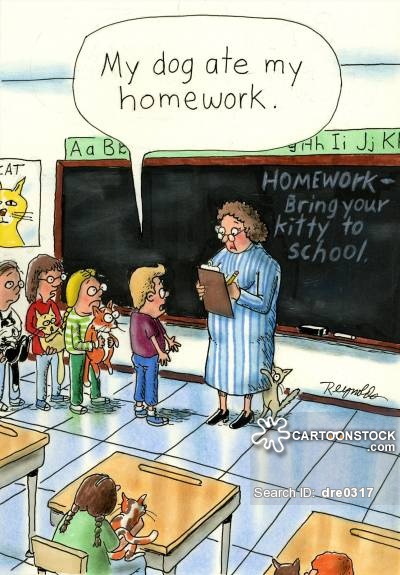
Homework: Bring Your Kitty To School.  'My dog ate my homework.'

Author’s Note:  I received a writer’s prompt in my email, which is something designed to get your creative juices flowing.  Usually they don’t inspire me because I am normally a non-fiction writer, but this one intrigued me and I thought “why not?”  After all, it is a well-known excuse and the challenge was to come up with an elaborate story as to what happened to your homework because the teacher didn’t believe the typical “my dog ate my homework” excuse.  A fun break from my normal type of post.

1 Comment

Filed under children, communication, kids, Life is a Melting Pot, school, Weather, work