Tag Archives: discrimination

What Is Our Future?

When I look at what is happening within the United States over the past few years, combined with the conduct and verbiage of political figures and citizens, I believe it won’t be long before this country finds itself in the midst of a civil war.

Civil war includes conflicts over government control and may involve military coups, insurgents from within the government, and challengers from outside the established government. Civil wars also include ethnic conflict and aspirations for social transformation.

Why do I believe we are headed into a full-blown war within our country? Look around you; there is hostility and violence everywhere. People within the government no longer believe in the very foundation this country was built on. Thomas Jefferson wrote in the Declaration of Independence, “Governments are instituted among Men, deriving their Powers from the Consent of the Governed.”

Part of allowing the governed to determine rights was placing control of elections on the states. It also prevented many citizens from being able to exercise that right. Initially, only white men who owned property could vote. Over the years, amendments expanded rights to blacks and other minorities, including women and non-property owners.

Leading up to and following the presidential election of 2020, we saw many things this country’s citizens fought hard to overcome come back to fruition. A desire to overturn the government and eliminate our freedoms began when the President of the United States began putting into his followers’ minds the belief that the election process is unfair. That the election was stolen.

How can an election be fair only if you win but not if you lose? That was his way of thinking, and people believed him. Now other republican candidates are following his example and have said they will only agree with election results if they are the winner.

Has anyone given consideration to what Trump’s claims of a false election cost the taxpayers?

When Trump refused to accept his loss and filed 62 lawsuits in federal and state courts attempting to overturn the election of Biden to the presidency. Trump was defeated in 61 cases. The only “win” was in Pennsylvania, where a Judge ruled that voters cannot go back and “cure” their ballot after failing to provide proper identification within three days of the election. This ruling didn’t change the outcome of the election.

As of February 2021, Trump’s election fraud lawsuits cost taxpayers more than $519 million. That is money out of your pocket to subsidize his refusal to recognize the will of the people.

Trump’s refusal to accept election results caused violence at the Capitol on January 6t. The main goal was to prevent the reading of the electoral votes to officially declare Joe Biden the winner of the presidential election. That was a direct attack on our government. Trump’s goal was to remain in office, thereby destroying the very basis on which this country was founded in 1776. Had they been successful, the freedoms you know today would no longer exist.

Trump’s rhetoric about a false election still rings out today, with other republican candidates saying they will only believe the election results if they win but not if they lose. You can’t have it both ways. Either we have a good election system, or we don’t. It can’t be fair “only when I win.”

That isn’t to say a candidate cannot question election results. It has been done many times in the past by both parties. The difference is whether the losing candidate accepts the findings or whether they refuse to accept defeat and continues fighting.

Social media hostility has become a very real problem in this country.

Studies and interviews with policy experts, activities, and social media industry professionals show that platforms such as YouTube, Twitter, and Facebook do not cause political polarization, but they do exacerbate it. When people view political content on social media, it makes them more upset and angry, causing them to develop stronger support for their own position.

In 2018 there was a major overhaul of Facebook’s recommendation algorithm. As a result, Facebook became an angrier place. The new algorithm prioritizes controversial content, resulting in otherwise peaceful people becoming trolls because of social media interactions.  

In addition to making people angrier than normal, those angry people are more likely to believe false information on social media. Hostile people in political discussions share misinformation. This doesn’t mean they believe what they share, but rather they refuse to admit their original belief was wrong. This behavior contributes to a disproportionate amount of misinformation, toxicity, and violent content because it is easier to inspire anger than positive emotions.

Studies in the United States and Denmark reveal that people who behave like jerks online are also jerks in person. People obsessed with politics are often frustrated, offensive, and angry, ranting about politics in person and online. The majority of these political posters are status seekers who crave a higher social status. Their main goal is to intimidate others into recognizing them, which serves their own personal agenda.

Discrimination Still Exists

The country has come a long way from the days of slavery, but discrimination still exists against people because of race, gender, religion, and for being LBGTQ. Violence against Jews in the U.S. has been the highest since the 1970s, with 2,107 incidents of harassment, vandalism, and violence against Jews in 2019.

The negative attitude about people who are not white dates back to the original days of voting, when only white male property owners could cast their votes. Some of this hatred has been invoked by our former POTUS blasting discriminatory comments about Mexican immigrants being criminals and rapists, proposing a ban on Muslims trying to enter the U.S., suggesting a Judge recuse themselves because of their Mexican heritage, joking about the Trail of Tears, pandering white supremacists at a Virginia rally, and claiming Kamala Harris doesn’t meet V.P. requirements because of her black heritage.

This kind of behavior should never be tolerated by anyone in this country. Trump claims he is “the least racist person” in the country, but his behavior says otherwise. The real danger is when he makes racially discriminatory remarks, his words impact those who follow him and negatively impact their behavior. Even though he no longer leads this country, his base follows his every command, which is dangerous.

This country was built on free-thinking people. If people do not think for themselves and follow one person’s commands, freedom will cease to exist, and the United States will become a dictatorship.

The Border Crisis is Real

There is no denying the high number of undocumented people crossing into our country. However, one must consider the failures of the prior administration regarding our border.

Before his 2016 election, Trump claimed he would build a border wall, securing our borders at less cost. That was a false claim and ended up costing taxpayers more money than ever before. Trump stifled competition among would-be builders, resulting in the wall costing five times more during the Trump administration than during the 16 years of the Bush and Obama administrations.

The reason for such as substantial cost increase? No bid contracts were awarded to a small group of pre-selected construction firms owned by donators to either Trump or other republican campaigns. Had contracts been submitted for competitive bids, costs to taxpayers would have been substantially less.

  • 2007 to 2015 (Obama Administration)—the government spent $2.4 billion to build 653 miles of the border fence, including gates, roads, lighting, and other infrastructure
  • By October 2020, the Trump administration spent $15 billion in contracts to build 738 miles of the border fence—$20 million per mile. This is contracts paid, not fence built
  • As of October 2020, the Trump administration completed repairs to 360 miles of fence in California and Arizona—no new fence was built

The biggest immigration problem is in Texas, where drugs and immigrants cross the 1,200-mile border along the Rio Grande.

When Trump was unsuccessful in using proper channels through congress to fund his wall, he declared a state of emergency, shifted billions of dollars from the Department of Defense and Treasury Department, then waived 10 federal contracting laws when attempting to fulfill his campaign promise. Oh, and Mexico hasn’t spent so much as a penny on it.

Destruction of Public Lands and Depletion of Water

The majority of the Arizona-Mexico border is on public lands the government set aside for special protection because of ecological value. This includes the San Bernadino National Wildlife Refuge, Cabeza Prieta National Wildlife Refuge, San Pedro National Riparian Conservation Area, and the Organ Pipe Cactus National Monument.

Construction crews for Trump’s border wall spent months dynamiting, drilling, pumping, clear-cutting, and excavating public lands in numerous spots, including Guadalupe Canyon in Arizona. This was only to build roads for construction equipment. The beautiful Saguaros of the Sonoran Desert, protected by law, were lying in heaps next to construction areas. The damage is permanent. Natural migration of javelina, deer, bobcat, mountain lion, and bighorn sheep, and access to their natural water supply is impacted by steel beams installed along main migration corridors.

Natural water supplies are depleted because of border wall construction. This includes the Quitobaquito, a rare desert spring in Organ Pipe Cactus National Monument. Between February 2020 and February 2021, 45 million gallons of water were withdrawn. Artesian-fed wetlands and springs in the San Bernadino National Wildlife Refuge were losing about 700,000 gallons per day as of February 2021 due to construction pumping.

This is only just a touch of how much damage to our water supply and natural wildlife this wall has caused. If you haven’t seen the beautiful national parks along our southern border, it’s too late. Trump destroyed them.

The Bottom Line

The problems above and other issues, including abortion, changes in voting requirements, intimidation at voting polls, police brutality, and more, are inciting the citizens of this country. The anger that Trump incited, leading to the January 6th attack on the capitol, continues and will likely lead us into a civil war.

Look back 10-20 years and the events taking place in this country compared to now. Did you feel safer in 2010 than you do now? If so, that is an indication that the country is floundering.

I’m not going to tell you whether to vote republican or democratic. That is your choice. The proper choice is to look at each individual candidate. What do they stand for, and what are their beliefs and goals? Do they align with your desires for this country?

If the answer is yes, they are the candidate to vote for. Ignore their political alliance, and vote for the best person, not the party. That is how to maintain a politically sound, safe, and free country. That is how we prevent another civil war.

Leave a comment

Filed under border wall, Election, Life is a Melting Pot, nature, reality, Trump, Voting

Always Ask a Man

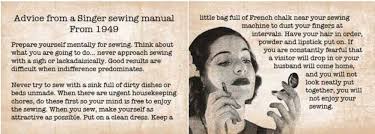
I recently came across Advice from a 1949 Singer Sewing Manual, which has been bouncing around on social media for years and has been verified as accurate. I think this speaks volumes about the era in which it was written.

Advice from a 1949 Singer Sewing Manual

How many women today would worry about having on a clean dress, their hair done, and with powder and lipstick applied for the chance encounter with a visitor stopping by while they were sewing? Even more so, the horror of horrors if their husband came home to discover they were not pristinely put together?

At the time the manual was written a woman’s position was to cater to her husband’s desires. She was to care for the home and children, and not be so forward as to pursue her own dreams or ambitions. After all, that would tax her brain beyond its perceived ability.

That got me to thinking about the 1960s and 1970s when I was growing up. Things were more forward-thinking then, or were they?

The 1960s

The 1960s were a time of change, the beginning of a revolution for women. Gone were the prim and proper dresses and pumps. Miniskirts and go-go boots were the things to be seen in. Long hair, headbands, and wild printed fabrics were in fashion.

In 1968 women protested against the Miss America Beauty Pageant, because not only was it sexist, but its core requirement was that the women be “of good health and of the white race. The requirements went on to state that Miss America was to represent what women are supposed to be, bland, apolitical, and inoffensive.

The push was on to equalize the rights of women with those of men. Women, in declaring their solidarity for equal rights, held public bra-burning events. Huge barrels labeled “freedom trash can” were available for women to toss their bras, panties, cosmetics, high heeled shoes, hair curlers, and any other possessions they considered to be “instruments of torture.”

By going braless women were gaining public attention for their cause. While many men didn’t agree with women having equal rights, they probably didn’t object to the bra-burning protests. This was the jump start for the no-bra fashion trend

The truth is, the 1960s and 1970s were an era of women striving to break out from under the control of men. They wanted recognition for their own abilities. I think one of the best attributes to the feeling of freedom for everyone was Woodstock. Three days of peace, love, and music held in August 1969.

Woodstock was not part of the women’s movement, but it was an event that rocked the nation. Over one million people made it to Woodstock, but only about half of those made it to the 3-day concert because of crowds and traffic jams.

If you don’t know what I’m referring to, it was flower children, hippies, middle class, upper class—an event all young people with an open mind and spirit wanted to be a part of. It moved people out of the restrictions of the past, away from the stress of the Vietnam War and the Civil Rights Movement, and forward into striving for newfound freedoms in the future.

I was too young to attend, but I remember seeing it on TV and my parents being disgusted at the sight of people in all modes of dress and undress, muddy, wet, sometimes naked, gathered in that huge field to listen to music and do drugs.

The 60s were just the beginning. I was surprised to learn recently how many freedoms women were denied throughout the 70s. Some had been resolved by the time I turned 18 in 1978, but it wasn’t without the tenacity of strong women pushing forward.

The 1970s

A prime example is the famous “Battle of the Sexes” which took place in 1973. Bobby Riggs was a No. 1 ranking 55-year old tennis champion. He was a male chauvinist who made a public claim that all women were inferior and that even at his age he could beat any woman in tennis.

Billie Jean King was a 29-year old female tennis player. She took Bobby Riggs up on his challenge. A tennis match between a male and female was unheard of, and hence the “Battle of the Sexes” name was born. The match was held on September 20, 1973.

Billie Jean beat Bobby 6-4, 6-3, 6-3.  It would still be many years before women were recognized as equals in sports, but winning that match established women as professional athletes. It was also a huge victory for women’s rights.

Always Ask A Man

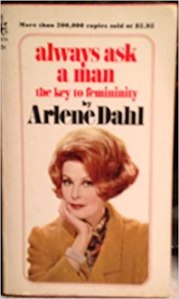
I remember when I was around 14-15 years old my mother gave me a book written in 1965. The book was Always Ask A Man: Arlene Dahl’s Key to Femininity. I don’t remember a lot about the book, but the title gives a pretty good indication of how non-forward thinking it was.

Always Ask a Man - The Key to Femininity
Always Ask a Man – The Key to Femininity

There is one section that still stands out in my mind. It appalled me as a teenager. The topic dealth with shopping for clothes.

If your husband or father went shopping with you, you should try on every outfit you are considering and model it for them. If they don’t like it, you don’t buy it. If the man does not go shopping with you, then upon your return home you model each outfit for them. If they don’t like it, you return it to the store.

I remember thinking “no way!” If I go shopping and like an outfit, I am buying it and wearing it. I am not submitting to some man’s ideas about my clothes. I don’t think I ever finished the book. Once I got to that point, I was done.

A few years later I read The Hite Report: A National Study of Female Sexuality, written by Shere Hite, published in 1976. I was probably around 16-18 years old when I read it. Shere Hite asked a lot of women intimate questions about their sexuality. The results were published in a 600-page book. My mother never said much about it, but I doubt she was pleased to see me reading it.

Moving Forward

A popular singer of the time, Helen Reddy, had a very popular song, I am Woman, which was released in 1971. It spoke to the fight for equal rights, one portion of the lyrics saying:

I am woman, hear me roar
in numbers too big to ignore
and I know too much to go back an’ pretend
‘Cause I’ve heard it all before
And I’ve been down there on the floor
No one’s ever gonna keep me down again

Even as laws changed, discrimination against women still took place in many areas. It was in the early to mid-1980s when applying for a job that I was asked 1) if I was married, 2) if I was pregnant, and 3) whether or not I planned to become pregnant.

It was illegal for the company owner to be asking those questions, and he knew it because he acknowledged it. He knew he had the upper hand, because I would be concerned about being denied employment if I refused to answer.

What did I do?  I danced around the question. I was off the pill, but when asked about plans for pregnancy I replied, “if it happens it happens.”  It happened.

Women’s clothing took on a very masculine look. If a woman wanted to make it in a man’s business world, they needed to dress like a man. Women wore pants suits with non-feminine blouses. That was the way to climb the corporate ladder.

Working Mother was a magazine launched in 1978 and written for women such as myself who were juggling full-time work with young children. Men were not adapted to this lifestyle and we were juggling daycare, household care, and full-time work. 

On top of that, there was a division between the stay-at-home mom and the working mom. Those who did not work outside the home were looked down on. It was a common phrase to hear “oh, you only stay home, you don’t work?” It was because of this attitude that the term “Domestic Engineer” was developed by stay-at-home mothers.

Things have improved, but gender based discrimination still exists today. If you are curious about how far we’ve come, check out the list of Discrimination and Lack of Rights in the 1970s below.

Please leave me your comments below. Were you discriminated against? Did you participate in any of the women’s rights movements?

Discrimination and Lack of Rights in the 1970s

Financial

  • Have credit cards in their own name—Women needed their husbands signature, and if unmarried a father or brother had to sign the application; banks could deny applications based on gender until the Equal Credit Opportunity Act passed in 1974
  • Could Not Open a Bank Account—Women were not allowed to open a bank account without their husband’s permission; men did not believe women could handle finances.

Educational

  • No Admittance to Military Academy—Women were denied admission because men believed women would not be able to make it through the academy; West Point admitted their first female in 1976 and four years later 61 females graduated from a military academy.
  • Could Not Receive Equal Education—Men felt that women could not handle the challenges of higher education, that they weren’t smart enough, and that they belonged in the kitchen, not school.
  • Could Not Attend Ivy League College—It was considered more important to educate males than females; Yale admitted its first woman in 1969, other ivy league colleges began to follow suit, but Columbia did not allow in a female until 1983.

Employment

  • Could Get Fired for Being Pregnant—The Pregnancy Discrimination Act of 1978 prevented this, but employers could give any other reason for their firing
  • No Paid Maternity Leave—Paid maternity leave first made news in 1969 when five states agreed women should be allowed to take time off around the time of birth, resulting in the Temporary Disability Insurance Act; today there are still hundreds of businesses that do not pay women for maternity leave.
  • No Protection for Sexual Harassment—It was not until 1977 that the U.S. Circuit Court of Appeals for Washington DC ruled that a woman could not be fired for refusing to provide sexual favors to her boss; the Equal Employment Opportunity Commission established a definition for sexual harassment in 1980 and it was 1986 when the U.S. Supreme Court agreed with that definition.
  • Could Not Apply for Any Job—Despite the 1964 Civil Rights Act, women could not find jobs beyond secretary or teacher before the 1970s; employers would find excuses other than gender to reject women applicants
  • Could Not Own a Bank—It was 1975 when the First Women’s Bank opened, becoming the first bank owned and operated by a female. The law did not initially accept the bank, but it was a milestone in the 1970s women’s rights movement.
  • Could Not Be Astronauts—NASA did not ban women, they simply did not allow them to interview, mainly because they only accepted military applications and the military did not accept women; In 1979 NASA began hiring women to train as astronauts and in 1983 Sally Ride was the first female to go up in space.
  • Could Not Be CEO of Fortune 500 Company—It was 1972 when Katharine Graham became the first female CEO of a Fortune 500 Company when she took the position at The Washington Post.
  • Could Not Be a Lawyer—There were a few women attorneys and judges, but it was not until the late 1960s and early 1970s they began being accepted into law schools more frequently; a study conducted at Cornell University found 90% of law firms refused to interview women applicants and most law schools would not admit women into their law programs.
  • Could Not Be A Judge—Some states had women judges prior to the 1970s, but it was rare and they were not paid at the standard rate; it was in the 1970s that the majority of the states began allowing women to serve as judges.
  • Serve on the Supreme Court—It was not until 1981 when Sandra Day O’Connor was seated on the Supreme Court that this 100% male dominated area was broken; other than that only three other women have served: Sonia Sotomayor, Ruth Bader Ginsburg, and Elena Kagan.

Medical

  • Get an abortion—in1970 Jane Roe claiming she had a right to abortion filed a lawsuit against Dallas County District Attorney Henry Wade in the Texas Federal Court; Roe won her case in 1973 when the Supreme Court deemed the banning of abortion unconstitutional
  • Receive the Morning After Pill—This was first available in the 1970s but difficult to obtain; it was not until 2006 that the FDA approved it for non-prescription behind-the-counter sales.
  • Receive the Birth Control Pill—The pill became available in the 1960s, but many states did not allow doctors to prescribe the pill, a woman was arrested for selling them which resulted in the 1965 Supreme Court decision that married women could receive birth control pills, but some states still did not allow their doctors to prescribe it until the 1970s.
  • Could Not Receive A Direct Medical Consultation—Rather than giving women a direct consultation on their health the doctor would speak to their husband because it was believed that the wife could not comprehend the doctor’s diagnosis and/or recommendations.

Relationships and Marriage

  • Refuse Sex from Husband—Women received very little protection from any type of spousal abuse; it was not until the Violence Against Women Act of 1994 that a woman received protection against any violent act from her husband, including rape and physical assault.
  • Could Not Divorce Because of Domestic Violence—The No-Fault Divorce Act of 1969 allowed women to request a divorce without proving wrongdoing of their husband; prior to that time women had to prove their husband was at fault, adultery being an acceptable reason, spousal abuse was not.
  • Interracial Marriage—This was illegal in most states until Loving v. Virginia in 1967 made it to the Supreme Court where it was ordered that denying couples interracial marriage was a violation of the Equal Protection and Due Process Clauses of the Fourteenth Amendment to the U.S. Constitution.
  • Living Together—Many states had laws against living together prior to marriage, and it was not until 2013 that all 50 states adopted laws allowing couples to legally reside together without being married
  • Could Not Adopt if Single—To adopt a baby a woman was required to have a male partner, even if the woman was wealthy, healthy, and could provide the child with a home, she was not allowed to adopt without a husband.

Other

  • Not Acknowledged for Running Boston Marathon—Katherine Switzer was the first woman to run in the marathon in 1967 for which she was spat on, taunted, and attacked; it was not until 1972 when Nina Kuscsik was one of the first women acknowledged for running.
  • Could Not Serve on Jury—Women on juries prior to 1970 was rare, and many states did not allow women jurors until 1973 when all 50 states ruled that females be allowed to serve as jurors.
  • Could Not Purchase Athletic Shoes—Women who desired athletic shoes had to purchase men’s shoes until the late 1970s and early 1980s; when women began to be recognized in the sports world female shoes became available.
  • No Voice in Their Work or Homelife—Men did not have to listen to what women had to say about their employment, civil rights, household matters, or their own bodies; women were expected to listen to their husband on how he wanted things done at home until sometime during the 1970s.
  • Unable to Participate in All Olympic Games—Women’s ability to participate began in the early 1900s but it was very limited; in 1976 ice dancing, basketball, rowing, and a few other events for women were added, in 2012 women’s boxing was added.
  • Discuss Sex—It was considered inappropriate and socially unacceptable for a woman to discuss sex prior to the 1970s; a book by Betty Friedan, The Feminine Mystique is believed to be a trendsetter in changing women’s behavior on this tabu subject.
  • Breastfeed in Public—This was not just controversial, it was not allowed; congress finally passed a law saying that a public place could not discriminate against women for breastfeeding because it was a violation of their equal rights

Leave a comment

Filed under Life is a Melting Pot

A Country at War With Itself

It is sad what the United States has become in just a short period of time. As we look at the destruction created by the looting and vandalism in the past few days, it is disturbing to see how much anger and hurt is harbored by so many of our citizens.

In truth, this is not a hurt or anger created by only George Floyd’s death, when a white officer pushed a knee into his neck for 8+ minutes, resulting in his death. This came only a few months after the killing of Ahmaud Arbery, who was attacked and gunned down by two white men while out for a jog. It took months for those men to be charged with a crime, and only after a video of the incident went viral on social media.

The protests being waged following Mr. Floyd’s death are the result of pent-up anger that has continued to grow as black people are disproportionately killed by white law enforcement officers.  Blacks make up 13% of the U.S. population, but are 2-1/2 times more likely to be killed by police.

What is further infuriating is that in many cases the officers are not charged for having committed a crime. If charged many are found not guilty.

A huge problem in this country is the blue wall of silence, also referred to as the blue code of honor. This is a silent code under which police officers stay silent, refusing to report other officers who exercise misconduct, criminal behavior, discrimination, police brutality, or any other unethical action. Body cameras and bystanders recording on their cell phone cameras are finally bringing some of this to light.

I was very pleased to see the Minneapolis Police Chief remove his hat and kneel at the spot where George Floyd’s life was taken, and also remove his hat when he answered their questions on the news. This shows him to be a person of moral and ethical character.

When questioned the police chief stated that he fired of all four officers because the other three officers, by not intervening, were complicit with Derek Chauvan having his knee in the neck of George Floyd for 8+ minutes, resulting in death. Derek Chauvin, who has been charged with 3rd degree murder and manslaughter.  The other officers have not been charged.

I have seen many cities where police officers are walking with demonstrators or kneeling with them in prayer. This shows that not all law enforcement condone the behavior of the bad, but it is not enough to heal the pain that has been going on for too long.

Obama Administration

It was only a short 12 years ago that this country reached a milestone when it elected Barack Obama as President of the United States. This country, with its horrible history of slavery, racial oppression and discrimination, had elected a black man into its highest-ranking position.  That said a lot for how far our country had come.

Barack Obama served for 8 years as president.  During his presidency there were several high-profile deaths of black Americans engaged in encounters with the police and protests led to rioting:

  • Oscar Grant, a black transit passenger, was shot by a white police officer. Riots broke out in Oakland, California. The officer, Johannes Mehserle was found guilty of involuntary manslaughter.
  • George Zimmerman was acquitted of murdering Trayvon Martin, a black teenager, and riots broke out in Los Angeles.
  • Manuel Diaz, a 25-year old black man, was shot to death when he ran from police. Destructive demonstrations broke out in Orange County, California.
  • Kimini Gray, a 16-year old, was killed by police after allegedly pointing a handgun at them. Riots broke out in Brooklyn, New York.

The Black Lives Matter movement began in 2013. It was created to give black people a voice in civil rights. Issues included a broken criminal justice system and a higher unemployment level among black Americans. Those problems still exist today.

Black Lives Matter believes in peaceful demonstrations. They do not participate nor do they encourage looting and violent acts like those taking place today.

George Floyd’s Two Autopsies

After the autopsy of George Floyd’s death indicated he died from underlying health conditions, not from the loss of breath created by a knee on his neck for 8+ minutes, people were angry and upset. His family ordered an independent autopsy.

That independent autopsy determined George Floyd’s death was caused by “asphyxiation from sustained pressure”. The difference in the two determinations makes one question whether the first medical examiner works frequently with the police and is part of the “code of blue.” Both medical examiners ruled the death a homicide.

Where We Stand on Race

In 2016 a survey showed 56% of white Americans said the race of a subject made no difference in the use of police force, but only 18% of black Americans believed that to be true.  More than 2/5 of black people said that police in their community made them feel more anxious than safe.

U.S. citizens, looking for change, elected Donald Trump in 2016. A non-politician, non-military, public figure who promised to Make America Great Again.  The question now comes to mind, Is America at War With Itself?

There continues to be racial divide in this country on how people are viewed based on the color of their skin. There is inequity that results in black people being disproportionately injured or killed by white police officers.   

The fact that we have protestors trying to storm the White House and destroying Secret Service vehicles says a lot about what a lot of Americans feel toward President Trump.

Where else in American history can you recall riots where Washington DC monuments were defaced?

Where the Treasury Department was attacked?

Where the White House was at risk of being breached by protestors? 

When Chopper One lands at the White House lawn and is greeted by protestors with their middle fingers raised? 

Why is former Vice President Joe Biden was out speaking with protestors while President Donald Trump is hiding in a bunker under the White House? 

Trump Administration and Racism

It is likely that a culmination of numerous factors has led to the anger displayed toward President Trump.  We are all familiar with his tweets that repeatedly insult people, make racial slurs, and instigate violent acts.  

American people have come to realize what a strong racist their President is. Mayors of cities undergoing riots have asked President Trump to be quiet. To stop posting comments on Twitter that instill violence. To stop posting racial comments from the 1968 racial riots.

It isn’t all about tweets and verbal comments. His tendency toward discrimination against those of non-white ethnicity screams out from his campaign and administration: 

  1. In 2016 there was a strong correlation between Trump campaign events and acts of violence. Data from the Anti-Defamation League showed that counties hosting Trump campaign rallies had more than double the hate crimes than similar counties that did not host a rally.
  2. Counties that voted for Donald Trump by the widest margins experienced the largest increase of reported hate crimes.
  3. Surrounding the election of Donald Trump, hate crimes peaked from October to December 2016 and continued through 2017. This was the second largest increase in hate crimes in 25 years. The highest increase in hate crimes followed September 11, 2011.
  4. Quinnipiac University released a poll that states 80% of African-American voters feel Donald Trump is a racist. 55% of Hispanics feel Trump is a racist, and 51% of all Americans feel he has racist views.
  5. In August 2019 President Donald Trump spoke at the 400th anniversary of the year slaves first arrived on American soil. His behavior prior to his arrival resulted in the Black Caucus of the Virginia legislature boycotting his appearance. In doing so they stated “It is impossible to ignore the emblem of hate and disdain that the President represents” and referred to his “repeated attacks on black legislators and comments about black communities” and they felt he was an “ill-suited” choice to commence that monumental period in American history.
  6. The Trump Administration is working to roll back President Barack Obama’s efforts to combat racial segregation. This roll-back would make it easier for banks to deny loans to black and Hispanic people. It would also make it easier for cities to confine families to minority neighborhoods.
  7. The Consumer Financial Protection Bureau has in 2020 proposed cutting back data collection that helps track discrimination in the mortgage market. In 2015 the Obama administration began tracking patterns of poverty and segregation with a checklist of 92 questions that had to be completed to access federal housing funds. The Trump administration is trying to eliminate that tracking system.  Of concern is that the Trump financial regulator could encourage banks to invest in inner city projects such as sporting arenas instead of loans that benefit local residents. 
  8. Black home ownership is at its lowest rate since segregation was legal. White rate is about 73% and black rate under 43%. 
  9. Housing discrimination complaints rose 8% in 2018, as reported by the National Fair Housing Alliance. This is the highest level since tracking started in 1995.

Trump Admnistration Civil and Human Rights Rollbacks

Between 2017 to 2020 there have been at least 79 Trump Administration Civil and Human Rights Rollbacks. Many of those rollbacks have a direct impact on low-income and racial minorities, which include:

*          In February 2017 President Trump signed three executive orders to fight crime, gangs, and drugs, and restore law and order, supporting the men and women of law enforcement. Civil rights organizations viewed these orders as vague and suspicious.

*          In August 2017 the Obama administration ban was lifted regarding the transfer of some military surplus items to domestic law enforcement, rescinding guidelines that had been created to protect the public from law enforcement’s misuse of military-grade weapons.

*          In August 2017 the Trump administration halted the EEOC rule that required large companies to reveal what they pay employees by sex, race, and ethnicity. The rule was intended to remedy unequal pay in American companies.

*          In September 2017 the Department of Justice ended the Community Oriented Policing Services Collaborative Reform Initiative. This program was created to build trust between police officers and the communities where they serve.

*          In February 2018 the Trump administration’s 2019 budget proposal denied critical health care to those in need. The funding was being diverted to funding the border wall.

*          In February 2018 the Trump Administration’s 2019 budget proposal eliminated the Community Relations Service which was established by the Civil Rights Act of 1964. Its purpose was to address discrimination, conflicts and tensions in communities around the country.

*          In 2018 The Office for Civil Rights at the U.S. Department of Education released a new Case Processing Manual that created a larger hurdle for people filing complaints. It allows for the dismissal of civil rights complaints based on the number of times an individual has filed.

*          In January 2019 the Trump administration was considering a roll-back of regulations that provide anti-discrimination protections to people of color, women and others.

*          In January 2019 it was reported that the Trump administration had stopped cooperating with and responding to UN investigators over potential human rights violations in the United States.

*          In April 2019 it was reported that the Trump administration would not nominate nor re-nominate anyone to the 18-member U.N. Committee on the Elimination of Racial Discrimination.

*          In January 2020 the Department of Housing and Urban Development issued a proposal that would gut the agency’s 2015 Affirmatively Furthering Fair Housing rule. HUD’s proposal would leave people of color, women, and protected communities already harmed by unfair and unequal housing policies at further risk.

Heal the Country

There is a very strong divide in this country. Racial discrimination and violence are at the heart of it. We are a country divided, and it needs to be healed. There is a Michael Jackson song that says in part: 

Heal the world
Make it a better place
For you and for me
And the entire human race
There are people dying
If you care enough for the living
Make a better place for you and for me

When Will it Stop?

We are now in our 7th day of protests, vandalism and looting. When will it stop? It is hard to say. We have had a President hiding in a bunker tweeting words that incite violence.  We have more than 37 cities in 22 states plus Washington DC destroyed.

It is time federal and state legislatures took action to make sure that the rights of every person in the United States are protected. Treatment and protection need to be equal regardless of whether a person is White, Hispanic, Middle Eastern, Muslim, Jewish, Black, or any other nationality.

This country was built by being accepting of all, a melting pot of immigrants that created a wonderfully diverse country. It is time laws were in place that guaranteed equal treatment for all. Until that is done and people are satisfied that their lives matter, history will continue to repeat itself.

Update:  As this writing was being finalized President Trump spoke in the Rose Garden.  Lafayette Park across from the White House was filled with peaceful protesters. Suddenly right before the speech law enforcement moved in, using tear gas and rubber bullets to force the peaceful protestors out of the park. Why?

It soon came to light. President Trump’s announced that he is deploying the 1807 law to deploy military then commented he was going to a special place.

Those peaceful protestors had been gassed and shot at by law enforcement because President Trump was walking through the park to St. John’s Church for a photo op.

Almost immediately the DC Episcopal Bishop denounced President Trump’s use of St. John’s Church as a prop. The Bishop stated that after having military police fire munitions against peaceful protestors President Trumps actions were an abuse of a sacred space.

And So We Continue

The anger continues. People want the remaining three officers involved in George Floyd’s murder charged. They want equal treatment by law enforcement. They want a justice system that is just.

It is up to the United States citizens to regain control of their country. It is time this country becomes what it was created to be, a melting pot. Many cultures living together, all on equal ground. Equal and just treatment for all races.

You may say I’m a dreamer, but I’m not the only one. I hope some day you’ll join us, and the world will be as one….from Imagine by John Lennon

1 Comment

Filed under assumptions, communication, Coping, death, decisions, events, Family, impressions, Life Changing, Life is a Melting Pot, reality

Realities of Racial Profiling

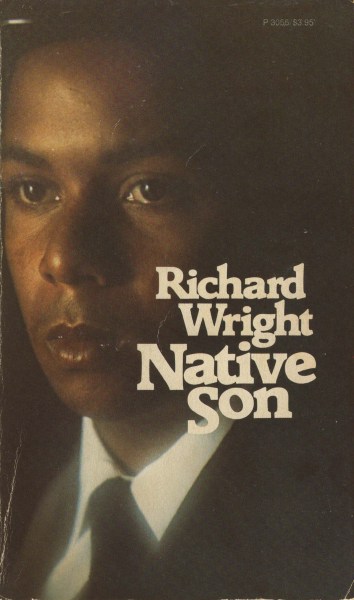
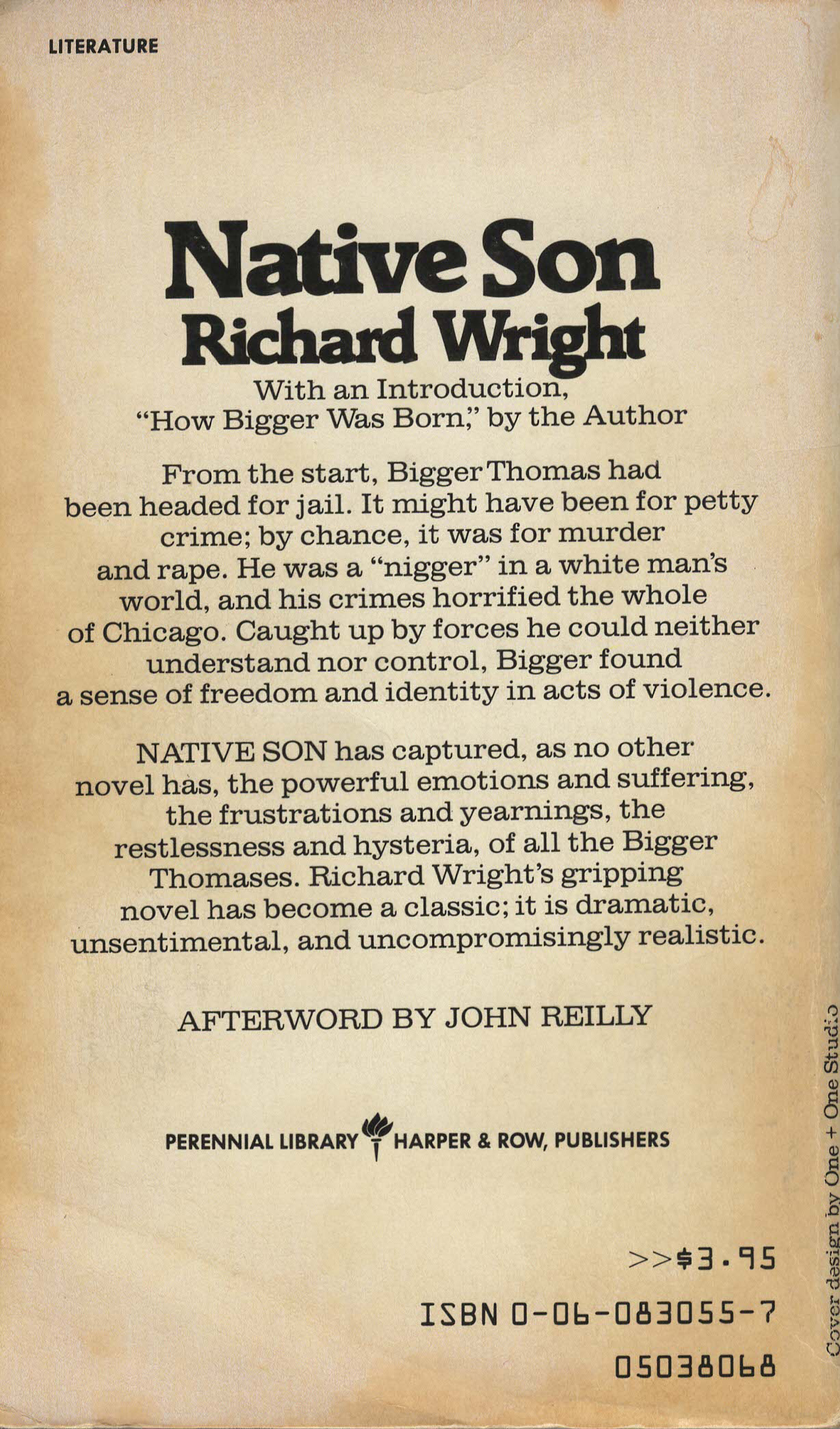
I am and always have been a reader.  On occasion I will read something which has a profound impact on me.  This is the case with a book I recently finished,  Native Son by Richard Wright.

Native Son, a novel published in 1940, tells the story of “Bigger”, an African American boy who represents the oppression of their race during that era.  A lot of progress has been made in the past 75 or so years since the book was written, but the treatment of  persons of African-American decent by the white race during that time period is disgraceful.EPSON MFP image

While we all know that there are prejudicial attitudes in this country as demonstrated in recent times by the brutality shown against black men by those of law enforcement without just cause, we at least have progressed to a point where derogatory terminology and failing to recognize the race as having intelligence on the equivalent with others is no longer accepted.

The novel takes place twenty years prior to my birth.  Growing up in the 1960’s I remember racial riots, derogatory references to the race in general, and other such behavior, but not to the degree which I encountered in this book.  What I found most disturbing was the de-humanizing of the race in general.  They were compared to apes, considered to be so lacking in intelligence that they could not plan anything.  After being arrested they were rushed through the judicial system without sufficient time for proper trial preparation and were tried in front of a jury panel of all white men.

racismIf you research racial injustice for the 1940’s you will find that the treatment of “Bigger” portrayed in the novel is a very accurate representation of the mindset during that era.  Lynchings were common for anything and everything considered inappropriate.  NAACP members campaigning to get those of African American decent the vote where removed from their homes and lynched.  A 26-year old man was lynched for failing to address a police officer as “Mr.”  If a white woman was attacked it was assumed that a black man had committed the crime and the “suspect” would often be captured and lynched.  Justice did not prevail.
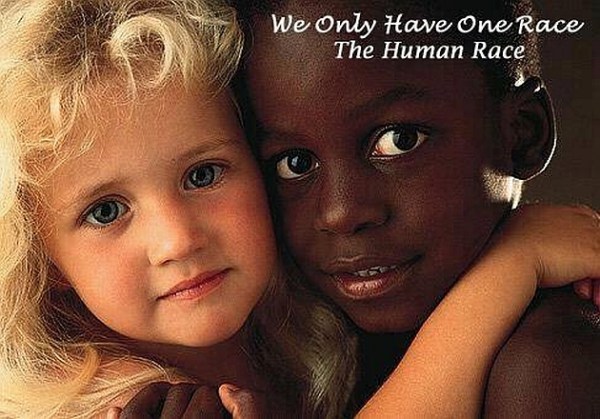
White workers would strike or riot against any black man that received even a minimal promotion at work.  A 15-year old boy was lynched for writing a card that revealed his crush on a white girl.  A 14-year old was sent to the electric chair after being accused in the disappearance of white girls and a 16-year old went to the electric chair after being convicted of killing a pharmacist; he was not properly represented at trial.  The list goes on, but this sampling gives you a taste of what life was like for those of African American decent in the 1940s.racial-profiling-we-were-all-the-human-race

In all fairness I must mention that those of black skin tone are not the only race the white Americans have discriminated against.  President Roosevelt issued an executive order after the bombing of Pearl Harbor and all of Japanese decent were gathered and placed in camps that were the equivalent of prisons.  They were surrounded by barbed wire and conditions were deplorable.  Latinos were beaten by soldiers because it was assumed they were the cause of crime in California.   The discrimination continues to this day.

Even now many white American’s behave in a discriminatory manner against those of other nationalities.  It doesn’t matter whether they are of Mexican/Spanish decent, Asian, African, Calderon, or any other nationality, if they do not have white skin they have most likely suffered some form of racial profiling and/or discrimination.

Why do the white Americans think that they are better than others?  The white man invaded this country and then forced the Native Americans away from their territory. From the time they set foot on this land white men have forced their way into control and oppression of those of a different cultural. religious or financial background.  The white man has proven himself to be a race of bullies.

racial-profiling-we-are-the-human-raceWe have come a long way in the acceptance of others since the 1940’s when Native Son was written….a book in which a 17 year old boy was sent to the electric chair for the murder of a wealthy white girl.  Although the book is a fictional writing, is is a very good replication of the era in which it was created.  Although those of African American decent are now given the same rights of due process as all others, discriminatory behavior continues to exist.
Every race has persons who have good behavior and persons who exhibit bad behavior.  The realities of racial profiling are evidenced in the behavior seen on our own TV screens and the treatment those of non-white race are frequently subject to…and far too often by those who are supposed to uphold the law. When will the American white citizen learn to treat all other American citizens as equals and not make assumptions on the way a person will behave based on the color of their skin?    That is a question that will likely remain unanswered for a long time.

EPSON MFP image

The back cover of Native Son


1 Comment

Filed under assumptions, communication, decisions, Life Changing, Life is a Melting Pot, reality